Disease Prevention as Public Good
Sanitation, Medicine, and Collective Health
Individual health is personal responsibility - but contagious disease affects everyone. Kautilya's public health system recognized that sanitation, epidemic control, and clean water are public goods that justify state provision, protecting individual freedom by preventing disease from destroying it.
When Disease Doesn't Respect Property Lines
You keep your home clean, your family healthy, your water pure. You do everything right. But your neighbor empties waste into the street, creating breeding grounds for disease. When epidemic strikes, your family suffers alongside his.
This is the public health dilemma: disease doesn't respect property lines or individual choices. Your health depends partly on your neighbors' sanitation. Your children's safety depends on whether others are quarantined when sick.
Kautilya understood that public health was a classic case where individual action isn't enough. Some health measures require collective action - and that's where the state has legitimate role.
Why Public Health?
Kautilya's reasoning was characteristically practical:
The Economic Case
Sick people don't work - disease reduces productivity and tax revenue. Epidemics disrupt commerce - trade stops when plague strikes. Treatment costs more than prevention - better to prevent disease than cure it. Human capital matters - healthy, strong people are more valuable than weak, sickly ones.
The Externality Argument
Your health choices don't just affect you - they affect others through contagion. This externality means purely private action will under-provide public health. When your neighbor's poor sanitation creates disease risk for everyone, individual responsibility alone cannot solve the problem.
Kautilya's Public Health System
The Arthashastra prescribed comprehensive health measures:
Urban Sanitation
Cities required waste removal - regular collection and disposal outside city limits. Drainage systems prevented standing water and sewage accumulation. Clean water supply protected sources from contamination, keeping them separate from waste. Street cleaning maintained public hygiene through regular sweeping. Market hygiene enforced food safety standards and inspection.
Disease Control
Quarantine isolated the sick to prevent contagion. Notification required reports of infectious disease. During epidemics, movement restrictions controlled travel from affected areas. Disposal of the dead ensured proper burial or cremation to prevent disease spread. Disinfection cleaned infected areas.
Medical System
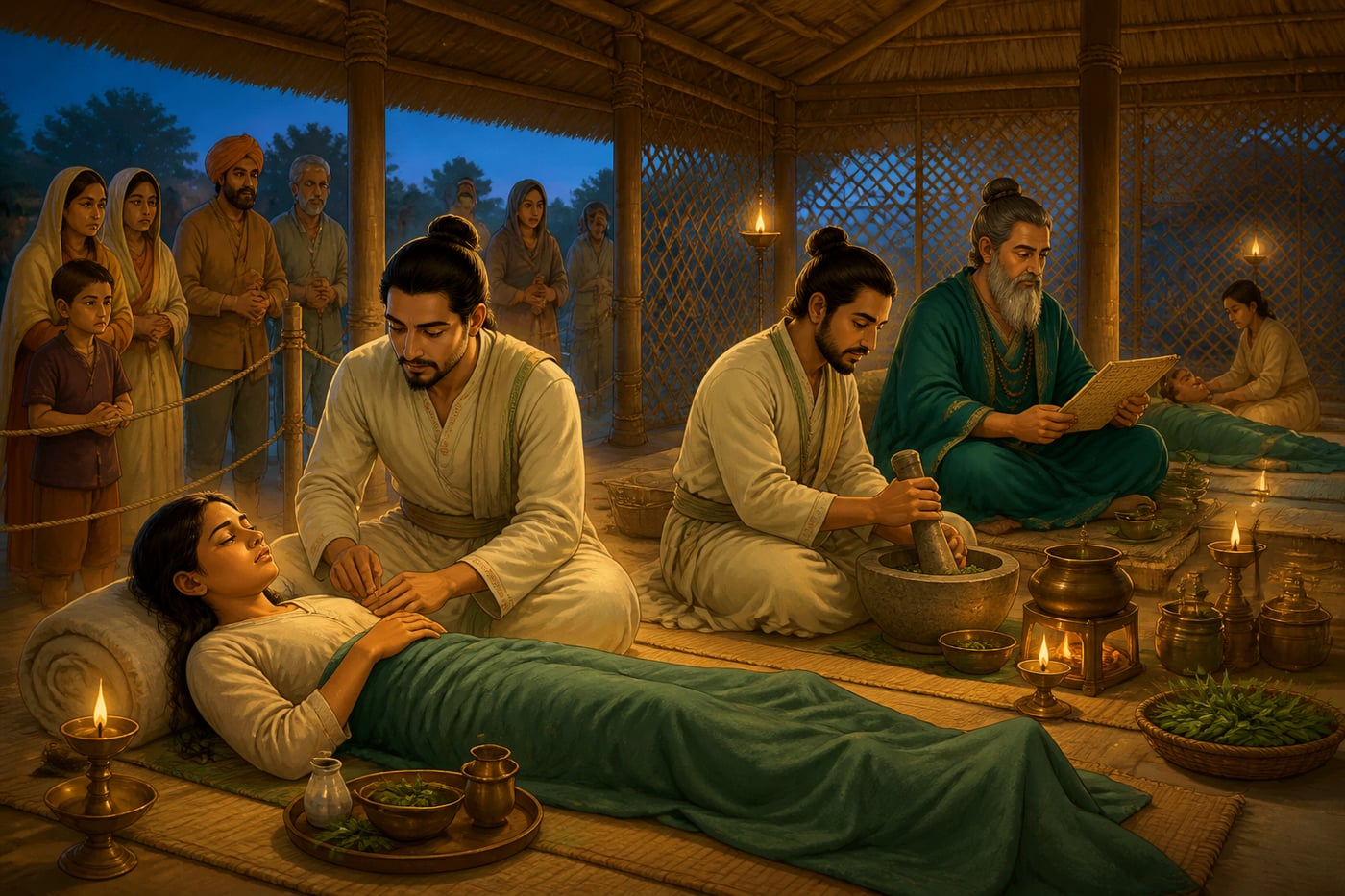
State physicians - royal doctors and local healers on public payroll - provided care. Hospitals treated serious cases. Medicinal gardens cultivated healing herbs and plants. Medical education trained physicians in recognized schools. Free treatment served the poor and certain conditions.
Preventive Measures
Food safety standards prevented adulteration. Water quality measures protected sources from contamination. Building codes required adequate ventilation and space between houses. Bathing facilities provided public tanks and wells for hygiene.
The Nagarika's Health Duties

The city superintendent (Nagarika) had specific public health responsibilities:
Daily Inspection
- Markets for food safety
- Streets for waste accumulation
- Water sources for contamination
- Public spaces for hygiene
Epidemic Response
- Early detection through monitoring
- Quarantine enforcement
- Treatment coordination
- Public communication
Sanitation Enforcement
- Requiring households to maintain cleanliness
- Penalizing those who created health hazards
- Organizing public cleanup
- Managing waste disposal systems
The Limits of State Power
Even in public health, Kautilya recognized boundaries:
Personal Autonomy in Treatment
People could choose their own physicians, decline treatment, use traditional or religious healing, and manage minor illnesses privately. The state intervened only when disease threatened others through contagion.
No Forced Treatment
Except in extreme epidemic situations, treatment was offered, not forced. People could refuse care. State provided access, not compulsion.
Private Medicine Alongside Public
The state didn't monopolize healthcare. Private physicians practiced freely. Traditional healers continued their work. Families could treat their own. State provision filled gaps, didn't replace private care.
Quarantine Was Last Resort
Movement restrictions happened only when epidemic was severe and contagious, other measures had failed, and duration was limited to the danger period. Affected people received support.
The Core Philosophy
Kautilya's public health approach reflects sophisticated philosophy:
1. Disease as Externality
Your illness can harm me through contagion. This externality justifies collective action for prevention and containment. This isn't paternalism - it's protecting others from harm you might cause.
2. Prevention as Public Good
Clean water, sanitation, epidemic control benefit everyone simultaneously and can't be provided purely privately. Like roads or defense, these are legitimate public goods.
3. Minimal Coercion, Maximum Enablement
The state should provide clean water (enables health), maintain sanitation (prevents disease), offer treatment (enables recovery), and quarantine dangerous contagion (protects others).
But NOT force treatment for non-contagious conditions, monopolize medicine, or regulate personal health choices that don't affect others.
4. Prevention Over Cure
Preventing disease is cheaper and less coercive than treating it:
"The wise physician prevents disease; the foolish one treats symptoms. The wise king builds healthy cities; the foolish one builds hospitals for the sick."
Specific Prescriptions
Water Quality Standards

Water sources should be clear and odorless, protected from animal access, separate from waste disposal, regularly inspected, and maintained by assigned officials.
Food Safety Rules
Markets required fresh meat sold same day, grain stored dry and protected from pests, milk sellers monitored for adulteration, spoiled food confiscated and destroyed, and violators fined or banned from trade.
Epidemic Response Protocol
Stage 1 - Detection: Unusual illness patterns reported, physicians notify authorities, investigation of causes.
Stage 2 - Containment: Isolate affected areas, restrict movement, provide treatment and food to quarantined.
Stage 3 - Treatment: Deploy physicians to affected areas, distribute medicines, care for orphans of disease victims.
Stage 4 - Recovery: Lift restrictions gradually, disinfect affected areas, replenish medical supplies, learn lessons for future.
Modern Parallels
Kautilya's principles remain strikingly relevant:
Public Sanitation
Modern cities face the same challenges: clean water supply, waste management, food safety, disease prevention. Successful cities solve these collectively, just as Kautilya prescribed.
Epidemic Control
COVID-19 responses echoed ancient dilemmas: When is quarantine justified? How to balance freedom and safety? What measures are proportional to threat? When do emergency powers end?
Kautilya's framework: severe contagion justifies temporary restrictions, but measures should be proportional and time-limited.
Food and Drug Regulation
Modern FDA-style agencies follow Kautilyan logic: preventing adulteration protects public, externalities justify regulation, standards enable informed choice, penalties for violations.
Public vs. Private Healthcare
The debate continues: Should state provide healthcare or just ensure access? How much should be public, how much private? What's legitimate public health vs. paternalism?
Kautilya's answer: Public provision of preventive measures and epidemic control; private provision alongside public for treatment; state as safety net for those unable to access private care.
The Difficult Cases
Public health creates genuine dilemmas:
Quarantine vs. Freedom
Restricting movement of the healthy to contain disease seems unjust to those restricted. But their freedom of movement risks spreading disease to innocents.
Kautilya's balance: Quarantine only when disease is genuinely dangerous, contagion is significant, less restrictive measures have failed, duration is limited to danger period, and quarantined receive support.
Forced Treatment
Can the state compel treatment? Kautilya said generally no - except when disease is highly contagious and dangerous, person refuses voluntary isolation, others are at serious risk, and treatment or isolation is for limited time.
Personal Freedom vs. Collective Safety
Where's the line between individual choice and public protection?
Kautilya's principle: Genuine externalities justify intervention; purely personal choices do not.
If your illness risks harming others, collective action is justified. If it affects only you, it's your choice.
The Test of Proportionality
How do we know if public health measures are legitimate or tyrannical?
Ask: Is there genuine risk to others (not just to oneself)?
Ask: Are measures proportional to actual danger?
Ask: Are they temporary, not permanent?
Ask: Do they use least restrictive means?
Ask: Do they end when threat passes?
Kautilya's measures passed these tests - they addressed real externalities with proportional, temporary interventions.
Why This Matters
Public health tests the limits of state power:
Some say: No state role in health - it's individual responsibility.
Others say: Comprehensive state control of health for the collective good.
Kautilya charts the middle:
The state SHOULD provide public goods like sanitation and epidemic control.
The state SHOULD prevent actions that harm others through contagion.
BUT the state should NOT regulate purely personal health choices.
AND interventions should be proportional, temporary, and least restrictive.
This respects both health (we prevent needless disease) and liberty (we limit coercion to genuine externalities).
The Foundation of Freedom
Here's the deeper insight: Freedom requires health.
You can't exercise liberty if you're dead from preventable disease. You can't pursue happiness if chronic illness drains your energy. You can't engage in commerce if epidemic shuts down markets.
Public health measures that prevent disease enable freedom by removing obstacles to human flourishing.
The clean water you drink, the sanitation that prevents plague, the quarantine that stops epidemic - these aren't tyranny. They're the foundation of the freedom you exercise every day.
Kautilya knew this. Modern libertarians who reflexively oppose all public health measures misunderstand their own principles. Freedom isn't the absence of all collective action - it's the presence of conditions that enable individual flourishing.
Public health, rightly understood and properly limited, is one of those conditions.
Prevention addresses problems at their source, reducing both human suffering and economic cost. Treating disease is expensive and disruptive; preventing it through sanitation preserves productivity and commerce. This applies beyond health to any domain where upstream interventions prevent downstream crises.
When individual actions create spillover effects on others, purely voluntary action produces suboptimal outcomes. The neighbor who maintains poor sanitation creates disease risk for everyone. Collective action solves this coordination problem by ensuring everyone contributes to measures that benefit all.
Disproportionate interventions waste resources and lose public support. Excessive restrictions for minor threats anger citizens without improving outcomes. Minimal restrictions for major threats fail to protect. Proportionality ensures measures match actual risk, maintaining both effectiveness and legitimacy.
Verses
जनपदस्य आरोग्यं रक्षेत्
janapadasya ārogyaṃ rakṣet
The king should protect the health of the population.
Public health isn't just individual concern - it's state responsibility. When disease can spread from person to person, preventing it becomes a public good that requires collective action.
Book 2, Chapter 4, Verse 11 (R.P. Kangle)
शुद्धं जलं प्रजाभ्यः दद्यात्
śuddhaṃ jalaṃ prajābhyaḥ dadyāt
The king should provide clean water to the people.
Clean water is a classic public good - it benefits everyone, prevents disease, and can't effectively be provided purely privately in urban settings. State provision of clean water isn't paternalism; it's solving a collective action problem that enables health and commerce.
Book 2, Chapter 36, Verse 45 (L.N. Rangarajan)
रोगिणं पृथक् कुर्यात्
rogiṇaṃ pṛthak kuryāt
The sick person should be isolated.
When disease threatens to spread, temporary isolation protects others. This isn't arbitrary power - it's preventing harm from spreading to innocents.
Book 4, Chapter 1, Verse 29 (R. Shamasastry)
Case studies
The Broad Street Pump
In 1854 London, cholera epidemic killed hundreds. Dr. John Snow traced cases and found they clustered around a particular water pump on Broad Street. He convinced authorities to remove the pump handle, and the epidemic stopped. Later investigation found sewage contaminating that well.
This validates Kautilyan principles: (1) Clean water is public good requiring collective provision. (2) Individual action (choosing which water to drink) can't solve the problem when contamination isn't visible. (3) Prevention (clean water) works better than treatment (caring for cholera victims). (4) State role in protecting water sources from contamination is legitimate because disease spreads from person to person. (5) Removing contaminated water protected everyone's freedom by preventing epidemic that would have killed thousands.
The Broad Street pump incident founded modern epidemiology and validated the ancient insight that sanitation and clean water are the foundation of public health. Cities worldwide built water and sewer systems, preventing more disease than medicine could cure.
Public health infrastructure (clean water, sanitation) enables freedom by preventing disease from destroying it. This isn't paternalism - it's solving collective action problems that individuals can't address alone.
The Flint, Michigan water crisis (2014-2019) demonstrated what happens when governments fail at this basic function. Switching water sources without proper treatment exposed 100,000 residents to lead contamination. Clean water infrastructure remains the single highest-return public health investment any government can make.
Dr. John Snow's 1854 investigation mapped 616 cholera deaths in the Broad Street area of London. After the pump handle was removed, new cases in the neighborhood dropped from over 100 per week to nearly zero. His work founded modern epidemiology 30 years before the cholera bacterium was identified.
COVID-19 Lockdown Debates
During COVID-19 pandemic, governments worldwide imposed varying restrictions - from strict lockdowns to minimal intervention. Debates raged: Were lockdowns justified public health measures or tyrannical overreach? How to balance disease prevention with economic and personal freedom?
Kautilyan framework offers analysis: (1) Contagious disease affecting others justifies some intervention (genuine externality). (2) But measures should be proportional to actual threat (varied by age, health status, local conditions). (3) Temporary not permanent (emergency powers should end when crisis passes). (4) Least restrictive means (targeted protection of vulnerable vs. universal lockdown). (5) Support for those restricted (if you prevent work, provide subsistence). (6) Exit strategy from start (clear criteria for lifting restrictions). Many COVID responses violated these principles - disproportionate measures, indefinite duration, no exit criteria, insufficient support for those harmed by restrictions.
Jurisdictions that followed Kautilyan principles (proportional, temporary, targeted measures with support for affected) generally fared better than those with excessive restrictions or complete inaction. The pandemic revealed how hard balancing freedom and safety remains.
Even genuine public health threats don't justify unlimited state power. Measures should be proportional to actual risk, temporary not permanent, least restrictive possible, and include support for those whose freedom is limited. Otherwise, emergency powers become tyranny.
Sweden's lighter-touch COVID approach and its comparison to strict-lockdown neighbors generated exactly this debate. Kautilya's framework cuts through the false binary: public health measures are justified when genuine externalities exist, but must be proportional, temporary, and targeted rather than blanket restrictions that cause more harm than the disease itself.
A Johns Hopkins study of 170 countries found that nations using targeted, proportional public health measures during COVID-19 achieved 30% lower excess mortality than those using either blanket lockdowns or no intervention, echoing Kautilya's principle of proportional response.
Historical context
c. 4th century BCE
Ancient India had advanced medical knowledge (Ayurveda) and surgical techniques (Sushruta). Kautilya's contribution was systematizing public health administration - combining medical knowledge with state capacity to prevent disease through sanitation, clean water, and epidemic control.
Effective public health strengthened the Mauryan economy (healthy workers are productive), military (healthy soldiers fight better), and legitimacy (people support states that protect them from preventable disease).
Living traditions
- Municipal Water and Sanitation Systems: Government-provided clean water supply and waste management systems protecting urban populations from disease
- Food Safety Regulation: Government inspection and standards preventing food adulteration and ensuring safe market products
- Epidemic Control Measures: Coordinated government responses to contagious disease outbreaks including surveillance, quarantine, and treatment
- Centers for Disease Control and Prevention (CDC): Modern institution for epidemic control and public health
- Indian Institute of Public Health: Institution advancing public health education and research
- Ayurvedic Treatment Centers at Major Temples: Traditional healing centers at temples combining spiritual and physical health, continuing ancient integration of healthcare and community
- Tirumala Tirupati Devasthanams Hospital: Temple trust operating modern hospital providing free and subsidized healthcare to pilgrims and local population
Reflection
- Kautilya prescribed quarantine for dangerous contagious disease but not for non-contagious conditions. Where's the line between public health and personal choice?
- Is providing clean water and sanitation 'welfare state overreach' or legitimate public good provision? What makes something a genuine public good versus private responsibility?
- Think about public health measures in your community. Which ones enable your freedom by preventing disease, and which ones restrict freedom without clear benefit?