Infrastructure as Freedom

Roads, Irrigation, and Cities

Public infrastructure isn't just convenient - it's the foundation of individual opportunity. Kautilya understood that roads, irrigation, and planned cities enable private enterprise and personal freedom by removing barriers that no single person could overcome alone.

The Road That Changes Everything
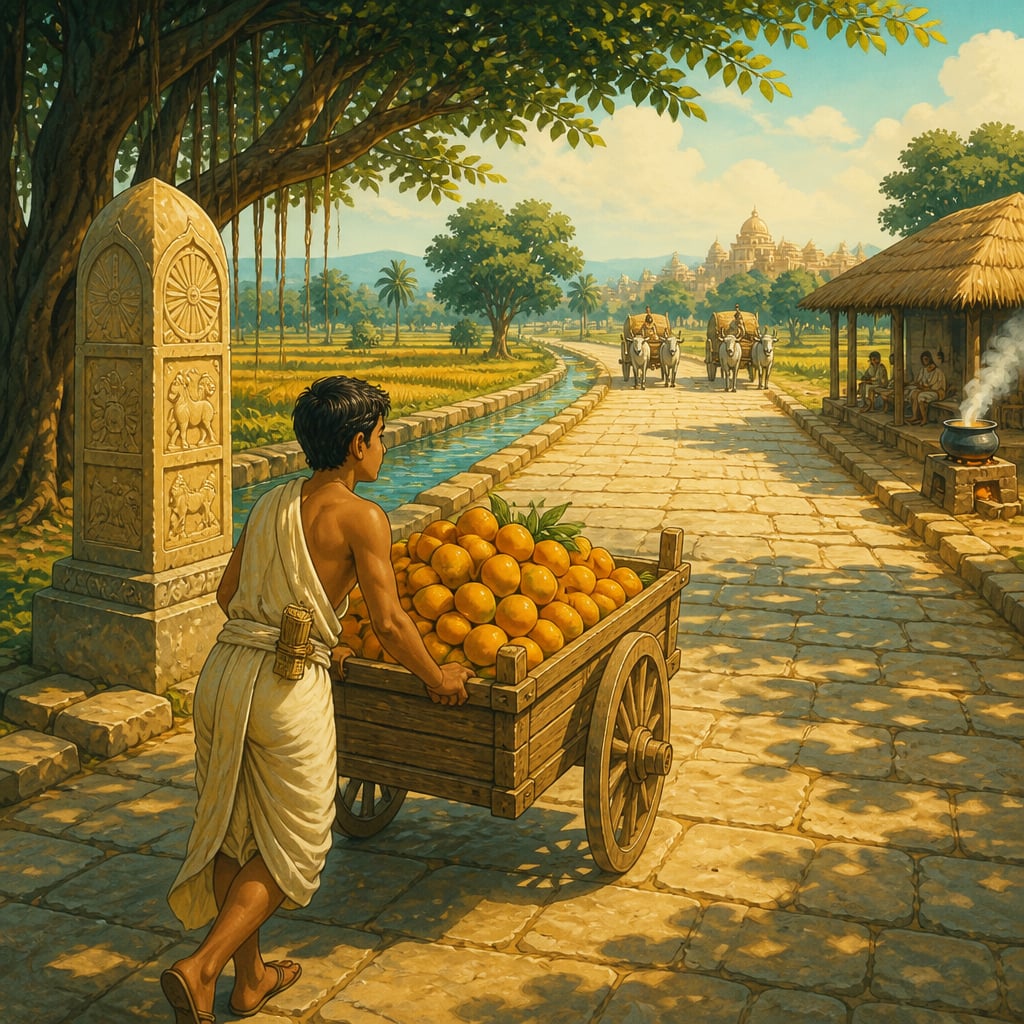
Mauryan farmer with mango cart on royal highway

Imagine you've grown the finest mangoes in your village. They're perfect - sweet, fragrant, ready for market. But the nearest city is three days' journey through dense forest on paths that barely exist. Half your crop will rot before you arrive. The capital, where you could get the best price, might as well be on the moon.

Now imagine a proper road connects your village to that city. Smooth, maintained, with rest houses every few miles and patrols that keep it safe. That same journey takes one day. Your mangoes arrive fresh. You return with goods your village needs and coins in your pocket.

The road didn't just make travel easier - it made your freedom to profit from your labor real.

Kautilya understood this fundamental truth: some goods are "public" not because government must provide them, but because their benefits flow to everyone and no single person can capture enough value to justify building them alone. Infrastructure creates the foundation for individual enterprise.

What Kautilya Meant by Infrastructure

The Arthashastra is remarkably specific about physical infrastructure:

Roads and Highways

Royal highways (Rajapatha) - major routes connecting cities, wide enough for two carts to pass, with mile markers and rest houses. Regional roads - connecting villages to market towns. Local paths - maintained by villages for field access.

Each type had specific width requirements, maintenance schedules, and supervision.

Irrigation Works

"Water is life; controlled water is prosperity."
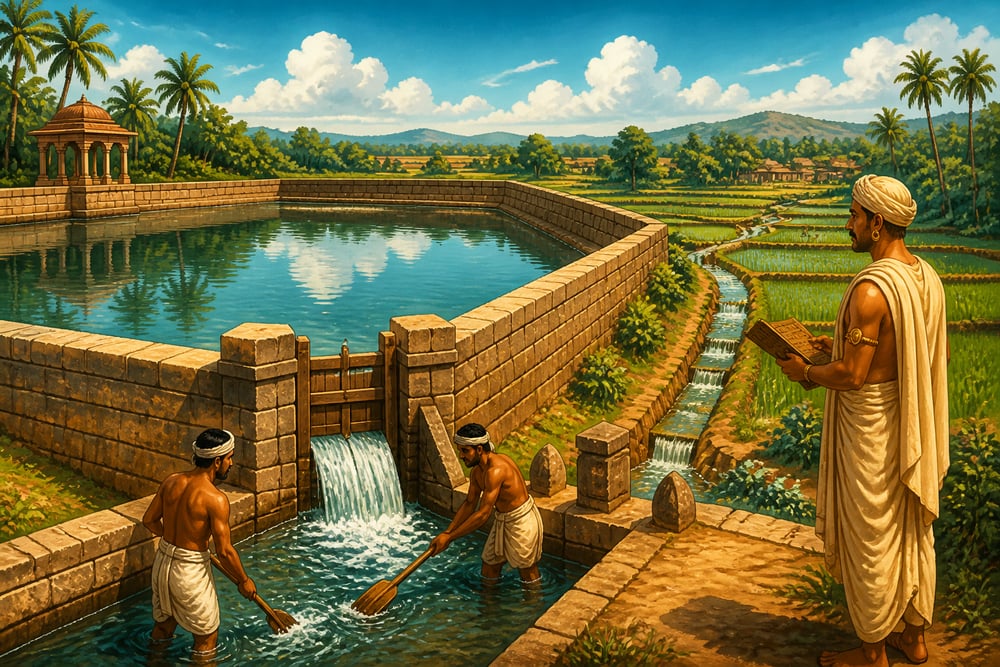
Mauryan irrigation reservoir feeding canal and paddies

Dams and reservoirs - capturing monsoon rains for year-round use. Canals - distributing water to fields far from rivers. Wells and tanks - local water sources. Drainage systems - preventing flooding and waterlogging.

Planned Cities

Mauryan cities weren't organic growths - they were planned:

Grid layouts - straight streets, defined blocks. Zoning - residential, commercial, and industrial areas separated. Public spaces - markets, temples, assembly halls. Utilities - water supply, drainage, waste management. Fire safety - wide streets as firebreaks, water storage.

The Economic Logic

Why should the state build infrastructure? Kautilya's reasoning was economic, not paternalistic.

The Problem of Collective Action

Some goods have a problem: their benefits spread so widely that no single person can profit enough from building them to justify the cost. A merchant might benefit from a road, but she'd only use a tiny fraction of it. Why should she pay for the whole thing?

The Multiplier Effect

Good infrastructure didn't just provide direct benefits - it multiplied economic activity:

Roads enabled trade - farmers reached markets, merchants moved goods, craftsmen sold their wares further afield.

Irrigation enabled agriculture - more land under cultivation, multiple crops per year, protection against drought.

Cities enabled specialization - when many people live together, specialized crafts emerge. The potter, the weaver, the goldsmith all depend on concentration of population.

Security enabled investment - when people feel safe, they build, plant, and invest in the future.

The Libertarian Insight

Kautilya's approach to infrastructure reflects sophisticated political economy:

Infrastructure Enables Private Action

The purpose wasn't to replace private enterprise but to enable it. Roads didn't carry state goods exclusively - they enabled private merchants to trade. Irrigation didn't make the state a farmer - it enabled private farmers to be more productive.

Public Provision, Private Benefit

The state built infrastructure, but individuals decided how to use it: which crops to grow with reliable water, which markets to reach via new roads, what businesses to start in planned cities. Freedom was exercised in the choices enabled by infrastructure, not controlled by it.

User Fees Where Practical

Kautilya prescribed tolls on major roads and water charges for irrigation - users paid according to use. But basic access was guaranteed:

"No one shall be denied passage on the royal highway, nor water from the royal reservoir, except as punishment for crime."

Maintenance Over New Construction

Kautilya emphasized that maintaining existing infrastructure was as important as building new:

Stonemasons repairing royal highway flagstones at dusk

"A road unmaintained soon becomes no road at all. The king who builds but does not maintain leaves only ruins."

Who Built and Maintained?

Kautilya's system distributed responsibility:

Central Government - Built and maintained royal highways between major cities, major irrigation works (large dams, main canals), and fortifications of strategic importance.

Local Administration - Maintained regional roads, secondary canals and local water systems, and city infrastructure within their jurisdiction.

Villages - Responsible for local paths, village tanks and wells, and maintenance of irrigation channels passing through their land.

Private-Public Partnerships - Private parties built infrastructure in exchange for tax breaks. Merchants organized to build rest houses along trade routes. Villages cooperated on shared irrigation works.

Modern Parallels

Kautilya's infrastructure principles remain relevant:

Physical Infrastructure Today

Modern highways, airports, power grids, and water systems face the same collective action problems Kautilya identified. They're still best provided publicly but used privately.

Digital Infrastructure

The internet, like roads, enables countless private activities without dictating their content. The debate over "net neutrality" echoes Kautilya's principle that infrastructure should be available to all.

The Maintenance Problem

Developing countries often build new infrastructure while existing infrastructure crumbles - exactly what Kautilya warned against.

Why This Matters

Infrastructure is where libertarian and welfare-state thinking can find common ground:

Libertarians recognize that some collective action problems require coordinated solutions. Pure private action can't build highway networks.

Welfare advocates recognize that the purpose is enabling individual opportunity, not creating dependence.

Both can agree that infrastructure should enable private enterprise, be accessible to all, be maintained over time, and not become an instrument of control.

Kautilya's insight was that freedom requires foundations. The absence of government isn't freedom if the result is that only the powerful can trade, irrigate, or prosper. Well-designed infrastructure makes freedom accessible to all.

The Test of Good Infrastructure

How do you know if infrastructure serves freedom?

Ask: Does it enable people to do more for themselves, or does it make them dependent?

Ask: Is it available to all on equal terms, or do some have privileged access?

Ask: Does it facilitate private choices, or does it direct them?

Ask: Is it maintained sustainably, or will it collapse without constant new investment?

Kautilya's infrastructure passed these tests. That's why his cities thrived, his agriculture flourished, and his commerce made the Mauryan Empire wealthy. The roads were freedom - freedom to trade, to travel, to prosper through one's own labor.

Collective action problems arise when the benefits of a good are distributed widely but the costs must be borne by individuals. Infrastructure like roads, irrigation, and city planning exemplifies this - everyone benefits, but no single person can afford to build them. The state solves the coordination problem by pooling resources.

Maintenance is less glamorous than new construction but more important for sustainability. Infrastructure degrades without care, and building new while existing crumbles wastes resources. This applies beyond physical infrastructure to any system requiring ongoing attention.

The most valuable infrastructure is neutral - it enables diverse uses rather than prescribing specific applications. When platforms empower users to make their own choices, innovation flourishes. Control-oriented infrastructure limits possibilities to what planners imagined.

Verses

पन्थानं कारयेत्

panthānaṃ kārayet

The king should cause roads to be made.

This simple directive reflects a profound understanding: some goods are essential to commerce and prosperity but won't emerge from purely private action. The state's role is to solve coordination problems that prevent beneficial projects.

Book 2, Chapter 1, Verse 14-15 (R.P. Kangle)

सेतुबन्धादर्थं प्रजानां करं गृह्णीयात्

setu-bandhād-arthaṃ prajānāṃ karaṃ gṛhṇīyāt

For building dams and reservoirs, tax should be collected from the people.

Infrastructure should be funded by those who benefit from it. This isn't arbitrary taxation but a fair exchange - people pay for the irrigation that will make their farms more productive.

Book 2, Chapter 24, Verse 18 (L.N. Rangarajan)

पुराणिसंस्कृत्य नवानि च कारयेत्

purāṇi-saṃskṛtya navāni ca kārayet

Having maintained existing infrastructure, then build new.

Maintenance comes before expansion. This reflects deep wisdom: unmaintained infrastructure degrades rapidly, and building new while old crumbles wastes resources.

Book 2, Chapter 1, Verse 19 (R. Shamasastry)

Case studies

The Grand Trunk Road

The Grand Trunk Road, running from Bengal to the northwest frontier, is one of Asia's oldest and longest major roads. While expanded by later empires, its origins trace to Mauryan-era infrastructure. It connected diverse regions, enabled trade, facilitated cultural exchange, and helped unify a vast territory.

This embodies Kautilya's infrastructure principles: (1) State-built and maintained major highway. (2) Enabled private commerce and travel without controlling it. (3) Had rest houses, water sources, and security - making it usable. (4) Created economic multiplier effects - regions it connected prospered more than isolated areas. (5) Required ongoing maintenance, not just initial construction.

The Grand Trunk Road remained vital for over two millennia, adapted by successive empires. It enabled trade that enriched regions along its route and facilitated the spread of ideas, religions, and cultures. Its economic impact vastly exceeded its construction cost.

Good infrastructure is self-justifying through its economic and social returns. The Grand Trunk Road didn't restrict travel - it enabled it, allowing countless private decisions about where to go and what to trade.

India's modern highway expansion under Bharatmala Pariyojana follows the same logic: state-built trunk infrastructure enabling private commerce across previously disconnected regions. The economic multiplier of well-maintained highway infrastructure remains among the highest returns any government investment can generate.

The Grand Trunk Road stretches approximately 2,500 km from Chittagong (Bangladesh) to Kabul (Afghanistan). Mauryan-era segments featured a standard width of 10.6 meters with shade trees planted at intervals of roughly 30 meters on both sides.

The Internet as Infrastructure

The early internet was government-funded research infrastructure - ARPANET connected universities and research centers. Its designers built a neutral platform for data transmission without prescribing uses. This 'end-to-end' principle meant intelligence was at the edges (user devices), not in the network.

This mirrors Kautilyan principles: (1) Government solved the coordination problem of building the initial network. (2) The infrastructure enabled private innovation without controlling it. (3) No single user could have built a network useful enough to be valuable. (4) Once basic infrastructure existed, private activity flourished - web browsers, email, e-commerce, social media, streaming. (5) The infrastructure's value came from enabling diverse, unanticipated uses.

The internet became the most valuable infrastructure in human history, enabling trillions of dollars in economic activity. This happened because it enabled rather than controlled - anyone could build applications on top of neutral infrastructure.

Infrastructure creates maximum value when it enables diverse uses rather than prescribing specific applications. The internet's power came from being a platform for countless private innovations, not a service with predetermined purposes.

The current debate over AI infrastructure follows the same pattern. Governments funding foundational AI research and open-source models (like DARPA funding early AI) create platforms for private innovation. Countries that build this enabling infrastructure while keeping it open will likely capture disproportionate economic value, just as early internet investors did.

ARPANET, launched in 1969 with just 4 connected nodes, grew into the internet which generated over $16 trillion in global economic activity by 2023. The original government investment was approximately $25 million, yielding a return ratio that exceeds any other infrastructure project in history.

Historical context

c. 4th century BCE

Before Mauryan unification, the Indian subcontinent had impressive urban centers (like Taxila) but lacked coordinated infrastructure across regions. The Mauryas' systematic approach to roads, irrigation, and cities was unprecedented in scale.

The Mauryan infrastructure network enabled the empire's prosperity and facilitated the spread of Buddhism and trade across vast distances. Infrastructure made cultural and economic exchange possible.

Living traditions

Reflection

More in Janapada: Land, Cities, and Infrastructure

All lessons in Janapada: Land, Cities, and Infrastructure · Arthashastra: Science of Governance course