Knowledge as Foundation

Vidya - Education Systems and Learning

Education isn't just personal enrichment - it's the foundation of prosperity and good governance. Kautilya's education system balanced state provision of basic learning with family responsibility, recognizing that an educated populace benefits everyone through economic growth and informed citizenship.

The Boy Who Could Read
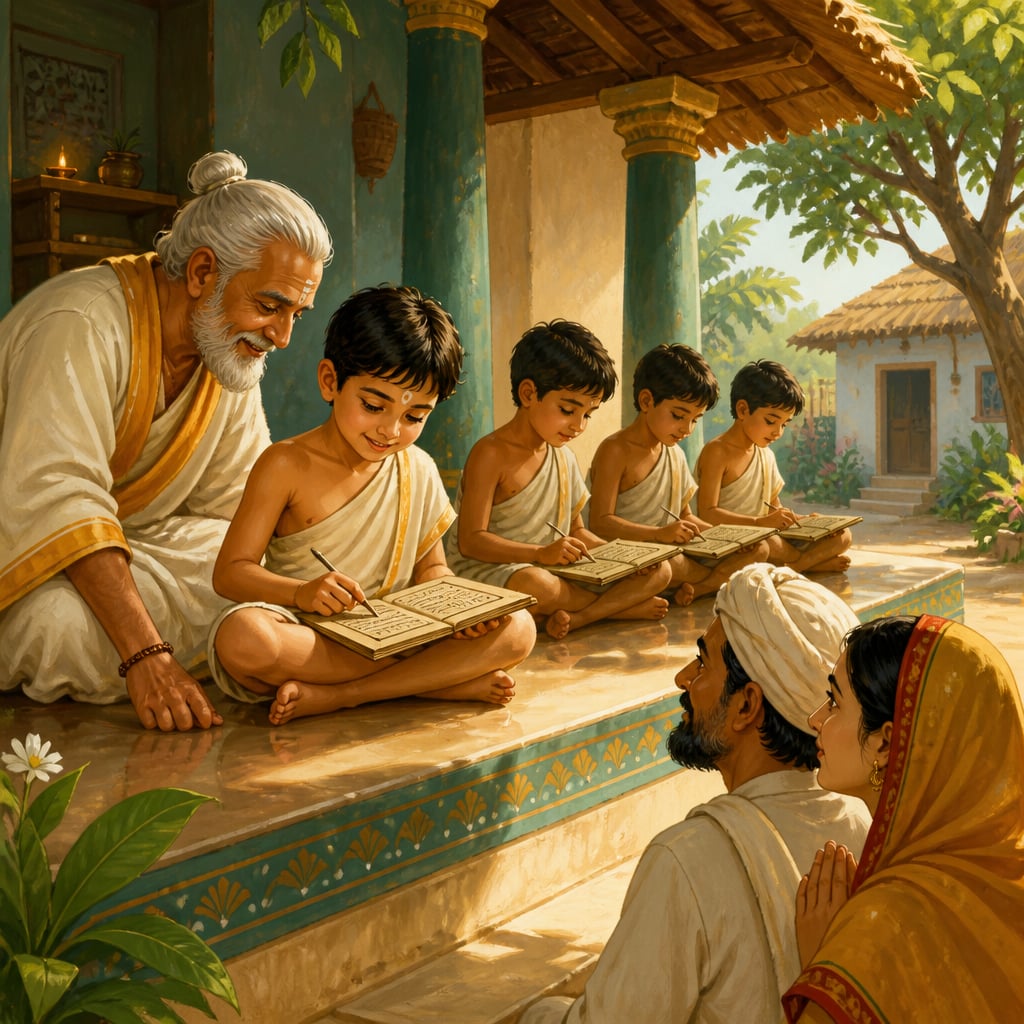
Village boy learning to read at small pathshala

In the village, most children work the fields alongside their parents. But one boy spends mornings at the local school, learning letters and numbers, studying the classics. His parents worry - time spent learning is time not earning.

Years later, that boy manages accounts for multiple merchants, teaches in a larger town, advises officials on tax matters. His childhood education transformed his life prospects - and the taxes he now pays, the trade he facilitates, the others he teaches, all enrich the kingdom.

Education is an investment that pays dividends for generations.

Kautilya understood that knowledge wasn't just personal enrichment - it was economic and social infrastructure, as important as roads or irrigation.

Why Education Matters

Kautilya's case for education combined pragmatism and principle:

Skilled workers are more productive - literacy, numeracy, and specialized knowledge enable complex economic activity. Innovation requires knowledge. Trade needs calculation.

Officials must be competent - administering a complex state requires trained bureaucrats. Justice needs judges who understand law and reasoning.

Education creates positive externalities - your literacy helps me. You can read contracts, teach others, follow instructions. Like public health or infrastructure, education's benefits spread beyond the individual who receives it.

Kautilya's Education System

The Arthashastra describes a multi-tiered approach:

Primary Education (Vidya)

Where: Local schools (pathshalas), guru households, family instruction

What: Reading and writing, basic arithmetic, religious texts and dharma, traditional knowledge

How funded: Mix of family payment, community support, and state assistance for the poor

Specialized Training

Vocational apprenticeships - craftsmen's sons learning trades, merchant families training in commerce

Advanced learning - philosophy and logic, law and administration, military arts, medicine, mathematics and astronomy

Royal Schools
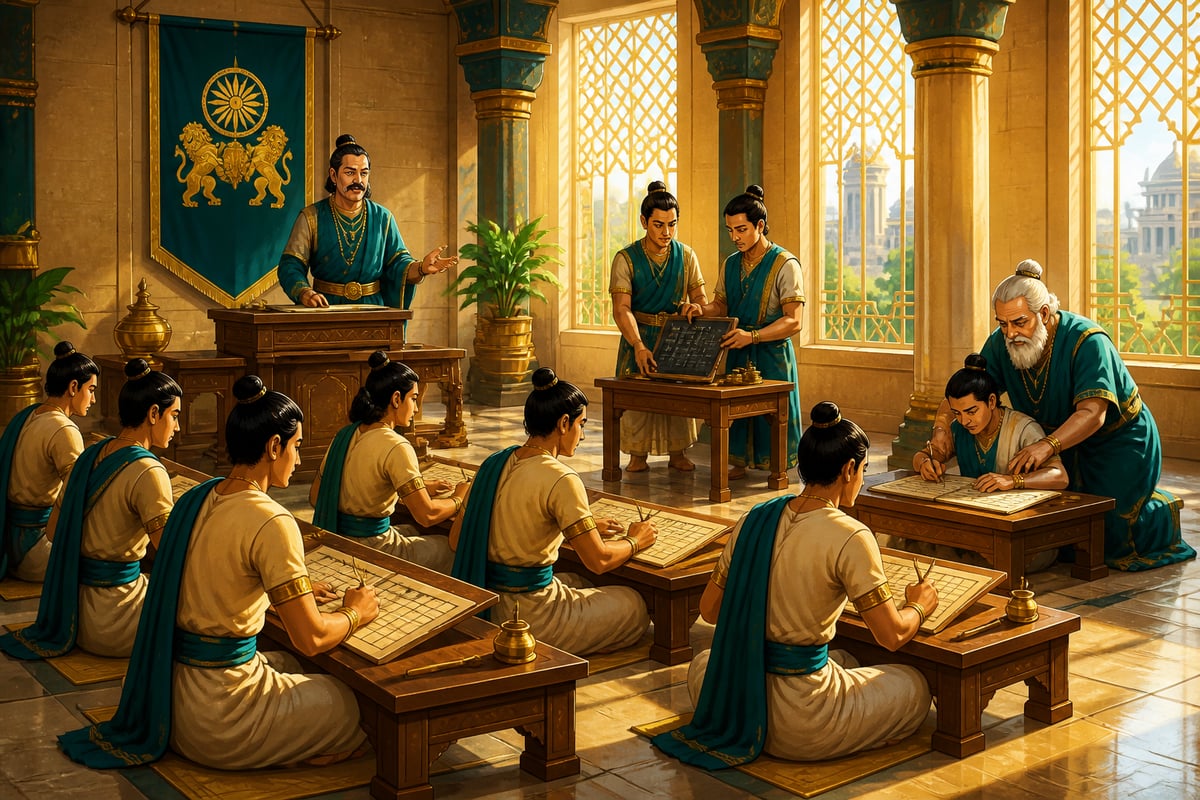
Royal academy hall training young Mauryan officials

The state directly funded:

The Gurukula System

Forest guru teaching disciples under banyan tree

Traditional education through master-student relationships. Students lived with guru, learning through observation and instruction. Curriculum combined theoretical knowledge with practical application. Merit-based - talented poor students could access learning through patronage.

The Division of Responsibility

Kautilya's system distributed educational responsibility:

Family Responsibility

Primary obligation to educate children rested with families. Families paid for basic education when able. Vocational training happened within family trades. Moral education was family and community responsibility.

Community Role

Villages supported local teachers and schools. Guilds trained apprentices in specialized crafts. Religious institutions provided charitable education. Wealthy patrons funded schools and supported poor students.

State Provision

The government filled gaps - providing education where family/community couldn't, training officials it employed, supporting scholars, educating orphans and vulnerable, maintaining standards.

Curriculum and Content

Kautilya organized knowledge into the Four Vidyas (Sciences):

Anvikshiki (Logic and Philosophy) - critical thinking, reasoning, ethics and statecraft

Trayi (The Three Vedas) - sacred knowledge, dharma, social order

Varta (Economics) - agriculture, trade and commerce, animal husbandry

Dandaniti (Science of Governance) - law and administration, military affairs, diplomacy

Plus practical skills: literacy, numeracy, trades, and social knowledge.

The Philosophical Framework

Kautilya's approach reflected sophisticated insights:

1. Education as Positive Externality

Your education benefits me - literate neighbors can help with documents, skilled workers provide better goods and services, knowledgeable citizens create more functional society. This externality justifies some collective support for education, especially basic literacy and numeracy.

2. Family Primary, State Secondary

Education is primarily family responsibility. Parents should educate children. Families should pay when able. State fills gaps, doesn't replace family obligation. This preserves family autonomy while ensuring everyone has access.

3. Diverse Provision, Not State Monopoly

Education came from families teaching their own, private gurus and teachers, religious institutions, community schools, and state institutions for specific needs. No monopoly - multiple providers served different needs.

4. Investment, Not Consumption

Education was investment in human capital - increasing productivity, enabling specialization, advancing knowledge, strengthening governance. Not leisure activity but economic and social foundation.

The Limits of State Provision

Even in education, Kautilya recognized boundaries:

Not Universal State Education - The state didn't operate schools for all children. Most education happened through families, apprenticeships, private gurus, and community schools. State provision was for training state officials, educating orphans and vulnerable, supporting advanced scholarship, and areas critical for governance.

Not Compulsory - Families chose whether and how to educate children. No mandatory attendance laws. Different paths for different aptitudes and stations.

Not Standardized - No single curriculum for all. Different knowledge for different roles. Brahmins learned different things than merchants or farmers. Diversity of educational approaches flourished.

Modern Parallels

Kautilya's principles remain remarkably relevant to contemporary education debates:

Public Education Debates

Modern societies struggle with fundamental questions: Should the state provide universal education? How to balance state, family, and private provision? What should be taught and who decides?

Kautilya's approach offers a middle path: State ensures access (especially for the poor and disadvantaged), provides training for those it employs, and supports knowledge critical for society. But it doesn't monopolize provision, standardize all content, or compel attendance against family wishes.

This framework respects both opportunity (everyone can access education regardless of ability to pay) and liberty (families retain primary responsibility and choice among diverse providers).

Vocational vs. Academic

The ancient tension between practical and theoretical learning persists today. Some students benefit from hands-on vocational training - learning trades, crafts, and practical skills that lead directly to employment. Others thrive with theoretical, academic learning that develops abstract thinking and prepares for professional careers.

Modern education systems often force students into one track or the other, or worse, provide only academic education while denigrating vocational paths. Kautilya recognized both as equally valuable - not everyone needed the same education. A civilization needs both scholars and craftsmen, both philosophers and farmers.

The wisest systems offer multiple paths, allowing students to pursue education suited to their aptitudes and aspirations. Guild apprenticeships, gurukula learning, family instruction, and royal schools each served different needs in Kautilya's system.

School Choice

Modern debates rage about public vs. private schools, charter schools, homeschooling, vouchers, and educational freedom. These echo ancient recognition that families should choose among diverse providers rather than accepting standardized state monopoly.

Kautilya's system featured remarkable diversity: families teaching their own, private gurus accepting students, religious institutions offering charitable education, community schools funded by villages, guild apprenticeships, and state schools for specific purposes. This pluralism served society better than any single approach could.

Why This Matters

Education tests theories of state role. Some say education is purely private - families should handle it entirely. Others say universal state provision with standardized curriculum.

Kautilya charts middle path:

State SHOULD ensure access - especially for poor and orphaned.

State SHOULD train those it employs (officials, military).

State SHOULD support knowledge creation and preservation.

BUT state shouldn't monopolize - family, community, private provision should flourish.

AND state shouldn't compel - education is opportunity, not obligation.

This respects both opportunity (everyone can access education) and liberty (families retain primary responsibility and choice).

The Foundation of Prosperity

Here's the deeper insight: Freedom requires capability.

You can't exercise economic freedom without literacy and numeracy to engage in commerce. You can't defend your rights without knowledge of law and governance. You can't improve your station without skills and knowledge.

Education enables freedom by providing tools to exercise it. The boy who learned to read didn't just enrich himself - he enriched his community and his kingdom.

Infrastructure provides physical foundation for prosperity. Education provides human foundation. Together, they enable the individual flourishing that Kautilya understood as the purpose of good governance.

The state that fails to ensure its people have access to knowledge fails to enable their freedom. But the state that monopolizes education, standardizes it excessively, or compels it against family wishes, fails differently - replacing family responsibility and diverse approaches with bureaucratic uniformity.

Kautilya knew both extremes failed. Education should be widely accessible but diversely provided. Basic knowledge should be universal but specialized knowledge appropriately varied. State should ensure access but not monopolize provision.

That's education as public good - enabling individual opportunity while preserving family autonomy and diverse approaches to learning.

By framing education as investment in human capital rather than consumption, Kautilya established an economic rationale for collective support. The returns from an educated populace - increased productivity, innovation, better governance - far exceed the costs of providing basic education. This externality justifies state involvement without requiring state monopoly.

Diverse educational approaches acknowledge that people have different aptitudes, needs, and social roles. Standardization creates uniformity but sacrifices specialization. Multiple providers - families, religious institutions, guilds, private teachers, state schools - create competition, preserve choice, and serve varied needs better than monopolistic provision.

Kautilya distinguished between ensuring access and monopolizing provision. The positive externality of education justifies collective support, especially for those who can't afford it. But state funding doesn't require state operation. Families retaining primary responsibility preserves autonomy and diverse approaches while state ensures no child is denied opportunity due to poverty or lack of family.

Verses

विद्याविनयाद् भवति

vidyā-vinayād bhavati

Knowledge comes from disciplined learning.

Education isn't passive absorption - it requires structured, disciplined study. This recognizes that knowledge transmission needs systems (schools, teachers, curricula) and effort (study, practice, discipline).

Book 1, Chapter 5, Verse 1 (R.P. Kangle)

अनधीतः सर्वशास्त्राणाम्

anadhītaḥ sarva-śāstrāṇām

One who has not studied the sciences...

The full passage contrasts educated and uneducated rulers, showing that governance requires knowledge. Education isn't optional for those in authority - ignorance in power is dangerous.

Book 1, Chapter 5, Verse 6 (L.N. Rangarajan)

अनाथबालानां विद्यां दद्यात्

anātha-bālānāṃ vidyāṃ dadyāt

The king should provide education to orphaned children.

Education is so important that those without family to provide it should receive it from the state. This isn't comprehensive state education - it's ensuring vulnerable children aren't denied opportunity due to circumstances beyond their control.

Book 1, Chapter 17, Verse 49 (R. Shamasastry)

Case studies

The Indian IT Boom

In late 20th century, India became global IT powerhouse despite limited infrastructure. Key factor: IITs and other technical institutions produced highly skilled engineers. State investment in technical education created human capital that enabled economic transformation.

This validates Kautilyan principles: (1) State investment in critical specialized knowledge (IITs like Kautilya's royal schools for officials). (2) Not comprehensive state education - private engineering colleges also flourished. (3) Education as investment creating economic returns. (4) Specialized knowledge (computer science) enabling specialized economic activity. (5) The externality: India benefits from having pool of skilled engineers, not just individuals who receive education.

IIT graduates powered India's IT industry, creating massive economic value. State investment in education yielded returns far exceeding costs. The model continues - state supports quality technical education without monopolizing provision.

Strategic state investment in critical knowledge areas can catalyze economic transformation. But success came from focused investment in quality specialized education, not universal state monopoly.

China's investment in AI research institutes and semiconductor fabrication mirrors this strategy. Targeted state investment in strategic technology sectors, rather than broad industrial policy, consistently produces higher returns. The countries winning the current technology race are those making focused bets on critical knowledge infrastructure.

India's IT industry grew from $150 million in exports in 1990 to over $245 billion in revenue by 2024. IIT graduates, produced at a state investment of roughly $20,000 per student per year, generated an estimated $400 billion in cumulative economic value for the Indian economy.

School Choice in the Netherlands

Netherlands has diverse school provision - public, Catholic, Protestant, secular private, alternative pedagogies - all funded equally per student by the state. Parents choose; schools compete; diversity flourishes. This 'pillarization' system has existed since 1917.

This echoes Kautilyan approach: (1) State ensures access through funding but doesn't monopolize provision. (2) Families choose among diverse providers. (3) Multiple educational approaches serve different values and needs. (4) Quality comes from choice and competition, not standardization. (5) State role is ensuring access and maintaining baseline standards, not operating schools. (6) Like ancient India's mix of gurukulas, guilds, and state schools - diversity of provision with public support.

Netherlands consistently ranks highly in educational outcomes while maintaining diverse approaches. Choice and diversity coexist with universal access. System proves state funding doesn't require state monopoly.

Education can be publicly funded without being state monopoly. Diverse provision can coexist with universal access. Families can choose while state ensures all children can be educated.

The global rise of charter schools, voucher programs, and education savings accounts reflects this principle. Countries like Sweden and Chile that fund students rather than institutions, letting families choose among diverse providers, demonstrate that universal access does not require state monopoly on provision.

The Netherlands allocates approximately 5.5% of GDP to education, with 70% of students attending non-government schools that receive equal per-pupil state funding. Dutch 15-year-olds consistently score above the OECD average in reading, math, and science on PISA assessments.

Historical context

c. 4th century BCE

Ancient India had sophisticated educational traditions - Vedic schools, Buddhist universities, guild apprenticeships. Kautilya's contribution was systematizing state support for critical knowledge while preserving diverse provision. The gurukula system and brahminical learning predated the Arthashastra.

India's educational infrastructure enabled its intellectual achievements in mathematics, astronomy, medicine, philosophy, and linguistics. The same system that trained administrators also advanced human knowledge.

Living traditions

Reflection

More in Janapada: Land, Cities, and Infrastructure

All lessons in Janapada: Land, Cities, and Infrastructure · Arthashastra: Science of Governance course