Protecting Those Who Cannot Protect Themselves
Widows, Orphans, and the Disabled
A just state protects those who cannot protect themselves - not from charity but from duty. Kautilya's provisions for widows, orphans, and the disabled reflected the principle that legitimate government serves those who cannot serve themselves, enabling dignity even in vulnerability.
The Widow and Her Sons
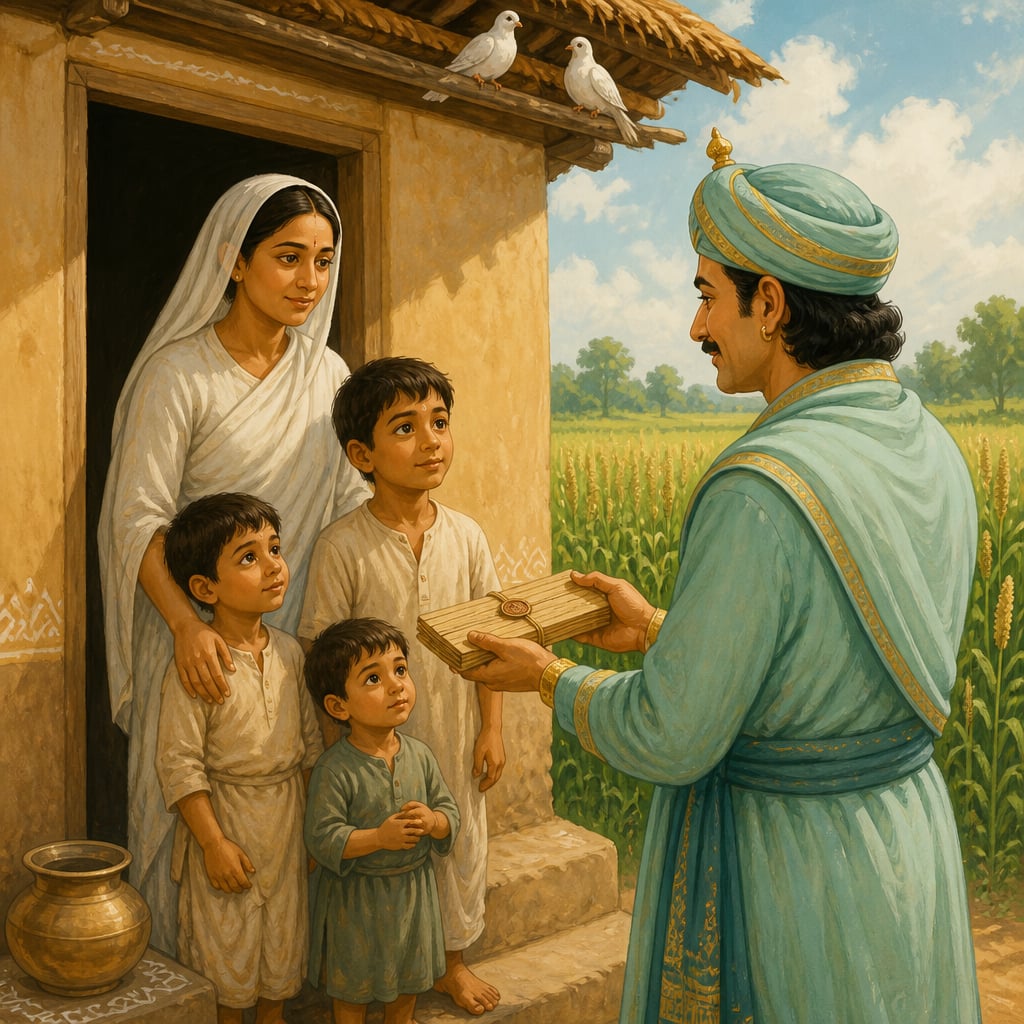
Her husband died in the king's service, leaving her with three young sons and a small field. In many societies, her fate would be bleak - perhaps forced to remarry, perhaps losing the land to relatives, perhaps reduced to begging.
But in Kautilya's system, an official comes with a different message: The state will protect the field until the boys are old enough to work it. She will receive grain from the royal storehouse. Her sons can attend the local school. If she wishes to work, there is employment available. Her husband served the king, and the king does not abandon the families of those who serve.
This is rakshana - protection - extended to those who cannot protect themselves.
Why Protect the Vulnerable?
Kautilya's reasoning combined pragmatism and principle:
The Pragmatic Case
Social stability - desperate people cause disorder. Preventing destitution prevents crime and unrest.
Economic efficiency - children who grow up fed and educated become productive taxpayers. Letting them starve or remain ignorant wastes human capital.
Legitimacy - a state that visibly protects the vulnerable earns loyalty. People support governments that demonstrate care for those who cannot care for themselves.
Military necessity - soldiers serve more loyally knowing their families will be cared for if they fall.
The Principled Case
Dharma - righteousness requires protecting those who cannot protect themselves.
The social contract - people accept state authority in exchange for protection. Those who cannot protect themselves have the strongest claim on state protection.
Common humanity - suffering from circumstances beyond one's control (widowhood, orphanhood, disability from birth) deserves compassionate response.
Specific Provisions
The Arthashastra prescribed detailed support:
For Widows
Property rights - a widow retained rights to her husband's property, managed as trustee for sons or for her lifetime.
Employment - the state provided work suitable for women (textile production, grain processing, herb cultivation).
Protection from exploitation - laws prevented relatives from seizing widows' property or forcing unwanted remarriage.
Maintenance - if unable to work, widows received regular grain and oil from state stores.
For Orphans

State guardianship - orphans without family became wards of the state until maturity.
Property preservation - orphans' inherited property was managed by appointed guardians with strict accounting, returned when they came of age.
Education - orphans attended state-supported schools, learning trades appropriate to their aptitude.
Adoption encouragement - incentives for families to adopt orphans.
For the Disabled
Suitable employment - work matching capabilities (blind people in certain musical or memory-based occupations, etc.).
Direct support - those unable to work received maintenance from the treasury.
Family obligations - families were required to support disabled relatives when able; state fills gaps.
No forced labor - the disabled were exempt from corvée obligations.
The Employment Principle
Even for the vulnerable, Kautilya preferred employment over charity where possible:
Why This Mattered
Dignity - earning wages, even in adapted work, preserved self-respect.
Productivity - disabled people could contribute according to their capabilities.
Integration - working kept the vulnerable connected to community, not isolated.
Sustainability - productive work offset some costs of support.
Types of Adapted Work

For the blind: Rope-making, music, memorization tasks, grinding grain
For the lame: Sitting work (basket weaving, garland making), supervision, teaching
For widows: Textile production, food processing, herb preparation, teaching young children
The Libertarian Insight
Kautilya's approach to vulnerable populations reflects sophisticated philosophy:
1. Genuine Incapacity Deserves Support
Liberty means freedom to pursue flourishing. Those genuinely unable to do so through no fault of their own (orphaned young children, severely disabled) have legitimate claim on collective support.
This isn't undermining individual responsibility - it's recognizing that responsibility presumes capability.
2. Support Should Enable Maximum Independence
Even for the vulnerable, the goal was maximum possible independence:
- Employment adapted to capability rather than pure charity
- Education and training rather than just maintenance
- Protecting assets rather than consuming them
- Preserving dignity and agency
3. Private (Family) Before Public (State)
The state was last resort, not first:
- Families should care for their vulnerable members
- Communities should help before state intervention
- State filled genuine gaps, didn't replace private obligation
4. Protection from Exploitation
The vulnerable cannot effectively defend their rights. State protection of their property rights and physical safety was essential.
This is core libertarian principle: government protects rights, especially when individuals cannot protect themselves.
The Balance
This lesson presents tensions:
Compassion vs. Sustainability - unlimited support bankrupts the treasury and helps no one long-term.
Support vs. Dignity - pure charity can demoralize; adapted work preserves self-respect.
Public vs. Private - state can provide but shouldn't replace family and community.
Rights vs. Capability - those unable to defend their rights need state protection; those capable should do so themselves.
Kautilya navigated these by:
- Distinguishing genuine need from opportunism
- Preferring employment over charity
- Making state last resort, not first option
- Protecting rights while encouraging maximum independence
Why This Matters
Vulnerable populations test political philosophy:
Pure libertarians might say: No state role - private charity will provide.
Pure socialists might say: Comprehensive state provision for all needs.
Kautilya charts the middle:
The state SHOULD protect those genuinely unable to protect themselves - this is legitimate government function.
BUT protection should preserve dignity - adapted employment over pure charity where possible.
AND family/community come first - state fills gaps, doesn't replace private obligation.
AND verification matters - distinguish genuine need from opportunism.
This approach respects both compassion (we protect the vulnerable) and liberty (we enable independence rather than create dependence, and we don't force support on those who should provide for themselves).
The widow with three sons receives help - but also opportunity. Her sons attend school and learn trades. The land is preserved for them. When they mature, they inherit and prosper, eventually supporting others in turn.
That's the difference between abandonment and opportunity - and Kautilya knew it well.
This reflects understanding that protecting future independence is more valuable than just maintaining present consumption. Preserving assets and building capability creates productive adults who eventually contribute rather than permanent dependents who drain resources.
Adapted employment serves multiple purposes: preserves dignity and self-worth, maintains skills and work habits, enables contribution to society, and reduces fiscal burden. It treats vulnerable people as capable adults rather than helpless dependents.
Family care is typically more effective than institutional care - more personal, more knowledgeable about individual needs, more invested in outcomes. State monopolizing care breaks these bonds. Supporting families to care for their own preserves both effectiveness and social fabric.
Verses
विधवा बालवृद्धातुराणां च रक्षणं कुर्यात्
vidhavā bāla-vṛddhāturāṇāṃ ca rakṣaṇaṃ kuryāt
The king should provide protection for widows, children, the elderly, and the sick.
Protecting the vulnerable isn't optional charity - it's essential duty of legitimate government. Those who cannot protect themselves have the strongest claim on state protection.
Book 2, Chapter 1, Verse 27 (R.P. Kangle)
अनाथबालानां धनं राजा संरक्षेत्
anātha-bālānāṃ dhanaṃ rājā saṃrakṣet
The king should protect the property of orphaned children.
Protection isn't just providing food and shelter - it's preserving the assets and opportunities that enable future independence. Orphans should inherit what their parents built, managed honestly until they can manage themselves.
Book 3, Chapter 5, Verse 14 (L.N. Rangarajan)
शक्तेभ्यः कर्म दद्यात्
śaktebhyaḥ karma dadyāt
To those who are capable, give work.
Even among the vulnerable, distinguish those capable of adapted work from those who truly cannot work. Employment preserves dignity and enables contribution.
Book 3, Chapter 7, Verse 36 (R. Shamasastry)
Case studies
The Social Security Disability Insurance Dilemma
Modern disability insurance systems face challenges: genuine disability deserves support, but determining genuine incapacity is difficult. Some systems are too strict, denying support to those who need it. Others are too lax, enabling dependency for those capable of adapted work. The 'all or nothing' approach - fully disabled or fully able - doesn't match reality where many have partial capabilities.
Kautilya's approach offers insights: (1) Distinguish true incapacity from partial limitation. (2) Provide adapted employment for partial capability rather than pure dependency. (3) Protect those genuinely unable to work. (4) But expect contribution from those capable of adapted work. (5) Support should enable maximum independence, not comfortable dependency. (6) Modern systems could better match support to actual capability rather than binary disabled/able categories.
Some modern programs (like supported employment) succeed by following Kautilyan principles - adapting work to capability. Others fail by creating all-or-nothing choices where working means losing all support, incentivizing people to not work even when partially capable.
Support systems work best when they match Kautilyan principles: enable maximum independence, adapt to actual capability, protect genuine incapacity, but don't create comfortable dependency where capability exists.
The gig economy creates a modern version of this dilemma. Workers classified as independent contractors lose access to disability insurance, health benefits, and unemployment protection. Portable benefits proposals that follow workers across employers, adapting to actual work patterns rather than forcing all-or-nothing employment categories, reflect Kautilya's emphasis on matching support to actual capability.
The U.S. Social Security Disability Insurance program pays benefits to approximately 7.6 million disabled workers. Studies show that recipients who attempt to return to work face effective marginal tax rates exceeding 80% due to benefit cliffs, discouraging reintegration.
Orphan Inheritance Protection in Practice
In many historical societies, orphaned children lost their inheritances to unscrupulous relatives or guardians. Without parents to protect their interests, children's property was often appropriated, leaving them destitute despite having inherited wealth. Some societies developed systems to prevent this, others did not.
Kautilya's system addressed this directly: (1) State-appointed guardians for orphans' property. (2) Strict accounting required - every transaction recorded. (3) Property returned intact when child reached maturity. (4) Severe penalties for guardian theft or mismanagement. (5) Preference for family guardians but with state oversight. (6) Recognition that protecting future independence required preserving assets, not just providing immediate needs.
Modern trust and guardianship law in many countries follows similar principles - court-appointed guardians, strict accounting, protection of minor's interests. Where such systems exist, orphans can inherit and eventually prosper. Where they don't, orphans often lose everything.
Protecting the vulnerable means protecting their rights and assets, not just their immediate needs. Systems that preserve future independence serve better than those that only address present consumption.
Modern trust funds and UTMA (Uniform Transfers to Minors Act) accounts serve exactly this function. Financial advisors consistently recommend establishing legal protections for minor children's inheritances, because without formal structures, studies show that up to 70% of inherited wealth is lost by the second generation.
Kautilya's Arthashastra (Book 2, Chapter 1) mandated state guardianship for orphans' property, with annual audits and penalties of 12% interest for guardians who misused funds. Modern trust law in India traces some principles to these ancient protections.
Historical context
c. 4th century BCE
Before systematic state support, vulnerable populations depended entirely on family or charity. Widows often faced destitution or forced remarriage. Orphans without family might be enslaved. The disabled were often abandoned. The Mauryan systematic approach was unprecedented.
Protecting vulnerable populations strengthened social cohesion and demonstrated that the state served people's welfare, not just extracted resources. This enhanced legitimacy and stability.
Living traditions
- Social Security Systems: Government programs providing income security for elderly, disabled, and survivors of deceased workers
- Disability Employment Programs: Programs emphasizing adapted work opportunities for people with disabilities rather than pure dependency
- Widow Protection Laws: Legal frameworks protecting widows' property rights and preventing exploitation by relatives
- National Institute for the Empowerment of Persons with Disabilities: Institution promoting disability rights and adapted employment
- SOS Children's Villages: Organization providing family-style care for orphaned and abandoned children
- Missionaries of Charity: Mother Teresa's organization caring for the dying, destitute, and disabled - embodying protection for those who cannot protect themselves
- Tirumala Tirupati Devasthanams: Temple administration that operates extensive charitable programs including orphanages, widow homes, and disability services
Reflection
- Kautilya prescribed state protection for those genuinely unable to protect themselves (orphaned children, severely disabled) but expected family to care for their own when capable. Where should that line be drawn?
- Is adapted employment for disabled people empowering or exploitative? Does it preserve dignity or does it force work on those who should be supported in comfort?
- Who in your life or community is vulnerable and might need protection or support? What would Kautilyan principles suggest about how to help?