Trade and Commerce

Varta - Economic Activity

Trade creates wealth. Kautilya's policies for encouraging commerce and protecting merchants.

The Merchant Who Changed Kautilya's Mind
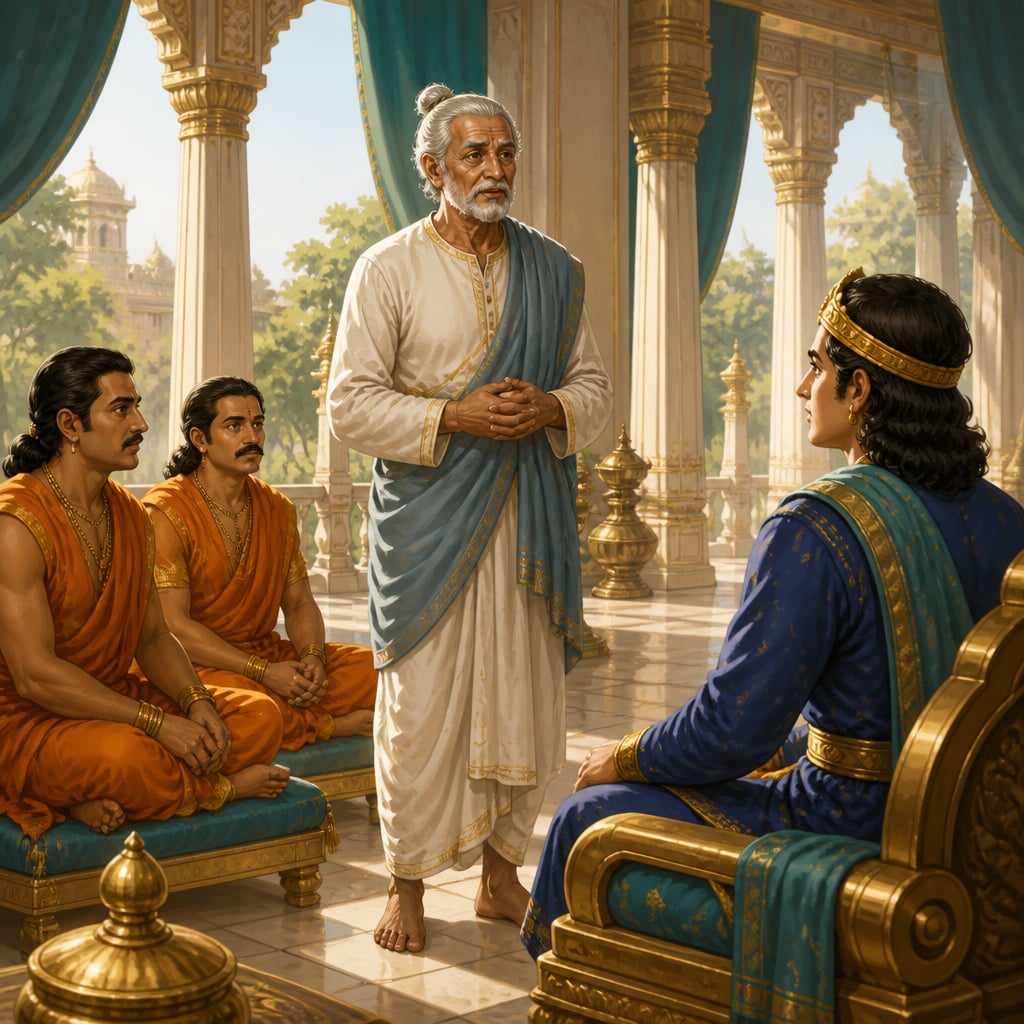
The elderly merchant Dhananjaya before Chandragupta's court

Dhananjaya was seventy years old when he walked into Chandragupta's court. He had traded silk along the northern routes for fifty years. Now bandits had robbed his entire caravan.

"The king's roads," he said, voice steady despite his loss, "are the arteries of the kingdom. When they're safe, wealth flows. When they're dangerous, the kingdom bleeds."

Kautilya had been skeptical of merchants, viewing them as motivated by greed. But Dhananjaya's next words caught his attention.

"Maharaj, I've paid taxes for fifty years. I've employed hundreds of porters. I've brought goods from distant lands that enriched everyone who touched them. I don't ask for charity. I ask: if the state cannot protect commerce, what does it exist for?"

Kautilya ordered the border patrols tripled that week. More importantly, he began writing his chapters on varta, understanding that the merchant wasn't just tolerated; they were essential.

Varta: The Foundation of Everything

The term varta encompasses all productive economic activity, agriculture, animal husbandry, and trade. But trade (vanijya) multiplies the value of the other two.

The farmer grows grain but cannot eat grain alone. The cowherd raises cattle but needs cloth. The craftsman makes tools but needs food. Trade connects them all, enabling specialization that increases total wealth.

Kautilya understood what economists call "gains from trade", that voluntary exchange creates value for both parties:

Everyone is better off. This isn't zero-sum plunder, it's positive-sum creation.

The State's Role: Enable, Don't Obstruct

Build Infrastructure

"Acharya," Chandragupta once asked, "why should the treasury pay for roads that merchants use?"

Kautilya smiled. "Because merchants who can move goods safely will move more goods. More movement means more economic activity. More activity means more tax revenue. Roads are not expense, they are investment."

A Mauryan state trade road with a merchant caravan at sunrise

The Arthashastra prescribes:

Secure Trade Routes

A merchant carrying valuable goods is a target. Unsafe roads mean merchants either won't travel or raise prices to cover risk. Either way, commerce suffers.

Kautilya's prescription is striking: if a merchant is robbed on a state road, the state pays compensation. This creates powerful incentives for effective security, the cost of failure comes directly from the treasury.

Establish Honest Markets

"The king should establish standard weights and measures for buying and selling commodities."

Organized markets with clear rules reduce transaction costs. When buyers trust the weights and sellers trust payment, trade increases. Without trust, every transaction becomes a battle.

The Merchant's Obligations

Kautilya's support for commerce comes with expectations:

Honest Dealing: Fraud destroys trust, and trust makes markets work. The cheating merchant harms all commerce by eroding confidence.

Fair Prices: Profit is legitimate, but exploiting emergencies crosses a line. Regulation is permitted when merchants take advantage of crises.

Tax Payment: Revenue supporting infrastructure comes from taxes. Evasion is theft from the system that enables commerce.

Quality Goods: Selling defective products as sound defrauds customers and damages the market's reputation.

The theme: reciprocal obligation. The state provides infrastructure and protection; merchants provide honest commerce and tax revenue.

The Merchant Guilds (Shreni)

A merchant guild assembly in the shreni hall

Kautilya recognized merchant guilds as important institutions:

The Arthashastra grants guilds autonomy while reserving state authority to prevent abuse. Self-regulation by informed practitioners can be more effective than external bureaucracy, but needs oversight to prevent manipulation.

Trade Creates Employment

Kautilya understood commerce creates jobs beyond merchants themselves:

A thriving trade sector multiplies economic activity throughout the kingdom. The farmer has markets for surplus. The craftsman has customers. The laborer has employment. The king has tax revenue.

The Merchant as Intelligence Source

A subtle but important point: merchants traveling widely gather valuable intelligence:

"A wise king doesn't just tax merchants," Kautilya told Chandragupta. "He consults them. The merchant who travels to distant lands knows things the court-bound official doesn't."

The Deeper Principle

Behind all specific policies lies a fundamental insight: prosperity comes from creation, not extraction.

The ruler who sees the economy as a fixed pie will implement different policies than one who sees it as potential to be developed. Kautilya belongs firmly in the second camp.

Trade creates wealth because it:

The merchant isn't extracting, they're facilitating creation. The state that supports this process multiplies its own power. The state that obstructs it impoverishes everyone, including itself.

The Role of Trust

Notice how much of Kautilya's commercial policy aims at building trust:

Commerce runs on trust more than law. But by punishing fraud severely and maintaining standards publicly, the state creates an environment where trust develops.

Once trust exists, commerce explodes. People trade with strangers, extend credit, make long-term investments. The kingdom that builds trust becomes wealthy. The kingdom that destroys it through arbitrary confiscation and corrupt officials remains poor regardless of natural resources.

Focus on growing the total pie rather than fighting over slices

Adam Smith's 'Wealth of Nations' makes similar arguments about productive activity creating national wealth

Kautilya integrates this insight with practical policy - infrastructure investment, trade protection, and merchant support all follow from this principle

The East Asian economic miracles (Japan, Korea, Singapore) succeeded by enabling production and trade, not by extracting from fixed resources

Public goods that enable private activity multiply overall value

Keynesian economics and modern development theory both emphasize infrastructure's role in growth

Verses

वार्ता कृषिगोरक्षवाणिज्या

vārtā kṛṣi-gorakṣa-vāṇijyā

Economic activity consists of agriculture, cattle-keeping, and trade.

Kautilya identifies the three fundamental sectors of the economy. Agriculture produces food and raw materials.

Book 2, Chapter 16, Verse 1 (R.P. Kangle)

पण्यक्रयविक्रये तुलामानप्रमाणानि च राजा संस्थापयेत्

paṇya-kraya-vikraye tulā-māna-pramāṇāni ca rājā saṃsthāpayet

The king should establish standard weights and measures for buying and selling commodities.

Honest commerce requires trust, and trust requires reliable standards. When weights and measures vary, every transaction becomes a negotiation over measurement itself.

Book 2, Chapter 28, Verse 9 (R. Shamasastry)

वणिजः स्वयोग्याभ्यागमेन लाभः

vaṇijaḥ sva-yogyā-bhyāgamena lābhaḥ

The merchant's profit comes from their own appropriate effort.

This sutra legitimizes commercial profit - but only when earned through genuine effort. The merchant who transports goods, assumes risk, stores inventory, and provides access to buyers deserves profit.

Book 4, Chapter 2, Verse 31 (L.N. Rangarajan)

Case studies

Singapore's Trade-Dependent Prosperity

Singapore has almost no natural resources, limited land, and no agricultural hinterland. Yet it became one of the world's wealthiest nations. How? By positioning itself as a trade hub - investing massively in port infrastructure, maintaining rule of law, keeping corruption low, and making it easy to do business.

Singapore exemplifies Kautilya's principles: infrastructure investment (world-class port), security (low crime, contract enforcement), honest markets (low corruption, reliable standards), and protection of merchants (easy business formation, fair treatment of foreigners). The state enables commerce rather than controlling it.

Singapore's GDP per capita exceeds that of most resource-rich nations. Trade volume vastly exceeds its domestic economy. The port handles more cargo than countries hundreds of times larger. The value of facilitating exchange exceeded any value from direct production.

Prosperity comes from creating conditions for commerce, not from natural resource endowment. The state that makes trade safe, efficient, and honest can thrive regardless of what's in the ground. Kautilya knew this 2,300 years before Singapore proved it.

Dubai and Hong Kong built their prosperity on exactly this model. Neither has significant natural resources, but both invested in world-class infrastructure, rule of law, and ease of doing business. In the digital era, countries competing to attract tech companies and remote workers are applying the same principle: make commerce easy and safe, and prosperity follows.

Singapore's port handles over 37 million TEUs (twenty-foot equivalent units) of container traffic annually, making it the world's second-busiest port. Trade volume in 2023 exceeded 300% of GDP, one of the highest ratios globally for any sovereign nation.

Historical context

c. 4th century BCE

The Mauryan period saw unprecedented trade integration. The empire's roads connected the northwest frontier with the Ganges plain and beyond. Maritime trade from western ports reached the Red Sea and Egypt. Internal markets flourished under standardized weights and secure conditions.

Kautilya wrote during the creation of India's first large empire. The integration of diverse regions into a functioning economic unit required sophisticated commercial policy. His prescriptions weren't theoretical - they were tested in managing an economy spanning from Afghanistan to Bengal.

Living traditions

Reflection

More in Economics and Taxation

All lessons in Economics and Taxation · Arthashastra: Science of Governance course