Sources of Revenue

Types of Taxes

How governments fund themselves - Kautilya's comprehensive taxonomy of revenue sources.

The Treasurer's Seven Lists
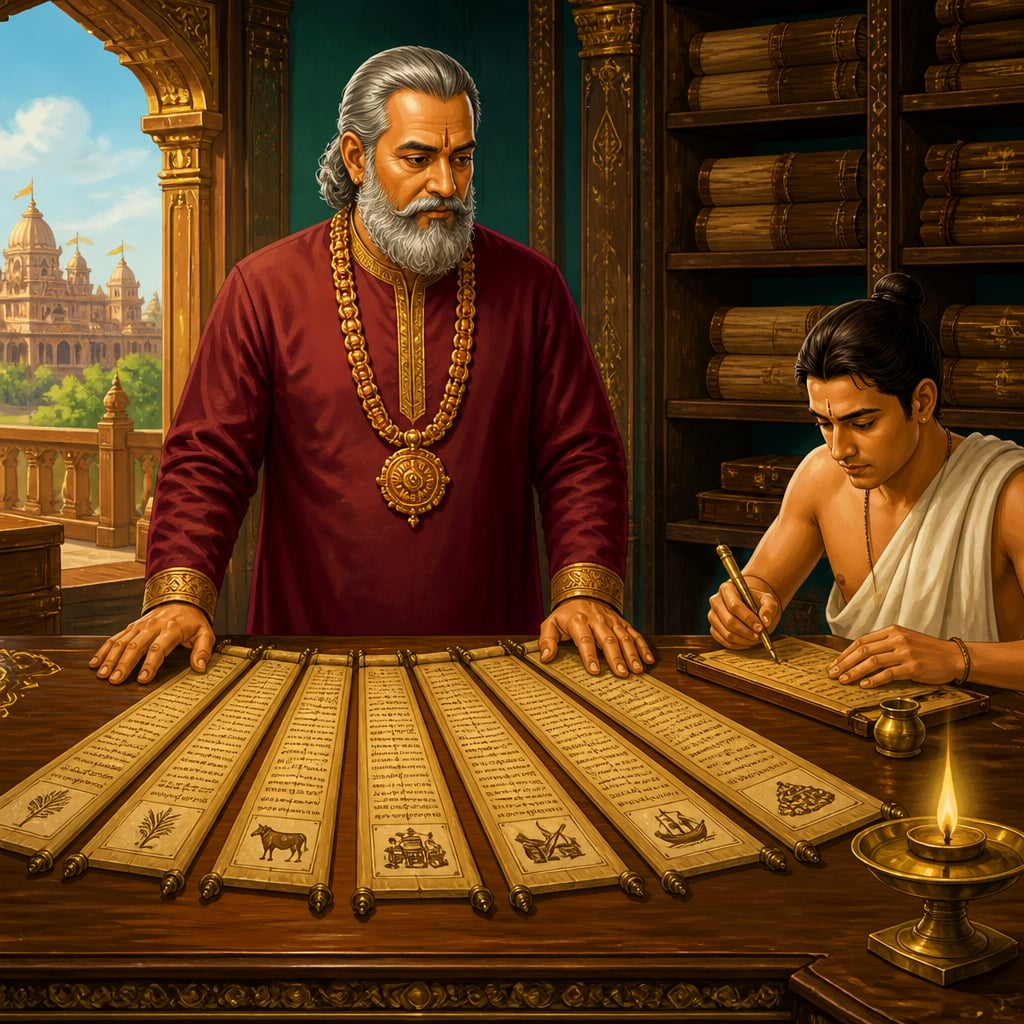
Sannidhata with seven revenue scrolls in the Pataliputra treasury

Sannidhata, the royal treasurer, spread seven scrolls across the table in the Pataliputra treasury. Each contained a different category of revenue. Kautilya examined them methodically while young Chandragupta watched.

"Why so many lists?" the young king asked.

"Because," Kautilya replied without looking up, "a treasury that depends on a single stream dies when that stream dries up. Seven streams mean seven forms of resilience."

"The king should establish revenue collection according to the nature of the source."

The Seven Major Categories

Kautilya's genius was systematic classification. He identified seven primary revenue sources:

1. Bhaga - Agricultural Share
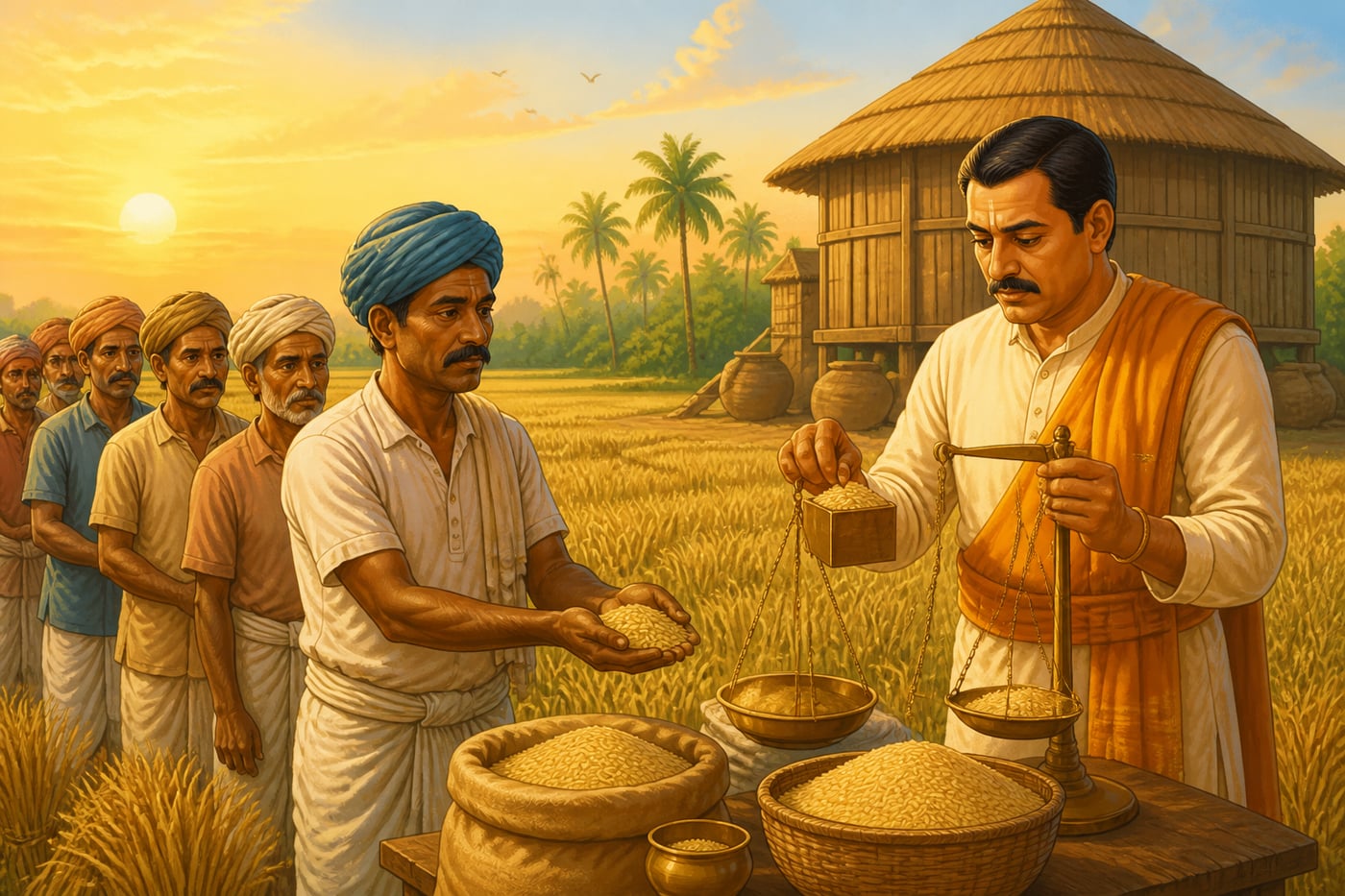
A Mauryan tax assessor weighing grain at a harvested field

The king's share of agricultural production - typically one-sixth of the harvest. This was proportional, not fixed. In bad years, collections fell automatically, protecting farmers.

2. Shulka - Trade Taxes
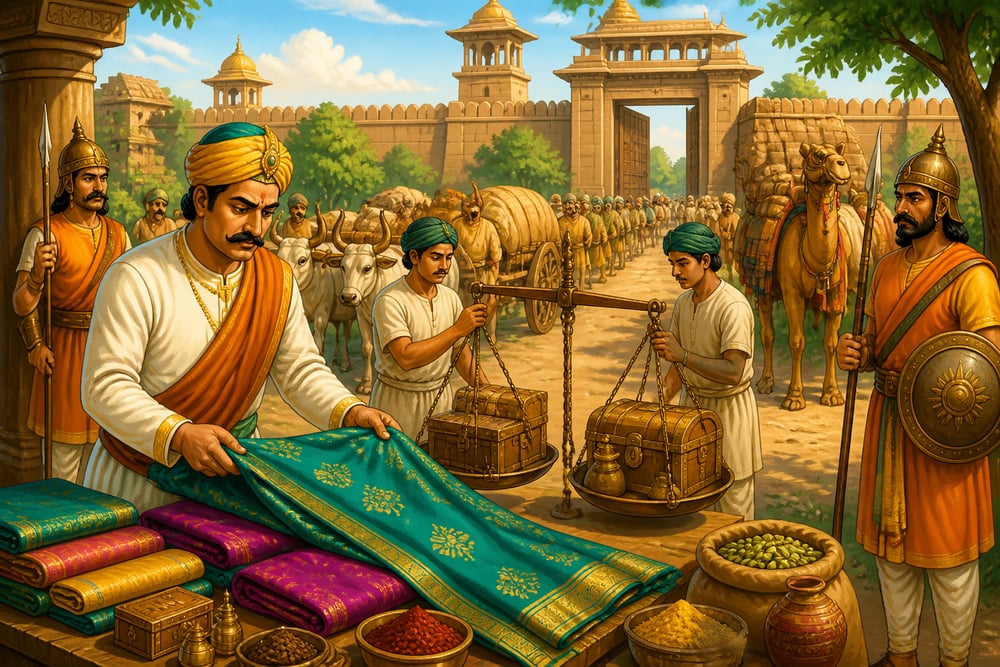
A Mauryan customs post inspecting caravan goods at a town gate

Customs and trade duties on goods entering markets or crossing borders. Usually 5% of value - low enough to not kill trade, high enough to generate substantial revenue from volume.

3. Vyaji - Interest from State Loans

The state as lender, providing capital to merchants and farmers. Interest on these loans became revenue while stimulating economic activity.

4. Vivita - Monopoly Revenue

State-operated industries: salt, mining, forestry, armaments. Direct revenue from selling products rather than taxing others.

5. Dandha - Fines and Penalties

Revenue from judicial fines and penalties. Secondary to justice itself - Kautilya warned against making fines a revenue target.

6. Prakrita - Crown Lands

Revenue from agricultural land directly owned by the crown, either farmed by state workers or leased to tenants.

7. Kara - Specific Activity Taxes

Targeted taxes on particular occupations, professions, or transactions - taxes on merchants, artisans, entertainers.

Why Diversification Matters

Kautilya understood portfolio theory twenty-three centuries before modern finance:

"The wise king establishes multiple streams feeding the treasury, so that drought in one channel does not dry the reservoir."

If agriculture fails, trade taxes continue. If trade slows, state monopolies persist. If the economy struggles, crown lands still produce.

Modern parallel: Countries dependent on oil revenue face "Dutch Disease" - windfall from one source destroys others, leaving them vulnerable when prices crash.

Matching Method to Source

Each revenue type requires different treatment:

Agricultural taxes need officials who understand harvest timing. Collect after crops mature, when farmers can pay.

Trade taxes need customs posts with officials who can value goods and detect fraud.

State enterprises need skilled superintendents who understand each industry.

Fines need honest courts that don't manufacture violations for revenue.

Trying to collect agricultural taxes like trade duties fails. Understanding the nature of each source enables effective collection.

The Danger of Over-Reliance

The Nandas who preceded Chandragupta had relied heavily on direct taxation of farmers. When harvests failed, revenue collapsed. When farmers couldn't pay, the Nandas squeezed harder, destroying their own base.

Kautilya's diversified system avoided this trap. Multiple moderate extractions from multiple sources yielded more sustainable revenue than heavy extraction from few sources.

Collection Infrastructure

Revenue doesn't collect itself. Each source requires investment:

For Bhaga: Officials who assess harvests, granaries for storage, systems to convert grain to currency.

For Shulka: Customs posts, trained assessors, anti-smuggling measures.

For Vivita: Skilled superintendents, workers, distribution systems.

For Vyaji: Lending officers, documentation systems, collection mechanisms.

The administrative investment must yield return. Revenue systems cost money to operate - the revenue generated must exceed the cost.

Transparency and Legitimacy

People pay taxes more willingly when they understand what they're paying for:

When taxation seems arbitrary, resistance grows. When taxation connects to services, compliance improves.

The Integration of Sources

Different revenue streams interact:

Trade and agriculture support each other. Prosperous farms create goods for trade; trade brings tools for farming. Both generate revenue.

State loans multiply all sources. Well-deployed loans increase economic activity, which increases all forms of tax revenue.

Infrastructure investment expands the base. Roads increase trade; irrigation increases agriculture; both increase revenue.

The total system is more than the sum of parts. Each stream reinforces others.

A kingdom with seven healthy streams flows with gold. A kingdom with one dammed stream runs dry.

Portfolio diversification - spreading risk across multiple income sources.

Modern portfolio theory recommends diversification to reduce risk. Kautilya applied this to government revenue.

Kautilya's specific taxonomy identifies how to diversify - seven distinct categories with different characteristics and risk profiles.

Oil-dependent countries face crisis when prices crash. The Nandas collapsed when agricultural revenue failed. Diversification prevents such disasters.

Contextual management - adapting approach to the nature of what you're managing.

Contingency theory in management: there's no one best way; the right approach depends on the situation.

Verses

षड्भागो वा अष्टभागो वा राजभागः स्यात्

ṣaḍbhāgo vā aṣṭabhāgo vā rājabhāgaḥ syāt

The king's share should be one-sixth or one-eighth of agricultural produce.

Agricultural tax is proportional, not fixed. The rate varies with circumstances.

Book 2, Chapter 6, Verse 1-3 (R.P. Kangle)

शुल्कं स्थानान्तरात् आगतानां द्रव्याणां पञ्चविंशतितमं भागं गृह्णीयात्

śulkaṃ sthānāntarāt āgatānāṃ dravyāṇāṃ pañcaviṃśatitamaṃ bhāgaṃ gṛhṇīyāt

Collect customs duty of one-twentieth the value of goods arriving from other places.

Trade taxes are moderate - 5% of value. Low enough not to prevent trade, high enough to generate substantial revenue from volume.

Book 2, Chapter 21, Verse 1-2 (R. Shamasastry)

व्यवहारतो दण्डः च

vyavahārato daṇḍaḥ ca

And fines from judicial proceedings.

Fines are legitimate revenue but must remain secondary to justice. When fines become revenue targets, authorities manufacture violations.

Book 2, Chapter 8, Verse 18-20 (L.N. Rangarajan)

Case studies

The Dutch Disease

In the 1960s, the Netherlands discovered massive natural gas reserves. Revenue flooded the treasury. However, this caused the guilder to appreciate, making other exports uncompetitive. Manufacturing declined. The economy became dependent on gas. When prices fell, the economy struggled.

The Netherlands violated Kautilya's diversification principle. Over-reliance on one source (natural resource extraction) created fragility. When that source faltered, total revenue crashed. Kautilya would have advised maintaining diverse streams so problems in one don't threaten the whole.

'Dutch Disease' now describes economic problems from resource windfalls. Many oil-dependent countries experienced similar patterns - initial wealth followed by distortion and crisis.

Revenue diversification creates resilience. A state with diverse sources survives disruption better than one dependent on a single source, even if that source is temporarily productive.

Many Middle Eastern oil states have recognized this risk. Saudi Arabia's Vision 2030 and the UAE's diversification into tourism, finance, and technology are direct responses to the Dutch Disease pattern. Countries that begin diversifying before their primary resource declines fare dramatically better than those that wait.

The Groningen natural gas field, discovered in 1959, contained an estimated 2,800 billion cubic meters of gas. Dutch manufacturing employment dropped by 16% between 1970 and 1977 as the guilder appreciated, coining the term 'Dutch Disease' in 1977.

Historical context

c. 4th century BCE

Previous kingdoms collected taxes but lacked systematic classification. Kautilya's innovation was identifying distinct types with different characteristics, enabling rational planning.

Revenue classification seems mundane until you realize it's foundational. You cannot optimize what you haven't categorized. Kautilya's taxonomy enabled Mauryan administrative sophistication.

Living traditions

Reflection

More in Economics and Taxation

All lessons in Economics and Taxation · Arthashastra: Science of Governance course