The Gardener vs the Farmer

Sustainable Taxation

Tax like a gardener picking flowers, not a farmer uprooting plants. Kautilya's famous metaphor for sustainable taxation.

The Metaphor That Changed Everything

Rajadhyaksha, the elderly chief revenue officer, had just proposed doubling taxes on merchants to fund the new military campaign. Chandragupta seemed inclined to agree, the treasury needed filling.
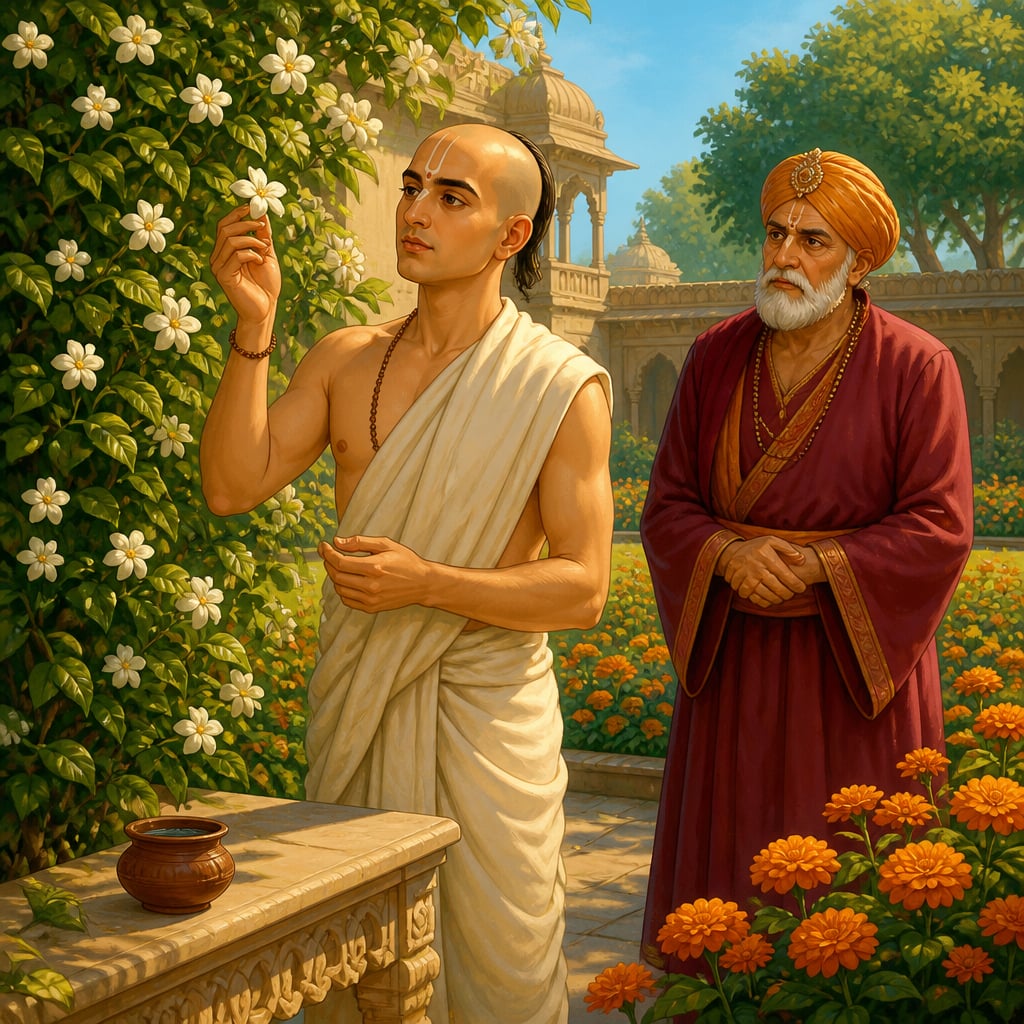
Kautilya picking a flower in the palace garden while teaching Rajadhyaksha

Kautilya walked to the palace garden without a word. He knelt beside a jasmine bush and carefully picked three blooms, leaving dozens more to continue growing.

"Do you see what I did?" he asked when the others followed him outside.

"You picked flowers," Rajadhyaksha said impatiently.

"And tomorrow there will be more. But watch, " Kautilya grabbed the entire bush and yanked it from the soil, roots dangling. "This is what you propose. Maximum flowers today. Zero flowers forever."

The acharya's eyes held cold fire. "The king should collect taxes as a gardener picks flowers, not as a charcoal-maker cuts down trees."

Two Methods of Extraction

The Gardener's Way

A gardener moves through his garden daily, picking blooms that have opened. He takes some from each plant but never strips any bare. Tomorrow brings fresh flowers. His income is modest on any given day, but it continues indefinitely. The garden grows more productive as plants mature.

The Charcoal-Maker's Way
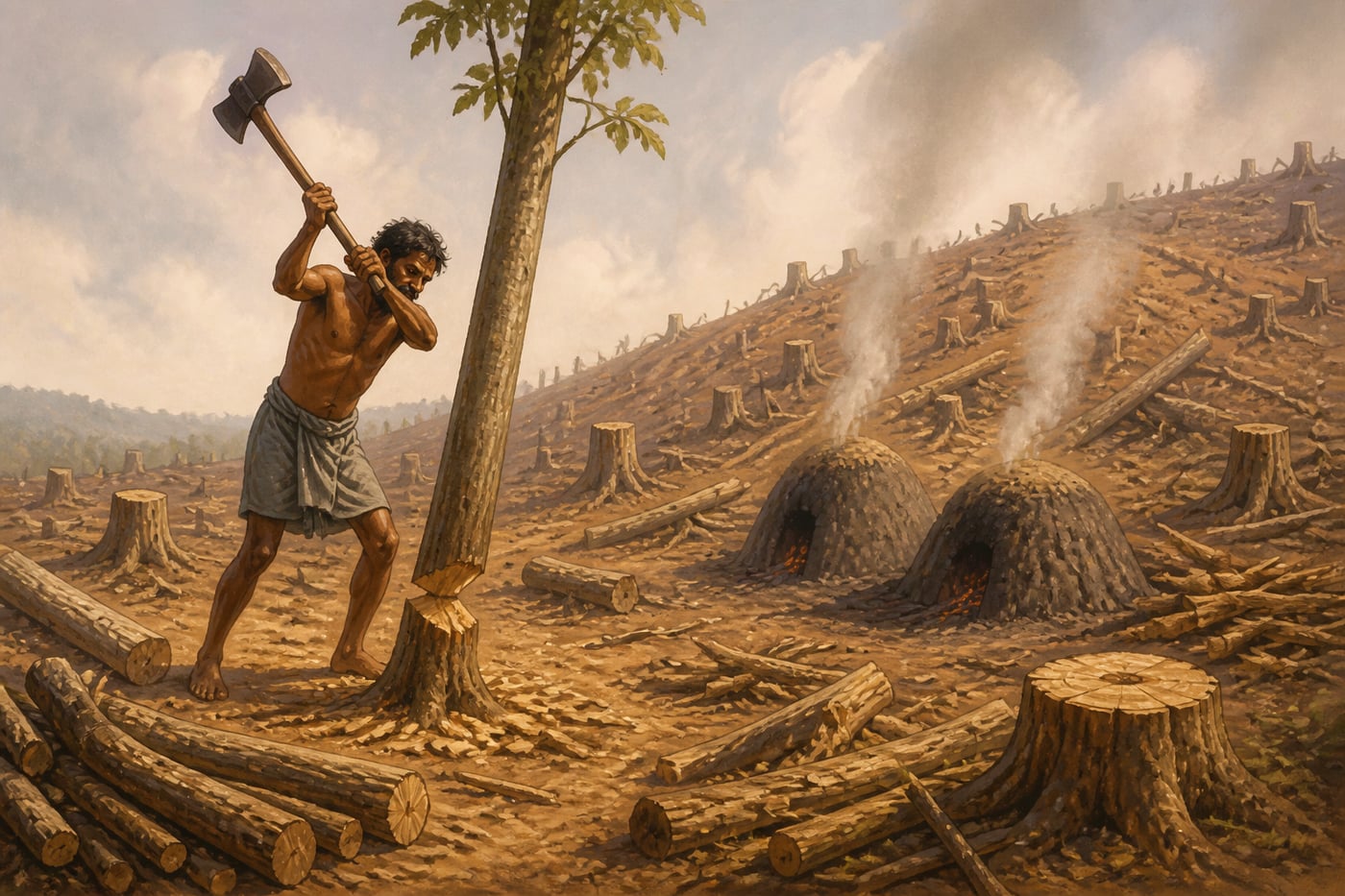
A charcoal-maker felling trees in a barren clearing

A charcoal-maker cuts trees entirely, converts them to fuel, and sells it. Today's income is substantial, a whole tree at once. But tomorrow he must find another tree. Eventually the forest disappears. Maximum extraction now means zero extraction forever.

The Taxation Parallel

When a king taxes subjects, he faces the same choice:

  1. Take moderate amounts regularly, leaving citizens enough to grow their businesses
  2. Extract everything now, destroying productive capacity

The second approach yields larger revenues this year and poverty thereafter. The first yields modest revenues forever.

The Economics of the Golden Goose

Aesop told a parallel story: a man owned a goose laying golden eggs. Wanting all the gold at once, he killed the goose, only to find nothing inside. By seeking immediate wealth, he destroyed ongoing wealth.

Kautilya understood deeply: productive capacity exceeds any single extraction from it.

A merchant earning 100 gold yearly, taxed at 16%, provides 16 gold annually forever. Tax him into bankruptcy, extract 50 gold once, then receive zero afterward. Sustainable taxation's present value vastly exceeds extractive taxation.

The Laffer Curve Before Laffer

Modern economics calls this the Laffer Curve, tax revenue is zero at both 0% (nothing collected) and 100% (no economic activity). The optimal rate lies between.

Kautilya understood this two millennia before Arthur Laffer drew his curve:

Kautilya recommended 16-17% for most taxes, enough for the state, low enough for economic vitality.

Why Rulers Choose Destruction

"But Acharya," young Megasthenes asked one evening, "if the gardener's approach is clearly superior, why do so many rulers behave like charcoal-makers?"

Kautilya stirred his evening tea thoughtfully. "Time horizon, Greek friend. If you'll only rule briefly, due to instability, illness, or expected overthrow, maximizing extraction now makes perverse sense. You won't face the consequences."

"So stable governance produces better economic policy?"

"Precisely. A king expecting his dynasty to rule for generations thinks like a gardener. A usurper expecting overthrow in five years thinks like a charcoal-maker." He smiled grimly. "This is why we build stable institutions. When the king identifies with his kingdom's future, not just his personal lifespan, sustainable policies become natural."

Practical Implementation

How does the gardener principle translate to specific policies?

Preserve Productive Capital: Never tax so heavily that people must sell tools of their trade. A farmer selling his plow, a merchant liquidating inventory, these convert productive capacity into one-time revenue.

Maintain Incentives: If hard work and laziness face identical outcomes after taxation, why work hard? Let people keep enough to make effort worthwhile.

Follow Economic Rhythms: Tax farmers after harvest when they have grain, not before when they've invested in seed. Tax merchants after profitable trades. Time collection to cash flow.

Distribute the Burden: Don't strip one sector completely. Spread taxes across many sources. If one industry struggles, reduce its burden temporarily.

Invest in Productivity: A good gardener waters plants, adds fertilizer, removes pests. Use tax revenue to increase future productive capacity, infrastructure, security, justice. The kingdom should become more productive over time.

When Emergency Demands Extraction

Kautilya was realistic. Sometimes circumstances force difficult choices. Existential threats, invasion, famine, epidemic, may require heavy taxation.

But he insisted this be recognized for what it is: depleting capital to survive crisis. Like a gardener cutting trees for winter firewood, knowing he's reducing future blooms.

The king should:

  1. Acknowledge he's sacrificing future revenue for current survival
  2. Take only what crisis requires, not what greed desires
  3. Reduce taxation after crisis to allow recovery

Emergency extraction should be rare, temporary, followed by restoration. Using crisis as pretext for permanent over-taxation is the charcoal-maker disguised as gardener.

The Convergence of Interest and Righteousness

Even a purely selfish king should tax sustainably:

But beyond self-interest lies moral duty. The king's authority rests on dharma, righteous rule. Taxation that impoverishes subjects breaks the dharmic contract.

A prosperous Mauryan village at harvest dusk with full granaries

Sustainable taxation isn't just smart economics. It's the moral foundation of legitimate rule.

Sustainable extraction values perpetual flows over one-time stock depletion

Modern finance distinguishes between income (flows) and principal (stocks) - never deplete principal for current consumption

The gardener metaphor makes an abstract financial principle viscerally concrete - anyone can understand flowers regrowing versus trees cut down

Norway's oil fund (gardener) vs. Venezuela's consumption (charcoal-maker) - identical resources, opposite outcomes

Longer time horizons naturally produce more sustainable decisions

Warren Buffett's 'investing in businesses you'd be happy to hold for 10 years' reflects the same time-horizon wisdom

Verses

कुसुमादिव माली राजा प्रजासु वर्तेत न चैककृत्वः

kusumād iva mālī rājā prajāsu varteta na ca ekaḳṛtvaḥ

The king should conduct himself toward his subjects like a gardener with flowers, not taking everything at once.

This is Kautilya's most famous economic metaphor. A gardener picks some flowers from each plant, allowing continued blooming.

Book 2, Chapter 1, Verse 38 (R.P. Kangle)

प्रजानां भरणपोषणरक्षणं राज्ञः परमं धर्मम्

prajānāṃ bharaṇa-poṣaṇa-rakṣaṇaṃ rājñaḥ paramaṃ dharmam

Supporting, nourishing, and protecting the subjects is the king's highest duty.

The king's fundamental obligation is to enable his subjects to flourish. This frames taxation morally - revenue must serve the king's duty to protect and enable prosperity, not merely extract wealth.

Book 5, Chapter 2, Verse 41 (R. Shamasastry)

अनिवेशितं निवेशयेत् निवेशितं वर्धयेत्

aniveśitaṃ niveśayet niveśitaṃ vardhayet

The king should develop areas that are unsettled and enhance areas already developed.

A true gardener doesn't just pick flowers - he cultivates the garden to increase productivity. Similarly, a wise king doesn't just collect taxes; he invests in expanding the economic base.

Book 2, Chapter 9, Verse 7 (L.N. Rangarajan)

Case studies

Norway's Oil Fund vs. Nigeria's Oil Curse

Both Norway and Nigeria discovered massive oil reserves in the 1970s. Norway created a sovereign wealth fund, investing oil revenues for future generations while maintaining moderate government spending. Nigeria consumed oil revenues immediately through government spending, with little long-term investment. Fifty years later, Norway has one of the world's largest sovereign wealth funds and high living standards. Nigeria remains poor despite having earned more total oil revenue than Norway.

Norway acted as the gardener - treating oil as a flower to be picked sustainably, with most revenue invested for future productivity. Nigeria acted as the charcoal-maker - maximizing immediate consumption of a finite resource. Norway extended its time horizon across generations; Nigeria focused on immediate needs. The result: Norway created perpetual wealth from temporary oil; Nigeria consumed everything and faces poverty when oil runs out.

As of 2025, Norway's Government Pension Fund Global holds over $1.7 trillion - nearly $300,000 per Norwegian citizen. The fund can sustain government spending perpetually from investment returns alone. Nigeria has little savings, crumbling infrastructure, and faces economic crisis as oil reserves deplete. The gardener created sustainability; the charcoal-maker created temporary wealth followed by poverty.

Even identical resource windfalls produce opposite outcomes depending on whether you think like a gardener or charcoal-maker. The difference isn't resources - it's time horizon and discipline. Immediate consumption maximizes current utility at the cost of future possibilities. Investment and sustainability sacrifice current consumption for perpetual abundance. The present value of perpetual moderate returns vastly exceeds any amount of immediate consumption.

This comparison is directly relevant to resource-rich developing nations today. Countries like Botswana (diamonds) and Chile (copper) that created sovereign wealth funds and invested revenues for future generations have followed Norway's gardener model. Those that consumed windfalls immediately, like Libya and Iraq, followed Nigeria's charcoal-maker path.

Norway's Government Pension Fund Global held over $1.7 trillion by 2025, roughly $300,000 per citizen. Nigeria, which earned over $600 billion in oil revenue between 1960 and 2020, saw its poverty rate rise to 40% of its 220 million population.

Historical context

c. 4th century BCE

Ancient India had seen kingdoms rise and fall partially based on taxation policy. The Nanda dynasty Chandragupta overthrew was reportedly unpopular due to heavy taxation. Kautilya explicitly designed a sustainable alternative that would make Mauryan rule legitimate and durable.

The gardener vs. charcoal-maker distinction became foundational to Indian political economy. It was cited by rulers across centuries as the standard for just taxation. The metaphor's power lies in making an abstract principle concrete - anyone can understand the difference between picking flowers and cutting down trees.

Living traditions

Reflection

More in Economics and Taxation

All lessons in Economics and Taxation · Arthashastra: Science of Governance course