The Treasury
Kosa - Root of All State Power
Without money, the state can do nothing. Understanding the central role of the treasury in governance.
The Empty War Chest
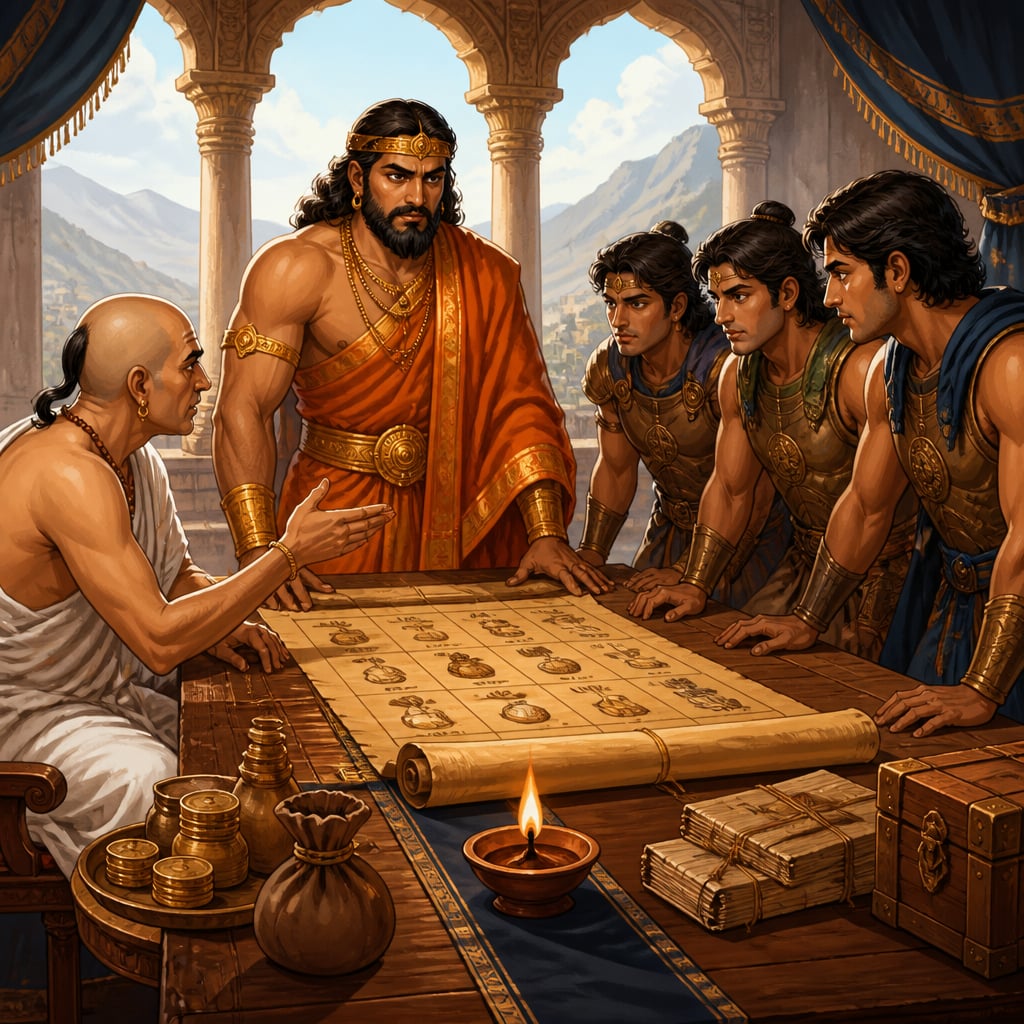
Chandragupta stood before the war council in Taxila. Maps covered the table. Battle plans had been debated. The moment had come to march against the Nanda dynasty.
"How many soldiers can we field?" asked an eager young commander.
Kautilya answered instead. "How many can we pay?"
Silence fell. Enthusiasm was cheap. Armies were not.
"Before we discuss strategy," Kautilya continued, "we must discuss gold. Soldiers who are not paid become bandits - or defectors. Weapons that are not purchased remain in enemy hands. Alliances that cannot be funded remain words."
"Kośa-mūlau vinaya-vyavahārau" - Administration and justice are rooted in the treasury.
"Tell me about our treasury," Kautilya said. "Then tell me about our plans."
The Foundation of Everything
Kautilya's analysis is brutally pragmatic. Before ethics, welfare, or justice - before any noble purpose - he establishes a harsh reality: without wealth, nothing is possible.
The treasury (kosa) isn't just one element among many. It is the foundation upon which all other state functions depend:
- No army without salaries
- No administrators without wages
- No famine relief without reserves
- No infrastructure without investment
- No defense without funding
Kautilya compares the state to a tree. The treasury is the root. Without strong roots, even the most magnificent tree withers.
More Than a Vault
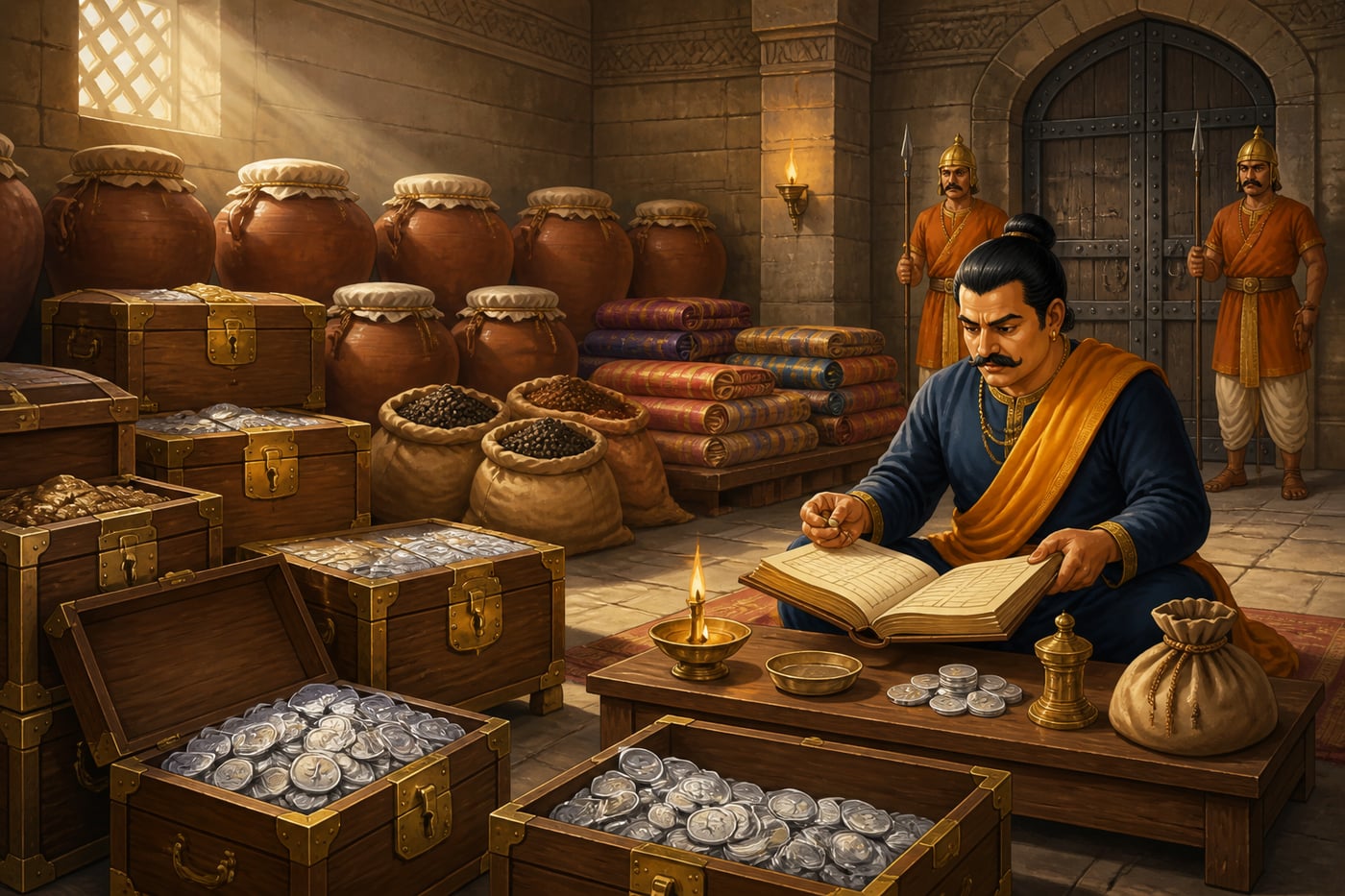
The Sanskrit term kosa encompasses:
Financial Resources: Money, precious metals, valuable goods - liquid assets deployable rapidly.
Economic Capacity: The productive base generating ongoing revenue - agriculture, trade, manufacturing.
Fiscal Management: Systems for collecting, storing, accounting, and disbursing resources efficiently.
Strategic Reserve: Surplus for emergencies, opportunities, and long-term investments.
A healthy kosa means all four dimensions working together. Gold without a productive base depletes. Productivity without collection systems wastes. Reserves without management disappear.
Why Reserves Matter
Kautilya insists that wise rulers maintain substantial reserves. Why?
Emergency Response: Famines, floods, earthquakes strike without warning. A state with reserves responds immediately. One living hand-to-mouth watches its people suffer.
Strategic Opportunities: A rival weakens. An alliance becomes possible. A critical territory comes available. These opportunities vanish quickly. The ruler with a full treasury acts. The ruler without one watches.
Deterrence: Enemies are less likely to attack a state with deep resources. A full treasury projects power without fighting.
Economic Stability: Reserves allow stabilizing markets during disruptions, preventing panic.
Kautilya recommends reserves for at least one year of complete operations with zero revenue. This seems excessive until you face a real crisis.
The Discipline of Accumulation
How does a state build healthy kosa?
Revenue Before Expenditure: Know your income, then set your budget - never the reverse. Many states collapse because they commit to spending without securing revenue.
Productive Investment: Spend money in ways that increase future revenue: irrigation that expands agriculture, roads that increase trade, forts that protect commerce.
Waste Elimination: Audit expenditures rigorously. Corruption and inefficiency drain treasuries faster than external enemies.
Economic Growth: The best way to fill the treasury is to grow the economic base. A thriving economy generates revenue almost effortlessly. Struggling economies make every rupee painful to extract.
The wise ruler focuses on expanding the pie, not just taking a bigger slice.
The Danger of Obsession
Having established kosa's centrality, Kautilya immediately warns against its misuse:
Hoarding: Wealth unused is wasted. The treasury exists for state purposes, not admiration in a vault.
Extraction: Draining people through excessive taxation kills the goose that lays golden eggs. Kautilya compares it to eating seed grain - it solves today's problem by making tomorrow impossible.
Personal Enrichment: The treasury belongs to the state, not the ruler. A king who treats kosa as personal wealth has violated his dharma.
Military Excess: Building massive armies because you can afford them, without strategic necessity, wastes resources and makes neighbors nervous.
"The king who impoverishes his people to enrich his treasury is like a man who cuts his own leg to feed his stomach."
The Nanda Lesson

The Nanda dynasty Chandragupta would overthrow demonstrated both kosa's power and its limits.
The Nandas had accumulated unprecedented wealth - the largest treasury in India. They could field 200,000 infantry and thousands of elephants.
But they had filled their kosa through oppressive taxation that alienated their population. Their full treasury couldn't save them because they had destroyed the foundation that made treasury meaningful.
Kautilya learned from this: kosa built through extraction is vulnerable. Sustainable kosa requires maintaining the productive and political base.
The Foundation, Not the House
Kautilya's emphasis must be understood properly. He isn't saying wealth is governance's purpose. He's saying it's the prerequisite.
A foundation is essential - nothing stands without it. But a foundation alone is not a house. You need walls, roof, rooms - all the other elements that make a building livable.
Similarly, kosa is essential but not sufficient. A state with a full treasury but corrupt administration, weak military, or oppressed people will still fail.
But a state without kosa will fail faster, and more completely.
The first task of governance is securing the material resources needed for all other tasks. This isn't greed - it's the realism required for serious engagement with politics.
Without money, the state can do nothing. But money is a means, not an end.
Financial discipline - matching commitments to capacity.
Startup wisdom says don't spend what you don't have. Governments that promise without funding face debt crises.
Kautilya makes this a first principle, not an afterthought. Resource assessment precedes planning.
The Nandas made commitments their treasury could fund - but destroyed the base that filled it. Chandragupta ensured his resource base remained healthy while expanding.
Modern financial advice recommends 3-6 months emergency fund. Companies maintain operating reserves. Countries hold foreign exchange reserves.
Kautilya recommends a full year - more conservative than modern practice. His experience with unpredictable crises justified extreme caution.
Verses
कोशमूलौ विनयव्यवहारौ
kośa-mūlau vinaya-vyavahārau
Administration and justice are rooted in the treasury.
Kautilya's most direct statement on wealth's centrality. You cannot maintain administration or deliver justice without financial resources.
Book 2, Chapter 8, Verse 1 (R.P. Kangle)
मूलं हि कोषदण्डयोर्जनपदः
mūlaṃ hi kośa-daṇḍayor janapadaḥ
The territory and people are indeed the root of both treasury and army.
The treasury itself has a root - the productive population. People create wealth; wealth creates state capacity.
Book 2, Chapter 8, Verse 3 (L.N. Rangarajan)
कोशमूलो विग्रहः सर्वकर्मणाम्
kośa-mūlo vigrahaḥ sarva-karmaṇām
War and all undertakings are rooted in the treasury.
Military campaigns require money - for salaries, weapons, supplies. The state with a full treasury sustains operations; the state without one must seek peace regardless of circumstances.
Book 5, Chapter 2, Verse 52 (R. Shamasastry)
Case studies
The Nanda Fall: When Full Treasury Isn't Enough
The Nanda dynasty had accumulated unprecedented wealth and could field the largest army in the subcontinent. Yet they were overthrown by Chandragupta, who started with minimal resources.
The Nandas violated a key principle: they filled kosa through extraction that alienated their population. They had enormous treasury but had destroyed the janapada (popular support). Kautilya's formula says kosa depends on janapada - they tried to maintain kosa while destroying its foundation.
Despite military superiority and vast wealth, the Nandas faced minimal resistance. Their own army was reluctant to fight; the population welcomed change. Their treasury couldn't save them because they had violated praja-sukhe sukham rajnah.
A full treasury built through extraction is vulnerable. Sustainable kosa requires maintaining the productive and political base. Short-term revenue maximization through harsh extraction is strategically foolish - it accumulates wealth while destroying capacity to defend it.
Venezuela under Chavez followed the Nanda pattern precisely. Massive oil revenues funded populist spending that initially boosted approval ratings but destroyed the productive economy. When oil prices dropped, there was nothing left. Extraction-based prosperity without maintaining productive capacity always ends the same way.
The Nanda treasury was legendary in ancient sources. Greek historians estimated the Nanda army's upkeep cost alone at the equivalent of millions of gold coins annually. Yet mass desertions meant the treasury could not convert wealth into battlefield loyalty.
Historical context
c. 4th century BCE
The Mahajanapada period saw increasing state complexity requiring sophisticated fiscal systems. The Nandas pioneered systematic revenue collection but became notorious for harsh taxation. Kautilya's principles emerged from observing both necessity and danger of wealth accumulation.
Kautilya wrote when statecraft was becoming expensive. Complex territorial states required massive resources. His treasury principles addressed how states could fund themselves sustainably.
Living traditions
- Central Bank Reserve Management: Central banks maintain foreign exchange reserves as strategic buffers, directly continuing Kautilya's emphasis on treasury accumulation for crises.
- Sustainable Fiscal Policy: Modern fiscal policy emphasizes sustainable tax bases over confiscatory taxation, applying Kautilya's gardener principle to government finance.
- Corporate Treasury Management: Corporate finance emphasizes cash reserves and working capital management, applying treasury principles to business operations.
- Reserve Bank of India Museum: Museum of Indian monetary history
- National Museum: Houses Mauryan period artifacts
- Reserve Bank of India: India's central bank embodies Kautilya's treasury principles at the national level. The RBI maintains foreign exchange reserves, manages currency stability, and serves as the government's banker - functions Kautilya prescribed for the kosha (treasury) as foundation of state power.
- North Block (Ministry of Finance): India's finance ministry manages the national treasury, continuing the Kautilyan tradition of centralized fiscal administration. Here, the annual budget is prepared, tax policy is formulated, and government expenditure is controlled - the modern kosha-adhyaksha function.
Reflection
- Think of projects or organizations that failed. How many failed because they ran out of resources rather than because their idea was wrong?
- Is Kautilya's emphasis on treasury cynical materialism or necessary realism? Can high ideals be achieved without resources?
- In your personal life or work, how strong is your 'kosa'? Do you maintain reserves? Commit before securing resources? Invest in growing your base?