Economic Freedom
Markets and State
The proper relationship between free markets and government regulation. Ancient wisdom for modern debates.
The Debate That Never Ends
They had been arguing for three hours. Brihadratha, the chief minister, wanted the state to control all grain trade, set prices, manage distribution, ensure no hoarding. Pushyamitra, the head of the merchant guild, demanded complete freedom, let markets work, let supply find demand, let traders prosper.
Kautilya had listened in silence. Now he spoke.
"You are both wrong. And you are both right."
Brihadratha sputtered. "Acharya, that's impossible, "
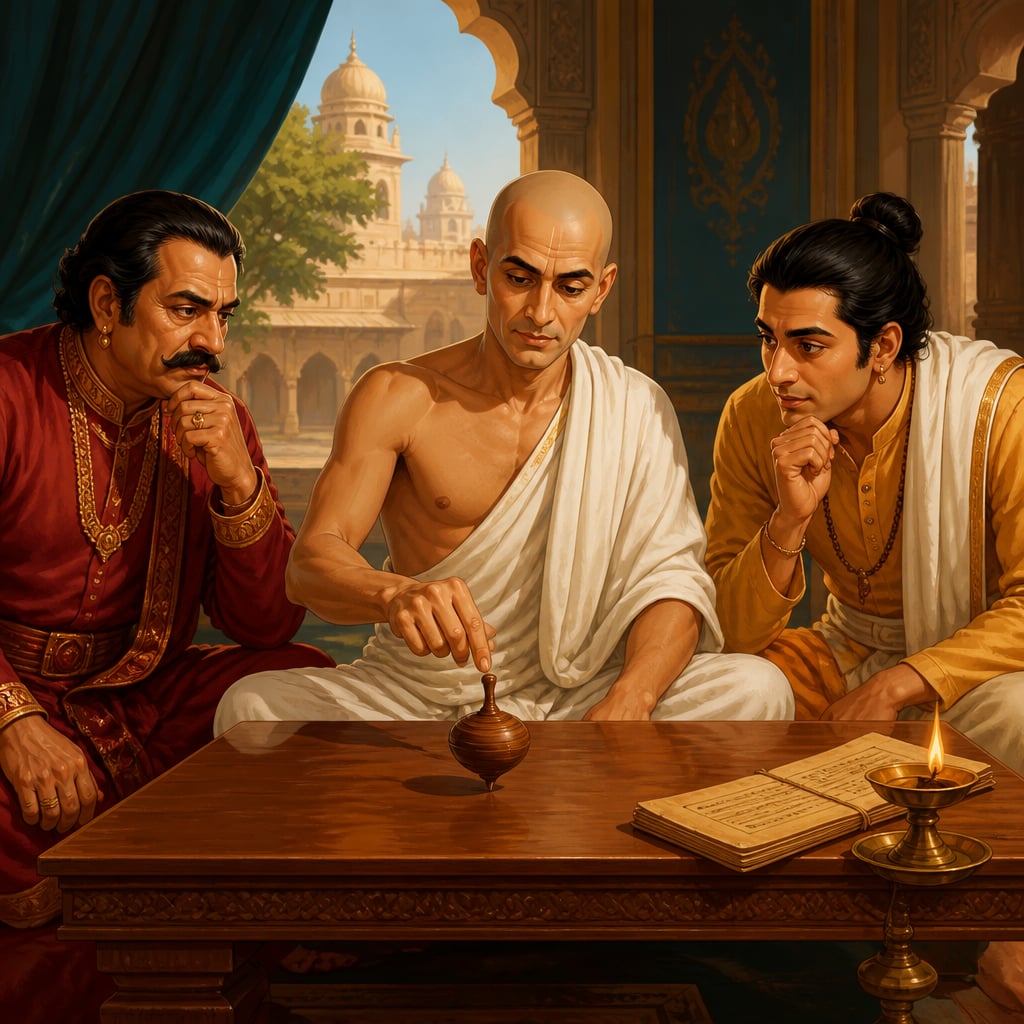
"Watch." Kautilya took a wooden top and spun it on the table. "What keeps it upright?"
"Balance," Pushyamitra said.
"Precisely. A top spinning left falls. One spinning right falls. Only balance keeps it upright." He stopped the top. "Markets without order become chaotic. Order without markets becomes stagnant. Prosperity requires both."
He looked at each man in turn. "The question is never 'markets or state.' The question is: when does each serve prosperity best?"
The Libertarian Elements in Kautilya
Modern readers are often surprised by how much economic freedom Kautilya endorsed:
Private Property Rights: The state couldn't arbitrarily confiscate assets. Property rights were enforceable in courts.
Freedom of Occupation: People were largely free to choose professions. A merchant could become a farmer, a farmer could take up craft production.
Market Pricing: For most goods, prices were set by supply and demand, not government decree.
Entrepreneurial Incentives: Tax holidays for new businesses, subsidies for opening mines, rewards for bringing wasteland under cultivation.
Minimal Regulation for Small Business: Small traders faced minimal government interference. They could sell their goods where they wished, at prices they negotiated.
These weren't accidental. Kautilya understood that prosperity came from productive activity, and productive activity flourished when people were free to pursue their economic interests.
When Markets Need Oversight
But Kautilya was no anarchist. He identified specific situations where unfettered markets produced bad outcomes:
Natural Monopolies: Mines, forests, certain manufacturing operations inherently tended toward monopoly. Unregulated monopolists would extract excessive profits while providing poor service. Solution: State ownership or heavy regulation.
Essential Goods: Basic necessities, grain, oil, salt, couldn't be left entirely to market forces. During scarcity, merchants would hoard and price-gouge. Solution: State grain reserves to stabilize prices. Price ceilings during emergencies. Penalties for hoarding. But notably, these interventions were temporary.
Market Power and Exploitation: Merchants might collude to fix prices. Moneylenders might charge usurious rates. Solution: Regulate interest rates. Prohibit price-fixing. Mandate fair weights. Target abuses, not normal commerce.
Information Asymmetries: Buyers often couldn't assess quality. Was the gold pure? Was the medicine effective? Solution: State inspection and certification. Penalties for adulteration and fraud.
Strategic Industries: Weapon manufacturing, ship-building, mining of strategic minerals, these couldn't be left to market forces that might align with enemies. Solution: Direct state control.
The Principle: Function Determines Form
What united Kautilya's approach? A simple principle: the form of economic organization should follow the function it serves.
- Activities that markets handle well should be left to markets
- Activities that markets handle poorly require state involvement
- The degree of involvement should match the degree of market failure
This is neither socialism nor capitalism as ideology. It's pragmatism as method.

Consider his approach to agriculture:
Private farmers cultivated most land. They decided what to grow, how to grow it, where to sell it.
But the state built irrigation works that individual farmers couldn't afford. It maintained grain reserves. It provided disaster relief. It protected farmers from predatory moneylenders.
The result? Productive private farming enabled by targeted public support.
Emergency Powers Are for Emergencies
"Acharya," young Megasthenes asked during a lesson, "if price controls help during famine, why not use them always?"
Kautilya's eyes narrowed. "Because what saves during crisis destroys during normalcy."

He explained: "During famine, merchants hoard grain hoping prices rise while people starve. Price controls prevent exploitation of desperation. But during normal times, high prices tell farmers to grow more grain. Controls that prevent this signal produce shortages that require more controls."
"How does one know when to intervene?"
"āpatkāle, in time of distress. Intervention is medicine. Medicine cures the sick but poisons the healthy. Know when you face genuine emergency. Know when emergency has passed."
He added grimly: "Emergency is also the word tyrants use to justify becoming tyrants. Question anyone who extends emergency forever."
State Enterprises and Market Discipline
Kautilya advocated state ownership of certain enterprises, mines, armaments, textiles. But his state enterprises operated under constraints:
Profitability Requirements: State businesses had to generate surplus, not losses.
Competition Where Possible: Private mines could exist alongside state mines.
Accountability: Superintendents faced strict auditing. Those who lost money through incompetence faced severe penalties.
Market Discipline: Even state enterprises largely sold at market prices.
This wasn't modern socialism, where state enterprises operate as bureaucratic monopolies insulated from consequences. It was state participation subject to market discipline.
The Synthesis: Embedded Autonomy
Modern economists use "embedded autonomy" to describe successful development strategies, state guidance combined with market discipline.
Kautilya anticipated this synthesis by twenty-three centuries:
Autonomous markets for routine economic activity, production, trade, pricing, innovation
Embedded in state frameworks that provided infrastructure, enforced rules, corrected failures, ensured stability
Neither state nor market alone, but state and market in functional partnership.
Beyond Ideology
As their debate concluded, Kautilya left Brihadratha and Pushyamitra with this:
"You both want prosperity. You disagree on means, not ends. Stop asking 'markets or government?' Start asking:
- What outcome do we seek?
- What institutional arrangement best achieves it?
- What are the tradeoffs?
Wisdom lies not in ideological consistency but in correctly matching tools to problems."
Prosperity requires both freedom and order, both market energy and state capacity, deployed intelligently in functional combination. The economic arrangements that work answer not to ideology but to reality.
Function determines form - choose institutional arrangements based on what they accomplish
Modern institutional economics makes similar arguments about matching governance structures to transaction characteristics
Kautilya provides a framework transcending ideology - neither free-market nor socialist dogma, but pragmatic evaluation of what works
Singapore combined extensive state involvement in housing and infrastructure with highly competitive markets in most sectors - matching tools to problems
Intervention is medicine - it cures the sick but poisons the healthy
Constitutional theory distinguishes between emergency powers (temporary, exceptional) and normal governance (constrained, regular)
Verses
राजा प्रजानां योगक्षेमं साधयेत्
rājā prajānāṃ yoga-kṣemaṃ sādhayet
The king should secure both the acquisition and preservation of wealth for his subjects.
Economic governance has two functions: enabling wealth creation (yoga) and protecting what has been created (kshema). Markets excel at the former, law and order at the latter.
Book 2, Chapter 1, Verse 19 (R.P. Kangle)
व्यापारे राज्यसाहाय्यं वणिग्भ्यः प्रयच्छेत्
vyāpāre rājya-sāhāyyaṃ vaṇigbhyaḥ prayacchet
The state should provide assistance to merchants in their trading activities.
The state's role is not to control commerce but to facilitate it. Build roads, protect trade routes, provide market infrastructure, enforce contracts.
Book 2, Chapter 16, Verse 3 (R. Shamasastry)
आपत्काले मूल्यनियमनं राज्ञः कर्तव्यम्
āpatkāle mūlya-niyamanaṃ rājñaḥ kartavyam
During emergencies, the king should regulate prices.
Price controls are for emergencies, not normal times. Markets usually price goods efficiently, but during crises - famines, wars, disasters - intervention prevents exploitation.
Book 4, Chapter 2, Verse 1 (L.N. Rangarajan)
Case studies
Singapore's Developmental State Model
After independence in 1965, Singapore had few natural resources and an uncertain future. Its government developed a model combining extensive state involvement in strategic areas (public housing, infrastructure, sovereign wealth funds, government-linked companies) with highly competitive market conditions in most sectors (low taxes, free trade, strong property rights, minimal regulation of routine business). State enterprises operated profitably in competitive markets. The result: transformation from developing to developed nation in one generation.
Singapore's model echoes Kautilya's functional approach. The state provided what markets couldn't - strategic coordination, long-term infrastructure, initial industrialization. But it maintained market discipline - government companies had to compete and profit, taxation stayed low, entrepreneurship was encouraged. Neither laissez-faire nor socialist planning, but purposeful synthesis. State capacity enabled market freedom; market discipline constrained state enterprises.
Singapore became one of the world's wealthiest and most competitive economies. Its government-linked companies operate efficiently. Private enterprise flourishes. The model attracted global attention and some emulation.
Ideological purity is less important than functional effectiveness. Singapore's success came from pragmatically combining whatever worked - state provision where appropriate, market freedom where effective. Kautilya would recognize the approach: maximize yoga-kshema (prosperity and security) through whatever institutional mix achieves it.
China's economic rise since 1978 follows this pragmatic pattern. State-owned enterprises dominate strategic sectors while private enterprise drives consumer markets. The ideological label matters less than whether the approach actually works. Countries that prioritize functional results over doctrinal purity consistently grow faster.
Singapore's government-linked companies account for roughly 37% of the total market capitalization of the Singapore Exchange. Temasek Holdings, the state investment company, managed a portfolio worth over $382 billion (SGD 389 billion) as of March 2024.
Historical context
c. 4th century BCE
Ancient India had sophisticated commercial culture - guilds, banking, long-distance trade - alongside extensive state economic activity. Kautilya's framework emerged from observing what worked in this complex economy.
The Mauryan economic system produced unprecedented prosperity, enabling infrastructure projects, military strength, and cultural flowering. The mixed-economy model worked in practice, not just theory.
Living traditions
- Developmental State Models: East Asian models combining market economies with strategic state guidance apply Kautilya's pragmatic approach to the state-market balance.
- Public-Private Partnerships: PPPs blend state resources with private efficiency, directly applying Kautilya's mixed-economy principles.
- Regulatory State Model: Regulatory agencies enforce market rules without controlling transactions, continuing Kautilya's balanced approach.
- Development Economics Programs: Academic study of economic development and institutional design
- World Bank and IMF: International institutions studying economic policy
- NITI Aayog: India's policy think tank represents the pragmatic approach to state-market relations that Kautilya prescribed. NITI Aayog evaluates what works rather than what satisfies ideology - functional assessment of when state intervention helps and when it harms.
- Department for Promotion of Industry and Internal Trade: DPIIT manages India's industrial policy, balancing state support with market mechanisms. The department's approach - strategic intervention in some sectors, market freedom in others - applies Kautilya's mixed-economy principles.
Reflection
- When you think about economic policy, do you start with ideological commitments or functional questions? How might your conclusions change if you focused on what works rather than what's theoretically pure?
- Kautilya saw both market freedom and state capacity as tools serving prosperity. Modern debates often treat them as opposing values. Why do you think pragmatic synthesis is harder in practice than in principle?
- In your own work or life, when do you benefit from freedom to act independently, and when do you need rules and structures? How do you determine which situations call for which approach?