Shulka: Customs and Trade Duties

Taxing Trade Without Killing It

Kautilya designed a sophisticated customs system that balanced revenue needs with trade promotion, establishing principles of border taxation that remain relevant to today's tariff debates.

The Checkpoint at Ujjayini
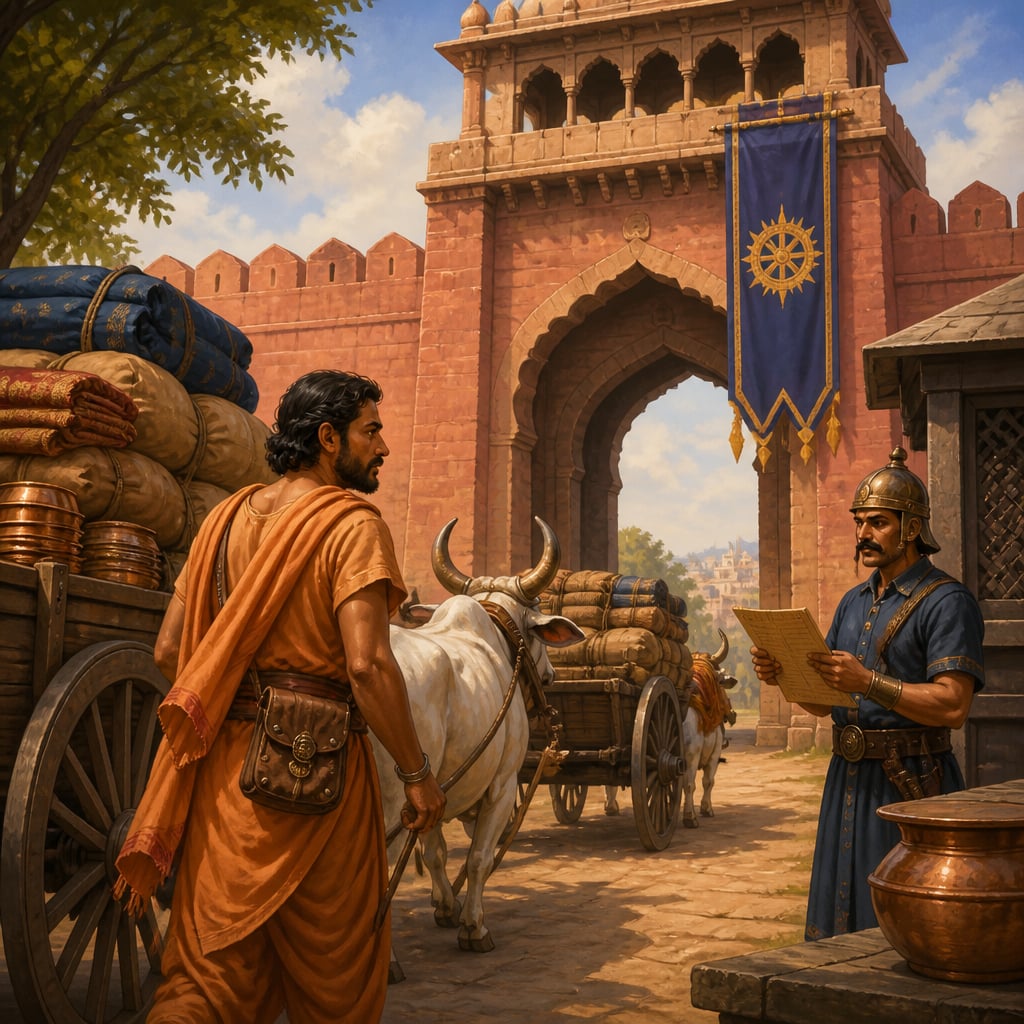
The merchant Pushyamitra approaching the customs gate of Ujjayini

The merchant Pushyamitra wiped sweat from his brow as his caravan approached the city gates of Ujjayini. Behind him stretched forty bullock carts loaded with fine muslin from the eastern coast, iron implements from Magadha, and precious spices from the southern forests. Ahead waited the Shulkadhyaksha, the Superintendent of Customs, who would determine how much of his profit the state would claim.

Would this official be fair or corrupt? Efficient or obstructive? The answer would determine whether Pushyamitra's six-month journey ended in profit or ruin.

Kautilya understood that moments like this, where merchant met state, could make or break an economy. The Arthashastra devotes extensive attention to Shulka (शुल्क, customs duty), designing a system that extracted revenue while protecting trade.

The Architecture of Shulka

Kautilya's customs system was remarkably sophisticated, anticipating modern principles of trade taxation.

Entry Points and Registration: The Arthashastra mandated that all trade goods pass through designated checkpoints (naka, नाक) where they would be:

This wasn't bureaucratic harassment, it was consumer protection and revenue assurance combined. The registration created records that prevented disputes and enabled merchants to prove legal ownership.

Rate Structure: Kautilya prescribed differentiated rates based on goods' nature:

Category Typical Rate Examples
Essential goods 5% or exempt Grain, salt, basic cloth
Standard trade goods 10-15% Metal implements, pottery
Luxury items 20-25% Jewelry, fine textiles, wines
Strategic goods Special rates Weapons, horses, elephants

This tiered structure served multiple purposes:

The Shulkadhyaksha: Guardian of Fair Trade

The Shulkadhyaksha examining indigo cloth at a Mauryan customs hall

The Shulkadhyaksha (शुल्काध्यक्ष, Customs Superintendent) was one of the most important officials in the Arthashastra's administrative hierarchy. Kautilya specified their duties with precision:

"शुल्काध्यक्षः पण्यावेक्षकश्च पण्यानि परीक्षेत।"

"The Customs Superintendent along with the commodity inspector shall examine all trade goods." , Arthashastra 2.21

But Kautilya was equally concerned with preventing official abuse. He warned:

"शुल्कस्थानेषु लोभो न कर्तव्यः।"

"In customs houses, greed must not be practiced."

To ensure compliance, he prescribed:

The Economics of Trade Taxation

Kautilya understood what modern economists call the "deadweight loss" of taxation, that duties change behavior and can reduce total economic activity.

Consider his reasoning: If customs are too high, merchants avoid the route. Trade shifts to competitors. Revenue falls. Artisans and farmers who depended on trade lose their market. The entire economy contracts.

But if customs are too low, the state lacks funds for roads, security, and port maintenance. Infrastructure crumbles. Bandits flourish. Trade becomes dangerous. Revenue falls anyway.

The optimal rate lies between these extremes, high enough to fund trade-supporting infrastructure, low enough that merchants still find the route profitable.

Kautilya expressed this as:

"शुल्कवृद्ध्या वाणिज्यं न हन्यात्।"

"Let customs increases not destroy trade."

Transit Duties: The Internal Customs Problem

One of Kautilya's most significant concerns was internal customs, duties collected at every district boundary within the kingdom. This was the ancient equivalent of India's pre-GST octroi and state border taxes.

The problem: A merchant traveling from coast to capital might cross a dozen internal boundaries, paying duty at each. By the time goods reached their destination, cumulative taxes had doubled or tripled the price. Consumers suffered. Merchants avoided long-distance trade. The economy fragmented.

Kautilya's solution was partial unification:

This principle, that goods should flow freely within a unified economic zone, would later become the foundation of India's GST: "One Nation, One Tax."

Western Perspectives on Trade Taxation

Modern Western economists have debated customs policy extensively, often arriving at insights Kautilya articulated millennia earlier.

David Ricardo (1772-1823) developed the theory of comparative advantage, arguing that nations benefit from specializing in goods they produce most efficiently and trading freely with others. Ricardo's logic suggested minimal customs duties, let trade flow unimpeded. His influence shaped Britain's 19th-century free trade policy.

Jean-Baptiste Say (1767-1832), the French economist famous for 'Say's Law' (supply creates its own demand), similarly advocated free trade. He argued that customs barriers were obstacles to prosperity, preventing the international division of labor that enriches all nations.

Friedrich List (1789-1846) offered a crucial counter-argument. A German-American economist, List observed that Ricardo's free trade doctrine served Britain's interests, an already-industrialized nation whose goods would dominate if tariffs fell. Developing nations, List argued, needed temporary customs protection for 'infant industries' to build productive capacity before facing foreign competition. His 'National System of Political Economy' (1841) influenced German, American, Japanese, and later East Asian industrialization.

Kautilya's approach anticipates List more than Ricardo. The Arthashastra doesn't advocate universal free trade or blanket protection, but strategic differentiation: low duties on raw materials and essentials, higher duties on luxury imports, and special rates for strategic goods. This is precisely List's prescription, customs policy serving national development, not abstract doctrine.

Protecting the Merchant

Remarkably, Kautilya devoted as much attention to protecting merchants from the state as to extracting revenue from them. The Arthashastra specifies:

Rights of Merchants:

Prohibited Official Behaviors:

Violations brought severe punishment. An official caught extorting merchants faced fines up to twelve times the illegal demand, enough to bankrupt most corrupt officers.

The Modern Parallel: India's Customs Transformation

A modern Indian customs officer running faceless digital assessment

India's 2017 GST reform directly addressed the fragmentation Kautilya warned against. Before GST:

After GST:

The transformation echoes Kautilya's vision of free internal movement with taxation only at the boundary of the economic zone.

In 2024, the Central Board of Indirect Taxes and Customs (CBIC) under Revenue Secretary Sanjay Malhotra launched "Faceless Assessment" for customs, removing human discretion from routine decisions, reducing the corruption opportunities Kautilya struggled against 2,300 years ago.

Your Turn

Kautilya's customs principles offer guidance beyond government policy. Any organization that controls a "chokepoint", a necessary passage for others' activity, faces the Shulka dilemma.

Platforms that charge transaction fees, landlords who control access to markets, employers who gatekeep opportunities, all face the choice: extract maximum immediate value, or build sustainable relationships that generate long-term prosperity.

Ask yourself: Where do you control chokepoints? How do you use that power? Are you a fair Shulkadhyaksha who enables trade while collecting reasonable dues? Or a corrupt official who maximizes extraction until merchants find another route?

In our next lesson, we examine Bali, voluntary tributes and the ethics of how tax collectors should conduct themselves.

Optimal tariff theory; trade elasticity; deadweight loss

Ricardo's trade theory (1817) argued for minimal tariffs. Modern trade economics debates optimal rates balancing revenue, protection, and trade flows.

Kautilya integrated ethical concern for merchants with economic analysis, trade policy should be fair, not just efficient.

India's average customs duty fell from ~32% in 1990 to ~13% in 2024, reflecting the principle that lower rates can generate more trade and revenue.

Transaction costs; corruption tax; regulatory burden

World Bank studies show corruption adds 10-30% to business costs in affected countries, a 'tax' that funds nothing productive.

Key terms

Śulka
Customs duty; tax on goods entering or leaving a defined territory. The primary form of trade taxation in ancient India.
Śulkādhyakṣa
The Customs Superintendent; the official responsible for administering trade duties, inspecting goods, and preventing smuggling.
Nāka
Checkpoint or customs station where goods were inspected, assessed, and duty collected before entering trade zones.
Vartman
Road, path, or trade route, the physical infrastructure enabling commerce. Kautilya emphasized that well-maintained vartman was essential for trade, with the state responsible for their construction, security, and upkeep.

Verses

शुल्काध्यक्षः पण्यावेक्षकश्च पण्यानि परीक्षेत।

śulkādhyakṣaḥ paṇyāvekṣakaśca paṇyāni parīkṣeta |

The Customs Superintendent, together with the commodity inspector, shall examine all trade goods.

Modern customs authorities similarly combine revenue collection with quality standards enforcement, trade statistics gathering, and border protection.

Arthashastra, 2.21.1 (R.P. Kangle)

शुल्कवृद्ध्या वाणिज्यं न हन्यात्।

śulkavṛddhyā vāṇijyaṃ na hanyāt |

Let not customs increases destroy trade.

This anticipates the concept of optimal tariff rates, the point where revenue is maximized without excessively distorting trade flows.

Arthashastra, 2.22.9 (Patrick Olivelle)

शुल्कस्थानेषु लोभो न कर्तव्यः।

śulkasthāneṣu lobho na kartavyaḥ |

In customs houses, greed must not be practiced.

This addresses what economists call 'transaction costs', the unofficial burdens (bribes, delays, uncertainty) that add to formal tax rates.

Arthashastra, 2.21.24 (L.N. Rangarajan)

Key figures

Kautilya (Chanakya)

Author of Arthashastra; Chief Advisor to Chandragupta Maurya · 4th century BCE

Kautilya designed a comprehensive customs system that balanced revenue extraction with trade promotion. His innovations included tiered rates by goods category, protection of merchant rights, anti-corruption measures for officials, and the principle that internal barriers should not fragment trade. The Arthashastra's customs provisions anticipate modern trade policy by millennia.

Kautilya's customs framework shows that sophisticated trade taxation, balancing revenue, protection, and commerce, is not a modern invention but an ancient Indian achievement.

Sanjay Malhotra

Revenue Secretary (2022-2024); RBI Governor (2024-present) · 1965-present

As Revenue Secretary, Malhotra oversaw India's customs modernization including the 'Faceless Assessment' system that reduces human discretion in routine customs decisions. His work exemplifies the Kautilyan principle that systematic procedures prevent corruption more effectively than individual moral appeals.

Malhotra's customs reforms directly address the corruption concerns Kautilya raised, using technology to achieve what the Arthashastra attempted through administrative design.

Friedrich List

German-American economist; pioneer of infant industry protection and national economics · 1789-1846

List's 'National System of Political Economy' (1841) argued that developing nations need temporary tariff protection for nascent industries against established competitors. He rejected the universal free trade doctrine of Adam Smith and Ricardo, arguing that what works for advanced nations may harm developing ones. List advocated strategic customs policy, protecting infant industries while allowing free import of raw materials and technology, to build national productive capacity. His ideas influenced German, American, Japanese, and later East Asian industrialization.

List's nuanced approach to customs policy parallels Kautilya's tiered shulka rates: neither blanket free trade nor blanket protection, but strategic differentiation based on goods' nature and national development needs. Both understood that customs policy serves national power, not abstract economic doctrine.

Case studies

Hong Kong Free Port Model: Zero Customs, Maximum Trade

When the British acquired Hong Kong in 1841, it was a rocky, sparsely populated island with no natural resources. Rather than imposing the tariff systems common in the empire, the colonial government made a radical choice: Hong Kong would be a free port with zero customs duties on almost all goods. This decision, maintained through 180+ years of change, transformed a barren island into one of the world's great trading centers.

Kautilya would have recognized Hong Kong's strategy immediately. He described how well-managed border posts (shulka-sthana) should facilitate trade, not obstruct it. But Hong Kong went further than even Kautilya prescribed by eliminating customs entirely. In Arthashastra terms, Hong Kong treated its entire territory as a durga (fortified zone) whose defense was not walls but commercial indispensability. By becoming the gateway through which goods flowed into China and Southeast Asia, Hong Kong made itself too valuable to attack or marginalize. Kautilya's principle that trade routes create prosperity is validated at city-state scale. The zero-duty model works precisely because surrounding economies maintain tariffs, making Hong Kong the low-friction entry point. Remove neighboring barriers, and the advantage disappears.

Hong Kong grew from a barren rock with minimal population to a $380 billion economy handling over $1 trillion in annual trade. Its container port became the world's busiest for decades. Per capita GDP reached $50,000+, among Asia's highest. The free port model survived the handover to China in 1997 under the 'one country, two systems' framework, though recent political changes have raised questions about long-term continuity. Despite these uncertainties, Hong Kong remains one of the world's top trading hubs, with its trade-to-GDP ratio exceeding 300%, a direct testament to what zero-friction customs policy can achieve.

Zero customs is possible when trade itself is the product. Hong Kong sells access, location, and frictionless movement, not manufactured goods or agricultural products. For territories whose competitive advantage is pure trading convenience, eliminating shulka entirely can work. But this is List's exception, not Ricardo's rule: Hong Kong succeeded by positioning itself as the gateway for larger economies that do maintain customs barriers.

Hong Kong's model influenced Special Economic Zones worldwide, including India's SEZs and proposed free trade zones. The lesson: for trade hubs competing on logistics and access, customs friction is the enemy. India's International Financial Services Centre (IFSC) at GIFT City applies similar logic, zero GST on transactions, minimal regulatory friction, to attract global financial activity.

0% customs duty on 99%+ of goods GDP grew from near-zero (1841) to $380 billion (2024) Trade-to-GDP ratio exceeds 300% (one of world's highest) Consistently ranked #1 or #2 in global economic freedom indices

India's Check Post Elimination (2017): Kautilya's Dream Realized

Before July 2017, driving a truck across India meant encountering dozens of state border checkposts, the modern equivalent of the internal nakas Kautilya warned against. At each boundary, trucks stopped for inspection, documentation, and often informal 'facilitation payments.' A journey from Gujarat to Tamil Nadu could involve 5-7 checkposts, each adding hours of delay. India's internal customs barriers were strangling its own economy.

Kautilya prescribed specific rules for nakas (checkpoints). They should verify goods, collect duties, and issue receipts efficiently. He warned that corrupt or slow officials at border posts could destroy trade as effectively as high tariffs. Pre-2017 India suffered from exactly this: checkposts had become revenue extraction points for state governments and corruption opportunities for officials, with minimal trade facilitation. The e-way bill system implements Kautilya's vision more faithfully than the physical checkposts ever did. It verifies goods in transit, creates a documented trail, and enables enforcement without stopping vehicles. Kautilya's Shulkadhyaksha (customs superintendent) was supposed to ensure honest, efficient border operations. The digital system removes the human element that made those operations corruptible.

The elimination of checkposts reduced average truck transit time across India by 20-30%. Logistics costs as a share of GDP dropped from approximately 14% to 12-13%, saving the economy tens of thousands of crores annually. Over 100 million e-way bills are now generated monthly, creating a digital paper trail that replaced the opaque manual system. Interstate trade grew 15% faster in the two years after GST than in the two years before. Informal payments at borders, estimated at Rs 45,000-65,000 crore annually before GST, were substantially eliminated. The reform demonstrated that Kautilyan principles of efficient, honest checkpoint management could be implemented at continental scale through technology.

India's checkpost elimination proves that Kautilyan principles can be implemented at continental scale with modern technology. What required the Shulkadhyaksha's integrity and the king's decree in ancient times can now be achieved through digital systems that remove human discretion entirely. The e-way bill is the 21st-century naka: it tracks, verifies, and records, but doesn't obstruct. Kautilya would recognize the goal; he would marvel at the technology.

India's checkpost elimination is studied globally as an example of using technology to implement ancient governance wisdom. The European Union achieved similar internal free movement through decades of treaty negotiation; India did it in a single reform. The lesson for other federal systems: internal trade barriers are self-inflicted wounds that technology can now heal.

22 state checkposts eliminated across major highways 100+ million e-way bills generated monthly Truck transit time reduced by 20-30% Logistics costs as % of GDP reduced from 14% to 12-13% Interstate trade grew 15% faster post-GST

Historical context

4th-3rd century BCE (Mauryan Period)

The Mauryan Empire straddled major trade routes connecting Central Asia, Southeast Asia, and the Indian Ocean world. Customs revenues funded the massive standing army, infrastructure projects, and administrative apparatus that made the empire possible.

Contemporary empires (Ptolemaic Egypt, Seleucid Persia) also collected customs, but their systems were primarily extractive. Kautilya's integration of merchant protection, quality control, and anti-corruption measures was distinctively sophisticated.

The Arthashastra lists over 400 different trade goods subject to customs classification, evidence of the immense variety and volume of Mauryan commerce.

Kautilya's customs framework demonstrates that India had sophisticated trade policy when much of the world was still purely agricultural. Modern debates about tariffs, free trade, and border taxation echo arguments Kautilya addressed millennia ago.

Living traditions

Kautilya's customs principles, tiered rates, merchant protection, anti-corruption measures, continue to shape Indian trade policy.

India's customs administration directly inherits Kautilyan principles: tiered rates, merchant facilitation centers, anti-corruption vigilance, and the goal of collecting revenue while promoting trade.

Reflection

More in The Science of Taxation

All lessons in The Science of Taxation · Arthashastra: Economic Principles course