Kara-Niti: Principles of Fair Taxation
The Art of Collecting Without Crushing
Discover Kautilya's revolutionary framework for taxation that balances state needs with citizen welfare, establishing principles that remain startlingly relevant to modern fiscal policy debates.
The Tax Collector's Dilemma
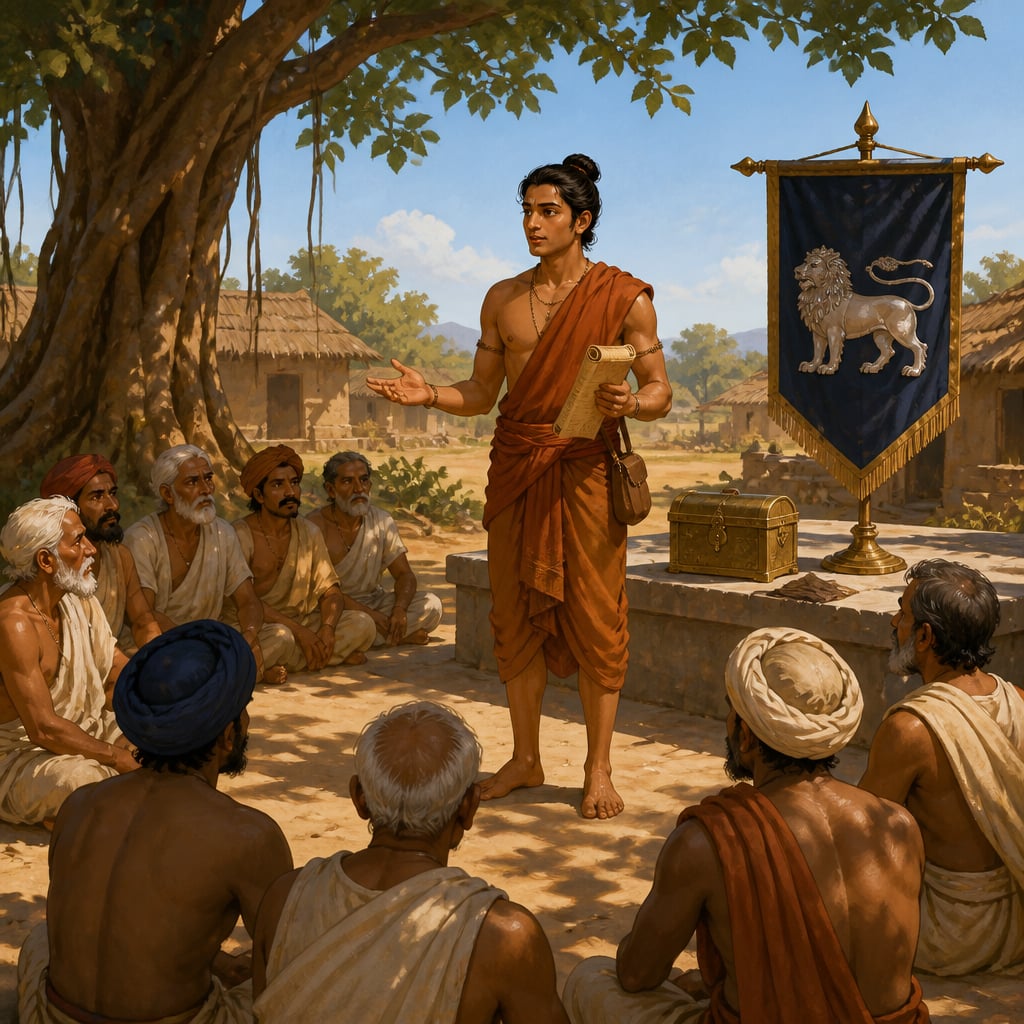
In the summer of 312 BCE, a revenue officer named Vasubandhu stood before a village assembly in the Mauryan province of Avanti. The monsoon had failed. Crops had withered. Yet the royal treasury in Pataliputra demanded its share. Vasubandhu faced a choice that would define his career, and his karma.
Should he squeeze the farmers for every copper coin, meeting his quota but leaving them destitute? Or should he show mercy, risking punishment from his superiors for falling short?
This wasn't just Vasubandhu's dilemma. It was the central problem Kautilya addressed in Books 2 and 5 of the Arthashastra: How does a state collect sufficient revenue without destroying the very prosperity it seeks to protect?
The Foundations of Kara-Niti
Kautilya's approach to taxation, called Kara-Niti (कर-नीति, the science of taxation), began with a startling premise. Unlike many ancient rulers who viewed subjects as resources to be exploited, Kautilya saw them as partners in prosperity.

The Arthashastra opens its discussion of taxation with this foundational verse:
"प्रजा सुखे सुखं राज्ञः प्रजानां च हिते हितम्।"
"In the happiness of the subjects lies the happiness of the king; in their welfare, his welfare." , Arthashastra 1.19.34
This wasn't merely ethical posturing. Kautilya was making an economic argument. A king who over-taxes creates poverty. Poverty reduces future tax revenue. The greedy king, seeking immediate gain, destroys his own long-term wealth. The wise king invests in his subjects' prosperity, knowing it multiplies his treasury over time.
Kautilya identified several sources of legitimate state revenue:
- Bhaga (भाग) - The king's share of agricultural produce, typically one-sixth to one-fourth
- Shulka (शुल्क) - Customs duties on trade goods entering or leaving the kingdom
- Kara (कर) - Direct taxes on professions, property, and transactions
- Bali (बलि) - Tributes and voluntary contributions
Each category had detailed rules about rates, collection methods, and exemptions. Nothing was arbitrary.
The Principle of Capacity
Kautilya's most sophisticated insight was that taxation must match paying capacity (शक्ति, shakti). This principle anticipates modern progressive taxation by over two thousand years.
The Arthashastra specifies:
"करः शक्त्यनुरूपः स्यात्।"
"Taxation should be according to capacity." , Arthashastra 5.2
What did this mean in practice? A wealthy merchant in Pataliputra paid higher rates than a subsistence farmer in a remote village. A prosperous year brought higher collections; a drought year brought reductions. The state adjusted its demands to economic reality rather than imposing rigid quotas regardless of circumstances.
Kautilya specifically warned against taxing people beyond their means:
"शक्त्यतिक्रमणात् प्रजा उद्वेजयति।"
"Exceeding the subjects' capacity causes them distress and ultimately rebellion."
This wasn't compassion for its own sake, it was economic wisdom. Distressed subjects flee, hide their wealth, or revolt. All three outcomes reduce state revenue far more than moderate taxation ever could.
East Meets West: Taxation Philosophy
How does Kautilya's approach compare to Western taxation theory? The contrast is illuminating.
| Kautilyan Approach | Western Classical Approach |
|---|---|
| State and subjects are partners | State extracts from subjects |
| Taxation funds collective welfare | Taxation funds state operations |
| Capacity-based rates | Often flat rates until modern era |
| Built-in drought/disaster relief | Relief as separate charity |
| King's dharma to tax fairly | King's prerogative to tax as needed |
Adam Smith, writing in 1776, proposed four canons of taxation: equity, certainty, convenience, and efficiency. Remarkably, Kautilya had articulated similar principles two millennia earlier, but embedded them in a broader ethical framework that Smith's "invisible hand" lacks.
Where Smith saw taxation as a necessary evil for funding government, Kautilya saw it as a dharmic relationship. The king who taxes fairly fulfills his sacred duty; the subject who pays honestly fulfills theirs. Both participate in Rajya-dharma (राज्यधर्म), the collective responsibility of maintaining a prosperous state.
The GST Revolution Through Ancient Eyes
On July 1, 2017, India implemented the Goods and Services Tax (GST), the largest tax reform since independence. Finance Minister Arun Jaitley called it "one nation, one tax." Critics called it chaotic. But through Kautilyan eyes, GST embodies several ancient principles.
Kautilya advocated for standardized rates across the kingdom to prevent traders from exploiting regional differences. Before GST, India had a bewildering maze of state taxes, central excise, service tax, and octroi. Goods crossing state borders faced multiple levies. The confusion was exactly what Kautilya warned against:
"बहुशुल्कता वाणिज्यं हन्ति।"
"Excessive and multiple duties kill trade."
GST's unified structure, with its four-tier rate system (5%, 12%, 18%, 28%), attempts the Kautilyan ideal of predictability. A businessman in Tamil Nadu faces the same rates as one in Punjab. Trade flows freely, just as Kautilya intended.
Nirmala Sitharaman, India's current Finance Minister, has continued refining GST with regular rate rationalizations. In 2024, the GST Council reduced rates on essential items while maintaining higher rates on luxury goods, directly echoing Kautilya's capacity principle. The poor pay less; the wealthy pay more.
Your Turn
Kautilya's taxation principles offer more than historical curiosity. They provide a framework for evaluating any tax system, ancient or modern.
Ask yourself: Does this tax match capacity? Does it fund genuine public goods? Is it predictable and fairly administered? If a tax fails these tests, Kautilya would call it adharmic, unrighteous, regardless of its legal status.
As a citizen, you're not just a passive taxpayer. You're a partner in the state's prosperity. Understanding taxation principles helps you evaluate policies, vote wisely, and participate meaningfully in economic debates.
In the next lesson, we'll explore Kautilya's most famous metaphor: the honeybee approach to revenue collection. Why did he compare the ideal tax collector to a bee gathering nectar? The answer reveals the deepest wisdom of the Arthashastra.
Adam Smith's 'invisible hand' assumes self-interest aligns with public good through markets. Kautilya explicitly makes the ruler responsible for aligning interests through wise policy.
By making citizen welfare the king's dharmic duty (not just economic strategy), Kautilya creates moral accountability Western economics lacks.
India's tax-to-GDP ratio is ~18% (2024), lower than OECD average of 34%, suggesting room for fair taxation increase if citizens see corresponding welfare improvements.
Progressive taxation became standard in the West only in the 20th century. The US introduced income tax in 1913; UK in 1799 as 'temporary' war measure.
Kautilya integrated progressive taxation with flexibility, rates adjusted for droughts, disasters, and economic conditions, not just income level.
India's income tax has slabs from 0% to 30%, with recent Budget 2024 providing relief to the middle class, echoing capacity-based principles.
Key terms
- Kara-Nīti
- The science or policy of taxation; the systematic principles governing how a state collects revenue from its subjects fairly and effectively.
- Śakti
- In taxation context: the paying capacity or economic ability of a taxpayer. More broadly: power, ability, strength.
- Bhāga
- The king's share of agricultural produce; the primary form of revenue in agrarian economies. Typically one-sixth (ṣaḍ-bhāga) of harvest.
- Śulka
- Customs duties and tolls levied on goods entering, leaving, or transiting through the kingdom. A key revenue source from trade that Kautilya regulated carefully to balance state income with commercial vitality.
Verses
प्रजा सुखे सुखं राज्ञः प्रजानां च हिते हितम्।
prajā sukhe sukhaṃ rājñaḥ prajānāṃ ca hite hitam |
In the happiness of his subjects lies the king's happiness; in their welfare, his welfare.
This anticipates stakeholder capitalism, the recognition that leaders prosper when they prioritize constituent welfare, not extractive policies.
Arthashastra, 1.19.34 (R.P. Kangle)
करः शक्त्यनुरूपः स्यात्।
karaḥ śaktyanurūpaḥ syāt |
Let taxation be proportioned to the taxpayer's capacity.
This is an early articulation of progressive taxation, the principle that tax burden should increase with ability to pay, anticipating 20th-century fiscal theory.
Arthashastra, 5.2.70 (Patrick Olivelle)
बहुशुल्कता वाणिज्यं हन्ति।
bahuśulkatā vāṇijyaṃ hanti |
Excessive taxation kills commerce.
This anticipates the Laffer Curve concept, that beyond a certain point, higher tax rates reduce total revenue by discouraging economic activity.
Arthashastra, 2.1.17 (L.N. Rangarajan)
Key figures
Kautilya (Chanakya)
Author of Arthashastra; Chief Advisor to Chandragupta Maurya · 4th century BCE
Kautilya created the world's first comprehensive taxation framework, detailing revenue sources, collection methods, rates by sector, exemptions, and anti-corruption measures. His Arthashastra dedicates multiple books to fiscal policy, establishing principles like capacity-based taxation and the honeybee approach to revenue that anticipated modern fiscal theory by two millennia.
Kautilya established the foundational principle that taxation should balance state needs with citizen welfare, that over-taxation destroys prosperity and thus reduces future revenue.
Nirmala Sitharaman
Finance Minister of India (2019-present) · 1959-present
India's first full-time female Finance Minister, Sitharaman has overseen GST rationalization, pandemic-era fiscal responses, and budget reforms emphasizing capital expenditure. Her budgets have balanced revenue needs with economic growth, often invoking principles that echo Kautilyan wisdom, including capacity-based exemptions and infrastructure-led development.
Sitharaman's ongoing GST reforms, simplifying rates, reducing compliance burden, exempting essentials, demonstrate Kautilyan principles applied to 21st-century India.
Adam Smith
Scottish economist and philosopher; author of 'The Wealth of Nations' · 1723-1790
Adam Smith's 'An Inquiry into the Nature and Causes of the Wealth of Nations' (1776) established the foundations of classical economics. His four canons of taxation, equity, certainty, convenience, and economy, became foundational principles for modern tax systems. Smith argued that taxes should be proportional to income ('ability to pay'), predictable in amount and timing, convenient to pay, and efficient to collect. His 'invisible hand' metaphor suggested that individual self-interest, through markets, produces collective benefit.
Smith's taxation principles arrived two millennia after Kautilya's remarkably similar insights. Comparing them illuminates what Kautilya added that Smith lacked: an explicit ethical framework (dharma) binding ruler and ruled in mutual obligation, and systematic flexibility for economic conditions like drought. Where Smith saw taxation as necessary evil funding government, Kautilya saw it as sacred partnership. Smith's influence on Western economics makes this comparison essential for understanding Indian economic thought's distinctive contributions.
Case studies
GST Implementation: India's Kautilyan Tax Revolution
On July 1, 2017, at midnight, India launched the Goods and Services Tax (GST), the most significant tax reform since independence. By replacing 17 different central and state taxes with one unified system, GST attempted what Kautilya advocated millennia ago: simplifying the tax structure to promote commerce while ensuring adequate revenue. The implementation, while initially chaotic, has evolved into a functioning system demonstrating Kautilyan principles in action. Pre-GST India was a tax nightmare. A truck carrying goods from Gujarat to Tamil Nadu might face: - Central Excise Duty - State VAT (different rates in each state) - Central Sales Tax on interstate movement - Octroi/Entry Tax at city boundaries - Service Tax on various components - Multiple surcharges and cesses The average compliance time was 243 hours annually. Goods spent 20-30% of transit time at checkpoints. This 'tax on tax' (cascading) effect increased consumer prices by 25-30% on average. Kautilya had warned: 'बहुशुल्कता वाणिज्यं हन्ति' (Excessive and multiple duties kill trade). Pre-GST India was living proof.
GST embodies multiple Kautilyan principles: **1. Unified Taxation**: Kautilya advocated standardized rates across the Mauryan Empire to prevent traders from exploiting regional differences. GST creates 'one nation, one tax', a businessman in Kanyakumari faces the same rates as one in Kashmir. **2. Capacity-Based Rates**: GST's four-tier structure (5%, 12%, 18%, 28%) places essentials at lower rates and luxuries higher, matching Kautilya's shakti (capacity) principle. Food grains are mostly 0%, while luxury cars face 28% plus cess. **3. Simplicity Over Complexity**: By replacing 17 taxes with one, GST dramatically reduced the 'bahuśulkatā' (excessive multiple duties) that Kautilya warned destroys commerce. **4. Technology-Enabled Transparency**: The GST Network (GSTN) creates digital trails that reduce evasion, echoing Kautilya's emphasis on systems that make corruption difficult.
GST collections grew from Rs 7.41 lakh crore in FY2018 (first full year) to Rs 20.18 lakh crore in FY2024, a near tripling in six years. The tax base expanded from 6.4 million registrants to over 14 million. Interstate truck transit times fell by 20-30% as checkposts vanished overnight. Compliance time dropped from 243 hours to roughly 120 hours annually. Rate rationalization reduced the number of items in the 28% slab from 228 to around 35. The GST Council held 50+ meetings, continuously adjusting based on real economic data. The system remains imperfect, with multiple rate slabs still defying Kautilyan simplicity, but the direction of travel validates the core reform.
**1. Simplification requires complexity initially**: Creating a simple system required immense upfront complexity in design and transition. Kautilya's simple principles required detailed Books in the Arthashastra to implement. **2. Federalism and taxation can coexist**: The GST Council model proves states can cooperate on tax matters when governance design is right. Kautilya's unified Mauryan taxation required similar coordination across diverse provinces. **3. Technology enables ancient principles**: Digital infrastructure (GSTN, e-invoicing, e-way bills) makes Kautilyan ideals practical at scale. Ancient wisdom combined with modern tools. **4. Continuous refinement is necessary**: GST Council's 50+ meetings show that good taxation requires ongoing adjustment, exactly what Kautilya's detailed rules anticipated. **5. Capacity-based rates work**: Lower rates on essentials, higher on luxuries, exemptions for small businesses, the shakti principle in action.
India's GST reform is now studied globally as the most ambitious tax unification in a federal democracy. The GST Council model, where central and state governments negotiate rates through consensus, offers a template for other federal nations like Brazil and Nigeria attempting similar consolidation.
GST replaced 17 separate central and state taxes with one unified system. Monthly collections grew from Rs 90,000 crore average in FY2018 to Rs 1.68 lakh crore average in FY2024. The registered taxpayer base more than doubled, from 6.4 million to over 14 million.
Historical context
4th-3rd century BCE (Mauryan Period)
The Mauryan Empire administered the largest economy in the ancient world. Kautilya's taxation system had to accommodate agricultural villages, trading cities, forest tribes, and border provinces, each with different economic capacities and collection challenges.
Contemporary tax systems in Hellenistic kingdoms (Ptolemaic Egypt, Seleucid Persia) were primarily extractive, funding royal courts and wars. Kautilya's emphasis on citizen welfare and capacity-matching was distinctive. Rome's sophisticated tax system would not emerge for another two centuries.
Megasthenes reported that Mauryan revenue officers maintained detailed land registers categorizing soil quality, irrigation access, and crop types, enabling capacity-based taxation at remarkable administrative scale.
Understanding Kautilya's taxation principles reveals that sophisticated fiscal thinking is indigenous to India, not imported from colonial administrators who often replaced functional systems with extractive ones.
Living traditions
Kautilyan taxation principles continue to influence Indian fiscal policy, from GST design to agricultural tax exemptions.
India's tax structure continues to reflect Kautilyan principles: exemptions for agriculture, progressive income tax rates, special provisions for small businesses (composition scheme in GST), and ongoing rate rationalization to balance revenue with economic growth.
- Agricultural Income Tax Exemption: Following Kautilya's principle of protecting cultivators' capacity, agricultural income remains exempt from Indian income tax, a direct continuation of ancient policy prioritizing food security.
- GST Council Deliberation: The GST Council, where Centre and States negotiate rates, echoes Kautilya's vision of calibrated taxation through consultation rather than arbitrary imposition.
- Kumhrar Archaeological Site: Remains of the Mauryan assembly hall where taxation policies may have been debated; includes pillar bases suggesting administrative grandeur
- GST Bhawan: Headquarters of India's modern unified taxation system, where Kautilyan principles meet 21st-century implementation
- Vishnupad Temple: One of the oldest pilgrimage sites in the Mauryan heartland, Gaya was a major revenue center during Kautilya's era. Temple inscriptions and historical records show the systematic collection and accounting practices that sustained religious institutions through royal treasury support.
- Agam Kuan (Ashoka's Well): This Mauryan-era site near Kumrahar connects to the administrative apparatus that Kautilya helped establish. Archaeological evidence confirms it as part of the sophisticated Mauryan infrastructure in Pataliputra where taxation policies were administered.
Reflection
- Kautilya saw taxation as a partnership between ruler and ruled, not mere extraction. How does this perspective change how you view your own tax obligations? Do you see yourself as a partner in national prosperity or simply a revenue source?
- Think of a tax or fee you pay regularly (income tax, property tax, GST). Does it follow Kautilya's capacity principle? If not, what would a fairer structure look like, and how might you advocate for change?