Modern GST Through Kautilyan Lens
One Nation, One Tax, Ancient Wisdom
India's 2017 GST reform was the world's largest tax transformation. Viewed through Kautilyan principles, it represents a return to unified markets, tiered rates, and fair collection, ideals articulated over two millennia ago.
Midnight, July 1, 2017
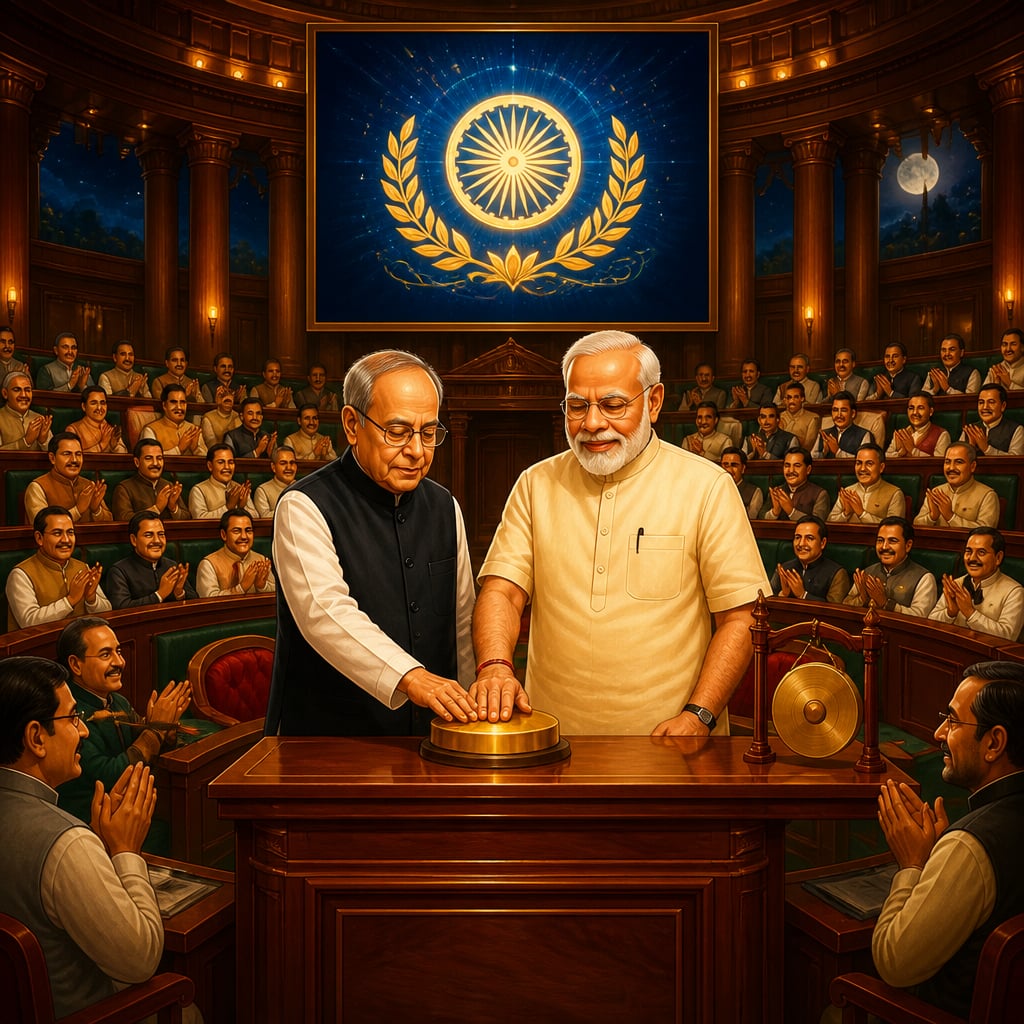
At the stroke of midnight in India's Central Hall of Parliament, President Pranab Mukherjee and Prime Minister Narendra Modi together pressed a button. Across India, 17 different taxes vanished. In their place: the Goods and Services Tax, a unified levy that transformed India's fragmented market into a single economic zone.
The ceremony deliberately echoed India's independence at midnight, August 15, 1947. The message was clear: this was economic freedom, liberation from the tax maze that had shackled Indian commerce for decades.
But to those who knew Kautilya, there was an older resonance. GST wasn't just modern reform. It was a return to principles articulated in the Arthashastra 2,300 years ago.
The Pre-GST Nightmare
To appreciate GST's significance, consider what it replaced. Before July 2017, Indian businesses navigated:
- Central Excise on manufactured goods
- Service Tax on services
- State VAT varying by state
- Entry Tax at state borders
- Octroi at city limits
- Central Sales Tax on interstate movement
- Plus various cesses, surcharges, and special levies
The result? A truck carrying goods from Mumbai to Delhi crossed multiple state borders, paying duty at each. It might spend more time waiting at checkpoints than actually moving. The cascading effect, taxes upon taxes, added 25-30% to final prices that no one could trace or credit.
This was precisely what Kautilya warned against:
"बहुशुल्कता वाणिज्यं हन्ति।"
"Excessive and multiple duties kill trade."
India had forgotten the lesson. GST remembered it.
GST as Kautilyan Restoration
GST embodies multiple Arthashastra principles:
1. Unified Internal Market: Kautilya advocated for goods to flow freely within the kingdom once they had paid border duty. GST eliminates interstate barriers entirely. A product taxed in Gujarat moves freely to Tamil Nadu with full credit for taxes already paid. The ancient vision of seamless internal commerce finally realized.
2. Tiered Rate Structure: The Arthashastra prescribed different rates for different goods, essentials taxed lightly, luxuries heavily. GST's four-tier structure (5%, 12%, 18%, 28%) directly mirrors this:
| GST Slab | Goods Category | Kautilyan Parallel |
|---|---|---|
| 0% | Food grains, healthcare | Essential exemptions |
| 5% | Basic necessities | Low rates on essentials |
| 12% | Standard goods | Moderate trade taxation |
| 18% | Services, durable goods | Standard commerce rate |
| 28% | Luxury items | Higher rates on luxury |
3. Input Tax Credit: Kautilya recognized that taxing the same value multiple times destroys commerce. GST's input tax credit system ensures taxes paid at each stage are credited forward, preventing cascading. A manufacturer who pays 18% on inputs claims that against their output tax, paying only on value added.
4. Digital Documentation: The Arthashastra mandated written receipts and registers to prevent corruption and disputes. GST's digital infrastructure, e-way bills, return matching, electronic invoicing, fulfills this vision with technology Kautilya could only dream of.
The Madhukara Principle in GST Rate Setting
Remember the honeybee: take without destroying. GST rate-setting explicitly follows this logic.

The GST Council, comprising the Union Finance Minister and all State Finance Ministers, meets regularly to adjust rates. The discussions echo Kautilyan concerns:
- Sector Stress: When a sector struggles (textiles in 2021, for instance), rates are reduced to preserve the source
- Inflation Impact: Essential items move to lower slabs when prices rise, protecting purchasing power
- Revenue Sustainability: Rates aren't cut so low that government functions collapse
- Compliance Burden: Small businesses receive composition scheme with simplified rates
The Council's debates are modern madhukara-nyaya in action, finding the rate that extracts sufficient revenue without crushing commerce.
What Kautilya Would Critique
Intellectual honesty requires acknowledging where GST falls short of Kautilyan ideals.
Complexity Despite Simplification: While GST unified taxes, it introduced its own complexity. Multiple rates (rather than one flat rate), frequent changes, and technical return requirements challenge small businesses. Kautilya preferred simplicity:
"स्पष्टं करं निश्चितं च।"
"Taxes should be clear and certain."
GST's frequent rate changes and classification disputes violate this principle. The ongoing rationalization toward fewer slabs acknowledges the problem.
Petroleum and Alcohol Exclusion: Petroleum products and alcohol remain outside GST, partly for revenue reasons, partly from political resistance. This creates exactly the fragmentation GST was supposed to eliminate. Kautilya would recognize this as powerful interests capturing exemptions he warned against.
Compliance Burden on Small Traders: The Arthashastra protected small traders from harassment. GST's digital requirements, while reducing corruption, created new burdens for traders unfamiliar with technology. The recent threshold increases and simplified composition schemes attempt to address this.
The Human Story: Truck Drivers and the Tax Reform

Before GST, India's truck drivers spent an estimated 60+ hours monthly waiting at state border checkpoints. Dharmendra, a driver on the Delhi-Chennai route, would budget three days just for paperwork and inspections.
After GST abolished interstate barriers, the same route takes 40% less time. Dharmendra makes more trips, earns more, and goes home more often.
This is the human meaning of unified markets. Kautilya built roads and rest houses for merchants; modern India removed the checkpoints that made those roads useless.
Logistics costs have fallen from 14% of GDP toward international benchmarks of 8-10%. This isn't just statistics, it's lower prices for consumers, higher margins for producers, and more competitive exports.
Sitharaman's Kautilyan Reforms
Finance Minister Nirmala Sitharaman, overseeing GST since 2019, has pushed reforms that consciously or unconsciously echo Kautilyan principles:
Rate Rationalization (Ongoing): Reducing the number of rates toward an ideal of 2-3 slabs. Fewer categories mean less classification disputes, less complexity, clearer certainty.
Compliance Simplification: Raising thresholds for mandatory registration, allowing composition scheme for more businesses, simplifying returns. Protecting small traders from excessive burden.
Anti-Evasion Technology: E-invoicing, return matching, and AI-based fraud detection. Kautilya's forty methods of embezzlement addressed through technological surveillance.
Dispute Resolution: Streamlined appellate mechanisms to resolve classification disputes faster. The Arthashastra mandated quick resolution; modern GST tribunals attempt the same.
Global Perspectives on Unified Taxation
The challenge of creating unified tax systems from fragmented ones is not uniquely Indian. Western thinkers across centuries grappled with the same problem.
Jean-Baptiste Colbert (1619-1683) served as Finance Minister under Louis XIV and faced a France fractured by internal customs barriers. His famous observation, 'The art of taxation consists in so plucking the goose as to obtain the largest possible amount of feathers with the smallest possible amount of hissing', echoes Kautilya's madhukara-nyaya. Colbert eliminated toll barriers between French provinces, creating what he called the 'Five Great Farms', a unified customs zone. Yet even Colbert couldn't unify all of France; regional exemptions persisted until the Revolution.
Maurice Lauré (1917-2001), a French economist at the Direction générale des impôts, invented the Value Added Tax in 1954. His genius was the input credit mechanism, tax paid at each stage credited forward, which solved the cascading problem that had plagued sales taxes worldwide. France adopted VAT in 1954; the EU followed; today over 160 countries use variations of Lauré's invention. India's GST input tax credit system is a direct descendant of Lauré's original design.
Carl Shoup (1902-2000), the American economist who led Japan's post-war tax reform, articulated principles remarkably similar to Kautilya's: taxes should be simple, certain, and broadly-based. His 1949 Shoup Mission report became a template for modern tax systems globally. Shoup argued that complexity breeds evasion, the same insight Kautilya captured in 'spaṣṭaṃ karaṃ niścitaṃ ca' (taxes should be clear and certain).
| Western Thinker | Key Insight | Kautilyan Parallel |
|---|---|---|
| Colbert | Unify internal markets | एको देशः एकं शुल्कम् (One territory, one tax) |
| Lauré | Input credit prevents cascading | Warnings against taxing already-taxed value |
| Shoup | Simplicity enables compliance | स्पष्टं करं निश्चितं च (Clear and certain taxes) |
India's GST synthesizes all these Western insights while implementing principles Kautilya articulated 2,300 years before any of them were born.
Your Turn
GST affects every Indian who buys or sells anything. Understanding its Kautilyan roots transforms how you see the system.
When you pay GST on a purchase, you're participating in a tax philosophy refined over millennia. The rate you pay reflects debates about capacity, necessity, and sustainability that Kautilya would recognize.
When you hear GST Council debates, listen for the madhukara principle: Are rates being set to extract without destroying? Are exemptions justified by genuine need or political capture? Is the burden distributed fairly?
As citizen, voter, and taxpayer, you're not just a revenue source. You're a partner in the fiscal compact, the same role Kautilya envisioned for subjects 2,300 years ago.
In our final lesson, we'll synthesize everything we've learned about Kautilyan taxation and ask: What does this ancient wisdom mean for India's path to 2047 and beyond?
Common market; internal trade barriers; economic integration
The EU single market implements the same principle, free movement within, common tariff at the border. India's GST creates a genuine internal market for the first time.
GST transformed India from 29 separate markets into one 1.4-billion consumer economy, the scale of integration Kautilya envisioned but couldn't achieve with ancient technology.
Post-GST, interstate trade barriers eliminated. Logistics time reduced 20-40%; costs moving from 14% of GDP toward 10%.
Tax certainty; compliance costs; administrative burden
Adam Smith's canon of 'certainty' directly echoes Kautilya. Modern tax administration research confirms that complexity reduces compliance more than high rates.
Key terms
- GST (Goods and Services Tax)
- India's unified indirect tax system implemented July 1, 2017, replacing 17 different central and state taxes with a single levy.
- Input Tax Credit (ITC)
- The mechanism allowing businesses to credit taxes paid on inputs against taxes due on outputs, ensuring tax is paid only on value addition.
- GST Parishad (GST Council)
- The constitutional body comprising Union and State Finance Ministers that sets GST rates, resolves disputes, and makes policy recommendations.
- E-way Bill
- Electronic waybill, a digital document required for interstate movement of goods worth more than ₹50,000 under GST. The e-way bill replaced physical checkposts with remote verification, enabling seamless goods movement while maintaining audit trails.
Verses
बहुशुल्कता वाणिज्यं हन्ति।
bahuśulkatā vāṇijyaṃ hanti |
Excessive and multiple duties kill trade.
The pre-GST Indian economy was a case study in what Kautilya warned against, proof that ancient principles remain economically valid.
Arthashastra, 2.1.17 (R.P. Kangle)
स्पष्टं करं निश्चितं च।
spaṣṭaṃ karaṃ niścitaṃ ca |
Taxes should be clear and certain.
Research shows that tax uncertainty imposes costs beyond the tax itself, compliance costs, planning costs, and the cost of disputes.
Arthashastra, 2.21.15 (Patrick Olivelle)
एको देशः एकं शुल्कम्।
eko deśaḥ ekaṃ śulkam |
One territory, one tax.
Unified tax systems reduce compliance costs, eliminate arbitrage opportunities, and create genuine single markets, as both Kautilya and modern economists agree.
Arthashastra, 2.22.6 (L.N. Rangarajan)
Key figures
Kautilya (Chanakya)
Author of Arthashastra; Chief Advisor to Chandragupta Maurya · 4th century BCE
Kautilya articulated the principles that GST implements: unified markets, tiered rates, non-cascading taxation, and transparent administration. His warnings against multiple overlapping duties proved prescient for pre-2017 India.
GST represents a return to Kautilyan principles after decades of fragmentation, ancient wisdom validated by modern economic science.
Nirmala Sitharaman
Finance Minister of India (2019-present); Chair of GST Council · 1959-present
Sitharaman has led GST's evolution from initial complexity toward simplification. Her reforms, rate rationalization, threshold increases, compliance simplification, echo Kautilyan principles of clarity, capacity-based taxation, and protection of small traders.
As GST Council Chair, Sitharaman embodies the ongoing application of Kautilyan principles to India's largest-ever tax reform.
Jean-Baptiste Colbert
Finance Minister of France under Louis XIV; Architect of French mercantilism · 1619-1683
Colbert unified France's fragmented internal customs system, eliminating toll barriers between provinces and creating a single economic zone. His famous maxim, 'The art of taxation consists in so plucking the goose as to obtain the largest possible amount of feathers with the smallest possible amount of hissing', captures the essence of sustainable taxation that Kautilya's madhukara-nyaya articulates more elegantly.
Colbert faced in 17th-century France the same challenge India faced before GST: internal barriers fragmenting what should be unified markets. His solutions, and his failures in obtaining full unification, illuminate both the power and difficulty of creating one-nation-one-tax systems.
Case studies
New Zealand's GST Success: The Gold Standard of Simplicity
New Zealand implemented GST in 1986 with a radical approach: one rate (initially 10%, now 15%), applied to almost everything, with virtually no exemptions. This simplicity made it one of the world's most efficient consumption taxes and earned it the nickname 'the gold standard' of GST design.
New Zealand's single-rate GST represents the purest implementation of Kautilyan clarity. While Kautilya did advocate tiered rates for different goods, he prioritized certainty above all. New Zealand chose maximum certainty, one rate, no exceptions, and compensated for equity concerns through direct transfers rather than rate complexity.
New Zealand's GST consistently collects approximately 30% of total government revenue with administrative costs under 1% of collections. The single-rate system has survived multiple changes of government across the political spectrum. No major party has proposed abolishing or fundamentally restructuring it. Compliance rates exceed 95%, and the system processes millions of transactions with minimal dispute. The country compensates for GST's regressivity through targeted transfers to low-income households, proving that tax simplicity and social equity can coexist when the transfer system does the equity work.
Simplicity has its own equity: by making compliance easy and evasion difficult, New Zealand's GST actually collects more from everyone, including the wealthy who might otherwise exploit classification loopholes. India's ongoing rate rationalization toward fewer slabs moves in this direction.
India's ongoing GST rate rationalization, moving toward fewer slabs, follows New Zealand's proven path. The Finance Ministry's push to consolidate the current 4-rate structure toward 2-3 rates acknowledges that simplicity itself generates compliance and revenue.
New Zealand GST: Single rate of 15%, applied to 96% of consumption Collection efficiency: Administrative costs under 1% of revenue collected Compliance burden: Average small business spends 12 hours annually on GST compliance Revenue stability: GST contributes ~30% of total government tax revenue
Malaysia's GST U-Turn: Implementation Lessons from a Political Reversal
Malaysia implemented GST in April 2015 at 6%, replacing a sales and service tax. Despite technical success in increasing revenue and formalizing the economy, GST became politically toxic. The Pakatan Harapan coalition won the 2018 election partly on promises to abolish it, which they did within 100 days, reverting to the old system.
Malaysia's reversal illustrates Kautilya's warning that taxation requires not just good design but social acceptance. The madhukara principle, extracting without creating resentment, demands political skill as much as economic sense. Malaysia got the economics right but the politics wrong. The 'hissing' grew too loud, regardless of how many 'feathers' were being collected.
Malaysia's GST abolition in 2018 created an immediate revenue shortfall estimated at RM20+ billion annually. The replacement Sales and Service Tax (SST) at 5-10% covers a narrower base, collects less revenue, and is less transparent. Government debt increased as spending commitments continued without adequate revenue. By 2023, fiscal analysts widely acknowledged that abolishing GST was economically costly, even if politically successful. Several policymakers who championed abolition later conceded privately that the decision was driven by electoral pressure, not economic analysis. The episode serves as a cautionary tale: technically sound tax reforms can fail if political groundwork and public communication are neglected.
Technical excellence is insufficient. India's GST, despite its complexity, has survived because of extensive political groundwork (GST Council consensus, compensation guarantees to states) that Malaysia neglected. Kautilya's insistence on the king consulting advisors and building consensus applies directly to modern tax reform.
Malaysia's reversal is a cautionary tale for any government implementing consumption tax reform. India's GST has survived precisely because of the political infrastructure that Malaysia lacked: the GST Council's consensus model, compensation guarantees to states, and phased implementation.
Malaysia GST lifespan: 3 years 3 months (April 2015 - September 2018) Rate at abolition: 6% (increased revenue but couldn't survive politically) Replacement: Sales and Service Tax (SST) at 5-10%, narrower base, less transparent Post-abolition revenue drop: Estimated RM20+ billion annual shortfall
Historical context
2017-Present (GST Era)
GST resolved decades of constitutional tension between Centre and States over taxation rights. The GST Council creates a unique federal body where Union and States jointly govern the tax system, unprecedented in Indian fiscal history.
Over 160 countries use VAT/GST systems. India's is unique in its federal complexity (dual GST with Centre and State components) and its digital infrastructure ambition (real-time return matching at national scale).
GST collections have grown from ₹7.4 lakh crore (2017-18) to over ₹18 lakh crore projected for 2024-25, demonstrating that unified taxation and reduced rates can increase total revenue.
GST proves that Kautilyan principles, unified markets, tiered rates, transparent administration, produce results in the 21st century. Ancient wisdom isn't just historical curiosity; it's operational guidance.
Living traditions
GST represents the most direct modern implementation of Kautilyan taxation principles, making ancient wisdom visible in every transaction across India.
Every GST invoice, every input tax credit claim, every e-way bill generated implements principles Kautilya articulated. The system's ongoing evolution, toward simplicity, clarity, and fairness, continues the ancient tradition.
- GST Council Deliberations: The Council's rate-setting discussions, balancing revenue needs, sector capacity, and consumer welfare, directly echo Kautilyan principles.
- E-Invoice System: Real-time digital documentation of transactions, Kautilya's written receipts upgraded for the digital age.
- GST Bhawan: Headquarters of India's unified tax administration, modern inheritor of Kautilya's treasury management principles
- Central Hall of Parliament: Where GST was launched at midnight on July 1, 2017, the site of India's 'tax independence'
- Birla Mandir (Lakshmi Narayan Temple): Inaugurated by Gandhi in 1939 with the condition it be open to all castes, this temple near the seat of government symbolizes the dharmic foundation underlying India's governance. Its construction by industrial family (Birlas) demonstrates how Kautilyan principles connect commerce, taxation, and religious-cultural patronage.
- Chattarpur Temple Complex: One of India's largest temple complexes, built through systematic fundraising that demonstrates transparent financial management. The temple trust's accounting practices reflect Kautilyan treasury principles, documented receipts, clear expenditure categories, and audited statements.
Reflection
- GST unified India's market after decades of fragmentation. What 'internal barriers' exist in your own life or organization, separate systems, siloed information, conflicting processes, that might benefit from unification?
- The next time you see GST on a receipt, pause and consider: Does this rate seem to follow madhukara principles, extracting without destroying? What would Kautilya think of how this particular transaction is taxed?