Setu: Irrigation and Water Infrastructure

The Water That Built the Treasury

In a monsoon-dependent land, Kautilya understood that water infrastructure was the foundation of economic prosperity. His setu system, dams, canals, tanks, transformed unreliable rainfall into reliable harvests, enabling the agricultural surplus that funded the empire. From the 2,000-year-old Kallanai dam to modern drip irrigation, these principles endure.

The River That Refused to Obey
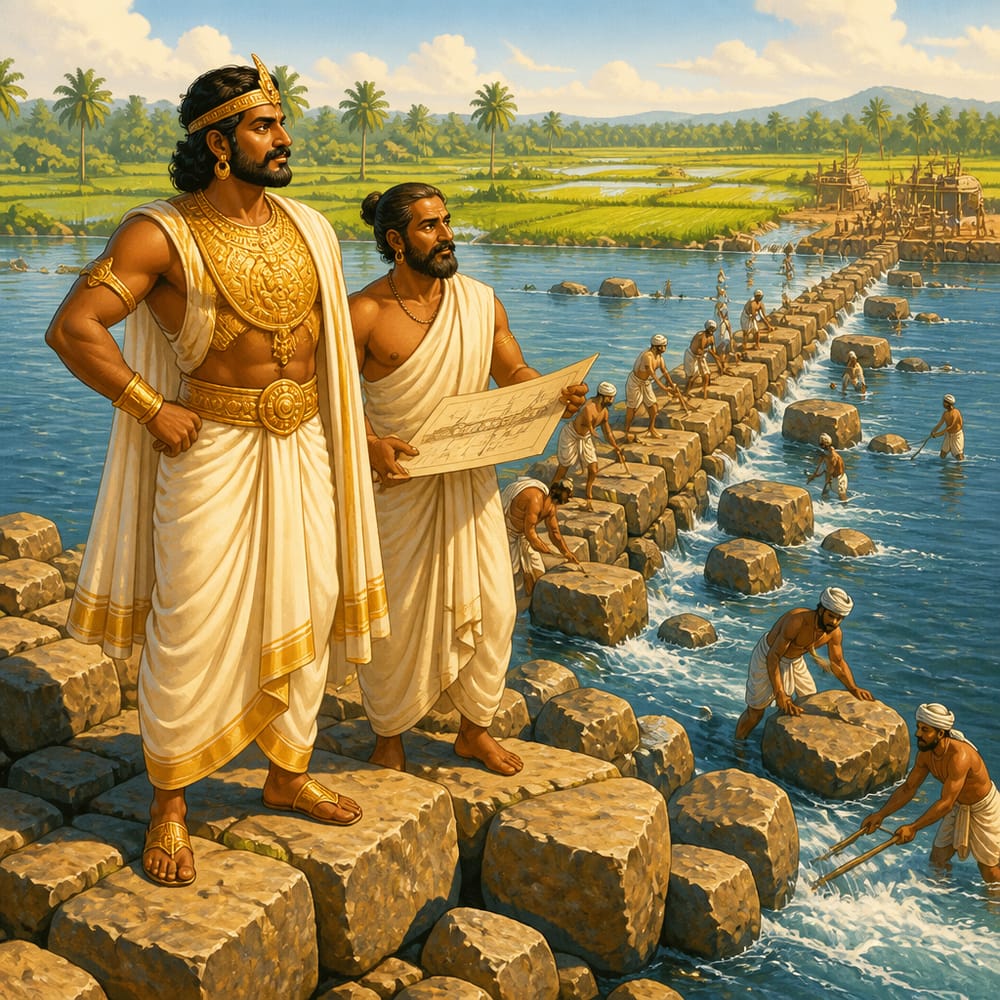
Karikala Chola at Kallanai dam construction

The year is 150 CE. Karikala Chola stands on the banks of the Kaveri near Srirangam, watching his engineers struggle. The river, swollen by monsoon, brings enough water to irrigate a million acres, but only for four months. The rest of the year, it dwindles to a trickle while rice fields crack and farmers starve.

"We cannot command the monsoon," his chief engineer says. "But perhaps we can command the river."

What followed was the construction of the Kallanai (Grand Anicut), a dam built of unhewn stone, 329 meters long, stretching across the Kaveri. It didn't stop the river; it redirected it, diverting water into canals that spread across the delta like veins. Nearly 2,000 years later, the Kallanai still stands, still functions, still irrigates. It is among the oldest water-diversion structures in the world still in use.

Karikala was applying wisdom that Kautilya had systematized centuries earlier: water is the foundation of the kosha.

The Kautilyan Water Doctrine

The Arthashastra devotes extensive attention to water infrastructure, not because Kautilya was personally interested in engineering, but because he understood economics. In a monsoon-dependent land, unpredictable water meant unpredictable harvests, unpredictable taxes, and an unpredictable treasury. State investment in water infrastructure converted this uncertainty into reliability.

"Setu-bandham kritya jalapurnam kshetram krisyabhivardhanam." "Having constructed embankments and water-filled tanks, agriculture shall be enhanced." , Arthashastra 2.24.18

The term setu literally means "bridge" or "embankment," but in Kautilya's usage it encompasses all water infrastructure: dams (bandha), tanks (tadaga), canals (kulya), and wells (kupa). Each served distinct purposes:

Types of Setu in the Arthashastra:

Type Sanskrit Function Economic Impact
Dam Bandha Store monsoon water Multi-season cultivation
Tank Tadaga Local water retention Village-level resilience
Canal Kulya Distribute water to fields Expand irrigated area
Well Kupa Groundwater access Drought insurance
Embankment Setu Flood control, diversion Protect harvest, redirect flow

Critically, Kautilya specified that water infrastructure was a state responsibility, not because private citizens couldn't build wells, but because the economic benefits spilled far beyond individual properties. A canal built by one farmer irrigates fields downstream; a tank that serves a village enables trade with the next. These positive externalities justified state investment.

Global Perspectives on Water and Civilization

Every great civilization has grappled with water management. The comparison reveals both universal principles and distinctive Indian contributions.

Dutch polders with windmills and dykes

The Dutch Polders (12th century onwards): The Netherlands literally created land from sea through dikes, drainage, and water management. Like India, the Dutch developed sophisticated communal institutions (waterschappen) to manage shared water resources. Unlike India's focus on scarcity (storing monsoon water), Dutch engineering addressed excess (keeping the sea out). Both understood: water infrastructure requires collective action.

Karl Wittfogel's "Hydraulic Hypothesis" (1957): The German-American scholar argued that large-scale irrigation required centralized bureaucracies, creating "hydraulic civilizations" with strong states. Critics have modified his thesis, but the core insight resonates with Kautilya: water infrastructure is state-building infrastructure. The Mauryan bureaucracy, with its superintendents of tanks, forests, and agriculture, exemplifies this.

Israeli drip irrigation in a Negev desert farm

Simcha Blass and Israeli Drip Irrigation (1960s): The Israeli engineer revolutionized water efficiency by delivering water directly to plant roots, reducing consumption by 30-50%. Blass wasn't just solving a technical problem; he was addressing Israel's existential water scarcity. His innovation represents water productivity, getting more crop per drop, a concept implicit in Kautilya's emphasis on proper canal maintenance and water distribution.

Thinker/Tradition Core Insight Kautilyan Parallel
Dutch Waterschappen Collective institutions for water management Setu maintenance as community duty
Wittfogel Water infrastructure builds state capacity Kautilya's bureaucracy of water superintendents
Simcha Blass Efficiency, more output per unit water Proper maintenance, canal cleaning, fair distribution

Modern Resonance: The Crisis and the Opportunity

India today faces a water crisis that Kautilya would have recognized instantly. The monsoon remains erratic; groundwater is depleting at alarming rates; rivers are polluted and over-extracted. The Tamil Nadu-Karnataka Kaveri dispute, the Andhra-Telangana Krishna conflict, the Punjab-Haryana Sutlej controversy, all echo ancient challenges of water allocation.

Yet the solutions also echo ancient wisdom:

Revival of Traditional Water Systems: The johad movement in Rajasthan, led by Dr. Rajendra Singh (the "Waterman of India"), revived traditional rainwater harvesting structures. Over 11,000 johads restored in Alwar district increased groundwater levels, revived five rivers, and transformed livelihoods. This is tadaga, the village tank, rediscovered.

Jal Jeevan Mission (2019): The government's flagship program to provide tap water to every rural household by 2024 represents the largest water infrastructure investment in independent India's history, ₹3.6 lakh crore. The logic is Kautilyan: water access enables health, productivity, and prosperity.

M. Visvesvaraya's Legacy: The great engineer (1861-1962) who built the Krishna Raja Sagar dam and designed Hyderabad's flood protection exemplified Kautilyan principles applied with modern engineering. His automatic sluice gates, still studied in engineering schools, maximized water storage while preventing overflow damage. He understood what Kautilya taught: water infrastructure requires both vision and precision.

The Economics of Water Investment

Why should states invest in water infrastructure when farmers could dig their own wells? Kautilya's answer anticipates modern economics:

  1. Positive externalities: Your canal benefits your neighbor's fields. Private investment will be sub-optimal because individuals can't capture all benefits.

  2. Public goods characteristics: A large tank serves many farmers simultaneously (non-excludable, non-rival in many uses). Markets undersupply public goods.

  3. Long time horizons: The Kallanai took years to build; its benefits extended for millennia. Private investors with shorter time horizons won't undertake such projects.

  4. Coordination failures: Effective irrigation requires system-wide planning, who gets water when, how canals connect, how to handle floods. Individual farmers can't coordinate; the state must.

Modern cost-benefit analyses confirm Kautilya's intuition. Studies of irrigation investments in India show returns of 20-40% annually, far exceeding private sector thresholds. The challenge isn't economics but execution.

Your Turn: The Water Wisdom

You might wonder: What does ancient irrigation policy mean for me?

Consider this: every organization, every household, every career faces "water problems", essential resources that require upfront investment, coordination with others, and long-term planning. Your education is a setu, an infrastructure investment with returns extending decades. Your professional network is a kulya, a canal distributing opportunities you couldn't access alone.

The Kautilyan question: What infrastructure investments are you neglecting because the benefits seem distant or diffuse? What "water" does your success depend on that you're leaving to chance?

Next, we examine another infrastructure that enabled ancient prosperity, the patha (roads) that moved goods, troops, and ideas across the subcontinent.

Paul Romer's endogenous growth theory (Nobel Prize 2018) emphasizes how infrastructure investments generate returns far exceeding their direct costs by enabling private activity. Aschauer (1989) estimated that public infrastructure investment yields 35-40% returns in developed economies, even higher in developing ones.

Kautilya understood the multiplier effect intuitively: a state-built canal doesn't just irrigate the immediate fields; it enables downstream irrigation, supports transport, creates fisheries, and raises property values. The kosha recovers its investment many times over.

World Bank studies show that irrigation investments in India yield 20-40% returns annually. The Indira Gandhi Canal in Rajasthan transformed desert into farmland, with irrigated area returning 3-4x the output of rain-fed land.

David Ricardo's theory of comparative advantage (1817) showed that regions should specialize in what they do relatively best. Economic geographers like Paul Krugman (Nobel Prize 2008) extended this to explain why industries cluster. Kautilya's insight, match investment to natural advantage, anticipates both.

India's diversity demanded this thinking. The Mauryan empire included Himalayan forests, Gangetic plains, Deccan plateaus, and coastal ports, each requiring different economic strategies. Uniform policy would have failed; tailored investment succeeded.

Punjab, with canal irrigation since the 1880s, produces 15-20% of India's wheat on 1.5% of its land. The investment matched geography, river-fed plains became the nation's breadbasket. Attempting wheat cultivation in Rajasthan's desert would waste resources.

Key terms

setu
Embankment, dam, bridge; water infrastructure for agriculture
tadaga
Tank, reservoir, pond for water storage
kulya
Canal, irrigation channel distributing water from main source to fields
nadimatruka
River-mothered; land dependent on river water for irrigation

Verses

सेतुबन्धं कृत्वा जलपूर्णं क्षेत्रं कृष्यभिवर्धनम्।

setubandhaṃ kṛtvā jalapūrṇaṃ kṣetraṃ kṛṣyabhivardhanam

Build the embankment, fill the field with water, and watch agriculture flourish.

Modern irrigation studies confirm this relationship. India's Green Revolution succeeded partly because canal irrigation expanded dramatically in the 1960s-70s. Areas with irrigation access show 2-3x higher agricultural productivity than rain-fed regions.

Arthashastra, Book 2, Chapter 24, Verse 18 (R. Shamasastry translation)

नदीमातृकं देशं कृषिप्रधानं च वर्धयेत्।

nadīmātṛkaṃ deśaṃ kṛṣipradhānaṃ ca vardhayet

A land mothered by rivers must be nurtured for agriculture, therein lies its wealth.

This principle guides modern regional planning. Punjab's canal irrigation made it India's breadbasket; Kerala's coast made it a spice trade hub. Matching investment to geographic advantage maximizes returns, a principle Kautilya articulated millennia before Ricardo's theory of comparative advantage.

Arthashastra, Book 2, Chapter 24, Verse 2 (R.P. Kangle critical edition)

उदकमार्गस्य छेदने दण्डः।

udakamārgasya chedane daṇḍaḥ

Who cuts the water's path shall face the king's justice.

Property rights over water remain contentious today. The Arthashastra's approach, water infrastructure belongs to the state, individual use is licensed, damage is punished, anticipates modern water law. Effective water management requires enforceable rules.

Arthashastra, Book 3, Chapter 9, Verse 33 (L.N. Rangarajan)

Key figures

Karikala Chola

Chola king, builder of the Kallanai (Grand Anicut) dam

Sir M. Visvesvaraya

Engineer, statesman, Diwan of Mysore, Bharat Ratna recipient

Simcha Blass

Israeli hydraulic engineer, inventor of modern drip irrigation

Case studies

The Kallanai: 2,000 Years of Functioning Infrastructure

Around 150 CE, Karikala Chola faced a problem: the Kaveri River brought abundant water during monsoon months but dwindled to inadequacy the rest of the year. The delta's agricultural potential was limited to single-season rice cultivation. Karikala's engineers proposed an audacious solution: a dam built not of cut stone or concrete (unavailable at that scale) but of unhewn stones laid in a precise gradient. The structure, 329 meters long, 20 meters wide, 5.4 meters high, wouldn't stop the river but divert it into canals spreading across the delta. Construction required moving thousands of tonnes of stone without modern machinery. The design required precise hydraulic calculations, too steep and the dam would erode; too gentle and it wouldn't divert water. Failure would mean wasted resources and continued famine.

Kautilya would recognize the Kallanai as perfect setu philosophy: massive state investment in infrastructure with benefits extending far beyond any individual landholder. The dam's costs were borne collectively (by the state, ultimately by taxpayers); its benefits were distributed across the entire delta. The dharmic dimension: Karikala was building not for himself, he would die long before the dam's full benefits materialized, but for generations unborn. This is dana (giving) as infrastructure, the king's duty to leave his kingdom better than he found it. The construction also required what we'd now call 'social capital': thousands of workers coordinating without modern communication, engineers applying knowledge passed through generations, a state capable of mobilizing resources for long-term projects. These institutional capabilities are themselves infrastructure.

The Kallanai succeeded beyond imagination. It transformed the Kaveri delta into one of the world's most productive agricultural regions, enabling year-round rice cultivation across 370,000+ acres. The dam facilitated the Chola Empire's prosperity for centuries. Most remarkably, it still works. In 1839, British engineer Arthur Cotton examined the Kallanai while planning his own irrigation works. He was so impressed that he restored and expanded it rather than replacing it. Today, 2,000 years after construction, the Kallanai remains operational, perhaps the world's oldest functioning dam. The infrastructure outlasted the dynasty that built it, the language that named it, and the economic system it was designed for. The returns on Karikala's investment continue to compound.

Infrastructure built to last generates returns across millennia. The Kallanai's initial cost, however enormous for its time, has been repaid countless times over. This is the setu principle at maximum: upfront investment, compounding returns, intergenerational benefit.

The Kallanai principle, building infrastructure that lasts centuries, challenges modern cost-benefit analysis that discounts anything beyond 30 years to near-zero. India's current dam safety rehabilitation program covers 736 dams, recognizing that maintaining ancient infrastructure is cheaper than replacing it.

The Kallanai has irrigated the Kaveri delta for approximately 1,900 years. At even modest agricultural returns, the cumulative economic value exceeds any meaningful calculation. The ROI on Karikala's investment approaches infinity.

Israel's Drip Revolution: When Scarcity Breeds Innovation

In the 1930s, Israeli engineer Simcha Blass noticed something curious: a tree near a leaking water pipe grew larger than identical trees receiving flood irrigation. Water dripping slowly at the roots was more effective than water flooding the surface. This observation became the foundation of drip irrigation, delivering water directly to plant roots through a network of tubes and emitters. The system used 30-50% less water than flood irrigation while increasing yields. For water-scarce Israel, this wasn't just efficiency; it was survival. Blass spent decades perfecting the technology. The breakthrough came in the 1960s when Israeli company Netafim commercialized drip systems. Israel transformed from a water importer to a water exporter, not of water itself, but of water technology, crops grown with minimal water, and expertise in arid agriculture.

Kautilya focused on water supply, building setu to capture and distribute water. Blass focused on water demand, reducing how much water each plant needed. Both understood that water management is economic management. The dharmic principle here is aparigraha, non-excess, taking only what is needed. Flood irrigation wastes water through evaporation, runoff, and delivery to weeds. Drip irrigation practices aparigraha, precise delivery of exactly what's needed, where it's needed, when it's needed. Israel's success also demonstrates jugaad elevated: turning constraint (water scarcity) into advantage (water innovation). The nation now exports $2+ billion annually in agricultural technology, much of it water-related. Scarcity bred innovation that became export.

Drip irrigation spread globally. India, facing its own water crisis, adopted the technology extensively. By 2024, India had over 10 million hectares under micro-irrigation (drip and sprinkler), up from virtually zero in 2000. The Pradhan Mantri Krishi Sinchayee Yojana targets 69 million hectares. Israel's example shows that water challenges can become water opportunities. The constraint of scarcity forced innovation that now serves the world. India, with far greater water challenges, has similar potential, if it can match Israeli focus and execution.

Water management requires both supply (Kautilya's setu) and efficiency (Blass's drip). India needs to build infrastructure AND use water wisely. Kautilyan dams filling Israeli-style drip systems would multiply the benefits of both.

India now has over 10 million hectares under micro-irrigation, with a target of 69 million hectares under PMKSY. As groundwater depletion accelerates across Punjab, Rajasthan, and Tamil Nadu, the shift from flood to drip irrigation is no longer optional but existential.

India's water use efficiency averages 35-40% (meaning 60-65% is wasted). Drip irrigation can push this above 90%. If India achieved Israeli efficiency levels, current water supply could irrigate 2-3x more land.

Historical context

Mauryan to Chola periods (300 BCE - 300 CE)

Ancient India developed sophisticated water management systems suited to monsoon climate. Unlike Egypt (dependent on single Nile flood) or Mesopotamia (twin rivers), India faced the challenge of extreme seasonal variation. Four months of monsoon had to supply twelve months of water needs. This required storage infrastructure (tanks, reservoirs) and distribution networks (canals) that exceeded anything in the contemporary world.

Roman aqueducts are justly famous, but they solved a different problem, transporting water to cities. Indian setu solved agricultural water needs at unprecedented scale. The Kallanai alone irrigated more land than all Roman aqueducts combined served populations. China's Grand Canal (6th century CE) is the closest parallel, but came centuries later.

Archaeological surveys suggest the Mauryan empire maintained over 4,000 significant water structures, tanks, dams, and canal networks. By some estimates, ancient India had more irrigated land per capita than modern India did in 1947.

Understanding ancient water infrastructure reveals that India's current water crisis is not inevitable. The subcontinent has been made productive before, through deliberate investment and maintenance. The knowledge exists; the challenge is political and economic will.

Reflection

More in State Enterprises & Infrastructure

All lessons in State Enterprises & Infrastructure · Arthashastra: Economic Principles course