Patha-Nirmana: Roads as Economic Multipliers
The Highways That Built Empires
From Kautilya's systematic road network to Sher Shah Suri's Grand Trunk Road to today's Bharatmala, road infrastructure has shaped India's economic destiny. Kautilya understood what modern economists would formalize millennia later: roads don't just move goods, they multiply economic activity, integrate markets, and strengthen the state.
The Sultan Who Built a Nation's Spine
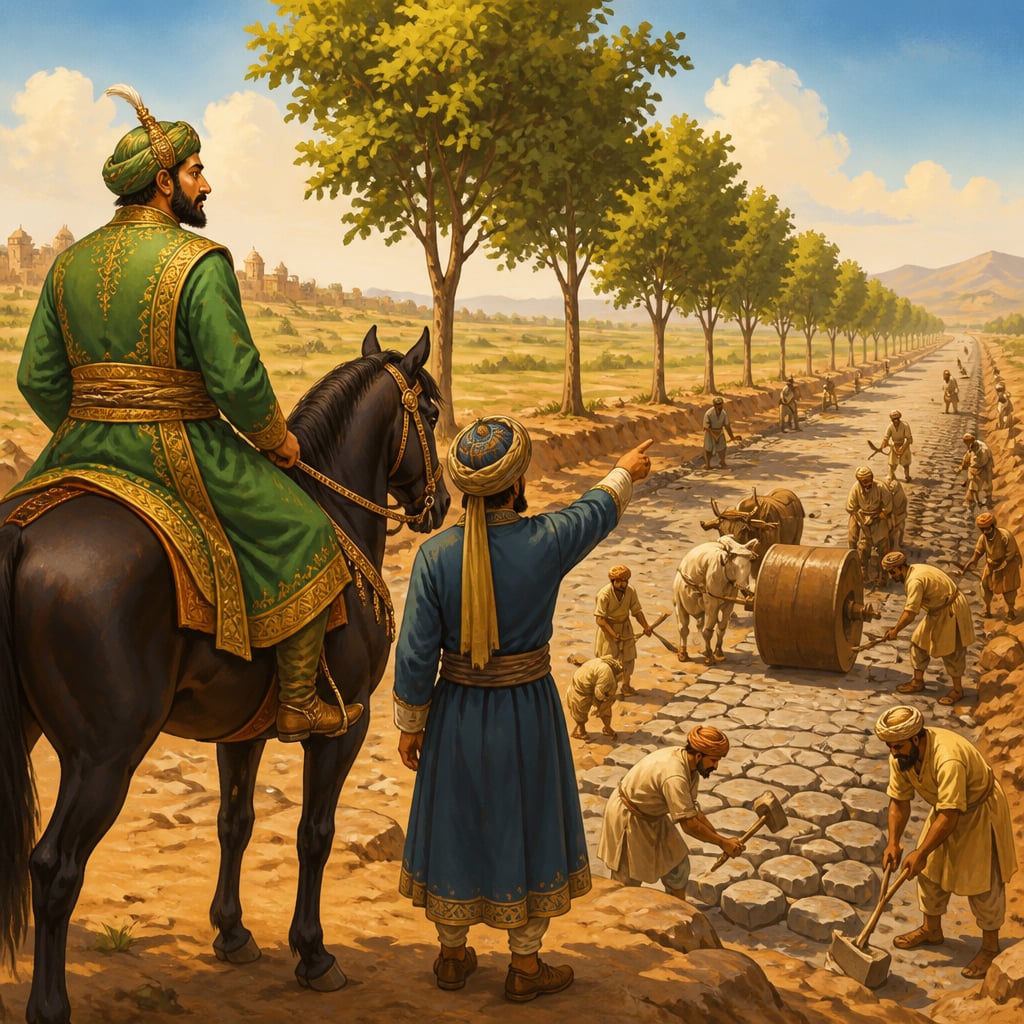
The year is 1542. Sher Shah Suri, the Afghan who displaced the mighty Mughals, faces a strategic problem. His empire stretches from Bengal to the Indus, but governing it is nearly impossible. Messages take weeks; armies move slower than rumors; traders avoid dangerous routes. The empire is vast but fragmented.
Sher Shah's solution: a road. But not just any road, a highway stretching 2,500 kilometers from Sonargaon (modern Bangladesh) to Peshawar (modern Pakistan), with rest houses (sarais) every few miles, wells for water, and trees planted for shade. He called it Sadak-e-Azam, the Grand Road. The British would later name it the Grand Trunk Road.
In just five years of rule before his death, Sher Shah transformed the subcontinent. The road that moved his armies also moved merchants, pilgrims, ideas. Markets that had been isolated became connected. Prices equalized. Trade flourished. Rudyard Kipling would later write: "Look! Look again! The whole world goes to and fro upon the Grand Trunk Road."
Sher Shah was applying principles that Kautilya had articulated nearly two thousand years earlier.
Kautilya's Road Doctrine: Patha as Economic Infrastructure
The Arthashastra treats roads (patha, marga, rajapatha) not as mere pathways but as economic infrastructure requiring systematic planning and maintenance. Kautilya classified roads by purpose, width, and strategic importance:
"Rajamarga sarva-vanijya-gaminam. Rashtra-setu-baddha-marga-nirmana karya." "The king's highway shall be open to all merchants. Road construction binding the kingdom shall be undertaken." , Arthashastra 2.4.1-2
The term rashtra-setu is striking: roads as "bridges binding the kingdom." Just as water setu connected agricultural lands, road setu connected economic zones. Without roads, the kingdom fragments into isolated villages; with roads, it becomes an integrated market.
Kautilya's Road Classification:
| Type | Sanskrit | Width | Purpose | Economic Function |
|---|---|---|---|---|
| King's Highway | Rajamarga | 4 dandas (24 ft) | Major trade routes | Interstate commerce |
| Provincial Road | Rashtra-patha | 3 dandas (18 ft) | Regional connectivity | District markets |
| Village Road | Grama-marga | 2 dandas (12 ft) | Local access | Farm-to-market |
| Cattle Path | Pasu-patha | 1 danda (6 ft) | Livestock movement | Agricultural support |
Critically, Kautilya mandated road maintenance (patha-samskarana) as a state duty, not optional. He understood what modern transport economists would formalize: deteriorating roads impose costs far exceeding maintenance savings. A road that takes 10% longer to traverse costs merchants time, increases transport expenses, and raises prices for everyone.
Global Perspectives on Roads and Empire
"All roads lead to Rome", the famous phrase captures the Roman Empire's understanding of road infrastructure. But the comparison between Roman and Indian approaches reveals important distinctions.

The Roman Road System (312 BCE onwards): Starting with the Via Appia (built by Appius Claudius Caecus), Rome constructed 80,000+ kilometers of roads across its empire. Roman roads were military infrastructure first, commercial second, built straight for rapid troop movement regardless of terrain. They were engineering marvels: paved, drained, durable. But their rigid design often ignored commercial logic; traders sometimes preferred longer natural routes that served markets better.
Dwight Eisenhower and the Interstate System (1956): The American president, having witnessed German autobahns during WWII, championed the Federal-Aid Highway Act creating 66,000+ kilometers of interstate highways. Eisenhower's explicit justifications were defense (evacuating cities during nuclear attack) and commerce (efficient interstate trade). The system transformed American economics: suburbs became viable, trucking replaced rail for many goods, and regional markets integrated into a national economy.
John McAdam (1756-1836): The Scottish engineer invented "macadamization", roads built from compacted stone layers that shed water naturally. Before McAdam, roads became impassable in rain; after him, year-round commerce became possible. His technical innovation enabled economic connectivity.
| Thinker | Core Insight | Kautilyan Parallel |
|---|---|---|
| Roman Builders | Roads enable military control | Kautilya's emphasis on rapid troop movement |
| Eisenhower | Defense + commerce integration | Rashtra-setu: roads binding the kingdom |
| McAdam | Technical quality enables economic value | Patha-samskarana: maintenance as economic investment |
What distinguishes Kautilya is the explicit economic framing. Roman roads served military and administrative purposes primarily; commerce was incidental. Eisenhower justified highways through defense. Kautilya placed commerce at the center: roads exist to move goods, integrate markets, and fill the treasury.
Modern Resonance: From GT Road to PM Gati Shakti
India's road story since independence has been one of chronic underinvestment followed by dramatic catch-up. In 1947, India had approximately 400,000 km of roads, mostly unpaved. By 2024, the network exceeds 6.4 million km, the second largest in the world, with 140,000+ km of national highways.

The transformation accelerated under Nitin Gadkari, Union Minister for Road Transport and Highways since 2014. His tenure has seen:
- Highway construction pace increase from 12 km/day (2014) to 37 km/day (2024)
- The Bharatmala Pariyojana: ₹10 lakh crore program to build 83,000 km of roads
- Expressway network expansion from near-zero to 4,000+ km operational
- PM Gati Shakti: integrated infrastructure planning connecting roads, rail, ports, and airways
Gadkari frequently invokes economic logic: "Every rupee spent on highways returns ₹3-4 in economic activity." This is the multiplier effect that Kautilya understood intuitively. Roads don't just move existing trade; they create new trade by making previously uneconomical exchanges viable.
The Mumbai-Delhi Expressway (1,380 km), when complete, will reduce travel time from 24 hours to 12 hours. But the economic impact extends far beyond time savings: industrial corridors along the route, agricultural land connected to urban markets, tourism opportunities previously unreachable. Every kilometer is a multiplier.
The Economics of Road Investment
Why do roads generate returns exceeding their costs? Modern economics provides frameworks that validate Kautilya's intuition:
Reduced transaction costs: Lower transport costs mean more viable trades. Products that couldn't profitably reach distant markets now can. The surplus from trade is shared between producers and consumers.
Market integration: Connected markets equalize prices. Grain that rotted in one region while people starved in another, a common pre-modern tragedy, becomes preventable when roads connect surplus and deficit areas.
Specialization: Adam Smith's division of labor is limited by the extent of the market. Roads extend markets, enabling specialization. A village can grow cash crops knowing they'll reach buyers; a craftsman can specialize knowing customers exist.
Agglomeration effects: Roads enable clustering of economic activity. Industrial corridors form along highways; cities grow at intersections. These clusters generate additional productivity beyond individual firm contributions.
Knowledge spillovers: Roads move ideas as well as goods. Sher Shah's sarais became centers of news exchange; modern highways enable training programs, consultancy visits, and knowledge transfer.
Studies estimate that road investments in India generate 20-60% annual returns, varying by route. Connecting isolated regions yields higher returns than adding capacity to already-connected areas, the first road to a village transforms everything; the second lane on an existing highway helps at the margin.
Your Turn: Roads in Your Life
The metaphor extends: what "roads" connect you to opportunities? Your network is a highway system, some connections are superhighways (strong relationships enabling major opportunities), others are village paths (occasional value but limited capacity).
Kautilya's principles apply:
- Classification matters: Not all connections need equal investment. Identify your rajamarga (strategic relationships) versus grama-marga (local connections).
- Maintenance is essential: Relationships deteriorate without attention. Occasional reconnection maintains the infrastructure.
- New routes create new value: Connections outside your existing network open opportunities invisible from your current position.
The question: Are you building roads, or waiting for someone else to connect you?
Next, we examine the destinations those roads served, the durga (fortified cities) that anchored ancient economies and reveal surprising parallels to modern urban planning.
Infrastructure-Led Development / Transport Economics
Paul Krugman's work on economic geography (Nobel Prize 2008) shows how reduced transport costs enable market integration and specialization. Jeffrey Sachs has argued that landlocked countries with poor infrastructure face persistent poverty traps. Both confirm Kautilya's insight: connectivity creates prosperity.
Kautilya placed infrastructure at the center of economic policy, not as afterthought. Modern India's PM Gati Shakti integrates this thinking: infrastructure isn't just spending but strategic investment enabling all other economic activity.
World Bank estimates that a 10% reduction in transport costs increases trade volumes by 20%+. India's logistics costs (14% of GDP) remain higher than China (8%) or USA (8%), suggesting enormous gains from infrastructure improvement.
Modern infrastructure economics confirms Kautilya's insight. The American Society of Civil Engineers estimates that every $1 of delayed road maintenance costs $4-5 in eventual repairs. Poor road maintenance costs the US economy $130 billion annually in vehicle repairs and lost productivity.
India historically underinvested in road maintenance, creating a massive backlog. The Ministry of Road Transport now allocates 10%+ of budgets to maintenance, recognizing that well-maintained roads have 2-3x the useful life of neglected ones.
Key terms
- rajamarga
- King's highway; major road for interstate commerce and military movement
- rashtra-setu
- Kingdom-bridge; infrastructure that binds and integrates the nation
- pathi-samskara
- Road maintenance; continuous repair and upkeep of transportation infrastructure
- sarai
- Rest house; roadside accommodation for travelers on major routes
Verses
राजमार्गः सर्व-वाणिज्य-गामिनाम्।
rājamārgaḥ sarva-vāṇijya-gāminām
The king's highway exists for all who carry commerce.
Public infrastructure serving private commerce, this is the essence of state investment in economic infrastructure. The state bears the cost; merchants (and through them, consumers) reap the benefit; the treasury recovers investment through taxes on increased trade.
Arthashastra, Book 2, Chapter 4, Verse 1 (R. Shamasastry translation)
राष्ट्र-सेतु-बद्ध-मार्ग-निर्माणं कार्यम्।
rāṣṭra-setu-baddha-mārga-nirmāṇaṃ kāryam
Roads that bind the kingdom together shall be built.
This is the earliest explicit articulation of infrastructure as nation-building. PM Gati Shakti's vision, integrated multimodal connectivity, echoes this ancient insight. Roads create not just physical but economic and political integration.
Arthashastra, Book 2, Chapter 4, Verse 2 (R.P. Kangle critical edition)
पथि-संस्कारं नित्यं कारयेत्।
pathi-saṃskāraṃ nityaṃ kārayet
Let roads be maintained without cease.
Modern studies confirm: ₹1 spent on timely maintenance saves ₹4-5 in eventual reconstruction. India's historical neglect of road maintenance, leading to potholes, accidents, and delays, represents a departure from Kautilyan principles that carries enormous economic cost.
Arthashastra, Book 2, Chapter 4, Verse 18 (L.N. Rangarajan)
Key figures
Sher Shah Suri
Afghan ruler of North India, builder of the Grand Trunk Road
Nitin Gadkari
Union Minister for Road Transport and Highways (2014-present)
Dwight D. Eisenhower
34th President of the United States, champion of the Interstate Highway System
Case studies
PM Gati Shakti: Kautilyan Infrastructure for the 21st Century
In October 2021, Prime Minister Modi launched PM Gati Shakti, a ₹100 lakh crore ($1.2 trillion) integrated infrastructure plan. The ambition was unprecedented: coordinate 16 ministries around unified infrastructure planning, eliminating the fragmentation that had plagued Indian development. The problem being solved was classic coordination failure. A highway would be built, then dug up for laying cables. A port would expand, but connecting roads lagged behind. Industrial corridors were planned without ensuring power supply. Each ministry optimized individually; the system underperformed collectively. Gati Shakti created a unified digital platform mapping all infrastructure, existing and planned, across roads, railways, ports, airports, waterways, power, and telecom. Before any project receives approval, planners check for synergies and conflicts across ministries. Bharatmala, the highway component, targets 83,677 km of new roads including 26,000 km of economic corridors, 9,000 km of feeder routes, and 6,000 km connecting ports and border areas.
Kautilya would recognize Gati Shakti as his rashtra-setu principle scaled to continental dimensions. The Arthashastra insisted on integrated planning, water infrastructure coordinated with agricultural development, roads connecting mines to markets, ports linking trade routes to production centers. The dharmic innovation is coordination as dharma. When ministries operate in silos, they may individually fulfill their mandates while collectively failing the nation. Gati Shakti establishes that infrastructure planning requires subordinating departmental interests to national integration, a form of institutional dharma. The multimodal approach also reflects Kautilyan pragmatism. He didn't prefer roads over waterways or land routes over sea routes, he advocated whatever moved goods most efficiently. Gati Shakti's integration of highways, railways, waterways, and airways embodies this pragmatic flexibility.
Early results show promise: highway construction reached 37 km/day in 2023-24, up from 12 km/day in 2014. The Delhi-Mumbai Expressway and Delhi-Meerut Expressway demonstrate world-class infrastructure. Coordination has improved, the platform identified 1,300+ multi-ministry projects requiring synchronization. Challenges remain: land acquisition delays, environmental clearances, financing constraints, and execution capacity across states. The full vision will take a decade or more to realize. But the strategic shift is real: India has moved from reactive, fragmented infrastructure building to proactive, integrated infrastructure planning. This is Kautilya's rashtra-setu elevated to national strategy.
Infrastructure effectiveness depends on integration, not just investment. ₹100 lakh crore spent uncoordinatedly would yield far less than the same amount spent with Gati Shakti-style integration. Kautilya's rashtra-setu requires not just building roads but binding the kingdom through coordinated connectivity.
Gati Shakti's integrated planning platform is being expanded to include state-level infrastructure projects, creating a single digital layer for all public construction. The approach addresses the core problem that plagued Indian infrastructure for decades: ministries building in isolation without coordinating connectivity.
Logistics cost as percentage of GDP: India 14%, China 8%, USA 8%. If India achieves Chinese efficiency through Gati Shakti, the savings would exceed ₹7 lakh crore annually, paying for the program many times over.
Historical context
Mughal Period (16th century CE)
The Grand Trunk Road connected areas that had been economically separate for centuries. Before Sher Shah, traveling from Bengal to Punjab was dangerous, expensive, and rare. After his road (and sarais), merchants could travel safely, knowing accommodation awaited. This connectivity transformed trade patterns, Bengali muslin reaching Lahore markets, Punjabi horses reaching Bengal buyers.
Sher Shah's achievement is comparable to Roman road-building compressed into five years. The Via Appia took decades to extend from Rome to Brindisi (540 km); Sher Shah's Grand Trunk Road (2,500 km) was built in five years. The sarais every few miles exceeded Roman *mansiones* in frequency and quality.
Sher Shah's Grand Trunk Road covered approximately 2,500 km with 1,700 sarais, one roughly every 1.5 km. This density of support infrastructure enabled travel speeds and security unprecedented in South Asian history.
Understanding the Grand Trunk Road reveals that India's infrastructure challenges aren't new. Solutions existed, Sher Shah proved it in five years. The question is always political will and execution capacity, not technical possibility.
Reflection
- Sher Shah Suri built infrastructure that outlasted his dynasty by centuries. What infrastructure, physical, institutional, or relational, might you create that outlasts your direct involvement? What would it mean to think in such long time horizons?
- Apply the rashtra-setu concept to your professional or personal life: What disconnected areas would benefit from better 'roads' between them? Where are coordination failures creating inefficiency? What would integration enable that fragmentation prevents?