PM Gati Shakti: Kautilyan Infrastructure Vision
Integrating the Seven Pillars of State Power
PM Gati Shakti represents the most ambitious application of Kautilyan integrated infrastructure thinking since independence. By connecting roads, railways, ports, airports, waterways, power, and telecom through unified planning, India is attempting what Kautilya advocated 2,300 years ago: rashtra-setu, binding the kingdom through coordinated connectivity.
The Minister Who Mapped the Kingdom
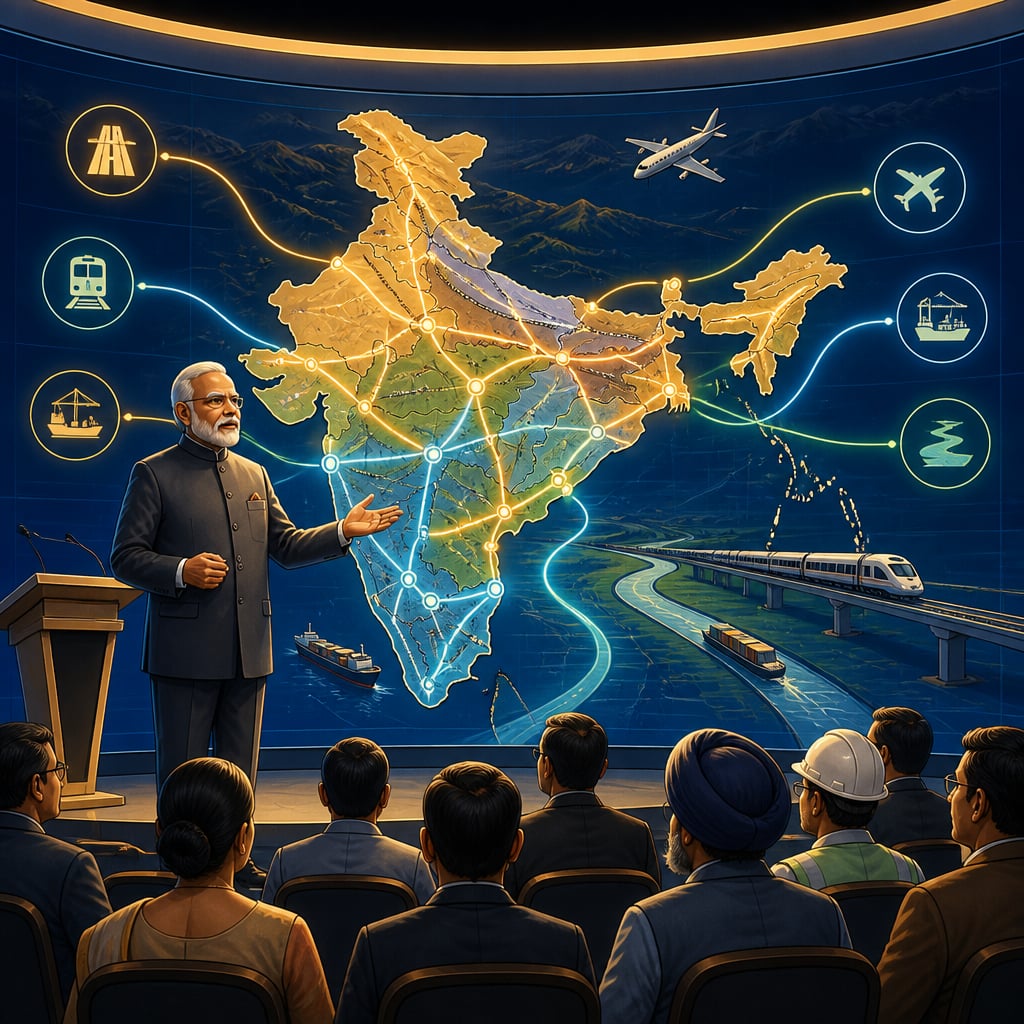
In October 2021, Prime Minister Modi unveiled a digital map unlike any India had seen. PM Gati Shakti's GIS platform displayed every road, railway, port, airport, waterway, pipeline, and power line, existing and planned, across the entire nation. Sixteen ministries' infrastructure projects appeared on a single screen, their intersections and conflicts visible for the first time.
The scene recalled another mapping exercise from 2,300 years earlier. The Arthashastra describes how Kautilya's administrators maintained detailed records of infrastructure across the Mauryan empire, mines, roads, warehouses, forts, irrigation systems, all coordinated through central planning. The technology differs; the principle remains identical: integrated infrastructure planning multiplies economic returns.
Gati Shakti means "speed and strength", an apt translation of what Kautilya sought through infrastructure: the velocity of commerce and the resilience of the state.
The Kautilyan Integration Principle
Throughout this chapter, we've examined infrastructure elements separately: khani (mines), karmanta (factories), setu (water systems), patha (roads), durga (cities). But Kautilya never conceived these as independent investments. The Arthashastra presents them as an integrated system:
"Dravya-kosha-danda-mitra-mula-sampad rashtra-vriddhi-karanam." "Resources, treasury, army, allies, and territory, together, cause the kingdom to grow." , Arthashastra 6.1.1
The key word is together. Resources without roads to move them are worthless. Factories without ports to export products are uncompetitive. Cities without water systems are unsustainable. The value of each investment depends on all others.
This is the rashtra-setu principle extended: not just roads binding the kingdom, but all infrastructure types binding together to multiply their collective value.
The Kautilyan Infrastructure Matrix:
| Element | Isolated Value | Integrated Value |
|---|---|---|
| Mine | Raw ore at site | Processed metal at factory via road |
| Road | Path between points | Economic corridor connecting production to markets |
| Port | Ships at dock | Gateway connecting domestic production to global demand |
| Factory | Products in warehouse | Manufactured goods reaching consumers via multimodal logistics |
| City | Population concentration | Economic hub connecting all infrastructure types |
The modern term is "network effects" or "infrastructure externalities." The Kautilyan insight: integrated infrastructure yields returns far exceeding the sum of individual investments.
The Delhi-Mumbai Industrial Corridor: Kautilya Scaled

The Delhi-Mumbai Industrial Corridor (DMIC) represents the most ambitious application of integrated infrastructure thinking in independent India's history. Spanning 1,504 km across six states (Delhi, Haryana, Rajasthan, Gujarat, Madhya Pradesh, Maharashtra), DMIC combines:
- Dedicated Freight Corridor: High-speed rail for goods movement
- Industrial nodes: Eight new manufacturing cities along the corridor
- Road connectivity: Expressways linking industrial nodes to existing cities
- Port access: Connections to JNPT, Kandla, and other western ports
- Power infrastructure: Integrated power generation and distribution
- Smart cities: Advanced urban infrastructure at each node
Total investment: ₹100,000 crore+ (approximately $120 billion when including all components).
This is Kautilya's rashtra-setu at continental scale. The corridor doesn't just move goods from Delhi to Mumbai; it creates an entirely new economic geography, manufacturing zones that would be unviable without the integrated infrastructure surrounding them.
The DMIC as Kautilyan Integration:
| Kautilyan Element | DMIC Component | Economic Function |
|---|---|---|
| Khani (resources) | Raw material access | Steel from Bhilai, chemicals from Jamnagar |
| Karmanta (manufacturing) | Industrial nodes | Eight new manufacturing cities |
| Patha (roads) | Expressways | Last-mile connectivity to production sites |
| Setu (water) | Water supply | Industrial water for manufacturing nodes |
| Durga (cities) | Smart cities | Urban infrastructure enabling workforce |
| Nau (ports) | Western ports | Export access for manufactured goods |
Global Perspectives on Integrated Infrastructure
India isn't alone in pursuing integrated infrastructure strategies. The comparison reveals lessons and distinctions.

China's Belt and Road Initiative (BRI): The $1 trillion+ program connects Chinese production to global markets through coordinated road, rail, port, and pipeline investments across 140+ countries. Like Gati Shakti, BRI integrates multiple infrastructure types; unlike Gati Shakti, it's external (connecting China to the world) rather than internal (connecting India to itself). The lesson: infrastructure strategy should match strategic objectives.
Germany's Industry 4.0: The German program integrates digital infrastructure with physical manufacturing, smart factories connected through high-speed networks. This is karmanta for the digital age: manufacturing upgraded through information integration. India's Smart Cities Mission and Digital India draw from similar thinking.
Japan's Development State Model (1950s-1980s): Post-war Japan coordinated industrial policy with infrastructure investment through MITI (Ministry of International Trade and Industry). Roads were built where factories were planned; ports expanded where exports were anticipated. This coordination, anticipating demand rather than reacting to it, accelerated development. Gati Shakti attempts similar anticipatory coordination.
| Model | Integration Focus | Kautilyan Parallel |
|---|---|---|
| Belt & Road | External connectivity | Maritime trade routes in Arthashastra |
| Industry 4.0 | Digital-physical integration | Karmanta protocols with modern technology |
| Japan MITI | Industrial-infrastructure coordination | Centralized planning in Mauryan bureaucracy |
| Gati Shakti | Multimodal domestic connectivity | Rashtra-setu binding the kingdom |
The distinctive Indian contribution: explicit integration across 16 ministries through a unified digital platform. This addresses India's historical weakness, ministerial silos, through technology rather than organizational restructuring.
The 2047 Vision: Viksit Bharat Through Infrastructure
PM Gati Shakti isn't just an infrastructure program, it's the physical foundation for India's ambition to become a developed nation by 2047, the centenary of independence.
The math is daunting. To reach developed-nation status ($12,000+ GDP per capita), India must roughly triple its economic output in 23 years while adding 200+ million to its workforce. This requires:
- Manufacturing scale: From 15% to 25% of GDP
- Urban capacity: Accommodating 300+ million additional urban residents
- Export capability: Growing from $450 billion to $2+ trillion annually
- Logistics efficiency: Reducing costs from 14% to 8% of GDP
No nation has achieved such transformation without massive infrastructure investment. China invested 8-9% of GDP in infrastructure for decades; India invests 4-5%. Gati Shakti represents the commitment to close this gap.
The 2047 Infrastructure Targets:
| Element | 2024 Status | 2047 Target | Investment Needed |
|---|---|---|---|
| National Highways | 145,000 km | 200,000+ km | ₹10+ lakh crore |
| Railways | 68,000 km | 100,000+ km | ₹10+ lakh crore |
| Major Ports | 12 | 20+ | ₹2+ lakh crore |
| Airports | 150 | 250+ | ₹3+ lakh crore |
| Power Transmission | 450,000 ckm | 800,000+ ckm | ₹5+ lakh crore |
Gati Shakti's value isn't just the investment volume, it's the coordination ensuring these investments reinforce rather than duplicate each other.
Your Turn: Thinking in Systems
The Kautilyan lesson extends beyond national infrastructure. Every complex endeavor, career, business, community, benefits from integrated thinking.
Consider your professional development through the Gati Shakti lens:
- Skills (your karmanta): Are they connected to opportunities?
- Network (your patha): Does it link you to where value flows?
- Credentials (your durga): Do they protect and enable your position?
- Resources (your khani): Are they being developed or depleted?
- Health (your setu): Does it sustain all other activities?
The Kautilyan question: Are these elements integrated, reinforcing each other, or isolated, each vulnerable to separate failure?
Leaders who think in systems outperform those who optimize components. Gati Shakti is systemic thinking applied to a nation. The principle applies at every scale.
Next, we conclude with the relevance of these ancient principles for 2026 and beyond, how Kautilyan infrastructure thinking informs India's path to Viksit Bharat and your role in that journey.
Robert Metcalfe formulated that network value grows with connections squared. Applied to infrastructure: a road connecting A to B has limited value; a road network connecting all points has exponentially more value. Gati Shakti aims to capture these network effects through integration.
India's historical weakness, ministerial silos, meant infrastructure investments often failed to connect. A highway would end where railway jurisdiction began; a port would lack road access. Gati Shakti addresses this through forced coordination, potentially unlocking decades of trapped network value.
McKinsey estimates that coordinated infrastructure planning can increase investment returns by 20-40% through reduced redundancy and improved intermodal connections. Applied to Gati Shakti's ₹100 lakh crore, this coordination could yield ₹20-40 lakh crore in additional value.
Amartya Sen (Nobel Prize 1998) argues that development is 'freedom', the expansion of human capabilities. This requires material foundations: adequate nutrition, healthcare, education, economic opportunity. Infrastructure enables these capabilities by connecting people to services and markets.
Kautilya's framework integrates economic and ethical development, artha serves dharma and kama. This prevents both spiritual bypassing (ignoring material needs) and pure materialism (ignoring higher purposes). Infrastructure investment serves civilizational goals.
World Bank research shows that a 10% increase in infrastructure access increases poverty reduction rates by 7%. India's infrastructure expansion isn't just GDP growth, it's enabling millions to pursue higher aspirations.
Key terms
- rashtra-vriddhi
- National growth; expansion of the kingdom's prosperity and power
- saptanga
- Seven limbs; the seven constituent elements of the state
- gatishakti
- Speed and strength; momentum and power combined
- samanvaya
- Coordination; harmonious integration of parts
Verses
द्रव्य-कोष-दण्ड-मित्र-मूल-सम्पद् राष्ट्र-वृद्धि-कारणम्।
dravya-koṣa-daṇḍa-mitra-mūla-sampad rāṣṭra-vṛddhi-kāraṇam
Resources, treasury, army, allies, and territory, together in prosperity, cause the kingdom to flourish.
This is systems thinking applied to statecraft. Modern development economics recognizes similar interdependencies: infrastructure enables industry; industry generates taxes; taxes fund more infrastructure. Gati Shakti operationalizes this integrated vision.
Arthashastra, Book 6, Chapter 1, Verse 1 (R. Shamasastry translation)
अर्थ-मूलौ हि धर्म-कामौ।
artha-mūlau hi dharma-kāmau
Material prosperity is the root of both righteousness and fulfillment.
Kautilya's hierarchy anticipates Maslow: material needs must be met before higher pursuits become possible. Infrastructure investment isn't just economic policy, it enables the entire civilizational project. Viksit Bharat requires artha-vriddhi.
Arthashastra, Book 7, Chapter 1, Verse 6 (R.P. Kangle critical edition)
सुखस्य मूलं धर्मः। धर्मस्य मूलम् अर्थः। अर्थस्य मूलं राज्यम्। राज्यस्य मूलम् इन्द्रिय-जयः।
sukhasya mūlaṃ dharmaḥ | dharmasya mūlam arthaḥ | arthasya mūlaṃ rājyam | rājyasya mūlam indriya-jayaḥ
Happiness springs from dharma; dharma from prosperity; prosperity from the state; the state from self-mastery.
The causal chain justifies state investment in infrastructure: without effective governance providing economic foundations (artha), citizens cannot pursue higher goods (dharma, sukha). Gati Shakti is ultimately about enabling Indian citizens to flourish.
Arthashastra, Book 2, Chapter 1, Verse 1 (L.N. Rangarajan)
Key figures
Kautilya (Chanakya)
Political strategist, economist, author of the Arthashastra
Narendra Modi
Prime Minister of India (2014-present), architect of PM Gati Shakti
Deng Xiaoping
Paramount leader of China (1978-1989), architect of economic reforms
Case studies
Delhi-Mumbai Industrial Corridor: Rashtra-Setu for the 21st Century
In 2006, India and Japan agreed to jointly develop the Delhi-Mumbai Industrial Corridor (DMIC), a 1,504 km industrial zone along the Dedicated Freight Corridor connecting India's political and commercial capitals. The vision was unprecedented: create not just a road or railway, but an entirely new economic geography. Eight new industrial cities would be built from scratch. The Dedicated Freight Corridor would move goods at speeds and volumes impossible on existing railways. Expressways would provide last-mile connectivity. Ports would link production to global markets. Power plants would provide reliable electricity. Water infrastructure would support industrial operations. Total investment: $100+ billion over two decades. The first industrial nodes, Dholera (Gujarat), Aurangabad Industrial City (Maharashtra), Integrated Industrial Township Greater Noida (UP), are now operational or under advanced construction.
Kautilya would recognize DMIC as the ultimate expression of rashtra-setu, infrastructure binding the kingdom into an integrated economic whole. The project combines all elements from this chapter: - **Khani** (resources): Access to steel from Bhilai, chemicals from Jamnagar, textiles from Gujarat - **Karmanta** (manufacturing): New industrial cities with world-class factories - **Patha** (roads): Expressways connecting each industrial node - **Setu** (water): Industrial water supply for manufacturing - **Durga** (cities): Smart cities with housing, services, governance - **Nau** (ports): Western port connectivity for exports The dharmic dimension: DMIC creates opportunity where none existed. Villages along the corridor will become manufacturing hubs; agricultural labor will find industrial employment; exported goods will earn foreign exchange that funds further development. This is artha in service of national dharma.
By 2024, DMIC shows mixed progress: Successes: - Dedicated Freight Corridor (1,500 km) 70%+ operational - Dholera SIR attracting semiconductor and renewable energy investment - Jhajjar-Rewari industrial node becoming electronics manufacturing hub - Land acquisition and planning completed for most nodes Challenges: - Slower than originally projected (2022 completion became 2028) - Industrial city population growth below targets - Private investment waiting for infrastructure completion - Coordination between central and state governments remains complex The lesson: integrated infrastructure works, but execution requires sustained political commitment across electoral cycles.
DMIC demonstrates both the promise and the challenge of integrated infrastructure. When executed, as with operational DFC sections, the economic impact is transformative. But integration requires coordination across multiple agencies, states, and time horizons. Kautilya's bureaucracy was unified under the king; modern democracies face coordination challenges he didn't.
The Dedicated Freight Corridor, now substantially operational, has reduced Delhi-Mumbai freight transit from 60+ hours to under 24 hours. As India targets a $5 trillion economy, integrated industrial corridors connecting production to ports become the backbone of export-led manufacturing growth.
Economic modelling suggests DMIC could: double industrial output in the corridor states; create 3 million direct and 6 million indirect jobs; attract $100 billion in manufacturing investment. The integrated approach generates returns 40%+ higher than isolated investments.
Historical context
Modern India (2014-present)
India's infrastructure deficit has been chronic since independence. While the Planning Commission identified infrastructure needs, ministerial silos prevented coordination. A highway ministry wouldn't know railway plans; ports expanded without road access. Gati Shakti represents the first systematic attempt to address this fragmentation through technology and organizational reform.
China invested 8-9% of GDP in infrastructure for decades, building 150,000+ km of expressways, the world's largest high-speed rail network, and modern ports. India's 4-5% investment produced proportionally less due to coordination failures. Gati Shakti aims to achieve Chinese-level coordination, if not yet Chinese-level investment.
India ranks 44th on World Bank's Logistics Performance Index (2023). Top-10 ranking, Gati Shakti's implicit target, would require reducing logistics costs by 40%+, achievable primarily through better coordination rather than more investment.
Gati Shakti represents the operational application of Kautilyan integrated thinking to modern governance. Success would validate the ancient insight that coordination multiplies value; failure would reveal the limits of planning in complex democracies.
Reflection
- Kautilya and Gati Shakti both emphasize integration over isolation. In your own life, where do you see 'ministerial silos', skills, relationships, or resources that don't connect to each other? What would integration look like, and what's preventing it?
- Create your personal 'Gati Shakti map': What are the five infrastructure elements of your career (skills, network, credentials, resources, health)? Draw the connections between them. Where are the gaps? What one integration would multiply value most?