Rajopakrama: State Enterprises and Public Goods

When the State Must Own the Mine

Kautilya's sophisticated framework for state ownership of strategic resources, mines, forests, and essential commodities, offers timeless wisdom on when governments should control economic assets and when to step back. From Mauryan gold mines to modern sovereign wealth funds, the principles remain strikingly relevant.

The Gold That Built an Empire
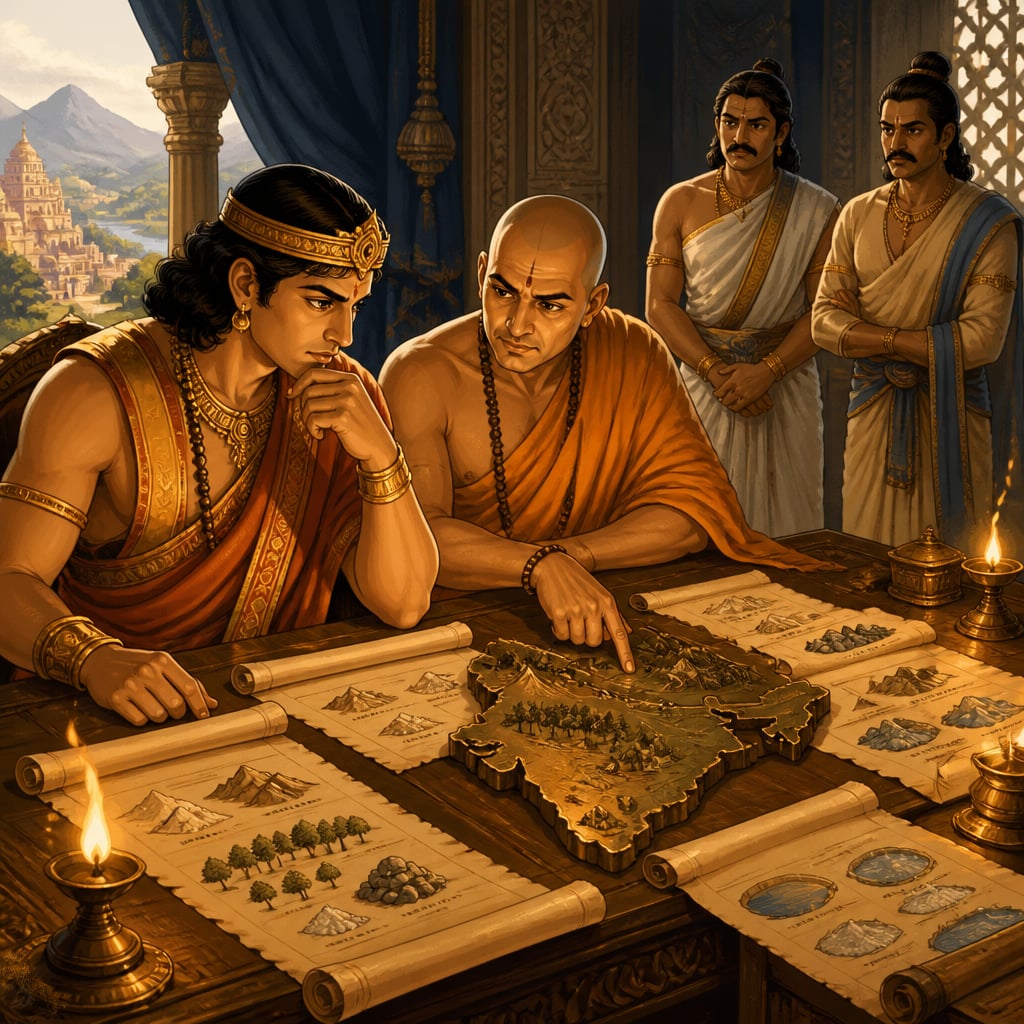
Chandragupta and Kautilya planning state enterprises

The year is 321 BCE. Chandragupta Maurya has just seized power, but his treasury echoes with emptiness. His guru Kautilya stands before a map of the subcontinent, his finger tracing the Kolar goldfields of the south, the iron deposits of Magadha, the diamond mines near the Mahanadi. "Rajopakrama," he declares, "the king's undertaking." These resources, he insists, cannot belong to private hands. The fate of the empire depends on it.

What followed was one of history's earliest and most sophisticated frameworks for state-owned enterprises, a system that would fund the largest empire of its age and offer lessons that echo in boardrooms from Riyadh to Oslo today.

The Kautilyan Framework: What Must the State Own?

Kautilya didn't believe in blanket state ownership. He was far too pragmatic for ideology. Instead, he developed precise criteria for what the state must control versus what it should leave to merchants.

The Arthashastra (Book 2, Chapter 12) lays out the doctrine with characteristic clarity:

"Khani-adhyaksha shall examine mines that have been worked before, discover new mines, and establish factories for metals that are newly discovered."

The Khani-adhyaksha (Superintendent of Mines) was no ordinary bureaucrat. He commanded geological surveys, managed extraction, controlled processing, and, critically, ensured the treasury received its due. Kautilya understood that mineral wealth represented concentrated value: one cart of gold could fund a thousand soldiers. Such leverage, in private hands, could destabilize the state itself.

But notice what Kautilya didn't nationalize: textiles, pottery, agriculture, ordinary trade. These were left to private enterprise, taxed but not controlled. The distinction was strategic, not ideological.

Three criteria determined state ownership:

  1. Strategic necessity (rashtra-raksha): Resources essential for defense, iron for weapons, horses for cavalry, elephants for war
  2. Natural monopoly (svabhava-ekantika): Resources where geography created inherent concentration, mines, major ports, salt deposits
  3. Revenue criticality (koshagara-poshana): Sources so lucrative that private control would create dangerous wealth asymmetries

Global Perspectives on State Resource Control

Kautilya wasn't alone in recognizing that some resources demand state control. Across civilizations, thinkers grappled with the same question.

Colbert signing French manufacturing charters

Jean-Baptiste Colbert (1619-1683), Louis XIV's finance minister, built France's economic might through state-controlled manufacturing. His manufactures royales, royal factories for tapestries, glass, and armaments, mirror Kautilya's rajopakrama. Colbert understood that strategic industries required state nurturing before they could compete globally. Unlike Kautilya, however, Colbert extended state control to luxury goods, not just strategic necessities, a overreach that ultimately burdened the French economy.

Friedrich List (1789-1846), the German economist, argued for "infant industry protection", the state must shield and develop strategic sectors until they mature. His National System of Political Economy (1841) could have been a commentary on the Arthashastra. List recognized what Kautilya knew two millennia earlier: pure free markets favor established powers; emerging nations need strategic state intervention.

Adam Smith (1723-1790) offers the contrast. In The Wealth of Nations, Smith argued against monopolies, including state ones. Yet even Smith carved exceptions: defense industries, infrastructure with public-good characteristics. His "invisible hand" required visible state protection for certain sectors.

Thinker Core Argument Kautilyan Parallel
Colbert State must build strategic industries Rajopakrama for defense, mining
List Infant industry protection State nurturing before private competition
Smith Limited state role, defense exceptions Kautilya also left most trade to merchants

The striking convergence: across 2,300 years and vastly different contexts, strategic thinkers reached similar conclusions about resource control.

Modern Resonance: From Aramco to the Sovereign Wealth Miracle

Fast forward to 2024. The world's most valuable company isn't Apple or Microsoft, it's Saudi Aramco, the state-owned oil giant valued at over $2 trillion. The Saudi state owns 98% of its shares. This is Kautilya's rajopakrama operating at planetary scale.

Norwegian offshore oil platform in the North Sea

But the more sophisticated application comes from Norway. When oil was discovered in the North Sea in 1969, Norway could have privatized extraction and collected taxes, the Western default. Instead, they created Statoil (now Equinor) as a state-owned enterprise and channeled profits into the Government Pension Fund Global, the world's largest sovereign wealth fund at $1.6 trillion.

The Norwegian model demonstrates Kautilyan wisdom perfected:

Contrast this with nations that privatized their oil wealth, creating billionaire oligarchs while public infrastructure crumbled. The difference is rajopakrama versus its absence.

India's own ONGC and Coal India represent attempts at this model, though with mixed execution. V. Krishnamurthy, the architect of India's PSU success stories, often quoted Kautilya when explaining why strategic industries required state stewardship, at least until Indian private capital matured enough to handle such responsibility.

Your Turn: The Modern Dilemma

You might be wondering: does this mean more nationalization? Not necessarily. Kautilya's genius was in criteria, not ideology. He would likely look at India's semiconductor mission, where the state provides $10 billion in incentives to attract Micron, Tata, and others, and nod approvingly. This is rajopakrama adapted: the state enabling strategic capability without necessarily owning every factory.

The question to carry forward: In your work, your investments, your policy preferences, can you distinguish between what requires state stewardship and what flourishes under private enterprise? The answer, as Kautilya knew, is rarely ideological. It's strategic.

Next, we'll explore what happened inside those state-owned mines and factories, the karmanta system that made Mauryan manufacturing the envy of the ancient world.

Natural Monopoly Theory / Strategic Industry Protection

John Stuart Mill (1848) defined natural monopolies as industries where competition is wasteful. Modern economists like Mariana Mazzucato argue the state must drive innovation in strategic sectors. Both echo Kautilya's selective approach.

Kautilya's framework is more comprehensive than Western theories, he considers not just economic efficiency (natural monopoly) but also national security (strategic necessity) and political stability (preventing dangerous private wealth concentration).

Norway's state ownership of Equinor (oil) generated $1.6 trillion in sovereign wealth; Russia's privatization of oil created oligarchs worth $300 billion while public infrastructure collapsed.

Modern corporate governance struggles with the same issue: how to ensure professional managers act in owners' interests. Jensen & Meckling (1976) formalized this as agency theory. Kautilya's solution, specialized superintendents with domain expertise and performance metrics, anticipates modern best practices.

The adhyaksha system separated technical management from political interference. V. Krishnamurthy succeeded at Maruti precisely because he had operational autonomy, the Kautilyan principle applied. PSUs that failed typically suffered political interference in technical decisions.

Key terms

rajopakrama
State enterprise; literally 'the king's undertaking'
khani-adhyaksha
Superintendent of Mines; the official responsible for all mining operations
kosha
Treasury; the state's accumulated financial reserves
svabhava-ekantika
Natural monopoly; a resource or activity inherently concentrated by nature

Verses

खनि-अध्यक्षः पूर्वं खनितान् खनीन् परीक्षेत, नवान् खनीन् अन्विष्येत, नवोद्भूतानां धातूनां कर्मान्तान् स्थापयेत।

khani-adhyakṣaḥ pūrvaṃ khanitān khanīn parīkṣeta, navān khanīn anviṣyeta, navodbhūtānāṃ dhātūnāṃ karmāntān sthāpayet

The Keeper of Mines shall survey what was dug before, seek what lies undiscovered, and build workshops for metals newly found.

Kautilya understood that mineral wealth requires state investment in exploration (R&D), not just taxation of existing discoveries. Modern nations that fund geological surveys and mining research echo this principle.

Arthashastra, Book 2, Chapter 12, Verse 1 (R. Shamasastry translation with Bibek Debroy commentary)

खनि-प्रभवः कोशो दण्ड-मूलम्।

khani-prabhavaḥ kośo daṇḍa-mūlam

The treasury born of mines is the root of military strength.

This is the earliest articulation of the 'resource curse' paradox in reverse, properly managed resource wealth *enables* rather than corrupts state capacity. The key is institutional design.

Arthashastra, Book 2, Chapter 12, Verse 37 (R.P. Kangle critical edition)

कोशमूलो दण्डः।

kośamūlo daṇḍaḥ

Military power is rooted in the treasury.

A striking parallel to modern defense economics: the US defense budget requires $800+ billion annually. States that control high-value resources can sustain such spending; others cannot.

Arthashastra, Book 2, Chapter 1, Verse 6 (L.N. Rangarajan)

Key figures

Kautilya (Chanakya)

Political strategist, economist, author of the Arthashastra

V. Krishnamurthy

Industrial administrator, 'Father of Indian PSUs'

Jean-Baptiste Colbert

Finance Minister of France under Louis XIV

Case studies

Norway vs. Russia: The Rajopakrama Divergence

In 1969, Norway discovered vast oil reserves in the North Sea. In 1991, Russia inherited massive Soviet-era oil infrastructure. Both nations faced the same question: who should own and benefit from this mineral wealth? Norway chose the Kautilyan path. The state created Statoil (now Equinor) as a national oil company, retained majority ownership, and channeled profits into the Government Pension Fund Global. Professional managers ran operations; politicians set strategic direction but didn't interfere in drilling decisions. The fund now exceeds $1.6 trillion, enough to give every Norwegian citizen over $300,000. Russia chose rapid privatization. State assets were sold at a fraction of value to politically connected buyers. By 1995, oligarchs controlled Russia's oil wealth. Mikhail Khodorkovsky's Yukos, Roman Abramovich's Sibneft, and similar empires emerged. Meanwhile, Russian public infrastructure crumbled, and average citizens saw little benefit from the nation's resource wealth.

Kautilya would recognize Norway's approach as textbook rajopakrama: strategic resource under state ownership, professional adhyaksha-style management, wealth channeled to kosha (treasury) for collective benefit. Russia's privatization violated all three Kautilyan criteria, it handed strategic resources to private parties, allowed political rather than professional management, and concentrated wealth instead of distributing it. The dharmic principle at stake: mineral wealth is a gift of nature (prakrti-dana), belonging to all generations. The state is trustee (nyasadhikari), not owner. Norway honored this trusteeship; Russia betrayed it.

By 2024, Norway ranks #1 globally in human development and sovereign wealth. Russia, despite equal or greater resource wealth, ranks #52 in human development, with resource revenues funding oligarch mansions in London rather than schools in Siberia. The divergence proves Kautilya's insight: the question isn't whether resources should be exploited, but who benefits. State ownership with professional management (Norway) distributed wealth. Private ownership with political management (Russia) concentrated it.

Rajopakrama isn't about government control, it's about strategic stewardship. Norway's sovereign wealth fund is Kautilya's kosha perfected: mineral wealth transformed into intergenerational prosperity through state ownership, professional management, and transparent accountability.

Norway's sovereign wealth fund model is now being adopted by resource-rich nations including Saudi Arabia (PIF), UAE (ADIA), and India (NIIF). The principle that mineral wealth belongs to citizens across generations, not just the current government, is reshaping how resource revenues are managed globally.

Norwegian sovereign wealth fund: $1.6 trillion for 5.4 million people ($296,000/person). Russian wealth concentration: 500 individuals control 40% of all wealth, while 13% of Russians live below the poverty line.

Historical context

Mauryan Empire (322-185 BCE)

The Mauryan economy represented the first unified economic zone in South Asian history. State-controlled mines, gold from Karnataka, iron from Bihar, copper from Rajasthan, funded an unprecedented military-administrative apparatus. The Arthashastra's mining protocols reflect practical experience: Kautilya wasn't theorizing but codifying working systems.

Contemporary Mediterranean states (Ptolemaic Egypt, Seleucid Persia) also practiced state resource control, but none developed the systematic administrative framework found in the Arthashastra. Greek city-states largely left mining to private contractors; Rome would develop state mining only centuries later.

Megasthenes reported that Mauryan state mines produced enough gold to fund 600,000 infantry, 30,000 cavalry, and 9,000 elephants, a military establishment larger than any Western power until Rome at its peak.

The Mauryan mining system demonstrates that state enterprise is not a modern socialist invention but an ancient governance technology. Understanding its successes and failures informs contemporary debates about public vs private ownership of strategic resources.

Reflection

More in State Enterprises & Infrastructure

All lessons in State Enterprises & Infrastructure · Arthashastra: Economic Principles course