Karmanta: Mining and Manufacturing Centers
The Factories That Forged an Empire
Inside the karmanta, Kautilya's state-run manufacturing centers, master craftsmen produced everything from weapons to textiles under meticulous government oversight. These weren't crude workshops but sophisticated operations with quality control, worker welfare, and strategic output planning. The principles echo in India's modern defense production landscape.
The Weapons Master's Dilemma
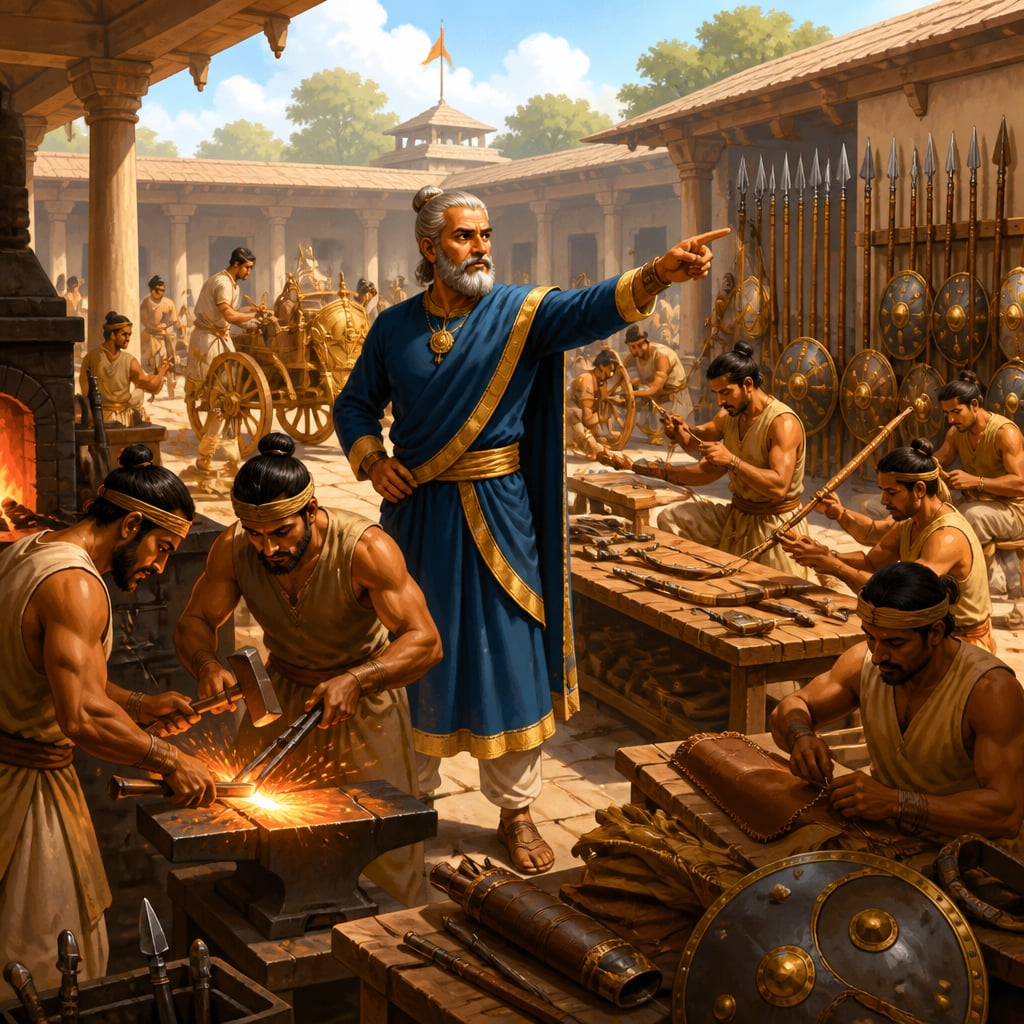
The year is 310 BCE. Varahamitra, the ayudhagara-adhyaksha (Superintendent of the Arsenal), faces a crisis in Pataliputra. The emperor has ordered 10,000 iron swords for the campaign against the Greek satrapies in the northwest. His workshops have the ore, the charcoal, the smiths, but competing demands from private merchants are driving up wages and luring his best craftsmen away.
He unfurls the Arthashastra scroll and finds his answer in Kautilya's precise instructions: "The superintendent shall employ skilled artisans on regular wages, preventing their dispersal to private work during state necessity." The solution isn't coercion but compensation, fair wages, housing, and the prestige of serving the empire. Within months, the swords are ready, and Mauryan steel earns its legendary reputation.
The Karmanta System: More Than Just Factories
The word karmanta derives from karma (action, work) and means "place of productive action." But Kautilya's manufacturing centers were far more sophisticated than this translation suggests. They were integrated industrial complexes combining:
- Raw material procurement (linked to state mines and forests)
- Skilled labor management (training, wages, welfare)
- Quality control (inspections, standards, rejection protocols)
- Inventory management (warehousing, distribution)
- Cost accounting (detailed records of inputs and outputs)
The Arthashastra (Book 2, Chapter 14) describes the organizational structure:
"The superintendent of the arsenal shall employ artisans of various crafts, blacksmiths, bow-makers, carpenters, leather-workers, each with their own chief. All weapons shall be marked with the royal seal after inspection."
This wasn't medieval craftsmanship but proto-industrial organization. Each karmanta had specialized divisions, hierarchical supervision, and, remarkably, a quality certification system. Weapons bearing the royal seal had passed inspection; those without could not be issued to troops.
Types of Karmanta in the Mauryan Economy:
| Type | Sanskrit | Products | Strategic Importance |
|---|---|---|---|
| Arsenal | Ayudhagara | Weapons, armor, siege equipment | Defense capability |
| Mint | Lakshana-griha | Coins, currency | Monetary sovereignty |
| Textile Works | Sutra-shala | Military textiles, royal garments | Uniform supply, trade goods |
| Shipyard | Nau-karma | Warships, transport vessels | Naval power, trade control |
| Elephant Depot | Hastishala | War elephant training, equipment | Decisive military advantage |
Global Perspectives on State Manufacturing
Kautilya's karmanta system finds echoes, and contrasts, across civilizations and centuries.
The Roman Fabricae (3rd-5th century CE): Six centuries after Kautilya, the Roman Empire established fabricae, state arsenals producing standardized weapons across the empire. Like the karmanta, fabricae employed skilled workers at state wages and maintained quality standards. However, Roman fabricae emerged from crisis (military defeats requiring rapid rearmament), while Kautilya designed karmanta proactively as a pillar of state power.

Henry Ford (1863-1947) revolutionized manufacturing through the assembly line, vertical integration, and standardization. Ford's River Rouge complex, which took in iron ore and produced finished automobiles, mirrors the karmanta's integrated approach. Yet Ford was a private industrialist maximizing profit; Kautilya designed for strategic capability, not commercial return. The difference matters: Ford could abandon unprofitable products; the state cannot abandon national defense.
Frederick Taylor (1856-1915) pioneered "scientific management", breaking work into measurable tasks, optimizing each step, and compensating workers accordingly. Kautilya's detailed specifications for craftsman grades, piece-rate payments, and quality inspections anticipate Taylorism by two millennia. The Arthashastra even specifies break times, workplace conditions, and protections against arbitrary dismissal.
| Thinker | Contribution | Kautilyan Parallel |
|---|---|---|
| Roman Fabricae | State arsenal network | Karmanta system across empire |
| Henry Ford | Vertical integration, assembly line | Integrated karmanta from raw material to finished product |
| Frederick Taylor | Scientific management, task optimization | Craftsman grading, piece-rate wages, quality inspection |
Modern Resonance: From Ayudhagara to HAL
Fast forward to independent India. In 1947, the nation inherited a few colonial-era ordnance factories but almost no capability to design or produce modern weapons. India's leaders faced Varahamitra's dilemma at civilizational scale: how to build state manufacturing capability for strategic goods?

Homi Bhabha and APJ Abdul Kalam represent two generations of this mission. Bhabha established the Atomic Energy Commission (1948) and Bhabha Atomic Research Centre (BARC), building the scientific-industrial complex for nuclear capability. Kalam led the Defense Research and Development Organisation (DRDO) and spearheaded the Integrated Guided Missile Development Programme (IGMDP).
Their approach was unmistakably Kautilyan:
- Strategic goods (nuclear technology, missiles) must be developed domestically, dependency is vulnerability
- State investment precedes private capability, the market won't fund 20-year R&D programs
- Integrated development, from basic research (BARC, ISRO) to manufacturing (HAL, BEL) to deployment
- Human capital, both invested heavily in training Indian engineers and scientists
Hindustan Aeronautics Limited (HAL), established 1940, is India's ayudhagara. It has produced over 4,100 aircraft, 4,600 engines, and countless helicopters, missiles, and avionics systems. The Tejas Light Combat Aircraft, India's first indigenous fighter jet, emerged from this state manufacturing ecosystem after decades of patient investment.
Critics point to delays, cost overruns, and technology gaps. They're not wrong. But compare India's trajectory to nations that privatized defense or depended on imports. Brazil outsourced fighter production to Embraer partnerships; its air force now flies Swedish Gripens. Turkey's ambitious defense industry required decades of state support before achieving export success. The Kautilyan insight holds: strategic manufacturing requires patient state cultivation.
Your Turn: Make or Buy?
You might be wondering: why should governments make things at all? Can't they just buy from the market?
Kautilya's answer: for ordinary goods, yes, let merchants compete. For strategic goods, no, dependency is surrender. The question isn't capability alone but sovereignty. Can you defend your nation if weapons require foreign spare parts? Can you conduct foreign policy if critical technologies depend on adversaries?
In your own domain, whether business, career, or household, ask the karmanta question: What must you be able to produce yourself? What can you safely outsource? The answer shapes your strategic freedom.
Next, we turn from production to the infrastructure that enables it, the setu (irrigation and water systems) that made agriculture possible and state revenue sustainable.
Oliver Williamson's transaction cost economics (Nobel Prize 2009) addresses when firms should make vs. buy. For strategic goods, 'asset specificity' (goods with few alternative suppliers) favors in-house production. National defense has ultimate asset specificity, you can't switch suppliers during a war.
Kautilya's analysis goes beyond economics to sovereignty. Even if foreign weapons were cheaper, dependency undermines foreign policy freedom. India's experience with sanctions after 1998 nuclear tests validated this, nations that controlled strategic manufacturing weathered sanctions; those dependent on imports suffered.
India's defense import bill fell from 70% (2010) to 40% (2024) as indigenous production expanded. HAL's Tejas program, despite 40-year development, now provides strategic autonomy no import could offer.
W. Edwards Deming revolutionized Japanese manufacturing with quality control principles after WWII. His insight: quality isn't an add-on cost but a fundamental requirement that actually reduces costs through fewer defects and rework. Kautilya's rajamudra system embodied the same principle millennia earlier.
Kautilya linked quality to dharma, the duty of the state to its soldiers and citizens. A defective weapon isn't just an economic loss but a moral failure. This framing elevates quality from management technique to ethical imperative.
India's Directorate General of Quality Assurance (DGQA) inspects all defense equipment before acceptance. In 2023, DGQA rejected 8% of submissions, the rajamudra system in action.
Key terms
- karmanta
- Manufacturing center; place of productive work; factory
- ayudhagara
- Arsenal; weapons manufacturing and storage facility
- shilpi
- Skilled artisan; craftsman; technical worker
- rajamudra
- Royal seal; official certification mark
Verses
आयुधागाराध्यक्षः सर्वायुधानां निर्माणं निक्षेपणं निर्गमनं च विद्यात्।
āyudhāgārādhyakṣaḥ sarvāyudhānāṃ nirmāṇaṃ nikṣepaṇaṃ nirgamanaṃ ca vidyāt
The Keeper of the Arsenal shall master all that weapons require, their making, their storing, their sending forth to war.
Modern defense production follows the same logic: vertically integrated systems where governments control design, manufacturing, stockpiling, and distribution. The 'military-industrial complex' isn't a modern invention, it's karmanta scaled up.
Arthashastra, Book 2, Chapter 18, Verse 1-2 (R. Shamasastry translation)
कुशलैः शिल्पिभिः सह वेतनभोगैः कर्म कारयेत्।
kuśalaiḥ śilpibhiḥ saha vetanabhogaiḥ karma kārayet
Let work be done by skilled craftsmen, rewarded with fair wages and rightful provisions.
The principle underlies modern debates about public sector pay. India's DRDO and ISRO compete for talent against private IT firms; their success depends on offering competitive compensation plus mission prestige, exactly Kautilya's formula.
Arthashastra, Book 2, Chapter 14, Verse 12 (R.P. Kangle critical edition)
राजमुद्राङ्कितं सर्वमायुधं स्यात्।
rājamudrāṅkitaṃ sarvam āyudhaṃ syāt
Let every weapon bear the royal seal, unmarked, it shall not go to war.
Modern defense procurement requires rigorous quality certification (MIL-SPEC in the US, DGQA in India). Substandard weapons kill your own soldiers. Kautilya understood that state manufacturing must prioritize quality over speed or cost.
Arthashastra, Book 2, Chapter 18, Verse 8 (L.N. Rangarajan)
Key figures
Kautilya (Chanakya)
Political strategist, economist, author of the Arthashastra
Homi Jehangir Bhabha
Nuclear physicist, founder of India's atomic energy program
APJ Abdul Kalam
Aerospace scientist, 'Missile Man of India,' 11th President of India
Henry Ford
American industrialist, founder of Ford Motor Company
Case studies
DRDO and the Tejas: Four Decades of Karmanta
In 1983, India launched the Light Combat Aircraft (LCA) program to build an indigenous fighter jet, the Tejas. The task was immense: India had never designed a modern combat aircraft. Foreign assistance was limited after India's 1974 nuclear test. Critics predicted failure. The program required building an entire ecosystem from scratch: aeronautical design capability, composite materials manufacturing, avionics production, flight control software, and engine development. HAL established new facilities; DRDO's Aeronautical Development Agency coordinated hundreds of suppliers; academic institutions trained thousands of engineers. The path was painful. The original 1994 delivery deadline slipped repeatedly. Development costs ballooned from ₹560 crore to over ₹10,000 crore. Every delay attracted criticism: 'Buy foreign jets,' 'Waste of money,' 'Admit failure.'
Kautilya would recognize Tejas as textbook karmanta philosophy in action, accepting short-term costs for long-term strategic autonomy. The Arthashastra never promises that state manufacturing is cheaper or faster than imports; it promises independence. The critics applying pure market logic miss the point. Could India have bought foreign fighters faster and cheaper? Probably. But that purchase would have come with: technology transfer restrictions, spare parts dependencies, maintenance requirements, and an implicit foreign veto over when and how India could use its own aircraft. The dharmic dimension: Is it right for a nation of 1.4 billion people to depend on foreign powers for basic defense? Kautilya's answer, and independent India's answer, was no.
The Tejas achieved Initial Operational Clearance in 2013 and Final Operational Clearance in 2019. By 2024, HAL had delivered 35+ aircraft to the Indian Air Force, with orders for 200+ more. The aircraft performs comparably to contemporary fighters at a fraction of import costs. More importantly, India now has: indigenous aeronautical design capability, domestic composite materials manufacturing, avionics production, and a trained workforce of 15,000+ aerospace engineers. This ecosystem enabled the Tejas Mark 2, the AMCA (5th generation fighter), and indigenous drone programs. The 40-year investment created not just an aircraft but an industry, exactly what Kautilya's karmanta system was designed to achieve.
State manufacturing of strategic goods is an investment in capability, not a purchase of products. The relevant question isn't 'Could we have bought cheaper?' but 'Can we now do what we couldn't before?' By that measure, Tejas is a success that justifies four decades of patient karmanta.
Tejas Mark 2 and the Advanced Medium Combat Aircraft (AMCA) are now in development, building on capabilities that four decades of indigenous effort created. India's defense export orders crossed $2.6 billion in FY24, proving that patient investment in strategic manufacturing eventually generates both security and commercial returns.
Tejas cost per unit: ~₹300 crore ($36 million). Comparable imported fighters: $80-150 million. More importantly: Tejas orders generate 40,000+ Indian jobs; imports generate zero.
Historical context
Mauryan Empire (322-185 BCE)
Mauryan karmanta produced weapons renowned across the ancient world. Greek accounts describe Indian steel (wootz) as superior to anything available in the Mediterranean. The ayudhagara system supported military forces larger than any contemporary power, proof that state manufacturing could achieve quality and scale simultaneously.
Contemporary Mediterranean states relied primarily on private contractors for weapons. Roman legions wouldn't establish state fabricae for another 500 years. Chinese state workshops under the Qin dynasty (221-206 BCE) offer the closest parallel, though less systematically documented than the Arthashastra's protocols.
Megasthenes recorded that Mauryan state factories employed tens of thousands of workers. Archaeological evidence from Pataliputra suggests industrial-scale production: standardized arrowhead molds, mass-produced pottery, and uniform coin dies.
The Mauryan karmanta system demonstrates that organized state manufacturing predates the Industrial Revolution by two millennia. Understanding this history challenges the assumption that industrial organization is a uniquely Western achievement.
Reflection
- Kautilya insisted on state manufacturing for strategic goods despite higher costs and complexity. In an era of global supply chains and comparative advantage, is this philosophy still valid? What makes a good 'strategic' enough to justify the inefficiencies of state production?
- Apply the karmanta principle to your own life or organization: What capabilities must you develop internally versus outsource? What are you currently dependent on that, if disrupted, would create serious problems?