Varta: Agriculture, Trade, and Cattle as Economic Base

The Three Pillars of Real Economy

Understand Kautilya's concept of Varta, the productive economic activities of agriculture, animal husbandry, and trade that generate real wealth. No state can prosper without a strong Varta foundation.

The Merchant's Dilemma
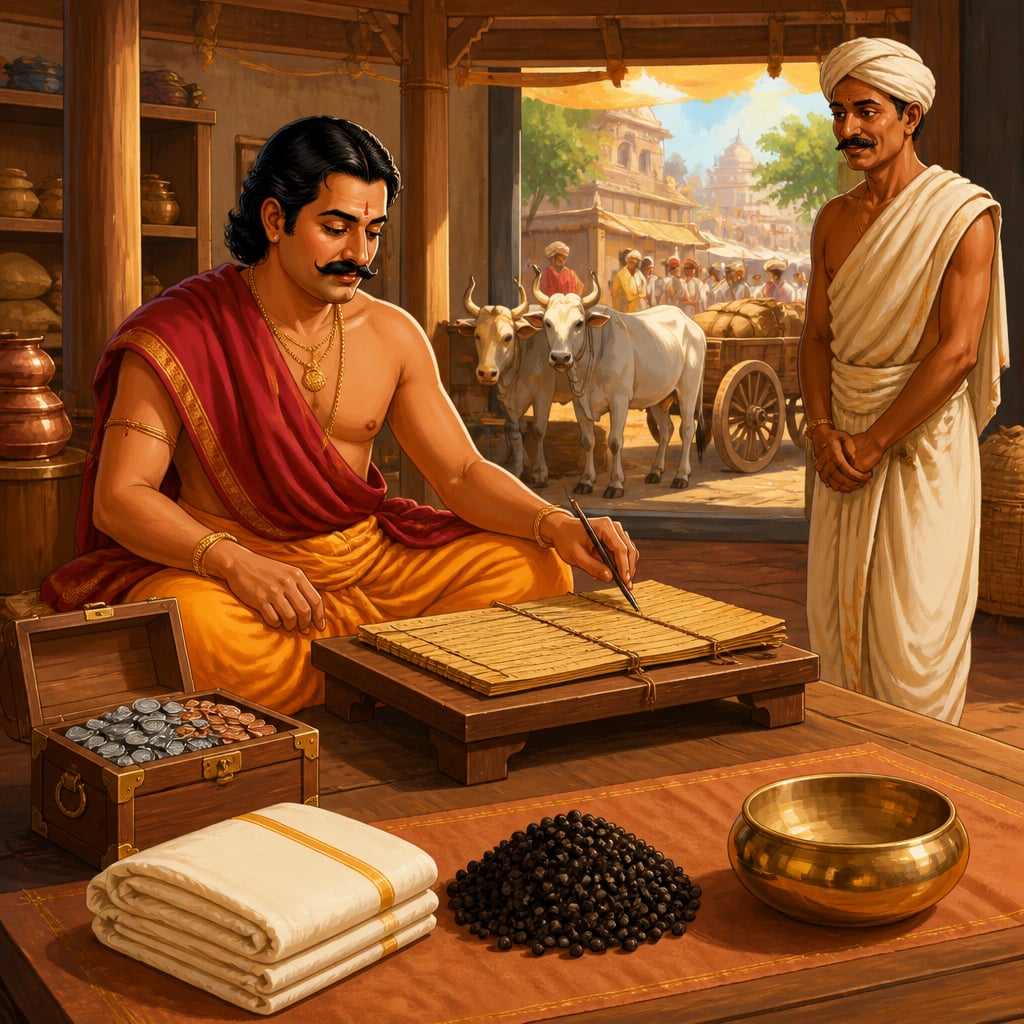
Dhananjaya the merchant in his trade hall

Around 300 BCE, a wealthy merchant named Dhananjaya faced a decision that would determine his family's fortune for generations. He had accumulated capital from his trading enterprise along the northern routes. Should he expand into new markets? Invest in farmland? Build cattle herds?

He consulted the local economic wisdom that had been codified by Kautilya. The answer was clear: diversify across all three. For real wealth, the kind that sustains families and nations, comes from Varta: the productive activities of agriculture, animal husbandry, and commerce.

What is Varta?

Varta (वार्ता) is Kautilya's term for the productive economy, the activities that create actual goods and services, as opposed to administrative functions or military operations.

"कृषिपाशुपाल्यवाणिज्या वार्ता।"

"Agriculture, animal husbandry, and trade constitute Varta." , Arthashastra 1.4.1

These three activities form the real economic base:

1. Krishi (कृषि) - Agriculture
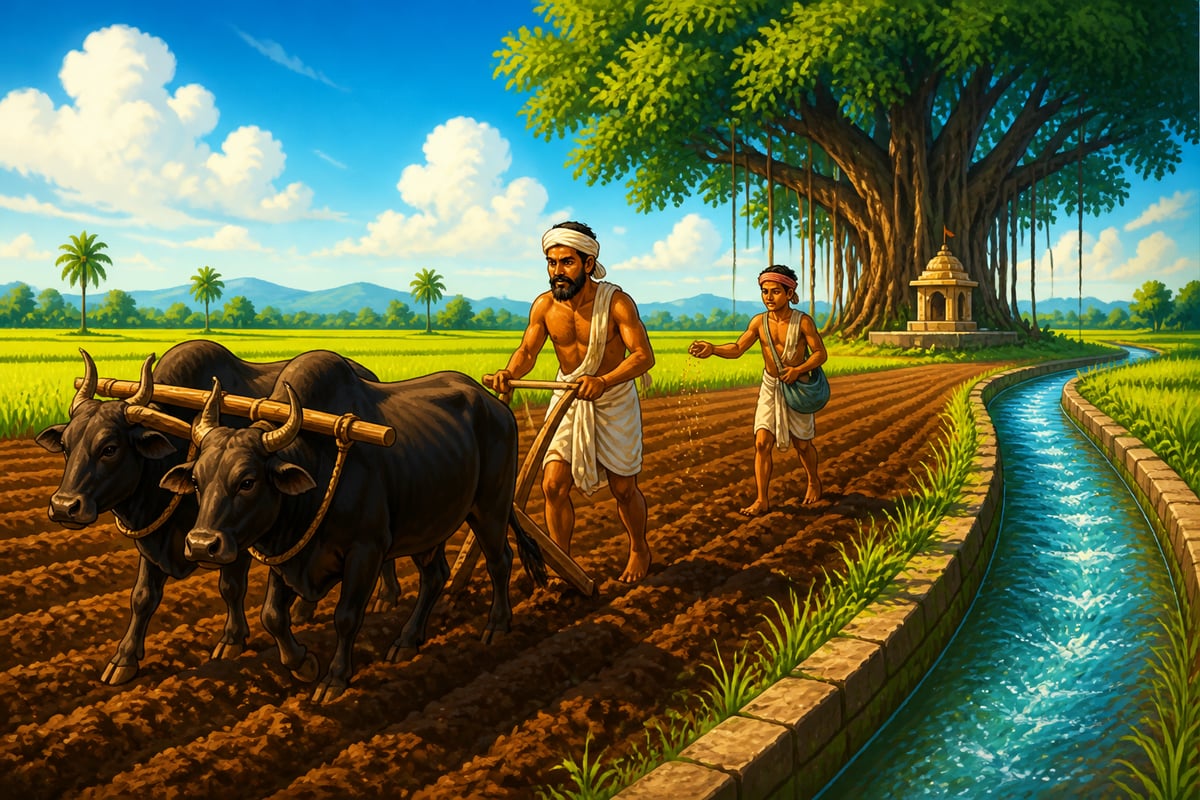
An ancient Indian farmer plowing his fields with oxen

The primary source of food, raw materials, and revenue. Kautilya devoted extensive attention to agricultural management:

Why it matters: Agriculture employed over 90% of ancient populations and generated the surplus that funded all other activities.

2. Pashupālya (पशुपाल्य) - Animal Husbandry

Livestock served multiple economic functions:

Kautilya established the Superintendent of Cattle (Goadhyaksha) to manage state herds and regulate the livestock economy.

3. Vānijya (वाणिज्य) - Trade and Commerce
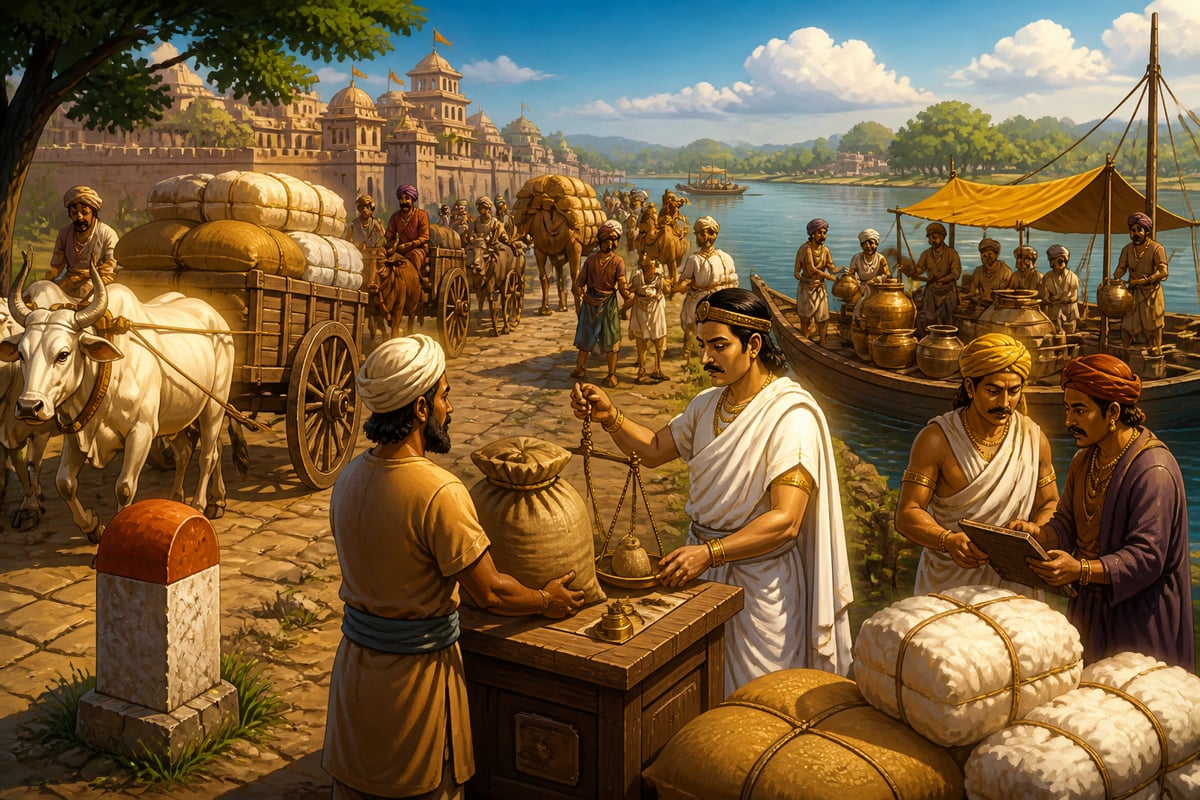
A trade caravan arriving at a riverside market town

Commerce transforms local surplus into broader prosperity:

The Superintendent of Commerce (Panyadhyaksha) regulated trade, while the Superintendent of Customs managed duties.

Why Varta Matters: The Real Economy

Kautilya understood what modern economists sometimes forget: all wealth ultimately derives from productive activities.

"वार्ता दण्डनीतेर्मूलम्।"

"Varta is the root of statecraft itself."

Without thriving agriculture, husbandry, and trade, even the most brilliant political strategy fails for lack of resources.

The Balance of Three Pillars

Kautilya recognized that the three Varta activities are interconnected:

Activity Provides Depends On
Agriculture Food, fiber, revenue Land, labor, draft animals, irrigation
Animal Husbandry Draft power, dairy, transport Pasture, fodder, agricultural byproducts
Trade Market access, foreign goods, currency Agricultural and pastoral surplus, roads

Weakness in any pillar affects the others:

State Role in Supporting Varta

Kautilya prescribed active state involvement in nurturing the productive economy:

For Agriculture

For Animal Husbandry

For Trade

Varta in Modern India

How do these ancient principles apply to 21st-century India?

Agriculture Today

Animal Husbandry Today

Trade and Commerce Today

The Merchant's Wisdom for Today

What would Kautilya advise modern India?

1. Don't Neglect Agriculture

Services and manufacturing are important, but food security remains foundational. The farmer is still the root of the economy.

2. Modernize Animal Husbandry

India's livestock sector is large but unproductive. Technology, breeds, and practices need Kautilyan-style state support.

3. Trade Strategically

Not free trade at any cost, but trade that serves national interest, Kautilya's merchants were protected, regulated, and encouraged.

4. Infrastructure is Key

Kautilya built roads and irrigation. Modern equivalents: highways, digital connectivity, cold chains, logistics networks.

Your Varta Perspective

Even in a service economy, Varta principles apply:

For your career: What is your productive output? What do you actually create? Abstract activities disconnected from value creation are vulnerable.

For your investments: Productive assets (businesses, real estate generating income, agricultural land) are more robust than pure speculation.

For your household: Consider food security, practical skills, and multiple income streams, the personal equivalent of diversified Varta.

In the next lesson, we'll explore how Bibek Debroy's translations have made these ancient economic insights accessible to modern readers and policymakers.

Classical economists like Ricardo emphasized production. Modern financialization has sometimes reversed this priority, to economic instability.

By grounding economics in production, Kautilya provides immunity against the bubbles that plague financialized economies.

India's services sector (54% of GDP) outstrips manufacturing (17%), a potential Varta imbalance that PLI schemes aim to correct.

Modern portfolio theory emphasizes diversification for investment. Kautilya applied the same principle to national economies.

India's relatively diversified economy (agriculture + services + manufacturing) provides resilience compared to commodity-dependent nations.

Countries with >40% GDP from single commodity (like oil) show boom-bust cycles; diversified economies are more stable.

Key terms

Vārtā
The productive economy comprising agriculture, animal husbandry, and trade, the activities that generate real wealth and sustain society.
Kṛṣi
Agriculture, cultivation of land for food crops, fibers, and other agricultural products. The foundation of ancient economies.
Vāṇijya
Trade and commerce, the buying and selling of goods, both internal and external trade, and the facilitation of exchange.
Paśupālya
Animal husbandry, the rearing of livestock including cattle, horses, elephants, goats, and sheep. One of the three pillars of Varta alongside agriculture and trade.

Verses

कृषिपाशुपाल्यवाणिज्या वार्ता।

kṛṣi-pāśupālya-vāṇijyā vārtā |

Agriculture, animal husbandry, and trade, these constitute the productive economy.

This is essentially the productive sector of an economy, what modern economists call the 'real economy' as opposed to financial or speculative activities.

Arthashastra, 1.4.1 (R.P. Kangle)

वार्तायत्तौ हि दण्डनीतिश्च।

vārtāyattau hi daṇḍanītiśca |

Indeed, statecraft itself depends upon the productive economy.

This inverts the common view that economics serves politics. Kautilya recognizes that political power is derivative of economic capacity.

Arthashastra, 1.4.2 (Patrick Olivelle (2013))

कृषिपाशुपाल्यवणिज्यानां योगक्षेमकरी वार्ता।

kṛṣi-pāśu-pālya-vaṇijyānāṃ yoga-kṣema-karī vārtā |

Agriculture, cattle, commerce, the sciences of livelihood that bring both getting and keeping.

The word "yoga-kṣema" is ancient and dense. Kautilya's single sutra defines the purpose of all economic activity: not maximization but the paired motion of acquiring and securing. Modern economics has only the first; Kautilya insists on both.

Book 1, Chapter 4, Verse 1 (R.P. Kangle)

Key figures

Verghese Kurien

Father of White Revolution; founder of Amul cooperative movement · 1921-2012

Kurien transformed India's dairy sector through cooperative organization, making India the world's largest milk producer. His Anand model empowered millions of small farmers, a modern implementation of Kautilya's vision of state-supported Pashupālya (animal husbandry) creating prosperity.

Kurien demonstrates how strengthening one Varta pillar (animal husbandry) can transform national prosperity, exactly what Kautilya prescribed.

Bindusara Maurya

Second Mauryan Emperor; expanded empire while maintaining Kautilyan economic system · 320-273 BCE

Bindusara maintained and expanded the economic systems established by Chandragupta and Kautilya. His reign saw continued agricultural expansion, trade route development, and livestock management that funded further territorial expansion.

Bindusara shows continuity of Kautilyan Varta principles, sustained economic management enabling political power across generations.

Norman Borlaug

Father of the Green Revolution; Nobel Peace Prize laureate (1970) · 1914-2009

Borlaug developed high-yielding, disease-resistant wheat varieties in Mexico, then brought them to India and Pakistan in the 1960s. His semi-dwarf wheat varieties, combined with irrigation and fertilizers, doubled and tripled yields. He is credited with saving over one billion lives from starvation. Borlaug spent decades working in fields, personally training farmers, embodying the principle that agricultural transformation requires both science and grassroots implementation.

Borlaug's Green Revolution was state-supported Krishi transformation at scale, exactly what Kautilya prescribed. The Indian government provided seeds, fertilizers, irrigation, and guaranteed prices (MSP). Borlaug's success validates the Kautilyan model: productive economy requires active state nurturing, not laissez-faire neglect.

Case studies

India's Green Revolution: From Famine to Food Surplus

In 1943, the Bengal Famine killed 2-3 million Indians. In 1966, India faced another crisis, severe drought threatened mass starvation. President Lyndon Johnson held food aid hostage to pressure India on foreign policy, shipping grain only 'by the boatload', humiliating a proud nation. India imported 10 million tons of wheat that year, the largest food aid in history. Critics predicted that India would never feed itself; Stanford biologist Paul Ehrlich declared in 1968 that 'hundreds of millions' of Indians would starve in the 1970s. But something remarkable happened. Within a decade, India became self-sufficient in food. By the 1980s, India was a food exporter. How?

The Green Revolution was textbook Kautilyan Varta support. **State-provided inputs**: The government distributed high-yielding variety (HYV) seeds developed by Norman Borlaug and Indian scientists like M.S. Swaminathan. **Infrastructure (Setu)**: Massive irrigation expansion, canal systems, tubewells, dams. **Price support**: Minimum Support Prices (MSP) guaranteed farmers wouldn't lose money. **Institutional support**: Agricultural universities, extension services, cooperatives. Kautilya would recognize every element: the state nurturing Krishi through infrastructure, technology, and price stability. The Green Revolution wasn't Western aid; it was Kautilyan policy implemented with modern science.

India's wheat production grew from 11 million tonnes (1966) to 110 million tonnes (2024), a 10x increase. Rice production tripled. India's food grain stocks now exceed 60 million tonnes. The nation that once begged for food aid now runs the world's largest free food distribution program (PM Garib Kalyan Anna Yojana, feeding 800 million people during COVID-19). Punjab, the Green Revolution's heartland, went from famine-prone to 'India's breadbasket', contributing 50%+ of national wheat procurement.

The Green Revolution proves that Varta transformation requires state leadership. Private markets alone couldn't have delivered the coordinated investment in seeds, irrigation, credit, and prices needed to transform Indian agriculture in a decade. But the state also worked *with* farmers, not against them, providing inputs and prices that made farming profitable. This is Kautilya's developmental state: neither socialist command nor laissez-faire neglect, but active nurturing of productive capacity.

India's Green Revolution model is directly relevant to Africa's current food security challenge, where yields remain 30-40% below potential. The lesson: transforming agriculture requires state-coordinated investment in seeds, irrigation, credit, and price support simultaneously. Partial reform produces partial results.

M.S. Swaminathan estimated that the Green Revolution saved 1 billion lives globally by preventing the famines that experts predicted. India's transformation from 'ship-to-mouth' dependence to food surplus is the greatest agricultural achievement in human history.

Israel's Agricultural Miracle: Making the Desert Bloom

In 1948, Israel was born into impossibility. 60% of the land was desert. Annual rainfall in the south was under 50mm, less than the Sahara. The British had declared the land could support at most 2 million people. Early Zionist settlers tried conventional farming and failed, the land was too arid, too rocky, too salty. Experts said large-scale agriculture was impossible. Yet today, Israel exports $3 billion in agricultural products annually, feeds 9 million people, and has become a global leader in agricultural technology. A nation with almost no water produces water-intensive crops like peppers, tomatoes, and flowers for European markets. How?

Israel's agricultural miracle exemplifies Kautilyan Varta principles adapted to extreme constraints. **State investment in infrastructure (Setu)**: The National Water Carrier (1964) moved water from the north to the Negev desert, a modern equivalent of Kautilyan irrigation canals. **Technology as force multiplier**: Drip irrigation (invented by Israeli engineer Simcha Blass in 1959) delivers water directly to plant roots, reducing waste by 50%. **State-supported research**: Agricultural research centers (Volcani Institute) developed drought-resistant crops, desalination technology, and precision farming. **Kibbutz system**: Collective farms pooled resources for capital-intensive investment individuals couldn't afford. Every element reflects Kautilya's teaching: when natural Janapada is limited, state-supported innovation can compensate.

Israel now produces 95% of its own food despite having less than 20% arable land. Water productivity is 100x higher than global average. Israeli drip irrigation technology is used in 150+ countries. Agricultural exports grew from near-zero (1948) to $3.5 billion (2024). The Negev desert, written off as wasteland, now produces winter vegetables for European supermarkets. Israel has proven that Varta is not limited by natural endowment but by human ingenuity and state support.

Israel demonstrates that Varta constraints can be overcome through state-led innovation. Natural limitations (water, arable land) are not destiny. Kautilya prescribed irrigation because he understood that infrastructure transforms productive capacity. Israel took this further: when conventional irrigation was insufficient, they invented drip irrigation. When natural water was scarce, they pioneered desalination. The lesson for India: Varta development is not just about using existing resources but about expanding what's possible through technology and infrastructure.

Israel's water technology is now deployed across 150+ countries facing water scarcity, including India's Pradhan Mantri Krishi Sinchayee Yojana. As climate change intensifies water stress globally, the principle that infrastructure can overcome natural constraints becomes more relevant each decade.

Israel recycles 90% of its wastewater for agriculture, the highest rate in the world. Second place is Spain at 20%. This is Kautilyan resource efficiency taken to an extreme: when the Janapada lacks natural resources, create artificial ones through engineering and state investment.

Historical context

4th-3rd century BCE (Mauryan Empire)

The Mauryan period saw systematic development of all three Varta pillars: agricultural expansion through irrigation and land grants, organized livestock management, and protected trade routes. Megasthenes noted that Indian farmers were protected during wars, revealing Kautilyan priority on productive base.

While Rome's economy was heavily dependent on slave labor and conquest for wealth, Mauryan India developed systematic agriculture, animal husbandry, and commerce that generated sustainable prosperity without requiring continuous military expansion.

Ancient India was consistently among the world's largest economies, accounting for 25-32% of global GDP for much of the first millennium CE, built on strong Varta foundations that Kautilya systematized.

Understanding Varta explains India's historical prosperity and provides a framework for contemporary economic development that balances agriculture, industry, and services.

Living traditions

The Varta framework continues to influence India's economic policy emphasis on agriculture, livestock, and balanced trade development.

PM-KISAN (agricultural support), Operation Flood (dairy), PLI for manufacturing, and trade agreements all reflect Kautilyan principles of state-supported Varta. The National Agriculture Market (eNAM) digitizes the ancient mandi tradition.

Reflection

More in Foundations of Kautilyan Economics

All lessons in Foundations of Kautilyan Economics · Arthashastra: Economic Principles course