Kautilya's Vision: The State as Economic Engine
Why Government Matters for Prosperity
Explore Kautilya's revolutionary insight that the state is not a parasite on the economy but its essential enabler, a perspective that challenges both extreme laissez-faire and socialist models.
The Minister's Midnight Calculation
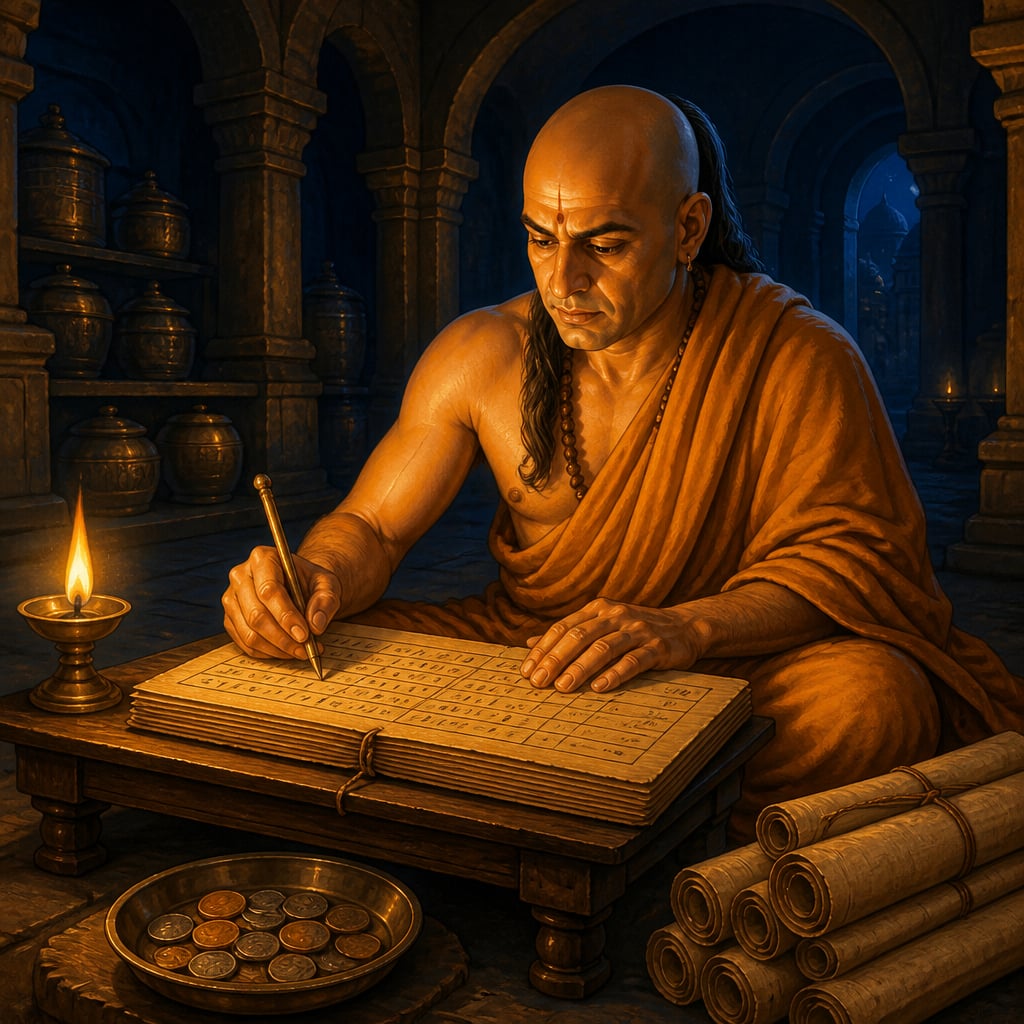
In the treasury chambers of Pataliputra, Kautilya worked by oil lamp, reviewing accounts from across the vast Mauryan Empire. A messenger had brought disturbing news: the northwestern province faced drought, and traders were hoarding grain, pushing prices beyond what common people could afford.
Kautilya faced a choice that governments still face today. Should the state intervene, opening royal granaries, controlling prices, punishing hoarders? Or should it let market forces resolve the crisis?
His answer, recorded in the Arthashastra, would define Indian economic thinking for millennia: the state is not an obstacle to prosperity but its architect.
The Fundamental Question: What Are States For?
Before Kautilya, the dominant view in many civilizations was that rulers existed primarily for conquest and glory. Taxes funded palaces and armies. Economic policy meant squeezing subjects for revenue.
Kautilya turned this completely around:
"प्रजासुखे सुखं राज्ञः प्रजानां च हिते हितम्। नात्मप्रियं हितं राज्ञः प्रजानां तु प्रियं हितम्॥"
"In the happiness of the subjects lies the happiness of the king. In their welfare, his welfare. What is dear to himself is not good for the king; what is dear to the subjects is good for him." , Arthashastra 1.19.34
This is extraordinary. The ruler's purpose is not self-aggrandizement but public prosperity. The state exists to make citizens wealthy, not to extract their wealth.
The Active State: Neither Laissez-Faire Nor Socialist
Kautilya's state is neither the minimal "night watchman" of classical liberalism nor the all-controlling apparatus of socialism. It is what we might call a developmental state, actively promoting economic growth while respecting private enterprise.
The state's economic responsibilities include:
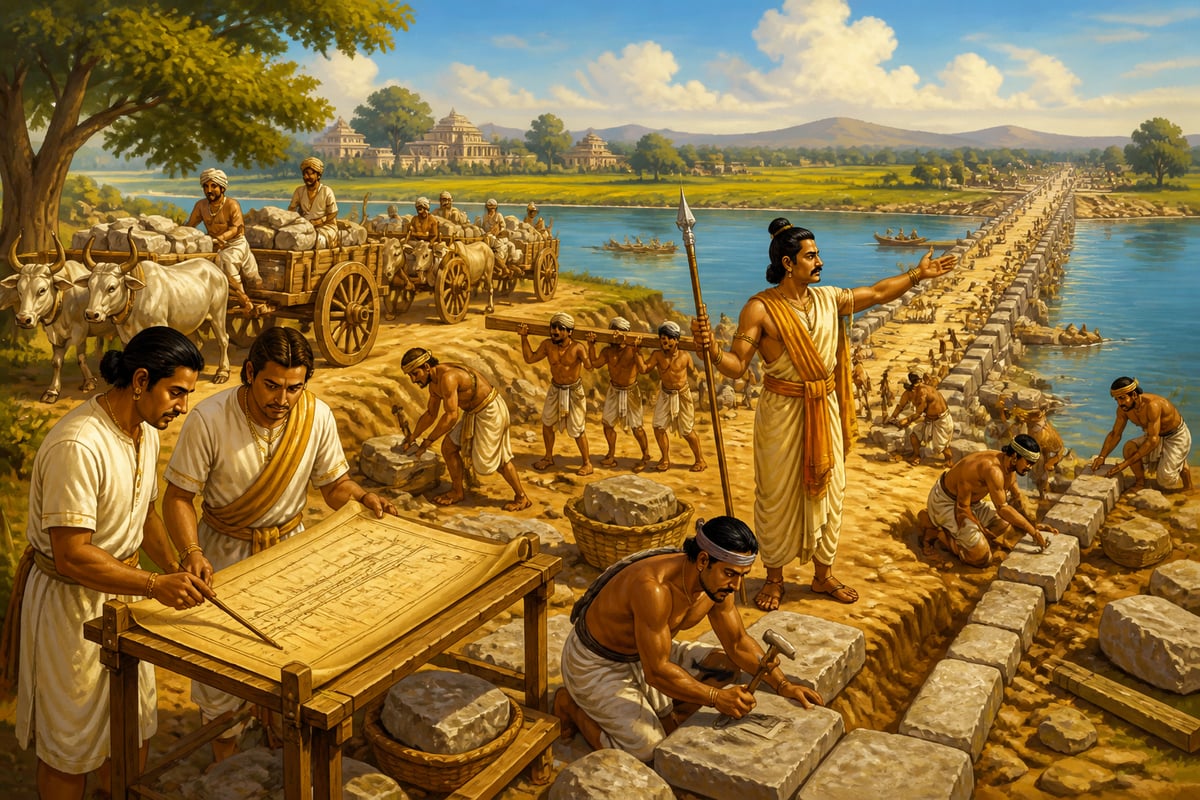
1. Infrastructure (Setu)
Kautilya devoted entire books to roads, irrigation, fortifications, and ports. He understood that private merchants cannot build highways or dam rivers. The state must create the infrastructure on which commerce depends.
Modern parallel: PM Gati Shakti's ₹100 lakh crore infrastructure vision echoes this directly.
2. Market Regulation
Merchants, left unchecked, will form cartels, hoard essential goods, and cheat consumers. Kautilya prescribed superintendents (Adhyakshas) for every major market, officials who verified weights, checked quality, and punished fraud.
Modern parallel: SEBI, CCI, FSSAI, and other regulators perform precisely this Kautilyan function.
3. Strategic Industries
Some industries are too important for national security to leave entirely to private actors. Kautilya's state ran:
- Mines (for metals and currency)
- Armories (for defense)
- Salt production (essential commodity)
- Forests (strategic resource)
Modern parallel: Defence manufacturing under Atmanirbhar Bharat, ISRO, nuclear power plants.
4. Welfare Functions
The state must protect those who cannot protect themselves. Kautilya mandated:
- Care for orphans, widows, and the disabled
- Emergency relief during famines
- Support for the aged
This was social security two millennia before Bismarck.
The Limits of State Power
But Kautilya was no advocate of unlimited government. He recognized crucial limits:
Private Property Rights
The state could not arbitrarily seize private property. Even the king was bound by law. Land disputes went to courts, not royal whim.
Commerce Should Be Free
Beyond regulation for fairness, trade should flow freely. Kautilya criticizes kings who overtax or over-regulate merchants:

"A king who imposes unjust taxes destroys commerce... like one who cuts down a fruit-bearing tree for its fruit."
Corruption Must Be Fought
A state that extracts wealth through corruption is worse than no state. Kautilya's elaborate anti-corruption measures (40 types of embezzlement!) show he trusted the institution of the state, not necessarily the individuals staffing it.
East Meets West: Comparing State Models
| Kautilyan State | Classical Liberal State | Socialist State |
|---|---|---|
| Active in infrastructure and regulation | Minimal, defense and courts only | Controls all means of production |
| Runs strategic industries | Privatize everything | Nationalizes all industry |
| Protects markets from manipulation | Markets self-regulate | Markets are abolished |
| Private property protected | Private property sacred | Private property eliminated |
| Welfare as state duty | Charity is private matter | Welfare as primary purpose |
Kautilya's model is neither extreme. It's a middle path, a state that enables prosperity without suffocating it.
India's Journey: From Kautilya to Today
Post-independence India initially adopted Soviet-style planning, ignoring its indigenous Kautilyan tradition. The result? The "Hindu rate of growth", decades of stagnation.
The 1991 reforms moved toward markets but sometimes forgot that Kautilya wasn't laissez-faire either. The state retreated from everything, including legitimate functions.
Today, under the Viksit Bharat framework, India seems to be rediscovering the Kautilyan balance:
- Massive infrastructure investment (Gati Shakti)
- Active industrial policy (PLI schemes)
- Strong regulation (digital payments framework)
- Strategic autonomy (semiconductor manufacturing)
- Welfare delivery (DBT, Jan Dhan)
Finance Minister Nirmala Sitharaman's emphasis on capital expenditure over revenue expenditure is pure Kautilya: the state should build, not merely consume.
Your Role in the State's Economy
Kautilya's vision places responsibilities on citizens too:
- Pay taxes honestly, they fund the infrastructure you use
- Participate in governance, democracy is your Arthashastra
- Build enterprises, the state enables, but citizens create
- Hold government accountable, Kautilya's anti-corruption spirit
The state as economic engine only works when citizens engage actively. You are not merely a subject of economic policy, you are its co-author.
In the next lesson, we'll explore the kosha, the treasury that Kautilya called the root of all state power.
Adam Smith acknowledged only defense, justice, and certain public works as state duties. Kautilya's state is far more active in enabling commerce.
By making infrastructure a state priority, India historically had better roads and waterways than medieval Europe.
PM Gati Shakti involves ₹100 lakh crore infrastructure investment, largest such program in Indian history, echoing Kautilyan priorities.
Bismarck introduced state welfare in 1880s Germany. Kautilya mandated it over two millennia earlier.
By integrating welfare into state purpose, Indian thought avoids the Western debate over whether welfare is legitimate government function.
India's PM-KISAN provides ₹6,000 annually to 11 crore farmers, direct welfare transfer following Kautilyan principle of state protection.
Key terms
- Rājya
- The state or kingdom, in Kautilyan thought, the institutional framework that enables economic prosperity through governance, infrastructure, and regulation.
- Adhyakṣa
- Superintendent or commissioner, specialized officials appointed to oversee specific economic activities like trade, agriculture, mining, or treasury.
- Prajā
- The subjects or citizens, the people whose welfare is the state's primary purpose according to Kautilya.
- Setu
- Bridge, causeway, or more broadly, infrastructure. In Kautilya's framework, setu encompasses roads, irrigation canals, dams, and all public works that enable commerce and agriculture.
Verses
प्रजासुखे सुखं राज्ञः प्रजानां च हिते हितम्। नात्मप्रियं हितं राज्ञः प्रजानां तु प्रियं हितम्॥
prajāsukhe sukhaṃ rājñaḥ prajānāṃ ca hite hitam | nātmapriyaṃ hitaṃ rājñaḥ prajānāṃ tu priyaṃ hitam ||
The king's joy lies in his people's joy; his welfare in their welfare. What pleases himself is not good for him, what pleases his subjects is truly good.
This articulates inclusive growth millennia before it became a buzzword, economic policy should benefit the broad population, not just elites.
Arthashastra, 1.19.34 (R.P. Kangle)
सर्वेषां कर्मणां मूलम् अर्थः इति कौटिल्यः।
sarveṣāṃ karmaṇāṃ mūlam arthaḥ iti kauṭilyaḥ |
The treasury is the foundation of all state activities, declares Kautilya.
This is fiscal conservatism in its original form: you cannot do good without the resources to pay for it. Sound public finance enables all other state functions.
Arthashastra, 2.1.1 (Patrick Olivelle (2013))
भूताविच्छिन्नदेशं राजा वार्तासिद्धम् आवासयेत्।
bhūta-avicchinna-deśaṃ rājā vārtā-siddham āvāsayet |
Let the king populate a land, unbroken, well-settled, and bring it to economic fullness.
Opening sutra of Book 2 ("The Activities of the Heads of Departments"). The state is not a caretaker of a pre-existing economy, it actively creates the economy through settlement, cultivation, and infrastructure.
Book 2, Chapter 1, Verse 1 (R.P. Kangle)
Key figures
Chandragupta Maurya
Founder of the Mauryan Empire; first emperor to implement Kautilyan economics at scale · 340-298 BCE
Chandragupta, guided by Kautilya, unified India and created the first pan-Indian economic system with standardized coinage, unified taxation, and systematic administration. His empire became the world's largest economy of its time.
Chandragupta demonstrates how Kautilya's vision of the state as economic engine worked in practice, proving that good governance creates prosperity.
Sanjeev Sanyal
Economic historian, Member of Economic Advisory Council to the PM · 1971-present
Sanjeev Sanyal's works including 'The Ocean of Churn' and 'Land of the Seven Rivers' document India's economic history, showing how the state's role in facilitating trade and infrastructure built Indian prosperity. He serves on the PM's Economic Advisory Council, bringing historical perspective to policy.
Sanyal articulates how India's traditional state model, neither socialist nor laissez-faire, enabled centuries of prosperity, and how this can inform current policy.
Alexander Hamilton
First US Treasury Secretary; architect of American industrial policy · 1755-1804
Hamilton authored the 'Report on Manufactures' (1791), arguing that the young American state must actively promote industry through tariffs, subsidies, and infrastructure investment. Against laissez-faire advocates like Jefferson, Hamilton built the First Bank of the United States and advocated state-led development, policies that transformed America from agrarian colony to industrial power.
Hamilton's developmental state vision closely parallels Kautilya's, though developed independently 2000 years later. Both rejected pure laissez-faire, both saw infrastructure as state duty, and both believed strategic industries required government support. Hamilton proves the Kautilyan model works across cultures.
Case studies
UPI: The State as Digital Setu-Builder
In 2016, India faced a paradox: 1.3 billion people, but only 22% with bank accounts had ever used digital payments. Private players like PayPal and Visa had tried and failed to crack the market, the economics didn't work for small transactions. Then NPCI (National Payments Corporation of India), a state-backed entity, launched UPI, an open, interoperable payment rail that any bank or fintech could use for free. The state didn't build the apps; it built the *infrastructure*. PhonePe, Google Pay, Paytm, and hundreds of fintechs built on top. By December 2024, UPI processed 16.7 billion transactions worth ₹23.5 lakh crore in a single month, more real-time transactions than all other countries combined. A chai-wallah in Varanasi now accepts digital payments. A vegetable vendor in Kerala sends money instantly to her daughter in Bangalore. Financial inclusion jumped from 53% (2014) to 80% (2021).
Kautilya would recognize UPI instantly: it is *setu* for the digital age. Just as ancient states built roads that merchants used for private commerce, the Indian state built digital payment rails that private companies use to serve customers. The state didn't try to run a payments company (socialist approach) or leave it entirely to private players who would extract monopoly rents (laissez-faire approach). It created enabling infrastructure, the Kautilyan middle path. The developmental state doesn't compete with markets; it creates the foundations on which markets flourish.
UPI is now the world's most successful real-time payment system. India processes 46% of global real-time transactions. The cost per transaction is near-zero, compared to 2-3% for card networks, saving Indian businesses an estimated ₹2 lakh crore annually. Financial inclusion reached the poorest: 80% of Jan Dhan account holders are active users. Countries from Singapore to France to Brazil are now adopting UPI or similar models, studying how a 'developing country' leapfrogged the West in financial infrastructure.
UPI proves Kautilya's developmental state model works in the 21st century. When the state focuses on infrastructure (setu) rather than running businesses, it enables private innovation while ensuring public benefit. The chai-wallah accepting UPI is the modern equivalent of the ancient merchant using royal roads, private enterprise flourishing on public foundations.
Countries from Brazil to Nigeria now study UPI as a blueprint for state-built digital public infrastructure. The lesson for developing economies is clear: governments that build open rails and let private companies build services on top unlock financial inclusion at a speed and scale that purely private solutions cannot match.
UPI processed 117 billion transactions in 2024, more than Visa and Mastercard combined process globally. The state built the rails; the market built the trains.
Historical context
4th-3rd century BCE (Mauryan Empire)
The Mauryan state collected revenues estimated at 700-800 tons of silver annually, funding the largest army in the world and extensive public works. The state ran mines, armories, and strategic industries while facilitating private commerce.
While Rome was still a republic fighting local wars and Greece had fragmented after Alexander, India under Kautilyan principles had unified the subcontinent and created sophisticated administrative systems including regular audits, anti-corruption measures, and welfare programs.
The Mauryan Empire's population is estimated at 50-60 million, roughly equivalent to the Roman Empire at its peak but several centuries earlier. This scale required advanced administrative systems that the Arthashastra provided.
Understanding Mauryan state capacity shows that effective governance is not a Western import but an indigenous Indian achievement that can be rediscovered and updated.
Living traditions
The Kautilyan vision of the developmental state continues to influence Indian governance philosophy and institutional design.
India's current development model, strong infrastructure investment, strategic industry policy (PLI), active regulation (UPI framework), and welfare delivery (DBT), represents a return to Kautilyan balance after decades of experiment with both socialist control and laissez-faire neglect.
- NITI Aayog Planning: India's policy think-tank explicitly draws on indigenous traditions while planning development, a successor to ancient state planning functions.
- Public Sector Strategic Industries: ISRO, DRDO, and nuclear establishments reflect Kautilyan principle that some industries are too important for purely private control.
- Mauryan Pillars at various locations: Ashoka's pillars, symbols of state authority and dharmic governance, stand across North India as reminders of Mauryan state capacity
- Indian Parliament: The modern institution continuing the Kautilyan principle that governance must serve citizen welfare
- Sanchi Stupa Complex: Built during the Mauryan period and expanded by Ashoka, Sanchi represents the zenith of state-supported religious infrastructure. The stupa complex demonstrates Kautilya's principle that a prosperous treasury enables civilizational projects that benefit all citizens.
- Mahabodhi Temple: Site of Buddha's enlightenment, patronized extensively by Mauryan emperors. Ashoka's visit and subsequent development of the site exemplifies how Kautilyan treasury management enabled state support for religious and cultural institutions.
Reflection
- Where do you see the state as enabler in your daily life? Consider the infrastructure, regulations, and institutions that make your economic activities possible. Do you take these for granted?
- As a citizen in a democracy, what is one specific action you could take this month to improve governance quality, whether through voting, civic participation, or holding officials accountable?