Saptanga: The Seven Pillars of State Economy

A Systems Approach to National Prosperity

Master Kautilya's Saptanga theory, the seven interconnected elements that determine a nation's power. Like a body with seven limbs, weakness in any element affects all others.

The Body Politic
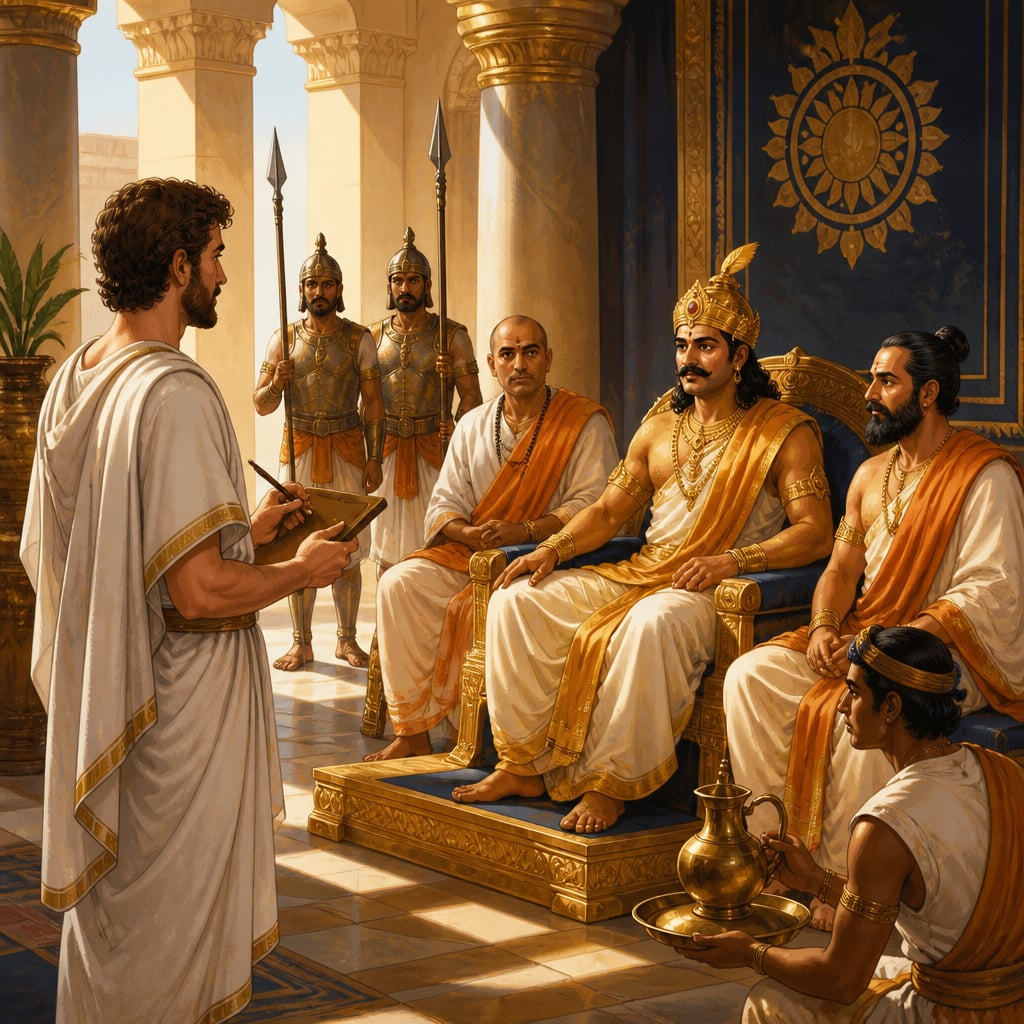
Megasthenes observing the Mauryan royal court

Megasthenes, the Greek ambassador to the Mauryan court around 300 BCE, was puzzled. How did this vast empire, stretching from the Himalayas to the southern Deccan, function so smoothly? How could one administration govern more people than Alexander had ever ruled?

The answer lay in a framework so elegant that Megasthenes devoted entire chapters to describing it: Kautilya's concept of the state as a living body with seven essential limbs.

Just as a human body needs all organs functioning together, a state requires all seven elements, Saptanga, working in harmony. Weakness in any limb cripples the whole.

The Seven Limbs Explained

Kautilya's Saptanga consists of:

1. Swami (स्वामी) - The Sovereign

The head of state, not merely a ruler by birth, but ideally a Rajarshi (philosopher-king) combining practical wisdom with ethical leadership.

Economic function: Strategic direction, final decisions on policy, setting priorities, inspiring confidence.

Modern equivalent: Prime Minister, CEO, or founder, the individual whose vision and decisions shape everything else.

What makes it strong: Education, self-mastery, good advisors, ethical character. What makes it weak: Incompetence, vice, poor judgment, isolation from reality.

2. Amatya (अमात्य) - Ministers and Officials

The administrative apparatus, ministers, superintendents (Adhyakshas), and bureaucrats who implement policy.

Economic function: Policy implementation, tax collection, dispute resolution, regulation enforcement.

Modern equivalent: Cabinet, civil services, regulatory bodies, India's IAS officers are modern Amatyas.

What makes it strong: Competence, loyalty, integrity, proper selection and testing. What makes it weak: Corruption, incompetence, factionalism, bloat.

3. Janapada (जनपद) - Territory and People

Not just land but the productive capacity of territory and population, agriculture, crafts, commerce, labor.

Economic function: The actual wealth-generating base. Everything else exists to protect and nurture this.

Modern equivalent: GDP, productive population, natural resources, manufacturing capacity.

What makes it strong: Fertile land, skilled population, good infrastructure, peace and security. What makes it weak: Drought, famine, emigration, internal conflict, poor education.

4. Durga (दुर्ग) - Fortified Capital

The secure center, not just military fortification but administrative infrastructure, treasury protection, and crisis resilience.

Economic function: Secure storage for treasury, safe headquarters for administration, refuge during crisis.

Modern equivalent: Capital city infrastructure, secure banking systems, disaster-resilient governance.

What makes it strong: Strategic location, multiple defenses, self-sufficiency in siege. What makes it weak: Poor design, corruption of guards, supply vulnerabilities.

5. Kosha (कोष) - Treasury

The financial reserves, gold, silver, currency, stored commodities. The "root of all undertakings."

Economic function: Fund all state activities, maintain reserves for emergencies, invest in productive capacity.

Modern equivalent: Foreign exchange reserves, sovereign wealth, fiscal health.

What makes it strong: Multiple revenue streams, prudent management, reserves for crisis. What makes it weak: Single-source dependency, corruption, excessive spending.

6. Danda (दण्ड) - Army and Enforcement

Military and police power, external defense and internal order enforcement.

Economic function: Protect trade routes, enforce contracts, collect taxes, maintain order enabling commerce.

Modern equivalent: Armed forces, police, courts, regulatory enforcement.

What makes it strong: Funding (kosha-mula!), training, morale, good leadership. What makes it weak: Underfunding, poor discipline, disloyalty, excessive costs.

7. Mitra (मित्र) - Allies

Strategic partnerships, foreign states, trading partners, and allies who extend the nation's reach and security.

Economic function: Trade agreements, shared defense costs, combined bargaining power, technology transfer.

Modern equivalent: Trade agreements, QUAD, BRICS, bilateral treaties, FTAs.

What makes it strong: Shared interests, mutual benefit, trust built over time. What makes it weak: Misaligned interests, unreliability, dependency without reciprocity.

The Interconnected System

A fortified Mauryan capital with all seven elements visible

Kautilya's genius was recognizing that these seven elements form an integrated system. Each affects all others:

"The elements are interdependent. A state with a wise sovereign but corrupt ministers will fail. A state with full treasury but weak army will be conquered. A state with powerful army but impoverished people cannot sustain."

Consider the dependencies:

If This Is Weak... Then These Suffer...
Swami (leadership) All elements lack direction
Amatya (administration) Policy fails in implementation
Janapada (productive base) Treasury starves, army weakens
Durga (security infrastructure) Treasury vulnerable, administration disrupted
Kosha (treasury) Army, administration, infrastructure all suffer
Danda (enforcement) Internal order collapses, trade disrupted
Mitra (allies) Isolated against enemies, trade restricted

Saptanga vs. Western Frameworks

Modern Western thinkers have independently developed similar systems frameworks, but none as comprehensive as Kautilya's:

Peter Drucker (1909-2005), the father of modern management, emphasized that organizations are systems where every part affects every other. His insight that 'management is doing things right; leadership is doing the right things' mirrors Kautilya's distinction between Swami (vision) and Amatya (execution). But Drucker focused on corporations, not states.

Michael Porter (1947-present) developed the 'Diamond of National Competitiveness' in 1990, identifying four factors determining national economic success: factor conditions, demand conditions, related industries, and firm strategy. Porter's Diamond is taught in every business school, yet Kautilya's Saptanga has seven factors, including three that Porter misses entirely: leadership quality (Swami), security infrastructure (Durga), and strategic alliances (Mitra). Kautilya's framework is more complete.

George Kennan (1904-2005), architect of America's Cold War containment strategy, understood the Mitra element intuitively. His 'Long Telegram' and subsequent strategy built alliance systems (NATO, bilateral treaties) that multiplied American power. Kennan's insight: 'The best thing we can do is create the impressions of a country that knows what it wants.' This is Swami clarity enabling Mitra effectiveness, Kautilyan logic, 2,300 years after Kautilya.

These Western thinkers prove that Saptanga insights are universal. But they each saw only part of the elephant. Kautilya saw the whole.

Applying Saptanga to Modern India

Let's evaluate India through the Saptanga lens:

Element India 2025 Strength/Weakness
Swami Stable elected leadership Strength: democratic legitimacy, clear vision
Amatya Large bureaucracy, ongoing reforms Mixed: competent at top, execution gaps
Janapada 1.4B people, growing economy Strength: demographic dividend; Challenge: skill gaps
Durga Major cities, digital infrastructure Improving: smart cities, but urban stress
Kosha $600B+ forex, growing GST Strength: healthy reserves; Challenge: fiscal deficit
Danda Large military, active police Strength: capability; Challenge: modernization needs
Mitra QUAD, bilateral ties, G20 presidency Strength: multi-alignment, growing influence

This analysis reveals India's strategic position, strong in some elements, developing in others.

Saptanga for Organizations and Individuals

The framework applies beyond nations:

For Companies

  1. Swami: CEO/Founder leadership
  2. Amatya: Management team and employees
  3. Janapada: Market position, customer base, products
  4. Durga: Headquarters, IP protection, business continuity
  5. Kosha: Cash reserves, profitability
  6. Danda: Legal team, competitive capability
  7. Mitra: Partners, investors, industry alliances

For Individuals

  1. Swami: Your own wisdom and decision-making
  2. Amatya: Your skills and capabilities
  3. Janapada: Your career, income sources
  4. Durga: Your home, health, security
  5. Kosha: Your savings, investments
  6. Danda: Your ability to protect interests
  7. Mitra: Your relationships, network, mentors

The Balance Imperative

Kautilya warns against focusing on one element while neglecting others:

The goal is balanced strength across all seven, like a healthy body where every organ functions well.

Your Saptanga Assessment

Before moving to the next lesson, assess your own "state", whether your household, your career, or an organization you lead:

The Saptanga framework provides a diagnostic tool that has worked for 2,300 years. Use it.

In the next lesson, we'll explore Varta, the economic base of agriculture, trade, and cattle that Kautilya considered the foundation of all prosperity.

Porter's Diamond (1990) identifies four determinants of national competitiveness. Kautilya's Saptanga offers seven, including alliance dimension often missed.

The body metaphor makes systems thinking intuitive, everyone understands that a strong heart with weak lungs doesn't make a healthy person.

India's Composite Development Index shows that states strong on multiple dimensions (not just one) have highest overall development outcomes.

Human capital as primary driver of organizational performance

Jim Collins' 'Level 5 Leadership' research shows that CEO quality is the strongest predictor of company performance, echoing Kautilya's sovereign primacy.

By placing leadership first in the hierarchy, Kautilya focuses attention on what matters most, quality of decisions, not just quantity of resources.

Key terms

Saptāṅga
The seven limbs or constituent elements of the state: sovereign, ministers, territory, fortification, treasury, army, and allies.
Janapada
The territory and its people, not just land but the productive capacity of the population including agriculture, crafts, and commerce.
Durga
Fortified capital or stronghold, the secure administrative center that protects treasury, enables governance, and provides refuge in crisis.
Svāmī
The sovereign or leader, the first and most important element of the Saptanga. In Kautilya's hierarchy, leadership quality determines how well all other resources are utilized.

Verses

स्वाम्यमात्यजनपददुर्गकोषदण्डमित्राणि प्रकृतयः।

svāmy-amātya-janapada-durga-koṣa-daṇḍa-mitrāṇi prakṛtayaḥ |

The sovereign, ministers, territory, fortification, treasury, army, and allies, these are the constituent elements of the state.

This is systems thinking applied to political economy, recognizing that national power is multidimensional and requires balanced development across all factors.

Arthashastra, 6.1.1 (R.P. Kangle)

तेषां प्रकृतीनां पूर्वपूर्वगुणवत्तरत्वम्।

teṣāṃ prakṛtīnāṃ pūrva-pūrva-guṇa-vattaratvam |

Among these elements, each preceding one is more important than those that follow.

This prioritizes human capital and leadership over material resources, a wise sovereign with limited resources outperforms a foolish one with abundance.

Arthashastra, 6.1.15-18 (Patrick Olivelle (2013))

तासां शुद्धौ सर्वारम्भसिद्धिः।

tāsāṃ śuddhau sarva-ārambha-siddhiḥ |

When all seven pillars stand unblemished, every undertaking succeeds.

After listing svāmī, amātya, janapada, durga, kośa, daṇḍa, mitra, Kautilya adds this single sutra as the connecting principle. The whole body politic is one organism, and health is system-wide.

Book 6, Chapter 1, Verse 16 (R.P. Kangle)

Key figures

Megasthenes

Greek ambassador to Mauryan court; author of Indica · 350-290 BCE

Megasthenes served as Seleucid ambassador to Chandragupta's court and wrote Indica, documenting Mauryan administration. His accounts confirm the sophisticated implementation of Kautilyan principles, including the seven-ministry structure that mirrors Saptanga elements.

Megasthenes provides external validation of Saptanga implementation, Greek observers marveled at the systematic organization of Mauryan governance.

S. Jaishankar

External Affairs Minister of India; author of 'The India Way' · 1955-present

As External Affairs Minister, Jaishankar manages the 'Mitra' (allies) element of India's Saptanga. His multi-alignment strategy, balancing relationships with US, Russia, and regional powers, reflects Kautilyan principles of strategic friendship adapted for the multipolar world.

Jaishankar's diplomacy demonstrates modern application of Mitra element, building strategic partnerships that enhance national power without dependency.

Michael Porter

Harvard Business School professor; creator of the Diamond of National Competitiveness · 1947-present

Porter's 1990 book 'The Competitive Advantage of Nations' introduced the 'Diamond Model', four interconnected determinants of national competitiveness: factor conditions, demand conditions, related industries, and firm strategy. This framework became the standard for analyzing why nations succeed in particular industries.

Porter's Diamond has four factors; Kautilya's Saptanga has seven, including crucial elements Porter misses: leadership quality (Swami), security infrastructure (Durga), and strategic alliances (Mitra). Kautilya's framework is more comprehensive, proving that ancient Indian thought anticipated and exceeded modern management theory.

Case studies

Japan's Post-War Resurrection: Saptanga Rebuilt from Ashes

In August 1945, Japan lay in ruins. Two atomic bombs, 66 cities firebombed, 2.5 million dead. Every element of the Saptanga was shattered: the Emperor (Swami) was forced to renounce divinity, the military bureaucracy (Amatya) was purged, the industrial base (Janapada) was destroyed, cities (Durga) were rubble, the treasury (Kosha) was empty, the military (Danda) was disbanded, and Japan had no allies (Mitra), only occupiers. By every measure, this was civilizational collapse. Yet within 25 years, Japan became the world's second-largest economy. How?

Japan's recovery was systematic Saptanga reconstruction. **Swami**: New leadership emerged, not military but industrial (Matsushita, Honda, Morita). **Amatya**: MITI (Ministry of International Trade and Industry) became the world's most effective industrial policy bureaucracy. **Janapada**: Massive investment in education created the world's most skilled workforce. **Durga**: Infrastructure was rebuilt with latest technology. **Kosha**: High savings rates funded investment without foreign debt. **Danda**: Security was outsourced to US alliance, freeing resources for economic development. **Mitra**: The US-Japan alliance provided security umbrella and export market access. Each element was deliberately strengthened, and their interdependencies were managed.

Japan's GDP grew from $20 billion (1950) to $5 trillion (1995), a 250x increase in 45 years. Japan invented the quality management revolution, became the world's largest creditor nation, and developed globally dominant industries in automobiles, electronics, and manufacturing. The 'Japanese miracle' was not miraculous, it was methodical application of systems thinking that Kautilya would recognize.

Japan proves that Saptanga is a rebuilding framework, not just an assessment tool. By systematically strengthening each element while managing their interdependencies, even catastrophic collapse can be reversed. The key insight: Japan didn't try to rebuild everything at once. It prioritized elements strategically, first Amatya (governance capacity), then Janapada (productive base), then Kosha (financial strength), each phase enabling the next.

Japan's post-war reconstruction remains the benchmark for systemic national rebuilding. Modern parallels include South Korea's post-war rise and Vietnam's doi moi reforms, both of which followed similar sequencing: stabilize leadership, rebuild institutions, invest in human capital, then open markets.

Japan's literacy rate was 99% even in 1945, the Janapada (human capital) element survived the war. This single preserved element enabled all others to be rebuilt. Saptanga teaches that some elements are more foundational than others.

China's Rise: Deliberate Saptanga Engineering Since 1978

In 1978, China was one of the world's poorest nations, per capita GDP of $156, below most African countries. Mao's Cultural Revolution had devastated every Saptanga element: leadership purged (Swami chaos), bureaucracy destroyed (Amatya collapse), economy shattered (Janapada ruined), infrastructure crumbling (Durga decay), treasury empty (Kosha depleted), military outdated (Danda weak), and isolated from the world (no Mitra). Deng Xiaoping inherited a broken state. His response was not ideology but systematic reconstruction.

Deng's reforms can be mapped directly to Saptanga elements. **Swami**: Collective leadership replaced personality cult, bringing pragmatic decision-making. **Amatya**: Bureaucracy was rebuilt through examination system and technocratic promotion. **Janapada**: Special Economic Zones created productive capacity; 'one country, two systems' preserved Hong Kong's expertise. **Durga**: Massive infrastructure investment, China now has more high-speed rail than rest of world combined. **Kosha**: Export-led growth built $3.2 trillion in forex reserves. **Danda**: Military modernization focused on 'informatized warfare.' **Mitra**: Strategic partnerships (BRI, SCO) extended influence globally. Each element was strengthened systematically over decades.

China's GDP grew from $150 billion (1978) to $18 trillion (2024), a 120x increase. 800 million people lifted from poverty. China became the world's largest manufacturer, trader, and forex reserve holder. Whether one approves of China's system or not, the Saptanga analysis explains *how* this transformation occurred: methodical strengthening of each element in sequence.

China's rise validates Kautilya's systems thinking at civilizational scale. The Chinese Communist Party explicitly studied Kautilya, the Arthashastra was translated into Chinese in the 1950s. Their long-term planning (Five-Year Plans) mirrors Kautilyan statecraft. The lesson for India: systematic Saptanga development works. China's advantage was not culture or ideology but disciplined application of the framework India invented.

China's systematic state-building approach is now studied by developing nations across Africa and Southeast Asia as an alternative to the Washington Consensus model. The Saptanga lens reveals why: coordinated development of multiple pillars simultaneously produces compound effects that piecemeal reform cannot.

China built more cement in three years (2011-2013) than the US did in the entire 20th century. This Durga (infrastructure) investment created the foundation for Janapada (productive capacity) growth, exactly the sequence Kautilya prescribed.

Historical context

4th-3rd century BCE (Mauryan Empire)

The Mauryan Empire was the first to implement Saptanga theory at continental scale. Each element had dedicated administration: the Amatyas included superintendents for each function, the Janapada was surveyed and classified, the treasury had detailed accounting, and diplomatic relations were systematically managed.

While Greek city-states failed to unite (lacking effective Mitra) and fell to Macedon, and Rome was still a regional power, India had achieved political unification and systematic governance. The Saptanga framework enabled this unprecedented achievement.

The Mauryan state employed an estimated 30,000 officials (Amatyas) across the empire, an administrative apparatus not matched in Europe until the 18th century.

Saptanga theory explains why some nations thrive while others fail despite similar resources, the difference lies in balanced development across all seven elements.

Living traditions

The Saptanga framework continues to influence Indian strategic thinking and organizational assessment.

India's Cabinet system (Amatyas), federal structure (balancing central Swami with state Janapadas), foreign policy establishment (Mitra management), and strategic forces (Danda) all reflect Saptanga organization updated for democratic governance.

Reflection

More in Foundations of Kautilyan Economics

All lessons in Foundations of Kautilyan Economics · Arthashastra: Economic Principles course