Arthashastra: The Science of Material Prosperity

Wealth as Sacred Life Goal

Discover why Kautilya declared material prosperity the foundation of all human achievement, and how this ancient insight challenges both Western materialism and false spirituality that rejects wealth.

The Emperor's Dilemma
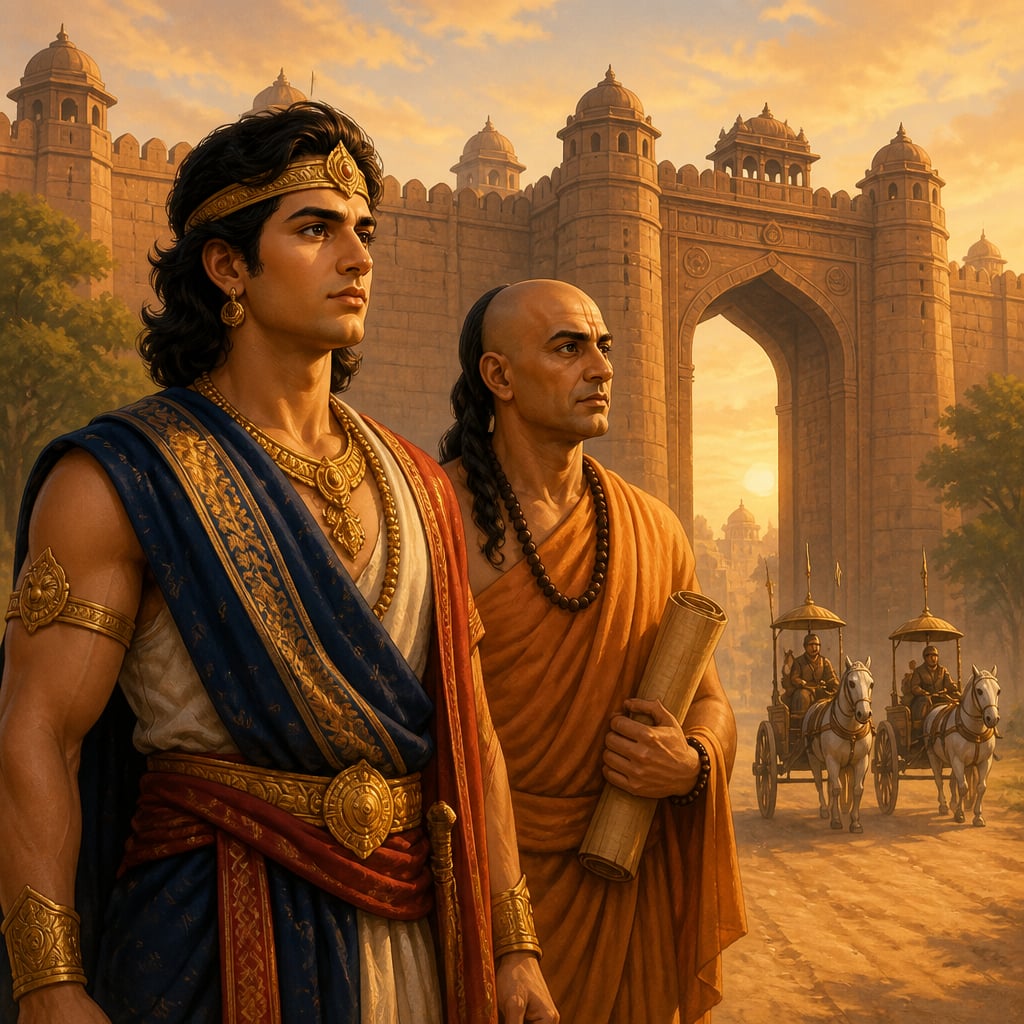
Chandragupta and Kautilya at the gates of Pataliputra at dawn

In 321 BCE, a young man named Chandragupta stood at the gates of Pataliputra, the mightiest city in the ancient world. Behind him was an army of liberation. Before him was a question that would shape Indian economic thought for millennia: What is wealth for?

His advisor, the brilliant strategist Kautilya, had spent years preparing for this moment. But Kautilya wasn't just planning military conquest. He was building something far more ambitious: a complete science of prosperity. This would become the Arthashastra, literally, the "science of wealth" or "treatise on material prosperity."

The Four Goals of Human Life

To understand Kautilya's economics, we must first understand the Vedic framework he inherited. Ancient Indian thought recognized four legitimate pursuits of human life, called Purusharthas:

  1. Dharma (धर्म) - Righteous conduct and sacred duty
  2. Artha (अर्थ) - Material prosperity and wealth
  3. Kama (काम) - Pleasure and emotional fulfillment
  4. Moksha (मोक्ष) - Spiritual liberation

Notice something remarkable: wealth is not merely tolerated, it is sanctified as one of life's four essential goals. This is not Western materialism dressed in Sanskrit. It is a fundamentally different understanding of prosperity's place in human flourishing.

But Kautilya went further. In a statement that shocked the ascetically-inclined, he declared:

"अर्थ एव प्रधानं इति कौटिल्यः। धर्मकामाव् अर्थमूलौ हि।"

"Artha is the most important, declares Kautilya. For dharma and kama both have their root in artha." , Arthashastra 1.7.6-7

This was revolutionary. Without economic foundation, Kautilya argued, a starving person cannot perform rituals. A homeless family cannot enjoy life's pleasures. A nation under foreign domination cannot pursue spiritual liberation. Material prosperity is not the enemy of spirituality, it is its foundation.

The Householder's Sacred Duty
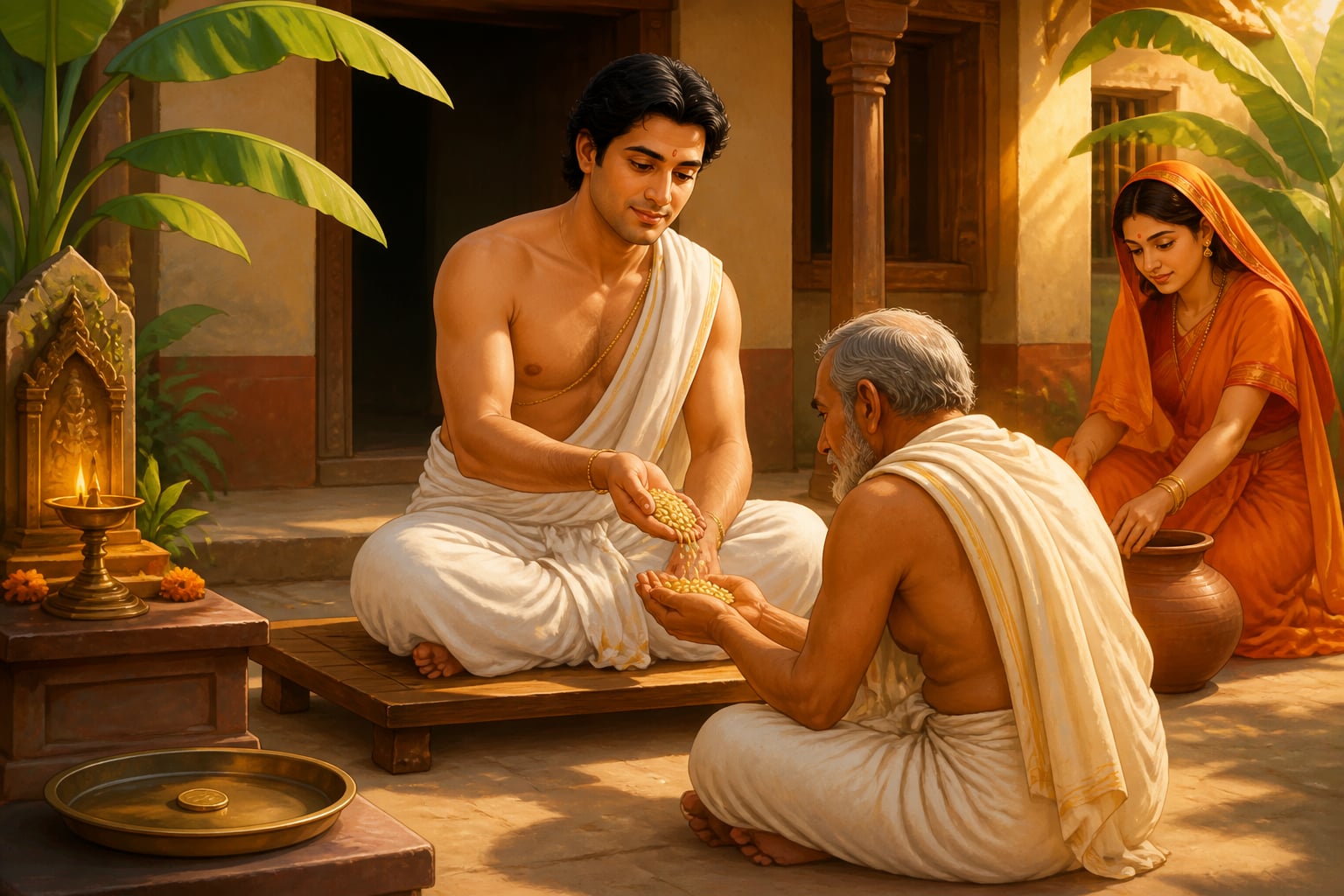
A Vedic householder distributing grain to family in his courtyard

Kautilya grounded his economics in the Grihastha (householder) stage of life. In the ashrama system, the householder has explicit economic duties that are not merely practical but sacred:

A householder who fails economically fails dharma itself. This is why Kautilya spent fifteen books detailing how states should generate and manage wealth, not as an end in itself, but as the foundation for civilizational flourishing.

East Meets West: A Crucial Distinction

How does this compare to Western economic thought? Adam Smith, writing in 1776, over two thousand years after Kautilya, proposed that individual self-interest, channeled through markets, produces public good. The butcher serves you not from benevolence but from self-interest.

Vedic Artha Western Materialism
Wealth as means to higher goals Wealth often treated as end in itself
Bounded by dharma (ethics) Maximization without explicit ethical limits
For self, family, AND society Primarily individual accumulation
Earning is sacred duty Earning is personal choice

The crucial difference: in the Kautilyan framework, wealth creation is inherently ethical because it serves dharma. In much of Western economic thought, ethics is external to economics, a constraint imposed from outside. Kautilya saw no such division. Economic activity is dharmic activity when done rightly.

The $5 Trillion Question

In December 2025, India stands as the world's fifth-largest economy, pursuing a vision called Viksit Bharat (Developed India) by 2047. Finance Minister Nirmala Sitharaman presents budgets emphasizing capital expenditure, manufacturing revival, and digital infrastructure.

Is this mere GDP worship? Or is it something deeper?

Through the Kautilyan lens, India's economic ambitions are not materialistic in the Western sense. They are the fulfillment of national dharma, the collective sacred duty to ensure prosperity for 1.4 billion people. The $5 trillion economy goal isn't just statistics; it's fulfilling the Purushartha framework for an entire civilization.

Sanjeev Sanyal, economic historian and member of the Economic Advisory Council, argues that India's civilizational decline began when it started viewing economic and military engagement negatively, a departure from the original Vedic and Kautilyan tradition that saw no false dichotomy between spirituality and prosperity.

Your Foundation

What does this mean for you?

First, release any guilt about earning and building wealth. If you're a householder, working, raising a family, engaging with the world, prosperity is not a distraction from your spiritual path. It is part of your spiritual path.

Second, understand that wealth comes with responsibility. The Kautilyan framework doesn't justify greed. It sanctifies dharmic wealth, earned honestly, shared generously, used wisely.

Third, see your economic activity as participation in something larger. Every honest business, every productive enterprise, every well-managed household contributes to the collective Artha of your community and nation.

In the next lesson, we'll explore how Kautilya envisioned the state as an economic engine, the seven pillars that make or break a nation's prosperity.

Adam Smith focused on wealth creation; Keynes on stability. Neither explicitly linked economics to ethical/spiritual flourishing as Kautilya did.

Kautilya integrates economics into a holistic framework of human purpose, preventing the alienation modern economics often creates.

India's per capita GDP was among world's highest in 1 CE (~25% of global GDP) when Kautilyan principles guided governance.

Labor force participation and intergenerational wealth transfer

Western economics treats work as individual choice; Kautilya frames it as social obligation with spiritual dimension.

By sacralizing productive work, Indian thought dignifies economic activity and motivates ethical behavior.

Key terms

Puruṣārtha
The four goals of human life: Dharma (righteousness), Artha (prosperity), Kama (pleasure), and Moksha (liberation). Literally 'goals worthy of human pursuit.'
Arthaśāstra
The science or treatise on material prosperity, statecraft, and governance. Kautilya's foundational text on economics and political science.
Gṛhastha
The householder stage of life, responsible for economic activity, family support, and sustaining society through productive work.
Kośa
The state treasury; a storehouse of wealth. In Kautilya's framework, the kosha is one of the seven essential pillars (saptanga) of state power.

Verses

अर्थ एव प्रधानं इति कौटिल्यः। धर्मकामाव् अर्थमूलौ हि।

artha eva pradhānaṃ iti kauṭilyaḥ | dharmakāmāv arthamūlau hi |

Wealth is supreme, declares Kautilya, for righteousness and pleasure both have prosperity as their root.

This represents an early articulation of economic preconditions for human development, anticipating modern concepts like Maslow's hierarchy where basic needs must be met before higher pursuits.

Arthashastra, 1.7.6-7 (Patrick Olivelle (2013))

सुखस्य मूलं धर्मः। धर्मस्य मूलं अर्थः। अर्थस्य मूलं राज्यम्।

sukhasya mūlaṃ dharmaḥ | dharmasya mūlaṃ arthaḥ | arthasya mūlaṃ rājyam |

Happiness is rooted in dharma; dharma is rooted in wealth; wealth is rooted in good governance.

This anticipates institutional economics, the recognition that economic outcomes depend fundamentally on governance quality and institutional frameworks.

Arthashastra, 1.4.3 (R.P. Kangle)

आन्वीक्षिकी त्रयी वार्ता दण्डनीतिश्चेति विद्याः।

ānvīkṣikī trayī vārtā daṇḍa-nītiś-ceti vidyāḥ |

Four are the sciences: philosophy, the Vedas, economics, and governance.

By placing vārtā alongside the Vedas and philosophy, Kautilya makes a radical claim: economic knowledge is not utilitarian addendum to statecraft, it is constitutive of it. A king ignorant of economics is an unformed king.

Book 1, Chapter 4, Verse 3 (R.P. Kangle)

Key figures

Kautilya (Chanakya)

Author of Arthashastra; Chief Advisor to Chandragupta Maurya · 4th century BCE

Kautilya authored the Arthashastra, the world's most comprehensive ancient treatise on economics, statecraft, and governance. He established the Mauryan Empire and created frameworks for taxation, treasury management, trade regulation, and anti-corruption that influenced Indian governance for centuries.

Kautilya established that material prosperity (artha) is fundamental to all human achievement, making economics a sacred science rather than a mere practical concern.

Bibek Debroy

Economist, Translator, Chairman of Economic Advisory Council to the PM · 1955-2024

Bibek Debroy translated the complete Arthashastra into modern English (Penguin, 2019), making ancient Indian economic thought accessible to contemporary readers. He served as Chairman of the Economic Advisory Council to the Prime Minister, bridging ancient wisdom and modern policy.

Debroy's translations and policy work demonstrate how Kautilyan principles remain relevant to 21st-century economic challenges and Indian governance.

Aristotle

Greek philosopher; author of Politics and Nicomachean Ethics · 384-322 BCE

Aristotle wrote on 'oikonomia' (household management) and distinguished between natural wealth acquisition for household needs versus 'chrematistics' (unlimited money-making), which he criticized as unnatural. His Economics and Politics laid foundations for Western economic thought, emphasizing moderation and purpose in wealth.

Aristotle was Kautilya's near-contemporary, writing his economic philosophy around the same time. Both saw wealth as instrumental to higher goals, but Kautilya developed a far more comprehensive and practical system. Comparing the two reveals the sophistication of Indian economic thought at this early period.

Case studies

Tata Group: 156 Years of Purushartha in Action

In 1868, Jamsetji Tata started a trading company with a radical premise: business exists to serve the nation. When he built India's first steel plant at Jamshedpur in 1907, he didn't just construct a factory, he built a city with worker housing, hospitals, schools, and India's first 8-hour workday (decades before it became law). Today, Tata Group operates in 100+ countries with $150 billion revenue (2024), yet 66% of its holding company shares belong to philanthropic trusts, not the Tata family. When Tata Motors acquired Jaguar Land Rover in 2008 during the financial crisis, Ratan Tata refused to lay off workers, unlike typical cost-cutting acquisition playbooks. The company absorbed losses for three years before JLR became profitable. In 2020, during COVID-19, Tata Trusts donated ₹1,500 crore for pandemic relief while Tata companies converted facilities to produce PPE and oxygen concentrators at cost.

The Purushartha framework explains Tata's approach: Artha (wealth creation) is pursued vigorously, Tata is India's largest private employer, but always bounded by Dharma (ethical constraints like no layoffs, fair wages, quality products). The group serves Kama (stakeholder satisfaction) for employees, customers, and communities, not just shareholder returns. And the majority ownership by trusts represents Moksha orientation, building institutions that transcend individual lifetimes. Conventional capitalism would maximize shareholder value; Tata maximizes civilizational value.

Tata Group has grown from a single trading firm to India's most valuable conglomerate ($365 billion market cap across listed companies, 2024) while donating over $100 billion to nation-building since independence. The group has never had a major corruption scandal in 156 years. Employee retention rates exceed industry averages. The 'Tata' brand is India's most trusted, valued at $25 billion, built not through advertising but through generations of dharmic conduct.

Tata proves that the Purushartha framework isn't idealistic philosophy, it's a viable business model. When Artha is pursued within Dharma, wealth compounds across generations. The Tata family owns almost nothing personally, yet their name is synonymous with prosperity. This is Kautilya's vision realized: wealth as foundation for civilizational flourishing, not personal accumulation.

The Tata model is studied at Harvard and Wharton as proof that stakeholder capitalism outperforms shareholder-only models over long time horizons. As ESG investing grows globally, Tata's 156-year track record offers the most compelling data point: dharmic wealth creation compounds precisely because it reinvests in the ecosystem that sustains it.

Tata Trusts have funded 70% of India's research institutions including IISc Bangalore, TIFR, and IITs. No other business family globally has reinvested such a proportion of wealth into national capacity-building.

Historical context

4th-3rd century BCE (Mauryan Period)

The Mauryan period saw India emerge as the world's largest economy with sophisticated administrative systems, extensive trade networks reaching Rome and Southeast Asia, and advanced agricultural productivity.

While Greece had philosophical economics (Aristotle's Oikonomia) and Rome was building its republic, India under Mauryan rule had implemented detailed economic policies including price controls, quality standards, and welfare programs that wouldn't appear in Europe for two millennia.

The Mauryan Empire had a standing army of 600,000 infantry, 30,000 cavalry, and 9,000 war elephants, funded entirely by the sophisticated tax system Kautilya designed.

Understanding Kautilya's historical context reveals that advanced economic thinking is indigenous to India, not imported from the West during colonization.

Living traditions

Kautilyan economic principles continue to influence Indian governance, business ethics, and household financial practices.

India's Finance Ministry operations, NITI Aayog's policy frameworks, and the emphasis on capital expenditure in Union Budgets reflect Kautilyan principles of state-led economic development. The Economic Advisory Council to PM, where Bibek Debroy served, explicitly draws on ancient Indian economic thought.

Reflection

More in Foundations of Kautilyan Economics

All lessons in Foundations of Kautilyan Economics · Arthashastra: Economic Principles course