Bibek Debroy's Translations: Accessing Ancient Economic Wisdom
Bringing Kautilya to the Modern World
Explore how Bibek Debroy's scholarly translations have made the Arthashastra accessible to modern readers, bridging 2,300 years to bring ancient Indian economic wisdom into contemporary policy discussions.
The Scholar's Mission
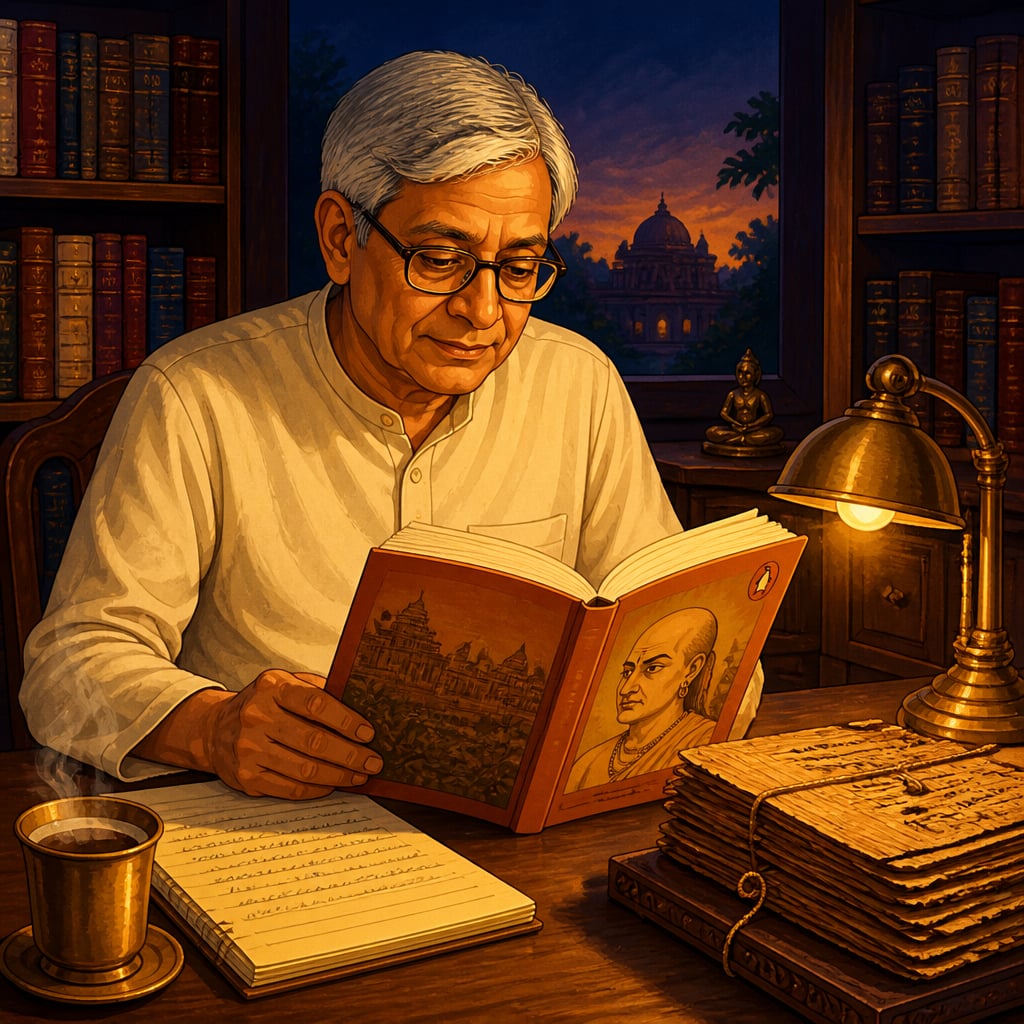
In 2019, a remarkable book appeared in Indian bookstores: a fresh, complete translation of the Arthashastra by Bibek Debroy, published by Penguin. For the first time, general readers could access Kautilya's economic insights in modern, readable English with extensive commentary connecting ancient concepts to contemporary issues.
This wasn't just an academic exercise. Debroy served as Chairman of the Economic Advisory Council to the Prime Minister. He was actively applying these ancient insights to 21st-century policy challenges. The translator was also a policymaker, bridging theory and practice across millennia.
Why Translation Matters
The Lost Text Problem
The Arthashastra was effectively lost for nearly two thousand years:
- Written: ~300 BCE
- Lost: Disappeared from circulation around 12th century CE
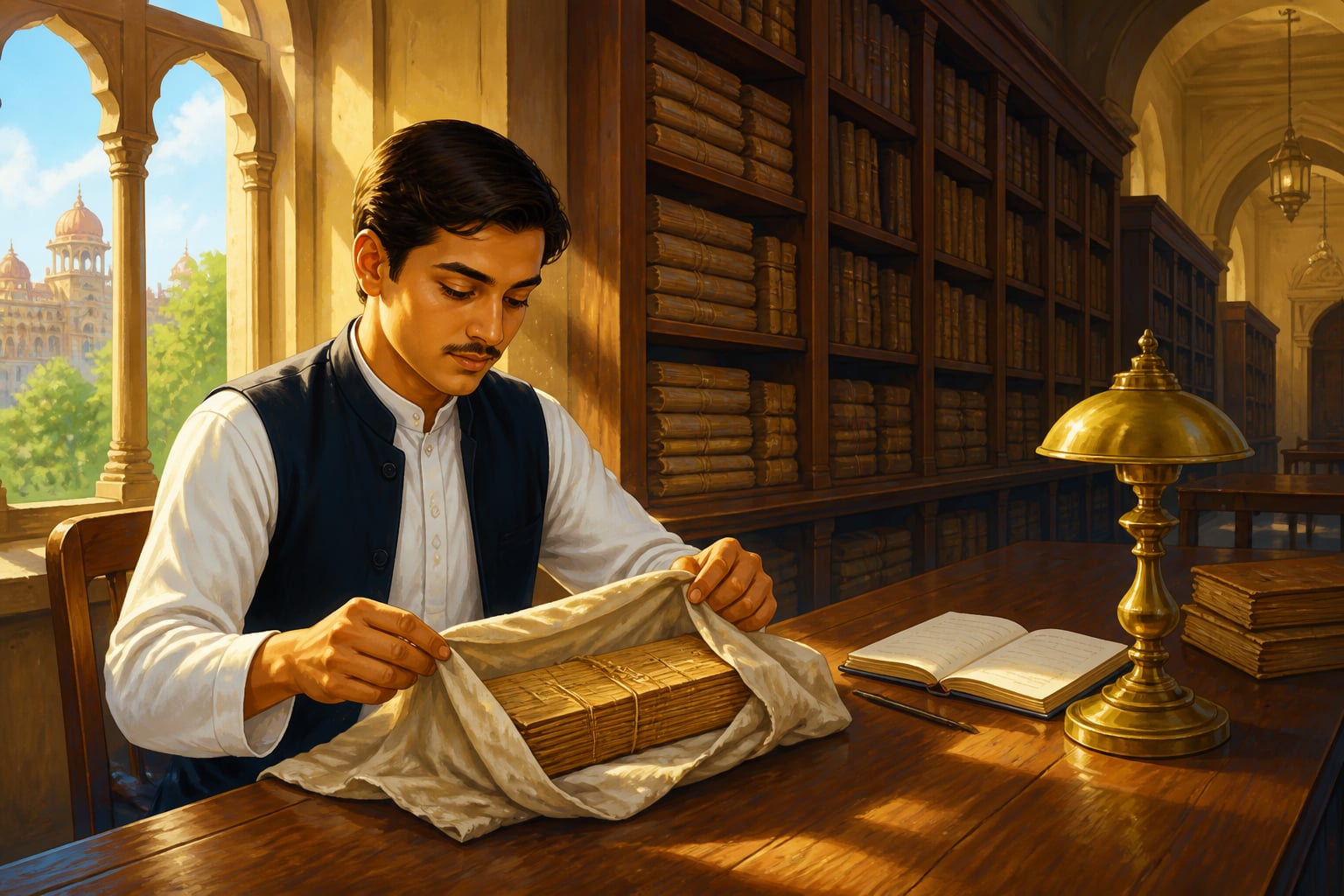
- Rediscovered: 1905 CE, by R. Shamasastry in Mysore
- First modern translation: 1915 CE
For centuries, Indians debated economics without access to their own foundational text. Colonial economics education imported Adam Smith and David Ricardo while the Arthashastra gathered dust.
The Accessibility Gap
Even after rediscovery, the text remained inaccessible:
- Language barrier: Classical Sanskrit is difficult even for educated Indians
- Technical complexity: Dense administrative and economic terminology
- Academic style: Early translations were scholarly, not readable
- Conceptual distance: Ancient context requires explanation for modern readers
Debroy's translation addressed all four barriers.
Key Translators and Their Contributions
R. Shamasastry (1915)
The discoverer and first translator. Shamasastry found the manuscript in Mysore and produced the first English translation. His work was pioneering but academic in style, valuable for scholars, challenging for general readers.
Contribution: Made the text available; established academic study.
R.P. Kangle (1960s)
The critical edition maker. Kangle produced the definitive Sanskrit text with critical apparatus, comparing different manuscript traditions. His three-volume work remains the scholarly gold standard.
Contribution: Established authoritative text; detailed linguistic analysis.
L.N. Rangarajan (1992)
The thematic organizer. Rangarajan reorganized the text by topic rather than Kautilya's original book structure, making specific subjects easier to find and study.
Contribution: Subject-wise accessibility; easier reference for researchers.
Bibek Debroy (2019)
The accessible translator for modern readers. Debroy combined scholarly accuracy with readable prose, extensive footnotes connecting to modern concepts, and an introduction placing the text in contemporary context.
Contribution: Made Arthashastra genuinely accessible to educated public; connected to policy.
Debroy's Distinctive Approach
What made Debroy's translation particularly valuable?
1. Contemporary Relevance
Debroy consistently highlights modern applications:
"When Kautilya discusses price regulation, we can see parallels to modern debates about essential commodities acts. When he describes taxation, the GST discussion becomes relevant."
2. Economic Framework
As a trained economist, Debroy brings economic analysis to the translation:
- Identifies concepts anticipating modern theory
- Draws comparisons to Western economists
- Notes where Kautilya differs from conventional assumptions
3. Policy Integration
Debroy's role as PM's economic advisor meant direct policy application:
- Tax philosophy informing GST design discussions
- Infrastructure priority reflected in budget allocations
- Anti-corruption design in governance reforms
4. Readable Prose
Unlike previous translations, Debroy's version reads smoothly. Complex Sanskrit compounds become clear English explanations. Administrative jargon is decoded.
Key Insights from Debroy's Work
On State Role
Debroy emphasizes Kautilya's nuanced position:
"Neither libertarian nor socialist, Kautilya prescribes active state involvement in infrastructure and strategic sectors while protecting private commerce. This is highly relevant for India's current development model."
On Taxation
The honeybee principle receives extended treatment:
"Kautilya understood what took Western economics until the 20th century to formalize, that tax rates and tax revenues don't move in a straight line. The Laffer Curve is in the Arthashastra."
On Corruption
Debroy highlights Kautilya's realism:
"Kautilya lists 40 methods of embezzlement not to encourage corruption but to arm auditors. He designed systems assuming officials would try to steal, a realistic foundation for anti-corruption policy."
On Indigenous Economics
Debroy argues for intellectual decolonization:
"Post-independence India adopted Western socialism and then Western liberalism, ignoring indigenous traditions that might have been more suitable. Kautilya offers a genuinely Indian framework for development."
Beyond Arthashastra: Debroy's Broader Project
Debroy translated not just the Arthashastra but related texts:
Mahabharata Translation
Debroy's complete Mahabharata translation (10 volumes) includes economically relevant sections:
- Shanti Parva: Extensive governance and economics discussions
- Raja-dharma sections: Duties of rulers including economic management
- Vidura Niti: Practical wisdom applicable to economic decisions
Dharmasutras and Dharmashastra
These legal texts contain economic regulations:
- Property rights and inheritance
- Commercial law and contracts
- Taxation principles
- Economic ethics
Creating a Corpus
Together, these translations create an accessible corpus of ancient Indian economic thought, allowing systematic study rather than isolated quotes.
Comparative Perspectives: Global Recovery of Ancient Wisdom
India's recovery of the Arthashastra parallels similar movements in other civilizations. Understanding these global patterns illuminates both what India has achieved and what more remains possible.
Max Weber and Eastern Economic Thought
The German sociologist Max Weber (1864-1920), famous for The Protestant Ethic and the Spirit of Capitalism, also wrote extensively on Hindu and Confucian economic ethics. Weber's comparative approach, asking how different religious worldviews shaped economic behavior, established a framework for taking non-Western traditions seriously as objects of study.
Weber argued that Hinduism's emphasis on ritual purity and caste obligations channeled economic energy differently than Protestant activism. While some of his conclusions are dated, his methodology, treating Eastern traditions as legitimate alternatives rather than primitive precursors, opened doors for serious engagement with texts like the Arthashastra.
Joseph Needham and Chinese Science
Joseph Needham (1900-1995), the British sinologist, spent decades documenting Science and Civilisation in China, a 27-volume encyclopedia demonstrating Chinese scientific and technological achievements. Needham showed that China had developed printing, gunpowder, the compass, and paper centuries before Europe.
Needham's work on China parallels what Shamasastry and Debroy have done for India: recovering an advanced tradition that colonial narratives had dismissed or ignored. His question, 'Why did China, despite its early lead, not develop modern science?', forced scholars to take Eastern achievements seriously rather than assuming Western superiority was natural.
Richard Wilhelm and Eastern Classics
Richard Wilhelm (1873-1930), a German sinologist, translated the I Ching (Book of Changes), Tao Te Ching, and other Chinese classics into German and English. His translations made Eastern wisdom accessible to Western audiences, including Carl Jung, who wrote the foreword to Wilhelm's I Ching.
Wilhelm demonstrated how translation bridges civilizations. His accessible, philosophically sensitive translations did for Chinese wisdom what Debroy's work does for Indian economic thought: moving texts from academic obscurity to living influence.
The Common Pattern
These scholars share a pattern: recovery of ancient texts that colonial or modernizing narratives had dismissed, translation into accessible form, and demonstration that non-Western traditions contain sophisticated wisdom relevant to contemporary challenges. India's Arthashastra recovery is part of a global movement reclaiming pre-colonial knowledge systems.
Impact on Policy Thinking
Debroy's influence extended beyond translation:
Economic Advisory Council
As Chairman, Debroy brought historical perspective to:
- Infrastructure investment priorities
- Taxation philosophy
- State capacity building
- Regulatory design
NITI Aayog Work
As Member, Debroy contributed to:
- Development planning with indigenous frameworks
- State capacity assessments
- Historical perspective on economic reforms
Public Discourse
Through columns and books, Debroy:
- Popularized ancient economic concepts
- Connected tradition to contemporary debates
- Advocated for intellectual self-reliance
Accessing Kautilyan Wisdom Today
How can you engage with this tradition?
Read the Translations
- Debroy's Arthashastra (Penguin): Most accessible complete translation
- Rangarajan's thematic version: Good for topic-specific study
- Kangle's critical edition: For serious scholarly work
Understand the Context
- Read introductions carefully, context matters
- Don't expect literal policy prescriptions, extract principles
- Compare with other traditions for perspective
Apply to Modern Questions
- What would Kautilya say about GST rates?
- How would he design anti-corruption systems?
- What infrastructure would he prioritize?
Integrate with Other Knowledge
- Combine Kautilyan insights with modern economics
- Balance indigenous and global perspectives
- Extract principles, not rigid prescriptions
The Ongoing Project
Debroy's work continues through those he influenced:
- Scholars building on his translations
- Policymakers applying Kautilyan frameworks
- Students discovering indigenous economic thought
The project of making ancient Indian economic wisdom accessible and applicable is not complete, it requires each generation to engage, interpret, and apply.
In the next and final lesson, we'll synthesize these foundations and explore their relevance for India in 2026 and beyond.
Newton: 'Standing on shoulders of giants.' Knowledge builds cumulatively. Kautilya acknowledges this explicitly.
Indian tradition emphasizes parampara (lineage) in knowledge transmission. Learning begins with acknowledging teachers.
India's 800+ ancient universities (like Nalanda, Takshashila) preserved and transmitted economic knowledge for centuries.
Keynes was also advisor to governments. The best economic theory comes from practitioners who test ideas in reality.
Indian knowledge tradition emphasizes 'anubhava' (experience) alongside 'shastra' (theory). Knowledge must be lived to be complete.
Debroy combined translation with policy advising, modern Kautilyan unity of theory and practice.
Key terms
- Śāstra
- Science, treatise, or systematic knowledge, a disciplined body of learning codified for transmission and application.
- Anuvāda
- Translation, the process of rendering text from one language to another while preserving meaning and context.
- Pūrvācārya
- Previous teachers, the scholars and sages who came before and whose work provides foundation for current knowledge.
- Paramparā
- Tradition or lineage, the unbroken chain of transmission through which knowledge passes from teacher to student across generations.
Verses
पृथिव्या लाभे पालने च यावन्त्यर्थशास्त्राणि पूर्वाचार्यैः प्रस्थापितानि प्रायशस्तानि संहृत्य एकमिदम् अर्थशास्त्रं कृतम्।
pṛthivyā lābhe pālne ca yāvanty arthaśāstrāṇi pūrvācāryaiḥ prasthāpitāni prāyaśastāni saṃhṛtya ekam idam arthaśāstraṃ kṛtam |
Having gathered together most of the treatises on the acquisition and protection of territory composed by previous teachers, this single Arthashastra has been composed.
This reveals that India had a developed tradition of economic writing before Kautilya, he is synthesizing, not inventing. Economics scholarship in India predates even the Arthashastra.
Arthashastra, 1.1.1 (Bibek Debroy (2019))
येन शास्त्रं च शस्त्रं च नन्दराजगता च भूः। अमर्षेणोद्धृता क्षिप्रं तेन शास्त्रमिदं कृतम्॥
yena śāstraṃ ca śastraṃ ca nandarājagatā ca bhūḥ | amarṣeṇoddhṛtā kṣipraṃ tena śāstram idaṃ kṛtam ||
He who, with righteous indignation, quickly rescued the earth from the Nanda king using both science and weapons, by him was this treatise composed.
The Arthashastra represents applied economics, tested in real empire-building. Unlike purely theoretical works, its principles proved themselves in practice.
Arthashastra, 15.1.73 (Bibek Debroy (2019))
सुखस्य मूलं धर्मः धर्मस्य मूलं अर्थः।
sukhasya mūlaṃ dharmaḥ dharmasya mūlaṃ arthaḥ |
The root of happiness is dharma. The root of dharma is artha.
This is the most-quoted line from the entire Arthashastra, and with reason: it articulates Kautilya's entire philosophical stance in ten words. Modern readers encounter it through Debroy's translation, but the claim is 2,300 years old.
Book 15, Chapter 1, Verse 72 (R.P. Kangle)
Key figures
Bibek Debroy
Economist, translator, Chairman of Economic Advisory Council to PM · 1955-2024
Bibek Debroy translated the complete Arthashastra into accessible modern English (Penguin, 2019), along with the complete Mahabharata and other texts. He served as Chairman of the PM's Economic Advisory Council and Member of NITI Aayog, actively bridging ancient wisdom and contemporary policy.
Debroy's translations made Kautilyan economics accessible to general readers and directly connected ancient principles to modern Indian policy, showing how translation enables practical application.
R. Shamasastry
Librarian, Sanskrit scholar, discoverer and first translator of Arthashastra · 1868-1944
R. Shamasastry discovered the Arthashastra manuscript in 1905 at the Oriental Research Institute in Mysore and published the first modern translation in 1915. His work rescued the text from oblivion and initiated modern Kautilyan studies.
Shamasastry's discovery reminds us that texts can be lost and recovered. His work enabled everything that followed, including Debroy's accessible translations.
Max Weber
German sociologist, economist, and founder of modern sociology · 1864-1920
Max Weber's comparative studies of world religions and their economic consequences, particularly 'The Protestant Ethic and the Spirit of Capitalism' (1905) and his studies of Hinduism, Confucianism, and ancient Judaism, established the framework for understanding how cultural and religious traditions shape economic behavior. His methodology of comparative civilizational analysis influenced how scholars approach non-Western economic thought.
Weber's work demonstrates how Western scholars began taking Eastern economic and religious traditions seriously as objects of study. His approach, treating Hindu and Confucian economic ethics as legitimate alternatives to Western capitalism, pioneered the comparative study that translations like Debroy's continue. Weber's analysis of Indian religion, though sometimes flawed, opened the door for serious academic engagement with traditions like the Arthashastra.
Case studies
Sanskrit Digital Preservation: Technology Rescuing Ancient Texts
The race to digitize millions of Sanskrit manuscripts before they physically decay represents one of the most ambitious knowledge preservation efforts in history. India's ancient wisdom, including economic texts that may rival or complement the Arthashastra, sits in libraries, temples, and private collections across the subcontinent, rapidly deteriorating. Digital initiatives are working against time to save this heritage. India possesses an estimated 5-7 million Sanskrit manuscripts, the largest body of handwritten heritage in the world. Many contain knowledge never translated or studied by modern scholars. These texts cover economics, governance, science, medicine, mathematics, and philosophy. However, palm leaf manuscripts have a natural lifespan of 300-400 years, and many are approaching or past this limit. Humidity, insects, and neglect accelerate decay. The National Mission for Manuscripts (NaMaML) was launched in 2003 to locate, catalog, and preserve this heritage.
The Arthashastra itself was lost for nearly 2,000 years until Shamasastry's 1905 discovery. How many other Arthashastra-level texts remain undiscovered in deteriorating collections? The mission to digitize Sanskrit manuscripts directly enables the kind of recovery and translation work that Debroy performed, but potentially for thousands of unknown texts. Kautilya mentioned that he synthesized 'treatises of previous teachers', many of these source texts may still exist in manuscript form, waiting for digital preservation and scholarly attention.
By 2025, NaMaML had catalogued over 4.2 million manuscripts and digitized roughly 300,000. IIT Bombay's Sanskrit Computational Linguistics project developed AI tools that can identify scripts and categorize texts automatically. The Muktabodha Digital Library made thousands of Shaiva and Tantric texts freely accessible online. Yet the pace remains far behind the rate of decay. Experts estimate that fewer than 5% of India's manuscripts have been properly digitized, and tens of thousands are lost each decade to humidity, termites, and neglect. The race continues, with each year of delay meaning permanent, irreversible loss of knowledge that may never be recovered.
**1. Time urgency matters**: Physical decay doesn't wait. Delayed preservation means permanent loss. The same urgency applies to living traditions, elderly scholars who can read these texts are themselves a threatened resource. **2. Technology serves tradition**: Digital tools don't replace scholarship but enable it. AI can help identify texts but human scholars must interpret them. The goal is accessibility, not automation. **3. Collaboration across boundaries**: Effective preservation requires partnerships, government agencies, universities, temples, private collectors, international scholars. No single institution can do it alone. **4. From preservation to application**: Digitization is only step one. The real value comes when texts are translated, studied, and applied, as Debroy did with the Arthashastra. Preservation without interpretation leaves potential unrealized.
Google and Microsoft are now investing in AI tools for Sanskrit text recognition, recognizing that India's manuscript heritage contains untapped knowledge. The race to digitize before physical decay continues, with fewer than 5% of an estimated 5-7 million manuscripts preserved digitally.
India holds an estimated 5-7 million Sanskrit manuscripts, the largest handwritten heritage collection on Earth. Fewer than 5% have been digitized. Palm leaf manuscripts deteriorate within 300-400 years, and many are already past their natural lifespan.
China's Confucian Revival: Ancient Wisdom for Modern Statecraft
After decades of official rejection during the Mao era, China has deliberately revived Confucian thought as a foundation for governance, social cohesion, and international relations. This recovery of ancient Chinese wisdom for modern statecraft offers striking parallels, and instructive contrasts, to India's rediscovery of Kautilya. Confucius (551-479 BCE), a near-contemporary of Buddha, developed a philosophy emphasizing hierarchical social harmony, moral cultivation, education, and benevolent governance. For over 2,000 years, Confucianism shaped Chinese statecraft, examination systems, and social norms. However, 20th-century reformers blamed Confucianism for China's weakness against Western powers. The Communist revolution explicitly targeted 'feudal' Confucian values. During the Cultural Revolution (1966-1976), Confucian texts were burned, temples destroyed, and scholars persecuted. Confucius was denounced as a 'reactionary.'
Both Kautilya and Confucius addressed how states should be governed and how economic prosperity connects to moral foundations, though from different angles. Kautilya emphasized pragmatic statecraft; Confucius emphasized moral cultivation. China's recovery of Confucianism parallels India's rediscovery of Kautilya: both involve reclaiming indigenous wisdom after periods of rejection (colonial for India, revolutionary for China), both serve contemporary nation-building, and both face debates about selective interpretation. Max Weber studied both traditions, seeing them as alternative paths to economic organization.
China invested over $10 billion in Confucius Institutes worldwide (reaching 550+ locations in 160 countries by 2020) and integrated Confucian ethics into school curricula domestically. Xi Jinping regularly quotes Confucius in speeches on governance and international relations. The revival shaped domestic policy through concepts like 'harmonious society' and influenced foreign policy through the 'community of shared destiny' framework. However, the revival is selective: elements supporting state authority are emphasized while Confucian traditions of dissent and remonstrance receive less attention. India's parallel Kautilyan revival is younger, less state-directed, but growing through academic scholarship and policy discourse.
**1. Ancient wisdom can serve modern states**: Both India and China demonstrate that rediscovering indigenous traditions provides resources for contemporary governance. This isn't nostalgia but strategic reclamation. **2. Selective revival raises questions**: When states promote ancient texts, what gets emphasized and what gets ignored matters. Both Kautilya and Confucius contain elements that might challenge as well as support current policies. **3. Translation enables application**: China's massive programs translating and publishing Confucian texts parallel India's translation projects. Accessibility is prerequisite to influence. **4. Civilizational narratives have power**: Both countries compete on soft power by projecting civilizational depth. Ancient wisdom traditions become strategic assets. **5. The recovery is ongoing**: Neither China's Confucian revival nor India's Kautilyan rediscovery is complete. Each generation must interpret what these traditions mean for their time.
India's lack of an institutional mechanism comparable to China's Confucius Institutes for projecting Kautilyan thought globally represents both a gap and an opportunity. As interest in non-Western governance models grows, India could leverage its ancient statecraft tradition for soft power projection.
China operated 550+ Confucius Institutes in 160 countries by 2020, investing over $10 billion in cultural soft power. In contrast, India has no equivalent institutional mechanism for projecting Kautilyan or Dharmic economic thought globally.
Historical context
20th-21st century (Modern Rediscovery Period)
The rediscovery and translation of Arthashastra occurred during India's journey from colonialism through independence to economic liberalization. Each phase shaped how the text was received, from colonial dismissal to post-liberalization appreciation.
While Western economic thought dominated global discourse (Smith, Marx, Keynes), other traditions were rediscovered: Chinese Confucian economics, Islamic economic principles, and Indian Kautilyan thought. The 21st century sees increasing dialogue between traditions.
Debroy's translation sold 50,000+ copies in first year, exceptional for an ancient economic text, demonstrating hunger for indigenous economic wisdom.
Translation is not just linguistic, it's cultural and intellectual recovery. Making ancient texts accessible enables their wisdom to inform contemporary challenges.
Living traditions
The tradition of studying and applying Arthashastra continues through translations, scholarship, and policy application.
Debroy's translation sparked renewed interest in Kautilyan economics. Policy discussions increasingly reference Arthashastra principles. Academic programs incorporate ancient Indian economic thought alongside Western frameworks.
- Arthashastra Studies in Universities: Several Indian universities now offer courses on ancient Indian economics, using translations by Debroy and others.
- Policy Research Incorporating Kautilyan Frameworks: Think-tanks like Centre for Policy Research and ORF increasingly reference Kautilyan principles in policy analysis.
- Oriental Research Institute, Mysore: Where R. Shamasastry discovered the Arthashastra manuscript in 1905, birthplace of modern Kautilyan studies
- Takshashila ruins: Ancient university where Kautilya reportedly studied and taught, physical connection to the text's origins
- Chamundeshwari Temple: Located in the same city where Shamasastry discovered the Arthashastra, this royal temple of the Wodeyar dynasty represents the tradition of scholarship and governance that preserved ancient manuscripts. The kings of Mysore were known patrons of Sanskrit learning, which is why the Oriental Research Institute was established there.
- Jaulian Buddhist Monastery: Part of the ancient Takshashila university complex where Kautilya studied and taught. The monastery ruins preserve the educational ecosystem that trained scholars in governance, economics, and statecraft, the institutional context that produced the Arthashastra.
Reflection
- Why do you think the Arthashastra was 'lost' for nearly 2,000 years? What does this say about how knowledge traditions are preserved or forgotten? What might we be losing today?
- Identify one specific way you could engage with Kautilyan or other indigenous Indian knowledge this month, whether reading a translation, attending a lecture, or discussing with knowledgeable people. What will you do?