Nyaya-Vanijya: Fair Trade Principles

Justice in Commerce

What ancient Indian commerce understood about fair pricing, honest dealing, and just exchange between parties.

The Rice Merchant's Dilemma
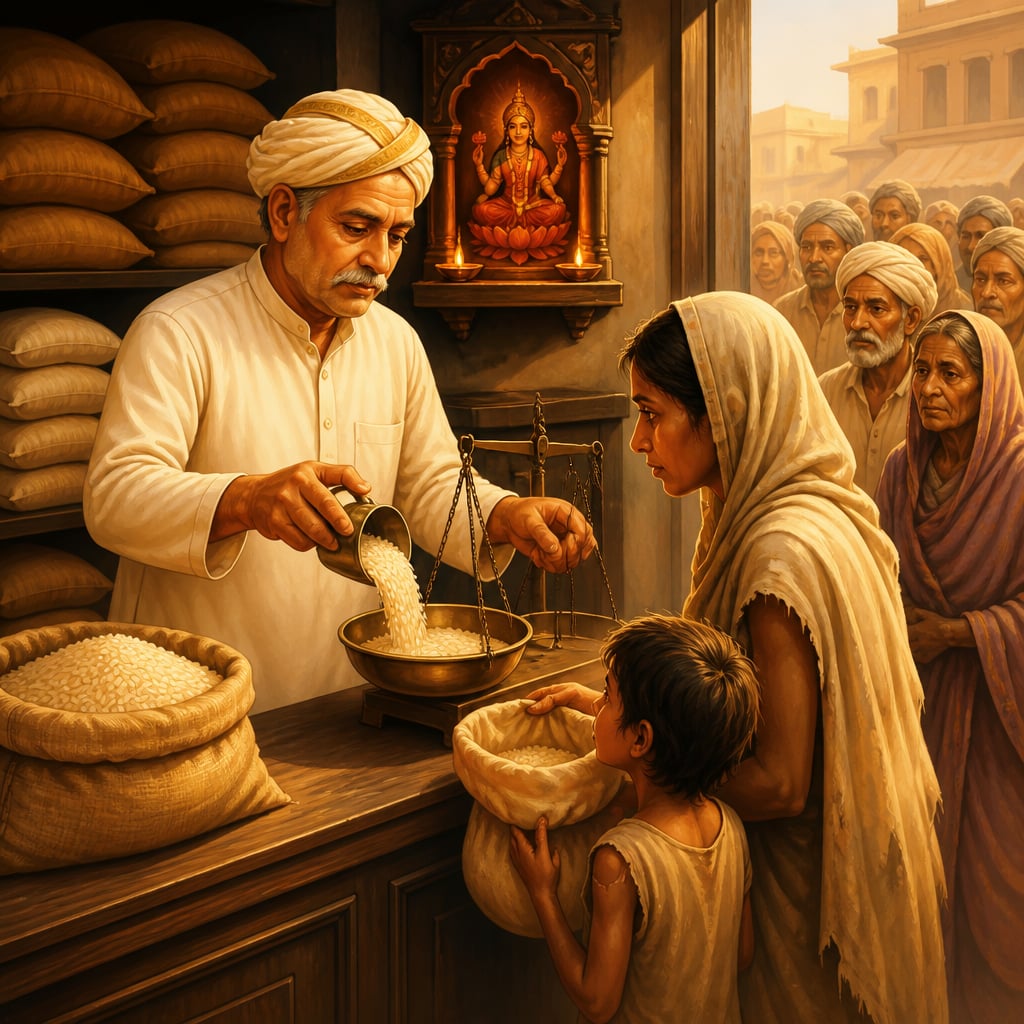
Marwari merchant holding fair price during 1943 famine

During the 1943 Bengal Famine, a rice merchant in Calcutta faced an impossible choice. He had stock. People were dying. He could charge whatever the market would bear, and people would pay anything to survive. Basic economics said: maximize price when demand exceeds supply.

But this merchant, following his family's Marwari traditions, chose differently. He sold at pre-famine prices, rationing to ensure more families could eat. His relatives called him foolish. His competitors laughed. When the famine ended, he was poorer than those who had exploited desperation.

Thirty years later, his grandson opened a textile export business. The first international buyers who trusted him? Children of the families his grandfather had fed during famine. Trust transmitted across generations.

This is Nyaya-Vanijya, fair trade, in its deepest form. Not a certification label or marketing strategy, but the understanding that just commerce creates wealth that endures while exploitative commerce creates wealth that evaporates.

The Dharmic Definition of Fair Price

What makes a price "fair"? Western economics offers two answers:

Dharmic economics adds a third dimension: contextual justice (nyaya). A price is fair only when it accounts for:

  1. Producer reality: Does the seller receive enough to maintain livelihood with dignity?
  2. Consumer capacity: Can the buyer afford without distress?
  3. Market circumstances: Is one party exploiting emergency, ignorance, or monopoly?
  4. Social consequence: Does this exchange strengthen or weaken community?

The Arthashastra (3.16) prescribes that prices should yield "reasonable profit" (yukta-labha) rather than "maximum profit" (adhika-labha). What's reasonable? Enough to sustain the merchant's family, reinvest in the business, and contribute to community welfare, not enough to impoverish trading partners.

The Five Unfair Trading Practices

Ancient Indian texts identified specific forms of trade that appear profitable but violate nyaya:

1. Apad-Vanijya (Disaster Trade)

Exploiting emergencies, famines, floods, epidemics, to charge inflated prices. Modern equivalents: price gouging during COVID for masks and sanitizers, inflating rates during natural disasters.

2. Ajnana-Vanijya (Ignorance Trade)

Profiting from buyer's lack of knowledge. A jeweler who sells synthetic stones as natural, a mechanic who charges for unnecessary repairs, a financial advisor who recommends products with hidden fees, all practice ajnana-vanijya.

3. Vishama-Vanijya (Unequal Trade)

Using market power to impose unfair terms. When a large corporation squeezes small suppliers to unsustainable margins, or when a monopoly extracts excessive prices because buyers have no alternative, this is vishama.

4. Maya-Vanijya (Deceptive Trade)

Misrepresenting quality, quantity, or origin. Adulterated food, false weights, fake certifications, misleading advertising, all forms of maya that create apparent value through deception.

5. Vyasana-Vanijya (Addiction Trade)

Profiting from dependencies that harm consumers. Traditional texts condemned intoxicant trade; modern equivalents include predatory lending, gambling, and products designed to create unhealthy dependencies.

Unfair Practice Traditional Example Modern Example Dharmic Alternative
Apad-Vanijya Famine price gouging COVID mask inflation Emergency price controls
Ajnana-Vanijya Selling fake gems Hidden financial fees Full disclosure policies
Vishama-Vanijya Monopoly pricing Supplier squeezing Fair margin partnerships
Maya-Vanijya Adulterated goods False advertising Honest representation
Vyasana-Vanijya Intoxicant trading Predatory lending Harm-avoiding commerce

The Principle of Mutual Benefit

Dharmic fair trade rests on ubhaya-hita, mutual benefit. Unlike zero-sum bargaining where one party's gain is another's loss, nyaya-vanijya seeks exchanges where both parties genuinely benefit.

This isn't naive idealism. It's practical wisdom. When a trade benefits both parties:

When a trade exploits one party:

The Mahabharata states: "He who makes a just gain is like one who makes a gift; he who makes an unjust gain is like one who commits theft." Fair profit is earned; unfair profit is stolen, regardless of legal status.

Modern Application: Transparent Pricing Models

Several Indian companies demonstrate nyaya-vanijya principles through radical pricing transparency:

Everlane (global example followed in India): The brand shows exact cost breakdown, materials, labor, transport, duties, and its markup. Customers see exactly what they're paying for.

Jaipur Rugs weaver at transparent-pricing loom

Jaipur Rugs: This carpet company shows artisan wages, time invested, and company margin. Customers paying ₹50,000 for a carpet know that ₹25,000 went directly to the weaver.

Ather Energy: The electric scooter company published its actual component costs when critics claimed excessive pricing. Transparency became marketing, customers trusted that margins were fair.

Buffer (tech example): This company publishes every employee's salary, including CEO's. The "salary formula" is public. Customers and employees both know no one is being exploited.

The Just Price Question

Medieval European theologians debated "just price" for centuries. Indian thought had resolved this earlier through context-dependent frameworks:

For necessities (food, medicine, housing): Prices should enable access for all. Profit should be moderate; hoarding during scarcity is sinful.

For luxuries (jewelry, fine clothing, art): Higher margins are acceptable because buyers choose discretionary purchase. But even here, deception about quality is prohibited.

For services (labor, expertise): Compensation should reflect effort, skill, and responsibility. Neither exploitation of workers nor gouging of clients.

For innovations (new products, technologies): Initial higher prices may be justified by development costs, but must decline as production scales.

Sage Yajnavalkya advising king on market prices

The Yajnavalkya Smriti prescribes that kings should regulate market prices to prevent both merchant poverty and consumer exploitation, a surprisingly modern concept of price regulation for essential goods.

Fair Trade and Information Asymmetry

Much unfair trade exploits information gaps. The seller knows the car has problems; the buyer doesn't. The lender understands compound interest; the borrower doesn't.

Dharmic commerce addresses information asymmetry through satya-vakya, truth-speaking as commercial obligation. This means:

Proactive disclosure: Revealing defects without being asked. A dharmic jeweler mentions inclusions in a diamond before the customer spots them.

Plain language: Explaining terms in words the other party understands. A dharmic banker ensures the farmer knows exactly what the loan will cost.

No exploitation of confusion: Not profiting from unclear terms. If a customer misunderstands a price, correct them, even if the misunderstanding favors you.

Warranty of claims: Standing behind representations. If you say the fabric is pure silk, be willing to accept return if testing proves otherwise.

The Fair Trade Certification Movement

Modern "fair trade" certifications attempt to systematize dharmic principles for global commerce. Organizations like Fairtrade International, Fair Trade USA, and India's own certification bodies verify:

These certifications have limitations, costs can exclude small producers, verification is imperfect, and premiums don't always reach intended beneficiaries. But they represent global recognition of what Indian shrenis knew: markets need ethical infrastructure.

Fair Trade in Digital Age

Digital platforms create new fair trade challenges:

Platform fees: When aggregators take 30% commission, are restaurant and delivery partners fairly compensated?

Dynamic pricing: When algorithms surge prices during high demand, is this efficient allocation or apad-vanijya (disaster trade)?

Data as payment: When services are "free" but users pay with attention and data, is the exchange fair?

Gig economy: When workers bear all risks (vehicle, fuel, health) while platforms take guaranteed commissions, where is ubhaya-hita?

Dharmic responses to these questions would apply ancient principles to new contexts:

The Margin Question

How much profit is fair? Dharmic tradition offers guidelines rather than fixed numbers:

Basic principle: Enough to sustain the merchant's family, invest in business improvement, contribute to community, and build reserves for difficult times.

Practical tests:

The Marwari tradition suggests 5-15% as "reasonable" for most retail trades, though specialized services requiring rare skills might justify more. The test isn't a specific number but whether the margin reflects yukta-labha (appropriate gain) or lobha (greed).

Building Fair Trade Culture

For individual entrepreneurs and consumers, practicing nyaya-vanijya requires:

As seller:

As buyer:

As platform/intermediary:

The Long View

The rice merchant during Bengal Famine died with less wealth than competitors who exploited desperation. But his grandson inherited something money can't buy: a reputation that opened doors across continents.

Nyaya-vanijya is ultimately about recognizing that commerce happens within community, and community memory is long. Every unfair transaction creates an adversary. Every fair transaction creates an ally. Over decades, the fair trader's network grows while the exploiter's shrinks.

As Chanakya taught: "Wealth earned through dharma and enjoyed with dharma, that alone is wealth. Wealth earned through adharma is like a snake; it may give warmth temporarily, but eventually it bites."

The fair trade isn't just morally superior, it's economically superior for anyone thinking beyond the next quarter.

Key terms

Nyaya-Vanijya
Fair trade; commerce conducted according to principles of justice, where all parties benefit appropriately and no one is exploited
Yukta-labha
Appropriate or reasonable profit; the dharmic limit on commercial gain that balances merchant welfare with customer and community interest
Ubhaya-hita
Mutual benefit; the principle that righteous commerce should benefit both parties to a transaction, not enrich one at another's expense
Apad-Vanijya
Disaster trade; the unethical practice of exploiting emergencies, calamities, or crises to charge inflated prices when people have no choice

Verses

युक्तलाभेन वर्तेत न लोभेन कदाचन।

yukta-lābhena varteta na lobhena kadācana |

Let commerce proceed with appropriate gain, never with greed, this is the eternal law of trade.

This verse anticipates modern debates about 'reasonable' versus 'maximum' profit. It rejects pure profit maximization as a business goal, substituting contextually appropriate returns. The word 'kadācana' (ever/never) makes this absolute, greed is never justified, regardless of market conditions.

Arthashastra, 3.16.26 (R. Shamasastry translation)

न्यायोपार्जितवित्तस्य दातुर्न च भोक्तुः। न च संग्राहकस्यापि न च दोषो विधीयते॥

nyāyopārjita-vittasya dātur na ca bhoktuḥ | na ca saṁgrāhakasyāpi na ca doṣo vidhīyate ||

For wealth earned justly, there is no fault, not for the giver, nor the enjoyer, nor the collector. Righteous wealth brings no karmic burden.

This verse resolves the spiritual anxiety some feel about commercial success. Fairly earned profit is morally clean, it can be enjoyed without guilt, given without shame, saved without sin. The emphasis on 'nyaya' (justice) distinguishes this from unconditional approval of all wealth.

Mahabharata, Shanti Parva 259.21 (Bibek Debroy translation)

द्रव्याणां च परिच्छेदं कुर्यात् प्रतिदिनं नृपः।

dravyāṇāṁ ca paricchedaṁ kuryāt pratidinaṁ nṛpaḥ |

The king should daily determine fair prices for goods, this is the duty of righteous governance.

This anticipates modern debates about government role in markets. Neither pure laissez-faire nor total control, but oversight ensuring fair exchange. The word 'pratidinam' (daily) suggests active monitoring, not passive rule-setting, governments should respond to market conditions continuously.

Yajnavalkya Smriti, 2.249 (Ganganatha Jha translation)

Key figures

Yajnavalkya

c. 700 BCE (traditional dating varies)

Ghanshyam Das Birla

1894-1983

Gopaldas Parmanand (Founder of Godrej)

1853-1936

Case studies

Jaipur Rugs: Radical Pricing Transparency

Nand Kishore Chaudhary founded Jaipur Rugs in 1978 with 9 looms and 2 weavers. By 2024, the company works with 40,000+ artisans across 600 villages, producing handmade rugs sold globally. What distinguishes Jaipur Rugs is radical pricing transparency: customers see exact breakdown of weaver wages, material costs, and company margin. When a customer pays $5,000 for a carpet, they know $2,500+ went directly to the weaver family.

Jaipur Rugs embodies multiple principles of nyaya-vanijya. **Satya-vakya** (truth-speaking): Full disclosure of cost structure eliminates information asymmetry between company and customers. **Ubhaya-hita** (mutual benefit): Pricing ensures weavers earn dignified livelihoods while company remains profitable and customers receive genuine value. **Anti-ajnana-vanijya**: Rather than exploiting customer ignorance about 'fair' carpet prices, the company educates buyers about actual costs. The founder's statement, 'We don't employ artisans; we partner with them', reflects shreni-style relationships over transactional extraction.

Jaipur Rugs achieved both commercial success and social impact. Artisan villages report improved education rates, reduced migration, and preservation of traditional skills. The company expanded from India to sell in 60+ countries. Harvard Business School developed a case study on its model. Transparency became competitive advantage, customers trust what they can verify.

Fair pricing can be demonstrated, not just claimed. When customers see exactly what they're paying for, including producer compensation, price becomes justification rather than negotiation. The 'premium' paid for ethical products transforms from charity to informed purchase.

As consumers demand supply chain transparency, brands across industries are adopting radical pricing disclosure. Everlane in fashion and Buffer in tech publish cost breakdowns publicly. Jaipur Rugs pioneered this approach in artisanal goods, proving that transparency commands premium pricing rather than eroding margins. In a world of hidden markups and opaque sourcing, visible fairness has become a competitive weapon.

Jaipur Rugs weavers earn 30-40% more than industry average, yet the company maintains competitive pricing and healthy margins. Fair trade proved compatible with commercial viability.

Historical context

Ancient Price Regulation to Modern Fair Trade (c. 500 BCE - 2025 CE)

Indian markets traditionally operated under both guild self-regulation (shrenis) and royal oversight (state price regulation). Colonial disruption replaced community-based fairness mechanisms with extractive trading systems. Post-independence Essential Commodities Act attempted to restore some price fairness for necessities.

Medieval European 'just price' debates (Aquinas, scholastic economists) parallel Indian concepts but emerged later and influenced Western economics less than 'free market' thinking eventually did. Modern fair trade movements draw more from developing-world producer demands than from Western philosophical traditions.

India's Consumer Protection Act 2019 defines 'unfair trade practice' in terms echoing ancient dharmic prohibitions, false representation, misleading advertisement, and exploitation of consumers.

As India's economy integrates globally, fair trade principles determine whether growth benefits all participants or concentrates wealth through exploitation. Indigenous concepts like nyaya-vanijya offer frameworks that international certifications often lack cultural depth to match.

Living traditions

Consumer protection laws, FSSAI food safety standards, and advertising standards councils attempt to institutionalize fair trade principles that traditional markets maintained through reputation and community pressure. Digital platforms introduce new challenges, how do algorithms maintain nyaya-vanijya?, while also new tools for transparency and accountability.

Reflection

More in Dharmic Entrepreneurship Today

All lessons in Dharmic Entrepreneurship Today · Vaishya Dharma: The Art of Ethical Commerce course