Naitik Purti-Shrinkhala: Ethical Supply Chains
Dharma in Sourcing
Building supply chains that honor dharmic principles - fair trade, sustainability, transparency.
The Hidden Workers Behind Your Smartphone
When you buy a smartphone in Mumbai, you're participating in a supply chain that spans 40 countries. The cobalt in its battery was likely mined in Congo, sometimes by child laborers. The rare earth elements came from processing plants with questionable environmental records. The assembly happened in factories where 12-hour shifts are routine.
Does the final consumer share responsibility for harms inflicted six links upstream? Does a Delhi retailer bear karma for a mining accident in Africa?
Dharmic ethics says yes, but with a crucial nuance. The Mahabharata teaches: "One who benefits from adharma becomes partner to it." This isn't about guilt; it's about connection. Every rupee you spend is a vote for how that product was made. Every supply chain decision ripples across thousands of lives you'll never see.
This is the challenge of Naitik Purti-Shrinkhala, ethical supply chains. In a world of global sourcing, how do dharmic businesses maintain integrity from origin to consumer?
The Ancient Model: Shreni Governance
Ancient India's shrenis (trade guilds) had solved this problem centuries ago. A shreni wasn't just a trade association, it was a moral ecosystem. Members were accountable not just for their own conduct, but for the conduct of those they traded with.
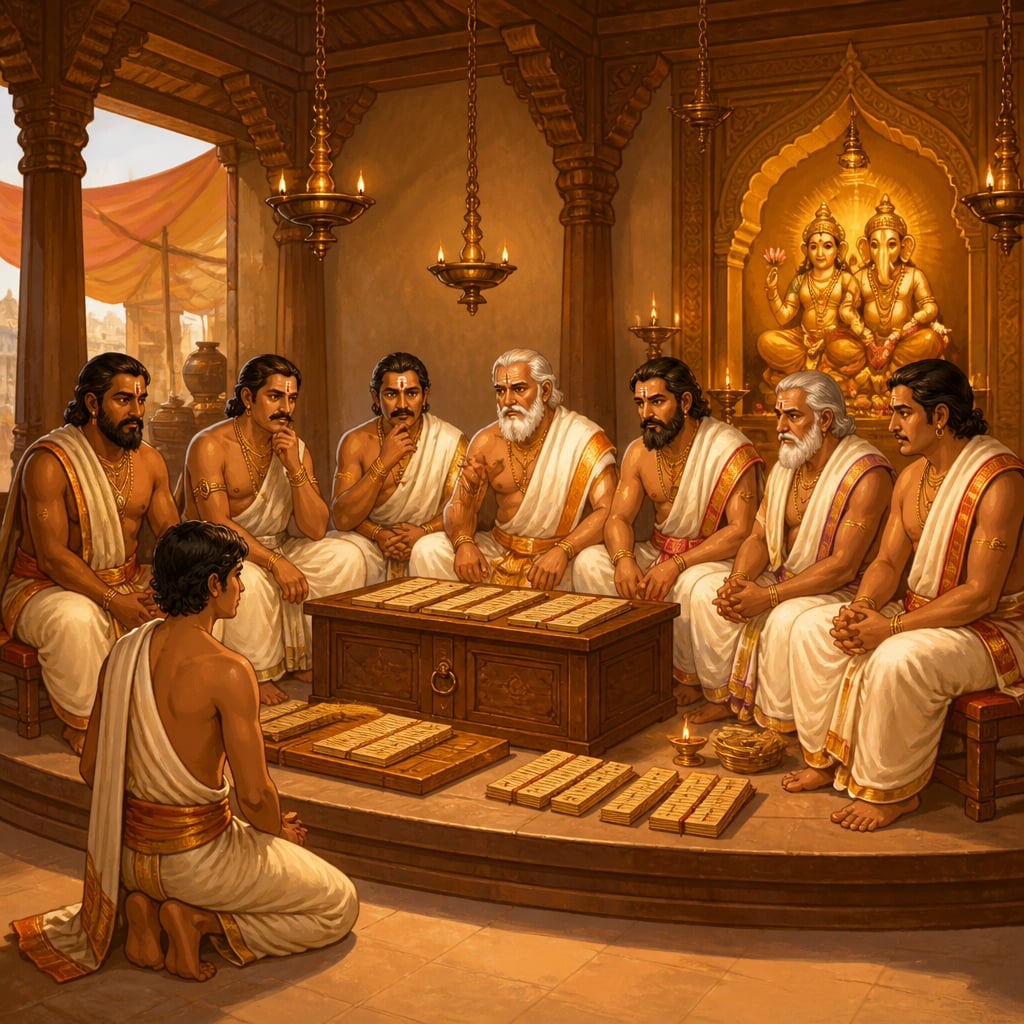
The Arthashastra (4.1) describes how shrenis maintained standards:
- Entry requirements: New members needed existing members to vouch for their character
- Quality enforcement: Goods bearing shreni marks had to meet documented standards
- Dispute resolution: Internal panchayats settled supplier conflicts before courts got involved
- Collective reputation: One member's misconduct damaged all members' standing
This created what modern economists call "network accountability", your reputation depended on the reputation of everyone you sourced from. A silk merchant couldn't claim ignorance of a weaver's exploitation; the shreni held both accountable.
Modern Application: Fab India's Artisan Networks

Fab India, founded in 1960 by John Bissell, demonstrates shreni principles at scale. The company sources from 55,000+ artisans across India, weavers, dyers, embroiderers, woodworkers. Each relationship involves more than price negotiation:
Transparency: Artisans know the final retail price and Fab India's margin. No information asymmetry.
Skill investment: Fab India trains artisans in design, quality control, and market demands, even if competitors then recruit them.
Community ownership: Many artisan groups hold equity in supplier companies that Fab India helped create.
Payment security: Artisans receive advance payments during production, not just on delivery, protecting them from seasonal cash crunches.
The result? Artisan communities that have worked with Fab India for three generations. Villages where traditional crafts thrive because fair supply chains made them economically viable. Products that carry genuine providence, you know whose hands made them.
The Karma of Supply Chains
Dharmic economics recognizes sankalita karma, collective karma arising from networked action. When a supply chain exploits workers, pollutes environments, or destroys communities, everyone who benefits shares the karmic consequence.
This isn't mystical, it's practical. Companies that ignore supplier ethics eventually face:
- Reputation damage: When exposés reveal sweatshop conditions, brands suffer
- Quality failures: Exploited workers don't maintain quality standards
- Supply disruption: Unsustainable practices eventually collapse
- Regulatory risk: Governments increasingly mandate supply chain due diligence
The Chandogya Upanishad states: "As is your action, so is your fruit." Supply chain actions produce supply chain fruits, often delayed, but inevitable.
The Three Lenses of Ethical Sourcing
Dharmic supply chain management evaluates every supplier relationship through three lenses:
1. Ahimsa (Non-Violence)
- Are workers treated with dignity, or subjected to physical/psychological harm?
- Is the environment being damaged in ways that harm communities?
- Are safety standards maintained, or are injuries treated as acceptable cost?
2. Satya (Truth)
- Do suppliers accurately represent their practices, or hide abuses?
- Is traceability maintained, or do products pass through opacity layers?
- Are certifications genuine, or purchased from corrupt auditors?
3. Asteya (Non-Stealing)
- Are suppliers paid fairly, or squeezed to unsustainable margins?
- Is intellectual property (traditional designs, techniques) properly compensated?
- Are communities where resources originate receiving fair share?
| Traditional Sourcing | Dharmic Sourcing | Key Shift |
|---|---|---|
| Lowest cost wins | Fair cost wins | Price includes externalities |
| Audit once annually | Continuous relationship | Trust over inspection |
| Supplier as vendor | Supplier as partner | Shared fate, shared investment |
| Arms-length contract | Embedded relationship | Beyond transaction to connection |
Case Study: Amul's Cooperative Chain

Amul (Gujarat Cooperative Milk Marketing Federation) demonstrates large-scale ethical supply chains. Its 3.6 million farmer-members don't just supply milk, they own the enterprise. Every liter purchased strengthens the hands that produced it.
The structure is revolutionary:
- Village-level collection: Farmers don't travel to sell; Amul comes to them
- Daily payment: No credit risk for small farmers
- Quality premiums: Better milk earns more, incentivizing improvement
- Democratic governance: Farmers elect their cooperative's leadership
- Profit sharing: Surpluses flow back to farmer-owners
Amul processes 26 million liters daily from farmers whose average holding is 2-3 cows. This isn't charity, it's structural ethics. The supply chain design itself ensures fair treatment; exploitation becomes structurally impossible.
Dr. Verghese Kurien, Amul's architect, explained: "I didn't want to help farmers. I wanted to make farmers the owners. Help creates dependence; ownership creates dignity."
The Due Diligence Imperative
Modern dharmic supply chains require viveka (discernment) applied systematically. This means:
Tier Mapping: Know not just your direct suppliers, but their suppliers. A clothing brand might source from an ethical factory, but where does that factory get its fabric? Where does the fabric mill get its cotton? Exploitation often hides in tier 2 and tier 3.
On-Ground Verification: Paper audits can be falsified. Dharmic sourcing requires actual relationships, visiting facilities, meeting workers, understanding community impact.
Whistleblower Channels: Workers who witness abuse need safe reporting mechanisms. Many violations continue because those who could speak are afraid.
Remediation Commitment: When problems are discovered, dharmic response isn't to cut and run (abandoning workers to worse alternatives) but to invest in fixing the issue.
The Hidden Subsidy Problem
"Low prices" often mask hidden subsidies paid by invisible stakeholders:
- When garment workers earn below living wage, their families subsidize your clothing
- When factories skip pollution controls, surrounding communities subsidize production with their health
- When suppliers are squeezed to bankruptcy, their creditors subsidize your margins
Dharmic economics recognizes these as paapa-labha, profits tainted by harm. Such profits may appear on balance sheets, but they carry karmic debt that compounds over time.
Contrast this with punya-labha, profits earned through righteous means. When Tata Steel pays premium prices to tribal iron ore miners and invests in their community development, the slightly higher cost buys something precious: shraddha (trust) that compounds across generations.
Building Your Own Ethical Supply Chain
Whether you run a business or simply make purchasing decisions, you participate in supply chains. Dharmic participation requires:
1. Ask Questions: Where did this come from? Who made it? Under what conditions?
2. Accept Higher Prices: Ethical sourcing costs more. Be willing to pay, or buy less.
3. Choose Transparency: Prefer brands that reveal their supply chains over those that hide them.
4. Think Relationship: Frequent smaller purchases from known suppliers beats sporadic bulk buying from anonymous sources.
5. Consider Lifecycle: The dharma of a product includes its disposal. Supply chains include end-of-life.
The Interconnected Web
The Isha Upanishad opens: "All this, whatever exists in this changing universe, is pervaded by the Lord." Modern supply chains reveal this interconnection materially. Your cotton shirt connects you to farmers in Gujarat, spinners in Tamil Nadu, dyers using chemicals from Germany, stitchers in Bangladesh, and shippers traversing the Indian Ocean.
Dharmic entrepreneurship doesn't see this complexity as burden but as opportunity, the chance to spread benefit across an interconnected web rather than concentrate extraction at one point.
When Infosys sources from small vendors and pays them within 10 days (while competitors stretch to 90 days), they're not just being nice, they're recognizing the interconnected karma of commerce. A supplier who struggles to meet payroll because payments are delayed carries that stress into every product they make.
The Future: Blockchain and Traceability
Emerging technologies offer new tools for dharmic supply chains:
Blockchain traceability: Immutable records of product journey from origin to consumer, making false certifications detectable.
IoT monitoring: Sensors that track working conditions, environmental impacts, and quality parameters in real-time.
Digital payments: Direct payment to artisans and farmers, reducing intermediary extraction.
But technology is only tool; intent remains primary. A blockchain can record lies as easily as truth. Dharmic supply chains require dharmic intentions, technology just makes those intentions verifiable.
The principle remains what shrenis knew millennia ago: you are responsible for the chain you participate in. Every link carries your karma. Choose your connections wisely, invest in their integrity, and remember that the lowest bid often hides the highest cost, paid by those who cannot refuse.
Key terms
- Naitik Purti-Shrinkhala
- Ethical supply chain; the complete network of relationships and transactions through which goods move from origin to consumer, governed by dharmic principles
- Shreni
- Ancient Indian trade guild that regulated commerce, maintained quality standards, and enforced ethical conduct among members through collective accountability
- Sankalita Karma
- Collective karma; the shared karmic consequence arising from networked actions where individual responsibility merges with systemic responsibility
- Paapa-labha
- Tainted profit; wealth gained through unethical means that carries negative karmic consequences regardless of legal status
Verses
अधर्मेणैधते तावत् ततो भद्राणि पश्यति। ततः सपत्नान् जयति समूलस्तु विनश्यति॥
adharmeṇaidhate tāvat tato bhadrāṇi paśyati | tataḥ sapatnān jayati samūlastu vinaśyati ||
Through adharma one may prosper briefly, may even see good fortune, may conquer rivals, but ultimately is destroyed, root and branch.
This verse captures what economists call 'externality accounting.' Profits that ignore harms to workers, environments, and communities aren't real profits, they're deferred costs that eventually come due. Dharmic supply chains internalize these costs upfront.
Mahabharata, Shanti Parva 134.7 (Bibek Debroy translation)
श्रेणीनां धर्मः स्वधर्मपालनम्।
śreṇīnāṁ dharmaḥ svadharmapālanam |
The dharma of trade guilds is to maintain righteous standards among all their members.
Modern equivalents include industry certification bodies, ethical sourcing alliances, and supply chain transparency initiatives. The principle is ancient: your association with others implicates you in their conduct.
Arthashastra, 4.1.3 (R. Shamasastry translation)
ईशावास्यमिदं सर्वं यत्किञ्च जगत्यां जगत्। तेन त्यक्तेन भुञ्जीथा मा गृधः कस्यस्विद्धनम्॥
īśāvāsyam idaṁ sarvaṁ yat kiñca jagatyāṁ jagat | tena tyaktena bhuñjīthā mā gṛdhaḥ kasyasvid dhanam ||
All this universe is pervaded by the Divine. Enjoy with detachment; covet not what belongs to others.
Supply chain ethics flow from this recognition of interconnection. The cotton farmer's wellbeing affects the fabric's quality, which affects the garment's value. Exploiting any node harms all nodes. 'Covet not what belongs to others' includes not extracting unfair value from supply chain partners.
Isha Upanishad, 1 (Eknath Easwaran translation)
Key figures
Dr. Verghese Kurien
1921-2012
John Bissell
1933-2017
Ela Bhatt
1933-2022
Case studies
Amul: Structural Ethics at Scale
In 1946, dairy farmers in Gujarat's Kaira district were exploited by private traders who paid minimal prices for milk while making substantial profits. Under Dr. Verghese Kurien's guidance, farmers organized into cooperatives that owned every stage of the supply chain, collection, processing, marketing, and retail. By 2024, Amul is India's largest food brand with ₹72,000 crore turnover, owned by 3.6 million farmer families across 18,700 village cooperatives. The average member owns 2-3 cows but receives institutional support previously available only to large farms.
Amul's model embodies shreni principles scaled for modern commerce. **Collective ownership**: Farmers don't just supply, they own. **Democratic governance**: Leaders are elected by farmer-members. **Shared prosperity**: Profits return to producers rather than extractive intermediaries. **Quality accountability**: Because farmers own the brand, they protect its reputation. The structure makes exploitation impossible, who would exploit themselves? This is **svadharma** (own-duty) applied systemically: each stakeholder's interest aligns with collective interest.
The White Revolution transformed India from milk-deficient to world's largest milk producer (22% of global output). But statistics miss the deeper change: millions of rural families gained economic agency, women (who manage most dairy work) gained income control, and villages retained youth who might otherwise migrate for factory jobs. Amul proved that ethical supply chains aren't just morally superior, they're economically superior at scale.
Design ethics into structure, not policy. Amul doesn't need ethics committees or compliance audits because farmer ownership makes exploitation structurally impossible. The lesson for modern supply chains: change the ownership model, not just the behavior rules.
Global food supply chains face criticism for extracting value from farmers while concentrating profits among processors and retailers. The Amul cooperative model is being studied and adapted in Rwanda (dairy cooperatives), Colombia (coffee cooperatives), and New Zealand (Fonterra). The structural insight remains powerful: when producers own the value chain, exploitation becomes architecturally impossible.
Amul farmers receive 80% of consumer price as payment, compared to 30-40% in conventional dairy supply chains. This isn't charity; it's ownership.
Historical context
Ancient Trade Guilds to Modern Supply Chain Ethics (c. 500 BCE - 2025 CE)
India's historical commerce was embedded in guild structures that maintained ethical standards through collective accountability. The colonial period disrupted these systems, replacing community governance with extractive intermediaries. Post-independence cooperatives like Amul attempted recovery of indigenous commercial ethics.
Western supply chain ethics emerged primarily after scandals (child labor exposés, factory collapses). Indian traditions approached supply chain responsibility proactively through shreni structures. Modern ESG and fair trade movements rediscover principles Indian guilds practiced two millennia ago.
Indian cooperatives (dairy, sugar, credit) account for 27% of GDP in their respective sectors, the highest cooperative participation rate among major economies.
As India becomes a manufacturing hub, supply chain ethics determine whether prosperity reaches workers or concentrates among intermediaries. Indigenous models like Amul offer alternatives to extractive global supply chain norms.
Living traditions
India's cooperative sector employs 20 million people directly and supports 300+ million livelihoods. Fair trade certifications (Fairtrade India, GI tags) build on shreni traditions of quality and ethical attestation. The National Cooperative Development Corporation continues promoting cooperative supply chains as government policy.
- Village Dairy Cooperatives: Morning and evening milk collection at village-level societies where farmers bring produce, receive immediate payment, and participate in cooperative governance
- Handloom Weaver Clusters: Geographic concentrations of weavers who maintain traditional supply chains, from raw material procurement through weaving to cooperative marketing
- Amul Dairy Complex, Anand: Visit the birthplace of India's cooperative dairy movement. The museum traces how farmer-ownership transformed exploitative supply chains. See modern processing facilities owned entirely by the farmers who supply them.
- Dastkar Craft Bazaars: Periodic craft fairs organized to enable direct artisan-consumer connection, eliminating exploitative middlemen. Artisans tell their stories alongside their products.
- Somnath Temple Trust: The temple trust operates extensive social enterprises including dairy processing and handicraft marketing, demonstrating how religious institutions can anchor ethical supply chains in communities.
Reflection
- Think about something you purchased recently. How many hands touched it before reaching you? What do you actually know about conditions in that supply chain, and what remains invisible?
- Why might indigenous models like shrenis and cooperatives prove more resilient than externally-imposed ethical standards? What gets preserved when communities govern their own commerce?
- Apply the three lenses (Ahimsa, Satya, Asteya) to analyze a supply chain you participate in, either as business owner or consumer. Where do you see alignment with these principles, and where do you see gaps?