Bharat Startup Paristhiti: India's Startup Ecosystem

Entrepreneurship Renaissance

India's emergence as startup nation - unicorns, innovation hubs, and founder culture through a dharmic lens.

From License Raj to Unicorn Factory

In 1991, India had zero startups in the modern sense. The economy was strangled by permits, quotas, and government control. Starting a business required navigating 80+ licenses. Innovation was discouraged; compliance was survival.

By 2024, India has the world's third-largest startup ecosystem: 110+ unicorns (companies valued at $1 billion+), 100,000+ registered startups, and $150+ billion in total funding raised. Bangalore alone produces more tech unicorns than most European countries combined.

This transformation, from socialist stagnation to entrepreneurial explosion in a single generation, is unprecedented in economic history. But what makes it distinctively Indian? And how does dharmic wisdom inform founders building the next century's great companies?

The Three Waves of Indian Entrepreneurship

Indian startup history unfolds in three distinct waves:
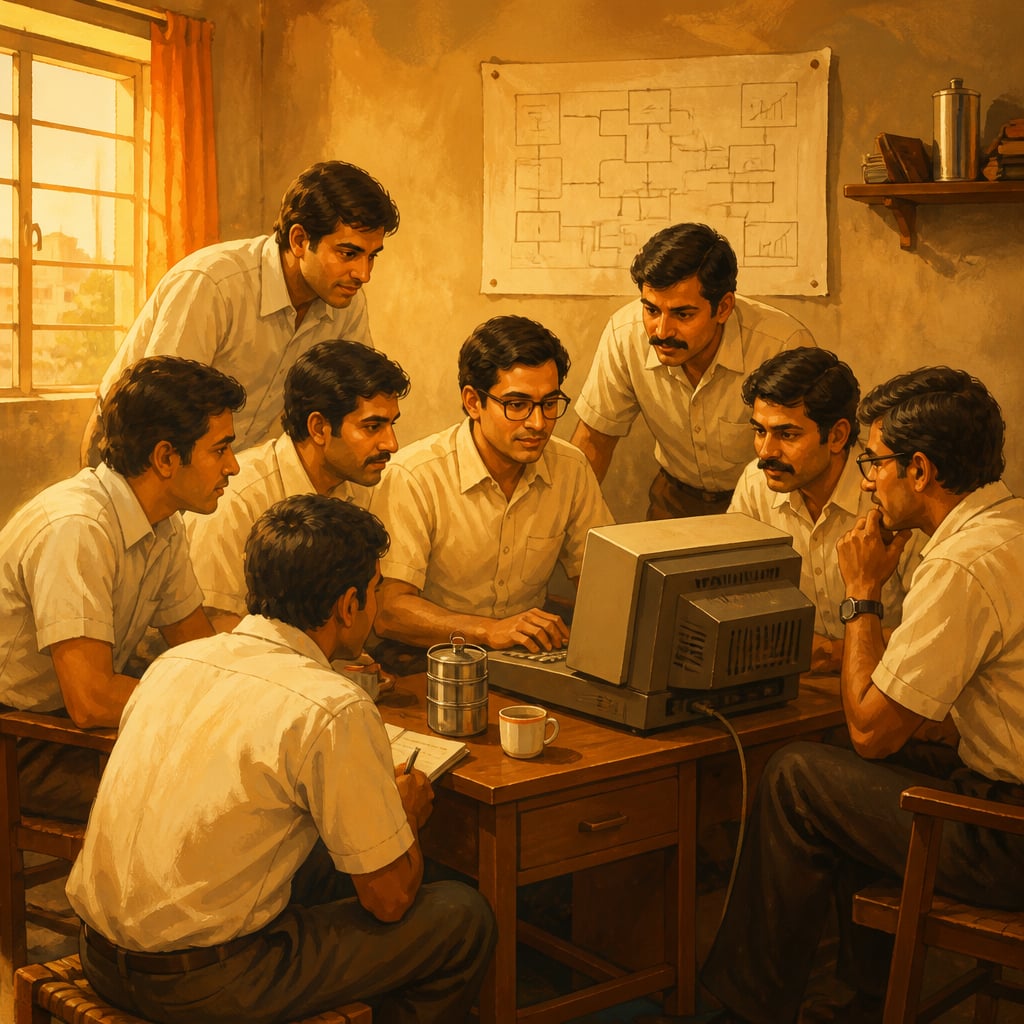
Narayana Murthy founding an IT company in 1981 Pune

Wave 1: IT Services (1990s-2000s)

Infosys, Wipro, TCS, companies that leveraged India's engineering talent to serve global clients. This wave created wealth and confidence but primarily served foreign markets.

Dharmic pattern: Seva (service), building capability by serving others' needs first.

Wave 2: Consumer Internet (2010s)

Flipkart, Ola, Paytm, Swiggy, companies that adapted global models (Amazon, Uber, PayPal) for Indian conditions. This wave created domestic value but often followed Western templates.

Dharmic pattern: Anukaran (adaptation), learning from others before creating original contributions.

Wave 3: India-First Innovation (2020s)

UPI revolutionizing payments, Aadhaar enabling identity, startups building for Bharat's unique needs, tier-2 cities, vernacular languages, India-specific problems. This wave creates solutions the world wants to copy.

Dharmic pattern: Svadharma (own path), finally building from India's distinctive strengths rather than imitating others.

Wave Period Characteristic Examples Dharmic Pattern
1 1990s-2000s Serve global markets Infosys, TCS, Wipro Seva (service)
2 2010s Adapt global models Flipkart, Ola, Paytm Anukaran (adaptation)
3 2020s India-first innovation UPI ecosystem, Bharat startups Svadharma (own path)

The Geography of Innovation

India's startup ecosystem has distinct regional characters:

Bangalore: The "Silicon Valley of India", tech-first, global ambition, venture capital concentration. Home to Flipkart, Swiggy, CRED, Razorpay. Culture is cosmopolitan, English-dominant, growth-obsessed.

Mumbai: Finance, media, and consumer brands. PhonePe, Dream11, Nykaa. More traditional business sensibility, stronger connection to established industry.

Delhi-NCR: Logistics, edtech, consumer services. Zomato, PolicyBazaar, Delhivery. Aggressive marketing, rapid scaling, sometimes at any cost.

Hyderabad: Pharmaceutical biotech, enterprise software. Growing rapidly with Telangana government's proactive policies.

Emerging hubs: Pune, Chennai, Kochi, Jaipur, each developing distinctive strengths as costs rise in primary cities.

Tier-2 revolution: The next wave of entrepreneurs emerges from Indore, Surat, Coimbatore, Lucknow, founders who understand Bharat, not just India.

The UPI Revolution: A Case Study in Dharmic Infrastructure

Chai-wallah receiving UPI payment at street stall

Nothing demonstrates India's startup uniqueness better than UPI (Unified Payments Interface). Launched in 2016, UPI processed 12 billion transactions in December 2023 alone, more than all credit card transactions in India's history combined.

What makes UPI dharmic?

Open infrastructure: Unlike Western payment systems controlled by private corporations (Visa, Mastercard), UPI is public infrastructure available to all. Any bank, any fintech can build on it.

Near-zero cost: Transactions cost fractions of what card networks charge. This enables small-value payments that sustain small merchants.

Financial inclusion: The chai-wallah and the CEO use the same system. UPI doesn't discriminate by transaction size or customer 'value.'

Interoperability: One app works everywhere. No walled gardens, no lock-in. Competition happens on service, not on network effects.

UPI embodies sarva-hita, designed for collective benefit rather than private extraction. It's why countries worldwide now study India's payment infrastructure.

Founder Archetypes in Indian Startups

Indian founders don't fit a single mold. Several archetypes emerge:

The Returnee

IIT/IIM education, years at Google/Amazon/McKinsey abroad, returns to build for India. Brings global standards but sometimes lacks Bharat understanding. Examples: Flipkart founders (Amazon experience), many fintech founders.

The Insider-Innovator

Rose through Indian industry, saw inefficiency firsthand, built solution. Deep domain knowledge, sometimes limited tech sophistication. Examples: Delhivery founder (logistics industry), CarTrade founder (automotive sector).

The Bharat Builder

Small-town origin, understands tier-2/3 markets intuitively, builds for the mass market others ignore. Examples: Meesho founders (social commerce for Bharat), PharmEasy (medicine delivery beyond metros).

The Technical Craftsman

Deep technical expertise, builds product excellence, less focused on market dynamics. Sometimes struggles with go-to-market. Examples: Zoho (Sridhar Vembu), Freshworks (Girish Mathrubootham).

The Serial Entrepreneur

Has built and sold before, brings pattern recognition and investor relationships. Sometimes over-indexes on fundraising versus fundamentals.

The Dharmic Test for Startups

Amid celebration of valuations and funding rounds, dharmic wisdom offers grounding questions:

Satya Test: Is the business model sustainable, or does it depend on subsidizing customers indefinitely with investor money?

Ahimsa Test: Does growth come through genuine value creation, or by harming workers (gig economy exploitation), competitors (predatory pricing), or customers (addiction design)?

Asteya Test: Does the company create value or extract it? Many "successful" startups merely capture existing value without creating new.

Svadharma Test: Is this founder building what they're genuinely called to build, or chasing whatever sector is currently hot?

Kshama Test: Is there patience for sustainable growth, or only urgency for the next funding round?

Many celebrated startups fail these tests. The companies that pass them often receive less attention but build more enduring value.

The Funding Ecosystem

Indian startups have access to increasingly sophisticated capital:

Angel investors: Wealthy individuals (often successful founders) investing early. Bangalore's angel networks, Mumbai's business family offices.

Venture capital: Sequoia, Accel, Tiger Global, local funds like Blume, Kalaari. Growth-focused, exit-oriented.

Corporate venture arms: Tata Digital, Reliance Jio, corporate India entering startup investing.

Government schemes: Startup India, Fund of Funds, tax benefits for investors (Section 54GB).

Alternative capital: Revenue-based financing, venture debt, options for founders who don't want equity dilution.

The challenge: most capital still rewards growth over sustainability, leading many startups to prioritize expansion over profitability. Dharmic entrepreneurship often requires choosing less capital to preserve purpose.

The Policy Landscape

Government policy has shifted dramatically to support entrepreneurship:

Startup India (2016): Single-window recognition, tax exemptions, simplified compliance.

Ease of doing business reforms: Company incorporation in days versus months. Digital processes replacing physical paperwork.

DPIIT recognition: 100,000+ startups registered, accessing benefits like tax holidays and self-certification.

PLI schemes: Production-linked incentives encouraging manufacturing startups in electronics, pharmaceuticals, textiles.

Social Stock Exchange: Enabling funding for social enterprises, businesses that measure success beyond profit.

Yet challenges remain: bankruptcy processes still slow, talent costs rising, regulatory uncertainty in emerging sectors (crypto, AI, drones).

Women in Indian Startups

Women founders remain underrepresented, only 15% of Indian startups have a woman co-founder, and women-led startups receive just 1.4% of venture funding.

Yet notable exceptions demonstrate possibility:

Indian woman founder presenting to her startup team

Falguni Nayar (Nykaa): Built India's largest beauty platform, successfully IPO'd, became India's richest self-made woman.

Ghazal Alagh (Mamaearth): Created toxin-free baby care brand, achieved unicorn status.

Divya Gokulnath (BYJU'S): Co-founded India's largest edtech company.

Radhika Gupta (Edelweiss AMC): Built major asset management business, advocates for women in finance.

The next wave of Indian startups will succeed or fail partly based on whether the ecosystem can unlock women's entrepreneurial potential.

Deep Tech and Beyond Software

Early Indian startups were predominantly software. The new wave includes:

Space tech: Skyroot, Agnikul, private rocket companies launching satellites.

Clean energy: Ather, Ola Electric, EV manufacturing at scale.

Biotech: Biocon's next generation, new drug discovery startups.

Agritech: DeHaat, Ninjacart, transforming agricultural supply chains.

Manufacturing: Electronics, semiconductors, building hardware capability India has lacked.

These sectors require patient capital (longer timelines), deeper expertise (beyond coding), and government coordination (regulatory approvals). They also create more employment per rupee invested than pure software plays.

The Bharatiya Advantage

What makes Indian startups distinctive globally?

Scale from day one: India's 1.4 billion population means even niche markets are massive. A "small" segment might be 50 million people.

Price innovation: Building for India's price-sensitive market forces cost innovation that creates global competitiveness.

Digital infrastructure: UPI, Aadhaar, DigiLocker, public digital infrastructure enables solutions impossible elsewhere.

Demographic dividend: Young population, increasingly educated, digital-native. The consumer and talent base grows simultaneously.

Jugaad to systematic innovation: The same creative problem-solving that produces makeshift solutions can, with resources, produce genuine innovation.

English advantage: Access to global talent networks, international expansion, and knowledge resources.

Building the Next Century

India's startup ecosystem is barely three decades old. The companies that will define the next century are being founded now, perhaps by someone reading this lesson.

Dharmic entrepreneurship in this context means:

Building for Bharat: Not just serving English-speaking metros but creating solutions for all of India's diverse population.

Creating employment: The startup that generates livelihoods serves dharma differently than the one that displaces workers through automation.

Sustainable growth: Patience to build for decades rather than urgency to exit in seven years.

Ethical scaling: Growing in ways that create value for all stakeholders, not just extracting value for shareholders.

Purpose beyond unicorn status: Measuring success by impact created, not just valuation achieved.

The entrepreneurs who will build India's greatest companies understand something deeper than unit economics: commerce is civilization's circulatory system. What they build doesn't just create wealth, it shapes what kind of society India becomes.

As the Arthashastra teaches: "The root of wealth is economic activity." India's startup ecosystem is generating that activity at unprecedented scale. The question is whether it will generate wealth that serves all of Bharat, or wealth that concentrates among few while leaving most behind.

Key terms

Unicorn
A privately held startup company valued at over $1 billion; the term reflects the rarity of achieving such valuations, though India has made unicorns increasingly common
Bharat Startup Paristhiti
India's startup ecosystem; the interconnected network of founders, investors, mentors, accelerators, and support systems that enable entrepreneurship
Jugaad
Innovative problem-solving with limited resources; creative improvisation to overcome constraints; the Indian approach to making things work despite limitations
Swadeshi Udyamita
Indigenous entrepreneurship; building businesses rooted in Indian strengths, addressing Indian needs, with Indian ownership and value capture

Verses

अर्थमूलौ हि धर्मकामाविति।

artha-mūlau hi dharma-kāmāv iti |

Indeed, both righteousness and fulfillment are rooted in economic activity, prosperity enables all other pursuits.

This sutra provides philosophical foundation for entrepreneurship: wealth creation isn't merely self-interest but enables dharma and societal wellbeing. Startups that generate economic activity serve these higher purposes, provided they do so dharmically.

Arthashastra, 1.19.34 (R. Shamasastry translation)

कर्मण्येवाधिकारस्ते मा फलेषु कदाचन। मा कर्मफलहेतुर्भूर्मा ते सङ्गोऽस्त्वकर्मणि॥

karmaṇy evādhikāras te mā phaleṣu kadācana | mā karma-phala-hetur bhūr mā te saṅgo 'stv akarmaṇi ||

Your right is to action alone, never to its fruits. Don't let results be your motive, nor be attached to inaction.

This verse provides antidote to startup culture's valuation-obsession. Focus on building (*karma*), not on unicorn status (*phala*). Paradoxically, companies that focus on excellence over exits often achieve both. Detachment from outcomes enables clearer decision-making.

Bhagavad Gita, 2.47 (Eknath Easwaran translation)

N/A (Tamil original)

Porulallār ellārkkum arivariā thākum ārulallār māṇbu

Without wealth, wisdom goes unheard; without grace, dignity is unearned. Prosperity and virtue must walk together.

This insight applies directly to India's startup ecosystem: entrepreneurship isn't just about individual wealth but about giving voice to solutions that might otherwise go unheard. A founder from Tier-2 India who builds a successful company gains platform to share perspectives that privileged urban India might never encounter.

Thirukkural, Kural 760 (P.S. Sundaram translation)

Key figures

N.R. Narayana Murthy

1946-present

Nandan Nilekani

1955-present

Sachin Bansal & Binny Bansal

1981-present (Sachin), 1983-present (Binny)

Case studies

UPI: Dharmic Infrastructure at Scale

In 2016, the National Payments Corporation of India (NPCI) launched UPI, a real-time payment system enabling instant, free transfers between any bank accounts via mobile phone. Unlike Western payment systems controlled by private corporations (Visa, Mastercard), UPI is public infrastructure. By December 2023, UPI processes 12 billion transactions monthly worth ₹17+ lakh crore, more than India's entire credit card transaction history combined. The chai-wallah and the CEO use the same system.

UPI embodies multiple dharmic principles. **Sarva-hita** (collective welfare): Designed for all Indians, not just the wealthy. Transaction costs near zero enable small payments that sustain small merchants. **Satya** (truth): Every transaction is transparent, recorded, traceable, reducing the cash economy's opacity. **Sama** (equality): No discrimination by transaction size or customer 'value.' The ₹20 payment receives the same infrastructure as the ₹20 crore transfer. **Swadeshi** (self-reliance): Indian-designed, Indian-owned, value captured domestically rather than flowing to foreign payment networks.

UPI transformed India's economy. Financial inclusion accelerated, millions accessed banking services through simple QR codes. Small merchants accepted digital payments without expensive hardware. Government transfers reached beneficiaries directly, reducing corruption. The system proved so successful that other countries (Singapore, UAE, France) now seek to integrate with it. India exports digital infrastructure rather than importing it.

Infrastructure designed for collective benefit creates more value than infrastructure designed for private extraction. UPI's near-zero transaction costs generated more economic activity than expensive Western payment systems that capture percentage of every transaction. Open ecosystems enable innovation that closed systems suppress.

Over 40 countries are now studying or replicating UPI's architecture for their own payment systems. Brazil's Pix, Singapore's PayNow, and the EU's proposed digital euro all draw lessons from India's approach. The design principle that public infrastructure should prioritize access over extraction is reshaping how governments think about digital financial systems globally.

UPI processed 12 billion transactions in December 2023 alone, equivalent to 400 million transactions per day. Western payment systems charge 2-3% per transaction; UPI costs are fractions of a rupee. The difference represents wealth retained in India's economy rather than extracted.

Historical context

Economic Liberalization to Startup Nation (1991 - 2025 CE)

India's entrepreneurial tradition was suppressed under License Raj (1947-1991) but never eliminated. Marwari, Gujarati, and other business communities maintained commercial traditions even under socialist policy. Liberalization released pent-up entrepreneurial energy. IT services companies proved Indian capability; consumer startups proved Indian market viability; now deep tech startups prove Indian innovation capacity.

China's startup ecosystem emerged similarly in the 1990s-2000s but with heavy government direction and domestic market protection. Israel produces more per-capita startups but in much smaller total economy. Only the US has a larger, more mature startup ecosystem than India's current state.

India went from 0 unicorns in 2011 to 110+ by 2024, the fastest unicorn creation rate in the world during this period.

India's startup ecosystem determines whether the country captures value from digital transformation or becomes market for foreign companies. Indigenous innovation creates employment, retains wealth, and builds capability. The ecosystem's health directly impacts Viksit Bharat 2047 goals.

Living traditions

India's startup ecosystem increasingly influences global entrepreneurship. Indian founders lead major companies worldwide (Google, Microsoft, Adobe). Indian payment innovation (UPI) is studied and adapted globally. The 'Bharat' market has become a laboratory for business models that work in emerging economies worldwide.

Reflection

More in Dharmic Entrepreneurship Today

All lessons in Dharmic Entrepreneurship Today · Vaishya Dharma: The Art of Ethical Commerce course