Nirmala Sitharaman: Vision for Indian Economy

Policy Through a Dharmic Lens

How modern economic policy reflects Vaishya Dharma principles - from Atmanirbhar Bharat to financial inclusion.

The Finance Minister's Sanskrit Invocation
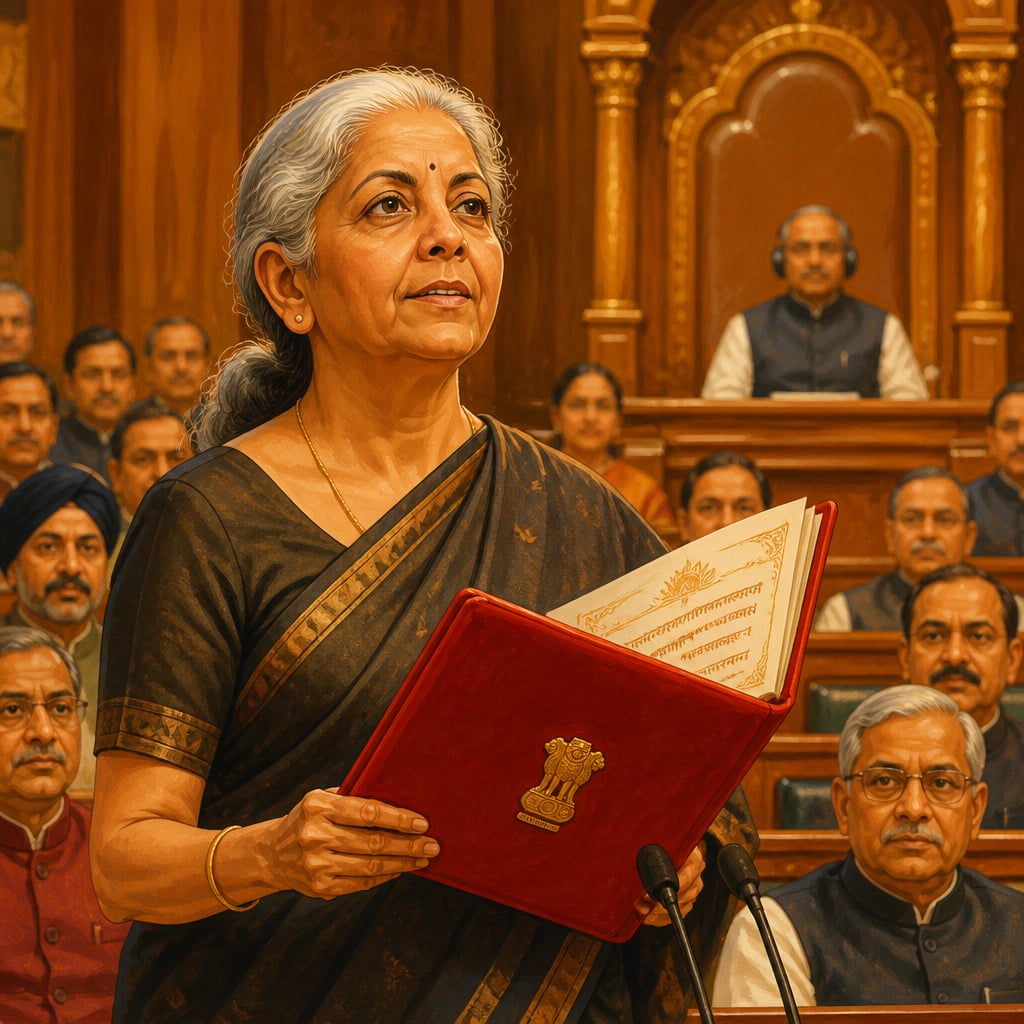
Indian finance minister delivering Union Budget speech

When Nirmala Sitharaman presented the 2020 budget amidst pandemic uncertainty, she began with a Sanskrit verse: "Annam Bahukurvita" (Let food be produced in abundance). The quote from the Taittiriya Upanishad signaled something deeper than policy, it placed economic management within civilizational continuity.

This wasn't performance. As India's first full-time female Finance Minister, Sitharaman has consistently framed economic policy through frameworks that echo ancient Vaishya Dharma while addressing 21st-century challenges. Her budgets reference Thiruvalluvar's economic wisdom. Her policy speeches invoke Kautilya's pragmatism. Her initiatives, Atmanirbhar Bharat, Startup India, financial inclusion, carry threads connecting modern India to its economic heritage.

Understanding these connections illuminates not just one minister's vision, but how dharmic principles can inform contemporary economic governance.

The Philosophy Behind the Policy

Sitharaman's economic approach rests on several principles that parallel classical Vaishya Dharma:

1. Svadeshi as Strategic Autonomy

The Atmanirbhar Bharat (Self-Reliant India) initiative isn't protectionism, it's the recognition that economic security requires capability, not just access. When Kautilya wrote about reducing dependence on foreign goods, he understood what modern supply chain disruptions have taught: vulnerability comes from reliance on sources beyond your control.
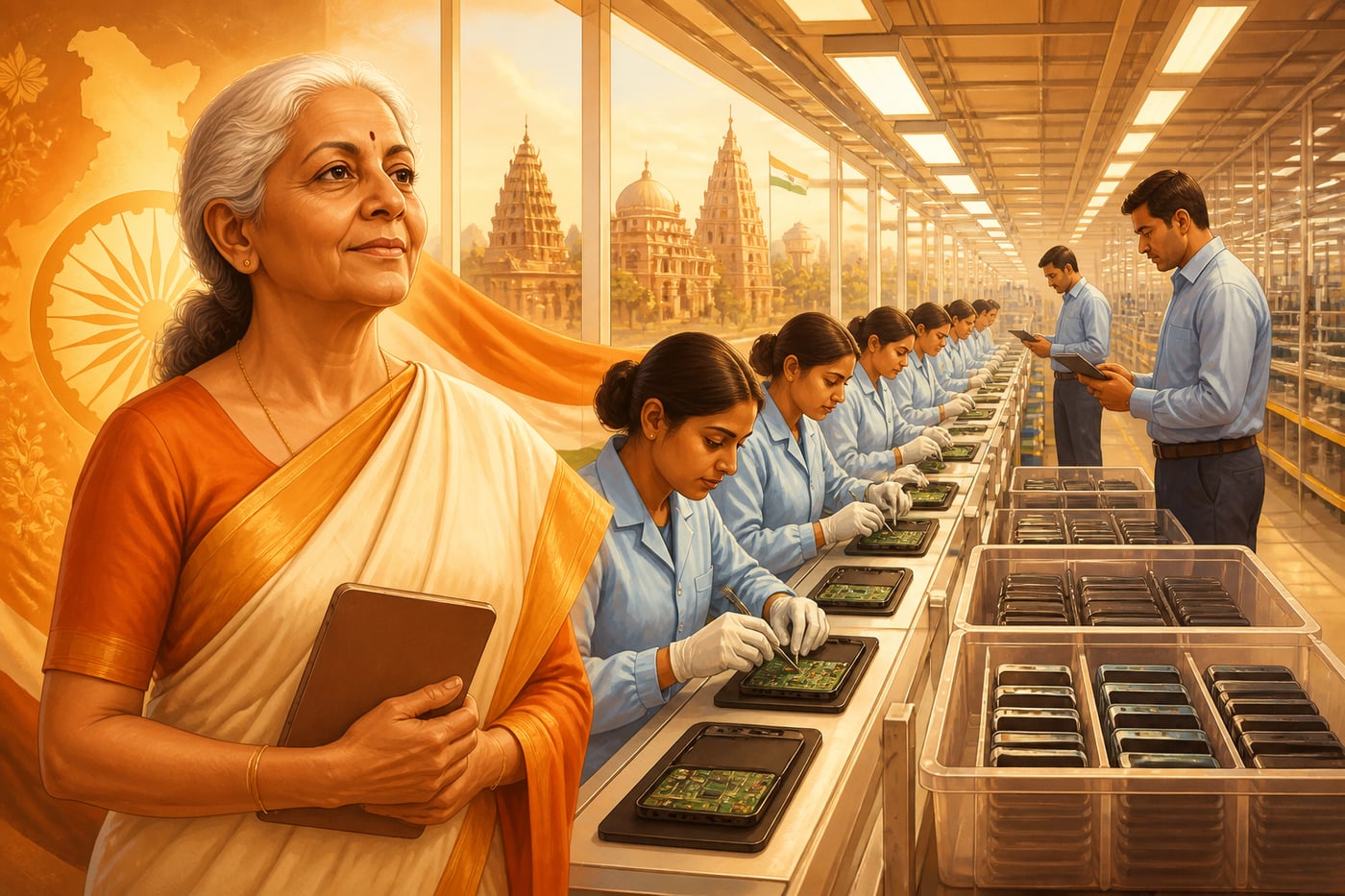
Atmanirbhar PLI electronics assembly line

The Production-Linked Incentive (PLI) schemes investing ₹2+ lakh crore across 14 sectors aim to build domestic manufacturing capability. Not isolation, but options. Not autarky, but autonomy.

2. Financial Inclusion as Dharmic Duty

Jan Dhan Yojana has created 520+ million bank accounts for previously unbanked Indians. This isn't just financial infrastructure, it's economic citizenship. The Arthashastra mandates that the state must ensure all subjects can participate in commerce; financial exclusion violates this fundamental obligation.

Direct Benefit Transfers (DBT) flowing through these accounts have saved ₹3+ lakh crore from leakage and corruption. When benefits reach intended recipients directly, both efficiency and dharma are served.

3. MSME Focus as Economic Foundation

Sitharaman's emergency credit schemes during COVID (₹3 lakh crore ECLGS) prioritized Micro, Small, and Medium Enterprises. Why? Because 63 million MSMEs employ 110+ million people, more than any corporate sector. Protecting them isn't sentimental; it's structural.

This echoes the Arthashastra's recognition that commerce is distributed activity. The health of a thousand small merchants matters more to economic stability than the performance of ten large corporations.

The Four Pillars of Sitharaman's Economic Vision

Pillar 1: Infrastructure as Economic Enabler

The Gati Shakti initiative coordinates ₹100+ lakh crore infrastructure investment across roads, railways, ports, and digital connectivity. The dharmic principle: infrastructure is lokakalyana (public welfare), everyone benefits, not just those who can pay tolls.

Kautilya devoted entire chapters to roads and waterways because he understood: commerce flows where infrastructure enables. A farmer who can't reach markets is poor regardless of harvest quality.

Rural grandmother opening Jan Dhan account

Pillar 2: Digital Public Goods

UPI, Aadhaar, DigiLocker, India's "Digital Public Infrastructure" stack represents a new approach: government builds rails, private innovation runs trains. This is neither pure privatization nor state control but yukta-vyavastha (balanced arrangement).

The Open Network for Digital Commerce (ONDC) aims to do for e-commerce what UPI did for payments: prevent private platforms from monopolizing digital marketplaces. When infrastructure is public, innovation can be democratic.

Pillar 3: Human Capital Investment

The New Education Policy 2020, Skill India, and expanded healthcare spending recognize that economic growth requires capable people. The Arthashastra calls this mantra-shakti, the power of wisdom and capability.

Investment in education and healthcare isn't welfare expenditure; it's economic investment with returns measured in decades.

Pillar 4: Green Transition

India's commitment to 500 GW renewable energy by 2030 and net-zero by 2070 reflects another dharmic principle: prithvi raksha (earth protection). Economic growth that destroys environment isn't prosperity, it's debt transferred to future generations.

PLI schemes for solar manufacturing, green hydrogen mission, and electric vehicle incentives aim to make India a climate solution exporter, not just a climate victim.

Policy as Dharma in Action

Examining specific initiatives through dharmic lens:

Startup India: Enabling Svadharma

The program provides tax holidays, simplified compliance, and funding access for entrepreneurs. The dharmic principle: people should be able to pursue their svadharma (own calling). When bureaucracy prevents capable people from building businesses, it blocks dharmic expression.

Result: 100,000+ recognized startups, 110+ unicorns, millions employed in entrepreneurial ventures.

PM-KISAN: Supporting the Food Providers

Direct cash transfers (₹6,000/year) to 120+ million farmer families recognize that food producers deserve economic security. This isn't subsidy, it's acknowledgment that anna-data (food givers) enable everyone else's work.

Ayushman Bharat: Healthcare as Right

Free healthcare for 500+ million poor Indians (₹5 lakh coverage per family) treats health as fundamental entitlement, not market commodity. When sick people can't afford treatment, their economic potential dies with them.

Corporate Tax Cuts: Enabling Investment

Reducing corporate tax to 22% (15% for new manufacturing) aims to make India competitive for investment. The dharmic balance: reasonable taxation that sustains government while enabling commerce to flourish.

Initiative Economic Mechanism Dharmic Principle
Atmanirbhar Bharat Build domestic capability Svadeshi, Self-reliance
Jan Dhan Universal banking access Sarva-hita, Inclusion
PLI Schemes Manufacturing incentives Strategic autonomy
Gati Shakti Infrastructure coordination Lokakalyana, Public good
Startup India Entrepreneur support Svadharma expression

The Budget as Dharmic Document

Sitharaman's budgets frequently invoke traditional wisdom:

Budget 2020: Began with Thiruvalluvar's economic verses, structured around "Aspirational India," "Caring Society," and "Economic Development."

Budget 2021: Post-pandemic recovery framed as sankalpa (solemn resolve) for "Atmanirbhar Bharat."

Budget 2022-23: "Amrit Kaal" framework placing current policy within 25-year vision toward India@100.

Budget 2024: Continued themes of inclusive development, infrastructure, and digital transformation.

The recurring pattern: immediate policy grounded in civilizational continuity. Not nostalgia, but recognition that India's economic traditions contain applicable wisdom.

Challenges and Critiques

No policy approach is without challenges:

Implementation gaps: Policies well-designed in Delhi often struggle in district execution. The distance between announcement and delivery remains India's governance challenge.

Employment generation: GDP growth hasn't translated proportionally to formal employment. The jobs question remains India's most urgent economic challenge.

Fiscal constraints: Ambitious spending requires either higher revenue or higher deficits. Managing this balance tests every finance minister.

Global volatility: Oil prices, geopolitical conflicts, and pandemic aftershocks create challenges beyond any domestic policy's control.

Inequality persistence: Despite growth and inclusion programs, wealth concentration continues. The top 10% own 77% of national wealth.

The Viksit Bharat 2047 Vision

The government's stated goal: making India a developed nation by its centenary of independence. This requires:

Achieving this requires what the Arthashastra calls samyak-prabandha, balanced governance that neither over-controls nor under-regulates, that enables private enterprise while protecting public interest.

Lessons for Future Leaders

Sitharaman's approach offers lessons for those who will govern future economies:

Ground policy in values: Economic policy isn't just technical, it reflects choices about what kind of society we want. Articulating values creates coherence.

Balance competing goods: Growth and stability, efficiency and equity, present and future, good governance navigates trade-offs without pretending they don't exist.

Learn from tradition: Indigenous economic thought, Arthashastra, Thirukkural, Dharmashastra, contains insights applicable to modern challenges. Wisdom isn't dated.

Build institutional capacity: Policy announcements matter less than implementation systems. Investing in government capability is investing in all future policies.

Communicate clearly: Complex policy must be explainable. If citizens don't understand what you're doing and why, democratic consent erodes.

The Dharmic Economist's Toolkit

Modern policymakers working in dharmic tradition might ask:

Sarva-hita test: Does this policy benefit all sections, or only some? Who bears costs and who gains benefits?

Deergha-drsti test: What are long-term consequences? Are we solving today's problems by creating tomorrow's?

Svadeshi test: Does this strengthen domestic capability, or increase external dependence?

Nyaya test: Is this fair to all parties? Are burdens and benefits distributed equitably?

Sustainability test: Can this continue indefinitely, or does it deplete what future generations need?

Beyond One Minister

While this lesson focuses on Sitharaman's tenure, the principles transcend any individual. Future finance ministers, whatever their party or philosophy, will face similar challenges:

Dharmic economic thought doesn't provide specific answers, circumstances change. But it provides enduring questions and frameworks that help navigate complexity.

The Arthashastra concludes: "In the happiness of his subjects lies the king's happiness; in their welfare his welfare." Translated to democracy: the government's economic success is measured by citizens' prosperity, not by indicators that citizens don't experience.

That's the dharmic test every economic policy must pass: Does it create conditions where all people can pursue their own flourishing? Does the farmer find fair price? Does the entrepreneur find clear path? Does the worker find dignity? Does the consumer find value?

When policy serves these questions, it becomes more than technocratic management, it becomes rajadharma (the duty of governance) in economic form.

Key terms

Atmanirbhar Bharat
Self-reliant India; the economic vision of building domestic capability to reduce dependence on imports while remaining globally integrated
Rajadharma
The duty of governance; the ethical obligations of those who wield state power, including economic stewardship for citizen welfare
Viksit Bharat
Developed India; the vision of India becoming a developed nation by 2047, its centenary of independence
Lokakalyana
Public welfare; the collective good of all people; the ultimate purpose of governance and economic policy

Verses

अन्नं बहु कुर्वीत। तद्व्रतम्।

annaṁ bahu kurvīta | tad vratam |

Let food be produced in abundance, this is the sacred vow. From abundant resources comes the capacity for generosity and security.

This verse sanctifies economic production. Growth isn't materialistic distraction from spirituality, it's the foundation for all other achievements. A hungry nation cannot pursue higher goals. Economic policy that enables abundance serves dharma.

Taittiriya Upanishad, Bhrigu Valli 3.10.1 (Swami Chinmayananda translation)

प्रजासुखे सुखं राज्ञः प्रजानां च हिते हितम्।

prajā-sukhe sukhaṁ rājñaḥ prajānāṁ ca hite hitam |

In the happiness of subjects lies the king's happiness; in their welfare, his welfare. The ruler's success is measured by citizens' flourishing.

This verse provides the dharmic measure of economic policy. Not stock market indices, not foreign investment figures, not GDP rankings, but actual citizen welfare. If inflation hurts households, policy has failed regardless of other metrics.

Arthashastra, 8.2.1 (R. Shamasastry translation)

N/A (Tamil original)

Eyatralum noolpala karkka avai naṅku uyatralum cheythu maṇappārkku

The ruler who has mastered economic science and applies it wisely brings wealth to the nation and welfare to its people.

This verse validates economic expertise as governance requirement. Populism that ignores economic realities eventually harms the very people it claims to serve. Dharmic governance combines good intentions with sound knowledge.

Thirukkural, Kural 542 (P.S. Sundaram translation)

Key figures

Nirmala Sitharaman

1959-present

Thiruvalluvar

c. 300 BCE - 500 CE (debated)

Dr. Manmohan Singh

1932-present

Case studies

Jan Dhan Yojana: Banking the Unbanked

In August 2014, Prime Minister Modi announced Pradhan Mantri Jan Dhan Yojana, a national mission for financial inclusion. The goal: ensure every household has at least one bank account with basic banking facilities. By 2024, the program has opened 520+ million accounts, with 67% in rural areas and 56% for women. These accounts became conduits for ₹35+ lakh crore in Direct Benefit Transfers, eliminating middlemen and reducing corruption. During COVID, relief payments reached millions within days through these accounts.

Jan Dhan embodies multiple dharmic principles. **Sarva-hita** (welfare of all): Financial inclusion means everyone can participate in formal economy, not just the privileged. **Satya** (truth): Direct transfers eliminate intermediary corruption, money goes where it's meant to go. **Svadharma enablement**: With banking access, people can save, borrow, insure, pursuing their economic calling without structural barriers. The Arthashastra mandates that rulers ensure all subjects can participate in commerce; financial exclusion violates this duty.

Jan Dhan accounts enabled crisis response impossible before: COVID relief payments reaching 430+ million beneficiaries in weeks, not months. The ₹3+ lakh crore savings from reduced leakage funds other programs. Insurance and pension schemes now reach previously unreachable populations. Financial inclusion became foundation for broader inclusion, social, political, economic.

Infrastructure precedes participation. People excluded from financial system cannot participate fully in economic life, no matter what other policies support them. Jan Dhan shows that government can enable capabilities that markets alone won't provide, and that such enabling makes markets work better for everyone.

Digital financial inclusion programs modeled on Jan Dhan are now active across Africa (M-Pesa evolution), Southeast Asia (GrabPay), and Latin America (Pix in Brazil). The sequencing matters: account access first, then digital payments, then credit products, then insurance. Jan Dhan proved that government-driven inclusion at scale is possible and creates the infrastructure on which private fintech innovation can build.

520+ million Jan Dhan accounts opened, making this the largest financial inclusion program in human history. 67% of accounts are in rural areas where traditional banking never reached.

Historical context

Post-Liberalization Economic Policy (1991 - 2025 CE)

India's economic policy oscillates between state direction and market freedom, currently seeking synthesis. The current framework attempts 'enabling state', government creating conditions for private enterprise rather than directly controlling production. This echoes Arthashastra's prescription that the ruler should enable commerce, not conduct it.

India's digital public infrastructure (UPI, Aadhaar) represents a different model than both Western private platforms and Chinese state control. Countries worldwide now study 'India Stack' as template for inclusive digital transformation.

India's economy grew from world's 11th largest in 2013 to 5th largest by 2024 (PPP basis: 3rd largest), demonstrating policy impact at scale.

Economic policy determines whether India's demographic dividend becomes demographic disaster. The 600 million young Indians entering workforce over coming decades need productive employment; policy creates, or fails to create, those opportunities.

Living traditions

India's economic governance traditions, budget secrecy, parliamentary approval, federally-distributed implementation, create checks and balances that prevent concentration of economic power. The Finance Commission tradition of periodic reviews ensures resource distribution remains responsive. These institutional traditions matter as much as any individual policy.

Reflection

More in Dharmic Entrepreneurship Today

All lessons in Dharmic Entrepreneurship Today · Vaishya Dharma: The Art of Ethical Commerce course