The Three Debates: Vaada, Jalpa, Vitanda

India's 2500-Year-Old Classification of Discourse

India classified debates into three types 2500 years ago. Truth-seeking debate (Vaada). Victory-seeking sophistry (Jalpa). Destruction for its own sake (Vitanda). Each maps to one of the three modes of action in the Bhagavad Gita (Gunas): truth-seeking is Sattvic, status-seeking is Rajasic, destruction is Tamasic. The Vaada Lens changes how you see every debate.

The Court That Refused To Hear

The hall at Hastinapura was full. Bhishma at the front, Drona beside him, Vidura standing apart, Karna and Dushasana at the right hand of the throne, Dhritarashtra seated, Duryodhana leaning forward like a man already certain of his answer. Krishna walked in alone, without escort, without weapon, in his blue silk uttariya. The Pandavas had sent him. Five villages, he said. Indraprastha, Vrikasthala, Makandi, Varanavata, and any one more. Five villages and they would not press their claim to the kingdom. The war would be averted.

He spoke for a long time. He was specific. He named each piece of land. He cited what was just under the rules of inheritance, what was merciful under the rules of kinship, and what was practical under the rules of statecraft. He addressed the elders. He addressed the king. He addressed Duryodhana directly.

Duryodhana laughed.

"Not a needle's worth of land," he said. "Not without war."

Then he ordered Krishna seized.
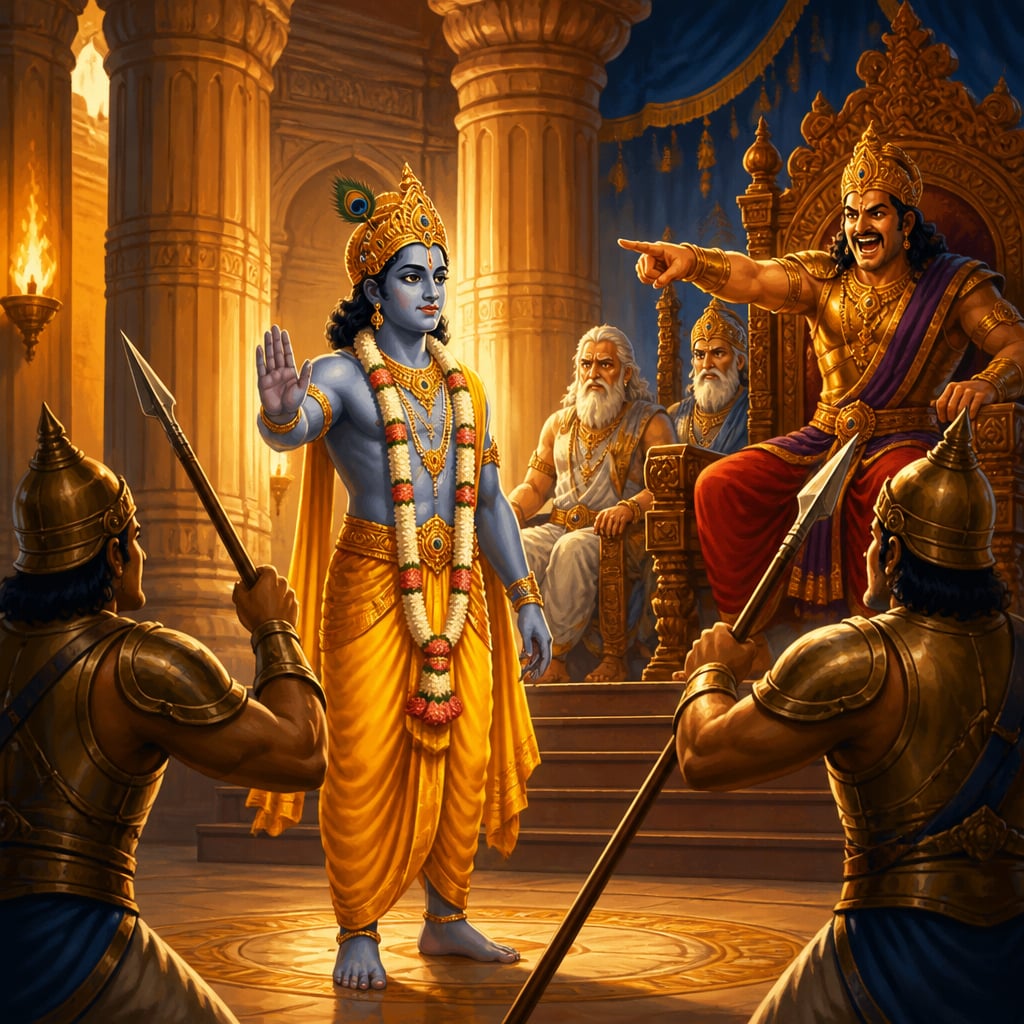
Krishna at the Hastinapura court refusing to back down

Three things happened in that hall in the space of a single afternoon, and they were not the same thing. Krishna spoke to find a settlement that was true to dharma. He sought the outcome that would prevent the deaths of millions. Duryodhana spoke to win the room, then to keep what he had taken, then to insult and arrest the messenger who had come unarmed. Bhishma and Vidura spoke too. They knew Duryodhana was wrong. But they spoke softly, hedged, asked the king to consider, and let the king's silence do the work that a clear word would not.

Three voices. Three modes. India named these modes more than two thousand years ago, before any of this scene had a single common reading. The names are Vaada, Jalpa, and Vitanda. By the end of this lesson you will see them every time a debate happens in front of you. You will also see, with painful clarity, which one you yourself default to.

Three Names For Three Different Things

The Nyaya Shastra is the world's oldest formal science of debate. Its founder, the sage Gautama, wrote the Nyaya Sutras some twenty-five centuries ago. In one short passage he set out a classification that the West has still not produced an equivalent for. He said: not all debates are the same. They differ by intent. There are three.

Three different games being played on the same board. The trouble is that most people do not know which game they are in until they have already lost. We will take each in turn.

Vaada: The Mode That Seeks Truth

Vaada is the rarest of the three. It needs two people who both want truth more than they want to be right. It needs rules: cite your evidence, define your terms, do not change the question mid-debate, accept defeat gracefully when your position fails. The Nyaya Sutras spell out the conditions in detail. Five-part syllogism. Both sides represented. No contradiction with established knowledge. No reliance on tricks.

The Yajnavalkya and Gargi exchange in King Janaka's court is the textbook case. Gargi rises in a hall full of men, asks the old sage the deepest possible question about the nature of reality, and listens. He answers. She asks again. Twice more he answers. The third time she rises, she asks a question so sharp that he warns her: ask once more and your head will fall. She does not ask. She accepts that the limit of speakable knowledge has been reached. She sits down. He sits down. Nobody won. Both learned. The room was richer than it had been at the start. That is Vaada.

In the Sattvic mode, the Bhagavad Gita says, the one who knows sees the same undivided reality across all things. The Vaadin sees that the truth of a thing is not changed by who is speaking. They are willing to lose because the gain is real. Losing a position is a small price for finding a truer one.

Jalpa: The Mode That Seeks Victory

Jalpa is far more common. The speaker has a side. They came in with the side, they will leave with the side. The whole purpose of the conversation is to make the side look stronger to the people watching. Evidence is selected. Definitions are bent. Hard questions are deflected. Easy questions are answered at length. If a clever line lands well, it does not matter that it was not quite true.

Cable news panelist in aggressive Jalpa mode

Jalpa is what most televised political debate is. It is what most social-media argument is. It is also what most dinner-table arguments about politics or religion turn into within three minutes. The listener can spot Jalpa by one test: ask the speaker, "What evidence would change your mind?" If the speaker has no honest answer, you are not in Vaada. You are in Jalpa.

Jalpa has a guna behind it. The Gita calls it Rajasic knowledge: knowledge driven by status, by ambition, by the wish to be seen winning. Rajasic knowledge can be beautiful in form. It can quote scripture. It can use logic. But its root is the wish for victory, not the wish for truth. The Jalpin can hold their position long after the evidence has turned against them, because for them holding the position is the point.

Vitanda: The Mode That Only Destroys

Vitanda is the lowest of the three. The Vitandin has no position. They are not defending anything. They have come to break what the other side is saying. Sometimes for sport. Sometimes for status with a third audience. Sometimes because watching another person's argument collapse feels good.

Anonymous troll at monitors after midnight

The Twitter quote-tweet pile-on is mostly Vitanda. So is the WhatsApp meme reply that says nothing about the question and just makes the original sender look foolish. So is the news-panel guest who has no proposal of their own and only sneers at the proposal in front of them. Vitanda is easy to perform and very hard to recover from, because there is nothing to engage. There is no thesis. There is only smoke.

The Gita names this mode Tamasic: knowledge that clings to one fragment as if it were the whole, without reason, without truth, and small. Tamasic discourse does not seek victory. Victory implies a goal. Tamasic discourse seeks only the satisfaction of pulling something down.

The Three Gunas Behind The Three Debates

Bhagavad Gita 18 spends a long passage on the three modes of knowledge.

सर्वभूतेषु येनैकं भावमव्ययमीक्षते। अविभक्तं विभक्तेषु तज्ज्ञानं विद्धि सात्त्विकम्॥

sarva-bhūteṣu yenaikaṃ bhāvam avyayam īkṣate avibhaktaṃ vibhakteṣu taj jñānaṃ viddhi sāttvikam

The knowledge by which one undivided imperishable reality is seen in all beings, undivided in the divided: know that knowledge to be Sattvic.

Bhagavad Gita 18.20

In Sattvic knowledge the seeker sees one undivided truth across many forms. In Rajasic knowledge the seeker sees many separate truths and picks the one that serves them. In Tamasic knowledge the seeker clings to one tiny piece, treats it as the whole, and ignores the rest.

Look at those three again. Sattvic knowledge is the inner posture of Vaada. Rajasic knowledge is the inner posture of Jalpa. Tamasic knowledge is the inner posture of Vitanda. The classification of debates is not a separate Indian invention. It is what falls out when you take the Gita's classification of knowledge and ask what each mode looks like when two people are speaking.

The guna of your intent decides the mode of your debate. If your guna is Sattvic, your speech will move toward truth. If it is Rajasic, your speech will move toward victory. If it is Tamasic, your speech will move toward destruction. You cannot fake the mode. The audience hears the guna long before they hear the argument.

Dharmic Lens: Why The Western Win-Lose Frame Falls Short

The Western tradition of debate, from Athens through the Oxford Union, treats the question of debate type as already settled. There are two sides. One wins. One loses. The point of the debate is to win. Critical thinking is taught as a way to spot bad arguments, but every debate is by default adversarial. Truth-seeking debate is not named as a different category. It is just debate done well.

The Dharmic tradition refuses this collapse. It says the win-or-lose game is a real game, but it is one game out of three. To call all three by the same word is to lose the most important distinction. A Vaadin and a Jalpin can both argue brilliantly. They are doing different things. A Vitandin can also argue brilliantly. They are doing a third thing. Treating the three as the same forces the Vaadin to play by the Jalpin's rules and lose, because the Jalpin's rules reward victory, not truth.

Vaada Jalpa Vitanda
Intent Find the truth Be seen winning Destroy the other side
Guna Sattvic Rajasic Tamasic
Tricks allowed? No Yes if they work Yes, anything goes
What both sides leave with A truer position A scoreboard Less than they came in with

This is why the Western public square has fallen so easily into the cable-news Jalpa and the Twitter Vitanda. Without a name for Vaada, it has no defense against the loss of Vaada. Without names for Jalpa and Vitanda, it cannot diagnose what mode it has slipped into. The Vaada Lens names them. Once named, they can be chosen between.

The Modern Test: Three Modes In One Hour

You can watch all three modes in the same hour any evening. Open a long-form podcast with two people who genuinely disagree, and you may catch a Vaada moment, a stretch where each is steelmanning the other before responding. Switch to a Hindi prime-time news panel, and you will see Jalpa in nine boxes at once, every guest fighting for their party's soundbite, the anchor closing the mute on whichever voice is winning the wrong way. Open Twitter on the same topic, and you will see Vitanda in the replies, where the goal is not to argue but to dunk.

Same topic. Same evening. Three different debate modes. The platform has a thumb on the scale. Long-form rewards Vaada because there is time to develop a position. Short-form rewards Vitanda because there is only time for the punchline. Cable rewards Jalpa because the ratings reward heat, not light. The discipline begins when you can name which game you have walked into before you open your mouth.

The Stanford political scientist Larry Diamond has called the post-2010 collapse of public discourse a "global democratic recession," and he points to the disappearance of any shared truth-seeking norm as its root. He is naming the disappearance of Vaada in the West. Twenty-five centuries before him, Gautama had already named what was disappearing. The diagnosis is older than the disease.

Back in the hall at Hastinapura, Krishna freed himself from the guards with a flash of his cosmic form, walked out unharmed, and rode back to the Pandava camp. The court he had left behind had chosen its mode. Vitanda had spoken loudest. Jalpa had hedged. Vaada had been refused. The war that followed was the price of the refusal. The court did not see the price until the field was already full of vultures.

Case studies

Krishna's Peace Mission to Hastinapura

On the eve of the Kurukshetra war, the Pandavas sent Krishna as their final peace envoy. The offer he carried was extraordinary: forget the kingdom, forget the rightful inheritance, give us only five villages and we will withdraw the claim. Krishna walked into Hastinapura's full court alone, without escort or weapon. He addressed the elders. He addressed Dhritarashtra. He addressed Duryodhana directly. He named the villages. He cited inheritance, kinship, and statecraft. He spoke at length and in good faith. Duryodhana laughed, refused 'a needle's worth of land,' and ordered Krishna seized. Bhishma and Vidura knew Duryodhana was wrong. They spoke softly, urged the king to reflect, and let the king's silence carry the day. Three modes filled the same hall in a single afternoon.

Krishna's offer was Vaada in its purest form: a position rooted in dharma, made falsifiable by the very act of compromise, and addressed to a counter-position taken seriously enough to anticipate it. Duryodhana's refusal was Vitanda: no position to defend, only the destruction of the other side's offer, capped by an attack on the unarmed messenger. Bhishma and Vidura's silence dressed as counsel was Jalpa: knowing the truth, performing the form of Vaada, but holding the side at every cost. Three voices, three gunas, one war that the room itself had decided before the messenger arrived.

Krishna freed himself, walked out unharmed, and rode back. The court had chosen its mode. Within weeks the war began. Eighteen days. Crores dead. The Kuru line ended. The price of the court's refusal of Vaada was paid in the bodies of millions, including most of those who sat in the room that day.

When the loudest voice in a room is in Vitanda mode, hedged Jalpa from the wise will not save the room. Either the Vaadin sets the mode in the first minute, or the room defaults to the loudest mode. Mode is contagious. So is its absence.

The Mahabharata records that Krishna's peace embassy occupies five chapters of the Udyoga Parva (Book 5). The asking price collapsed from the full kingdom, to half the kingdom, to five villages, to one village in some retellings. Vaada is willing to lose ground for truth. Vitanda is not willing to give the smallest inch.

Rajiv Malhotra and the Indology Establishment

Between 2014 and 2018, the independent scholar Rajiv Malhotra published a series of books, including 'Indra's Net' and 'The Battle for Sanskrit,' that engaged the work of Western Indologists like Wendy Doniger and Sheldon Pollock head-on. His method was Purva Paksha: state your opponent's position more precisely than they themselves state it, then respond. Malhotra's books quoted his targets at length, mapped their frameworks faithfully, and only then offered the Dharmic counter. The response from much of the Indology establishment did not engage the textual arguments. Open letters branded the work 'Hindutva,' raised plagiarism allegations on technical citation issues, and circulated petitions. The substantive theses, on Sanskrit non-translatables and on the political consequences of the American academic framing of Hindu texts, went largely unanswered for years.

Malhotra's method was Vaada in the strict Nyaya sense. He met the conditions: faithful representation of the counter-position (Purva Paksha), shared rules of evidence (textual citation across primary sources), and a stated willingness to lose if the textual case did not hold up. The institutional reply was Jalpa shading into Vitanda: the side was held without engaging the case, the messenger was attacked instead of the message, and the audience was the prize. Two players were not playing the same game in the same room, and the audience eventually noticed which player was willing to be tested.

The frame Malhotra named, 'Sanskrit non-translatables' and 'digestion' of Dharmic categories into Western universalism, broke through to a wider Indian audience anyway, largely on YouTube and through book tours. Several mainstream academic positions have shifted in subsequent years. The non-engagement was a strategic loss that the establishment did not see in the moment.

If your opponent comes prepared for Vaada and you respond with Jalpa, you may hold the institution. You will not hold the audience. Long-form rewards Vaada eventually. Refusing the engagement is a tell. Audiences learn to read the tell.

The Family WhatsApp Group on a Polarising News Day

Imagine a composite Indian family WhatsApp group of twenty-three members on the day of a polarising news event. An uncle in Pune posts a careful 600-word note explaining his reading of the event, with two news links and an honest acknowledgement that he is not certain. He is attempting Vaada. A cousin in Bangalore replies within forty seconds with a meme that ridicules people who hold the uncle's position. No counter-argument. Just the meme. That is Vitanda. An aunt in Delhi follows up: 'Yes, but what about the other party? They did the same thing in 2019.' She has not engaged the original event. She has changed the subject to defend her side. That is Jalpa. Within ten minutes the original 600-word note is buried under reaction emojis, three further memes, and two link drops from partisan news outlets. The uncle stops typing.

Three modes appeared in a single chat in under ten minutes. The Vaadin tried to set the mode and was outnumbered before the second message. The platform itself favoured the shorter, punchier, more emotional messages: meme over essay, reaction emoji over reasoned response, link drop over considered citation. The room defaulted to the loudest mode the moment the loudest mode arrived. Vidura's problem at the Hastinapura court is the same problem on every modern family WhatsApp group, scaled by twenty-three users instead of by the population of Bharatavarsha, but structurally identical down to the silences of the elders who knew better.

The uncle is now less likely to post a careful reading next time. Over months, the group conversation drifts to memes and links, with the careful voices going silent. This is how Vaada disappears: not through being defeated, but through being made expensive. The Vaadin is the only one who pays a cost. The Vitandin pays nothing.

Mode is set in the first reply. If the first reply to a Vaada post is in Vitanda or Jalpa mode, the post will not survive. If you want Vaada in your group, be the first reply, and reply in Vaada mode. The mode propagates. So does its absence.

Reflection

More in Vaada Kshetra: The Battlefield of Words

All lessons in Vaada Kshetra: The Battlefield of Words · Vaada Shastra: The Dharmic Art of Debate course