The Noise: Why Nobody Wins

When Everyone Talks and Nobody Listens

Most debates are not about truth. They are about ego, identity, and who gets to be seen as right. Before you can debate well, you must see why most debates fail, and why social media made the failure civilizational.

The Studio at Ten O'Clock

On a Tuesday night in 2020, in a television studio in Mumbai, seven people sat in small boxes on a large screen. One was a retired army officer. One was a political spokesperson. One was a former diplomat. Two were journalists from different newspapers. One was a professor. One was the anchor, sitting alone at a glass desk with his sleeves rolled up. The topic was a single news event from that morning, already two headlines old.

The anchor began with a question. Before the first guest could finish a sentence, the second guest cut in. The third raised her voice to be heard over the second. By minute four, all seven were speaking at the same time. The anchor, instead of restoring order, began shouting louder than the guests. At minute nine, someone called someone else a word that had to be bleeped. At minute twenty, the anchor looked into the camera and said the nation wanted to know.

The panel ended. Nothing was decided. No one had changed their mind. Not one new fact had entered the room. By the next morning, each side had cut a ninety-second clip from the panel, posted it on social media with a caption claiming victory, and moved on. The clips trended. The nation, whatever that word meant, still did not know.

This is what most debates look like now. They are not failures. They are working exactly as designed. The design is just not what we think it is.
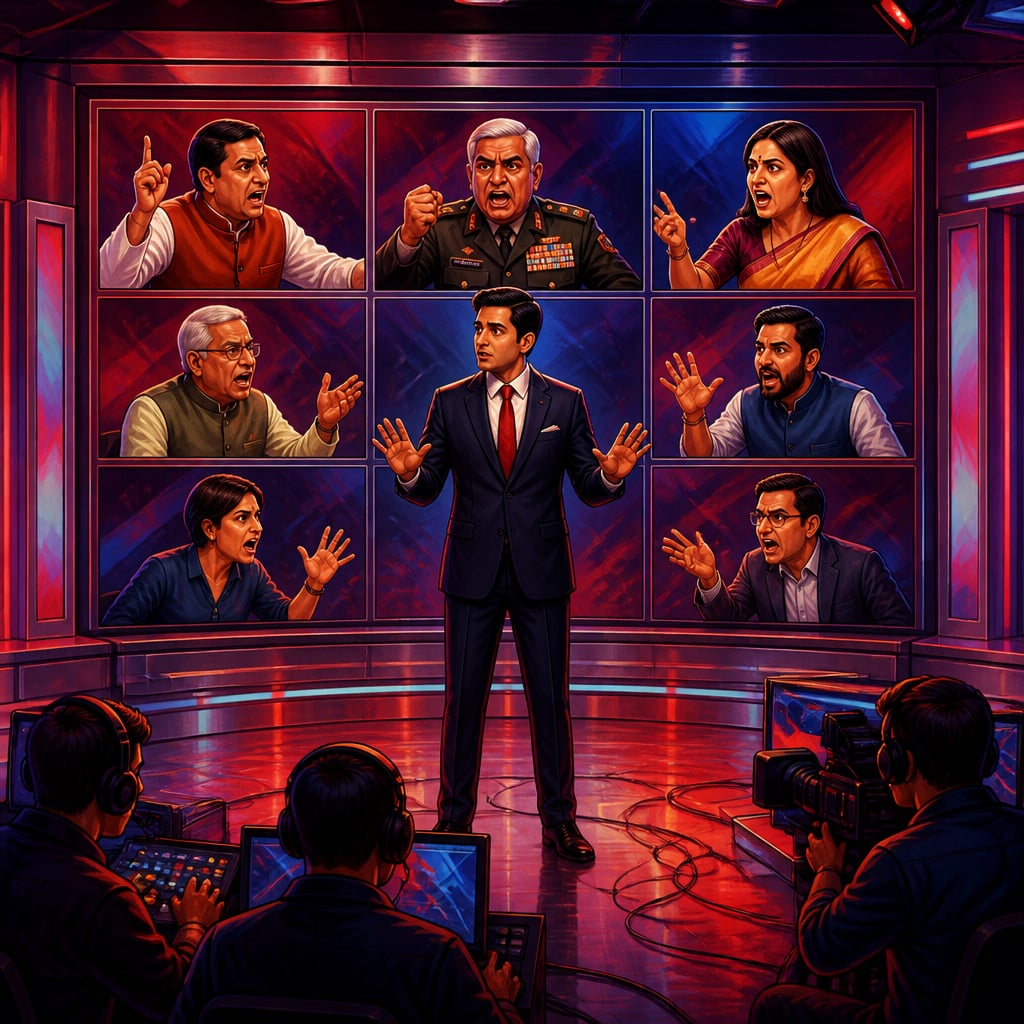
Mumbai TV news panel of seven shouting guests

The Old Lie About Debate

We were told a story in school. Debates are how ideas compete. The best idea wins. The side with more evidence and cleaner logic beats the side with less. Truth rises to the top like oil on water.

This story is very old and almost always wrong.

The Nyaya Shastra, India's 2500-year-old science of logic and debate, saw the problem and named it clearly. Not every debate is about truth. Some debates are about victory. Some are about destruction. Only a specific kind is about truth, and that kind is rare. The ancient Indian logician Gautama, who wrote the Nyaya Sutras, did not call this three-way split an opinion. He called it the first thing you must see before you argue at all.

The three kinds have names. Vaada is truth-seeking debate, where both sides are trying to find out what is real. Jalpa is victory-seeking debate, where both sides are trying to win. Vitanda is destruction-seeking debate, where one side just wants to tear down. You will learn all three in the next lesson. For now, hold just this: most of what you see on TV, on Twitter, on WhatsApp, at your dinner table, is not Vaada. It is one of the other two.

And because we were told in school that all debates are Vaada, we keep walking into Jalpa and Vitanda expecting truth to rise. It does not rise. It drowns.

Why People Actually Argue

Sit quietly with this question for a moment. When was the last time you changed your mind in the middle of an argument, because the other person said something true?

For most people, the honest answer is: almost never. We change our minds later, alone, when nobody is watching. In the middle of an argument, something else is happening.

What is actually happening in most arguments is not a search. It is a defence of the self. When someone disagrees with a view you hold, your mind does not first ask whether they are right. It first asks whether you are under threat. Your views are stitched into your identity. If you are wrong about this, what else are you wrong about. If your tribe is wrong about this, are you still safe in your tribe. The argument is not about the topic. The argument is about whether you still get to be who you are.

The Bhagavad Gita calls the force that drives this Ahamkara, the I-maker. It is the part of the mind that builds a fortress around the self and defends it against every incoming sentence. Ahamkara is not evil. It is how the ego survives in a social world. But Ahamkara makes very bad debates, because it cannot tell the difference between a threat to your view and a threat to you. It treats every disagreement as an attack. It replies to evidence with insult. It replies to insight with insult. It replies to agreement with suspicion.

When two people argue and both are running on Ahamkara, there is no debate. There are two defence systems shouting at each other across a table. Nothing moves.

The Three Fuels of a Pointless Fight

Look back at the studio panel for a moment. What was each person actually doing.

The political spokesperson was protecting the brand of their party. A loss on camera is a loss for the party. They cannot afford to concede anything, even a small point, because the clip will travel.

The retired officer was protecting a worldview built over forty years. Changing his mind in public would mean his whole career had been wrongly understood. He will not do that on a Tuesday night.

The journalist was protecting a column she had written earlier that week. If the column was wrong, her next book deal is in trouble. So the column must be right.

The anchor was protecting the show. The show runs on conflict. If the guests agree, the show ends, ratings fall, and his own job shrinks. Conflict is the business model. He does not want resolution. He wants heat.

None of these are bad people. They are all, in their own way, rational. But none of them are in the room to find out what is true. They are in the room to protect something. This is what we mean when we say a debate is running on ego, identity, and dominance. Ego is the defence of the self. Identity is the defence of the tribe. Dominance is the defence of the position one holds in front of an audience. Put all three together and you get the modern debate: a fight that cannot end because nobody is there for the reason they said they were there for.

How Social Media Turned a Small Flame Into a Forest Fire

Indian family arguing in front of the panel

Ego, tribe, and audience are not new. The Mahabharata has scenes of each. Duryodhana defending his claim to the throne is ego. The gathering at Indraprastha laughing at him is tribe. The whole Sabha watching Draupadi's insult is audience. These forces have always been there.

What is new is the scale.

Before social media, a bad argument stayed in the room it happened in. Two uncles shouting at a wedding reached twelve relatives and then faded. Now, a ninety-second clip of a shouting match reaches twenty million phones before lunch. The reward system on the platform rewards the shouting, not the listening. A thoughtful reply gets seven likes. An angry reply gets seventy thousand. The algorithm, which has no view on truth, learns what gets engagement and serves more of it.

Mumbai skyline with phone-lit windows at midnight

The result is what we now live inside. A world where the loudest voice in the room is amplified a million times, and the careful voice is buried on page nine of the search results. A world where nobody reads the article and everybody shares the headline. A world where your cousin and your college friend are arguing about the same news story but seeing two entirely different versions of it on their feeds, each version tuned to confirm what they already believed. They are not disagreeing. They are living in different rooms.

This is what the title of the lesson means. Nobody wins, because the game is not set up for anyone to win. The game is set up to generate heat. Heat is valuable. Heat sells ads. Heat keeps you scrolling. Truth is a by-product the platform does not need and sometimes actively penalises.

The Avidya Diagnosis

The Yoga Sutras give us a word for what we are all living through. Avidya is not plain ignorance. It is active mis-seeing. It is taking the temporary for the permanent, the impure for the pure, the opinion for the fact, the clip for the whole panel. The word breaks down as a (not) plus vidya (knowing). Avidya is not the absence of knowing. It is a kind of knowing that is wrong.

In the studio panel, every person in every box had Avidya. Each was sure they were seeing the full picture. Each was sure the other was the confused one. Each was sure that a shouting match was a debate. None of them could see that the real game was ratings, and the argument on screen was the raw material the network sold to advertisers. The fight was the product. They were the ingredients.

The first job of a Dharmic debater is to see this clearly. Not to become cynical about it. Not to stop engaging. Just to see it. A debate is a kind of action, and every action runs on a certain quality of intention. If you do not know your own intention, you cannot know what you are doing. You think you are seeking truth, but you are defending pride. You think you are correcting a friend, but you are scoring points in front of an audience. You think you are cutting down a falsehood, but you are burning the forest because someone hurt your feelings last week.

The first turn of Viveka, discernment, is inward. Before you ask what kind of debate this is, ask what kind of debater you are in this moment. That question alone will change half your arguments.

Modern Echoes

The American neuroscientist Lisa Feldman Barrett has shown in her work on emotion that the brain does not first perceive and then react. It predicts, then perceives. When a person with a strong prior walks into a conversation, the brain has already decided what the other side is about to say, and the listening is a kind of theatre. Her book How Emotions Are Made argues that what we call a rational exchange is in most cases a pre-scored play being acted out.

The Indian-American psychologist Jonathan Haidt, in The Righteous Mind, calls this the rider and the elephant. The elephant, the emotional engine, decides. The rider, the reasoning mind, makes up a justification after. He reviewed fifty years of moral psychology and found that almost no one changes a moral view through argument. People change through relationship, through time, through shock, and through direct experience. Almost never through debate.

And the former Google design ethicist Tristan Harris has shown how the attention economy feeds on outrage. His testimony to the United States Senate in 2019 laid out how engagement algorithms convert civic discourse into a gladiator pit. The arena is new. The blood is not.

Gautama named the diagnosis 2500 years ago in the opening of the Nyaya Sutras. Modern neuroscience, moral psychology, and attention economics have now independently confirmed it. The debates you see are not what you were told they were. The noise is not a breakdown of discourse. It is the discourse, working as the incentives ask it to.

Back to the Studio

The panel ended. The anchor thanked his guests, went to his green room, and checked the ratings on his phone. The guests left in seven different cars and went home. The clips travelled. The audience split along lines drawn long before the show began.

Nothing in the room was true. Everything in the room was working.

In the next lesson, you will learn the names and shapes of the three kinds of debate, so that the next time you open your phone, you can tell which one you are inside before you open your mouth.

Case studies

Arnab Goswami's Nightly Panel: The Product Is the Fight

Between 2017 and 2022, Republic TV's nine o'clock panel, anchored by Arnab Goswami, became the most-watched English news debate slot in India. The format was standardised. Seven to nine guests in boxes on a single screen. A headline picked from that day's news. Three minutes of nominal question, followed by twenty-five minutes of overlapping shouting. A signature closing line, the nation wants to know, delivered by the anchor at camera, often drowning out the last guest. The audience split into two clean halves. One half clipped the anchor's lines and shared them as courage. The other half clipped the anchor's lines and shared them as proof of decline. Both halves grew. Ratings grew with them.

In Nyaya terms the panel is not Vaada, and it is not even clean Jalpa. It is a hybrid run on Asuri Sampada from Gita 16.4. Show (dambha) in the anchor's theatrics. Arrogance (darpa) in the guests. Self-conceit (abhimana) in each side's certainty that it won the clip war. Anger (krodha) as the fuel that keeps the format watchable. Harshness (paarushya) as the editorial style. And Avidya underneath it all, each person in each box sure they are in a debate when in fact they are ingredients in a product.

The format did not resolve a single policy question in five years. It did move the entire Indian news industry to imitate it. Rival channels copied the split-screen, the bleep button, the outrage headline. Ratings across the sector rose. Trust in news, measured by Reuters Institute's India report in 2022, fell to 41%, among the lowest for any country surveyed that year. The fight won. The discourse lost.

When the business model of the platform pays for heat, the heat is not a bug. It is the design. A Dharmic debater who walks into that studio to seek truth will leave as raw material. Know the room before you speak in it.

Reuters Institute's 2022 Digital News Report recorded trust in Indian news at 41%, down from 45% in 2019, while prime-time news ratings in the debate slot rose over the same period. Trust fell as heat rose.

Sam Harris and Ezra Klein: When Two High-IQ Debaters Change Nothing

In April 2018, the American writers Sam Harris and Ezra Klein sat for a two-hour podcast conversation on the question of race and IQ, triggered by Harris's earlier interview with the psychologist Charles Murray. Both men came prepared. Both were fluent, well-read, and careful. Both had large, loyal audiences. The transcript ran to roughly thirty thousand words. At the end, Harris believed Klein had debated in bad faith. Klein believed Harris had refused to understand the argument. Neither man changed his mind on a single substantive point. Their audiences, almost without exception, walked away more certain of the side they had arrived with.

This is the Jalpa diagnosis in its cleanest modern form. Both speakers were intelligent. Neither was acting in obvious bad faith in the street-fighter sense. Both were, nevertheless, running on Ahamkara and on a public audience. The argument was never really between Harris and Klein. It was between each man and the half of the listening audience that was scoring him in real time. The Vidura Niti would recognise this instantly. A debate conducted in front of a tribe that cannot be disappointed is not Vaada. It is Jalpa dressed in the costume of Vaada, because the speakers are too thoughtful to shout.

The episode became, in the years after, a teaching case for how even careful podcast debate fails. Both men have said in later interviews that they regret different parts of the exchange. Neither says he learned anything new from the other. The audiences hardened. The clip-outs circulated. The truth did not move.

Intelligence is not the cure for a broken debate format. If both speakers are performing for watching tribes, the IQ in the room only raises the quality of the weapons. Format determines outcome. Choose the format before you choose the words.

A text analysis of the transcript by the linguist John McWhorter noted that both participants used the phrase you said roughly three times more often than the phrase I think. The debate was largely about what the other person had said, not about what either thought was true.

Yajnavalkya and Gargi at King Janaka's Court

In the court of King Janaka of Videha, in the first millennium BCE, a philosophical assembly was convened. A thousand cows, each with gold tied to its horns, stood as the prize for the sage who could prove himself the wisest. The sage Yajnavalkya ordered his students to drive the cows home, accepting the prize before the debate had even begun. The gathered scholars were furious. They began, one by one, to challenge him. The last and sharpest challenger was Gargi Vachaknavi, a woman philosopher whose questions cut to the root of Yajnavalkya's metaphysics. She asked, on what is everything woven, warp and weft. He answered. She asked again, and what is that in turn woven on. He answered. She pressed him to the edge of what language can say. He replied. And when she was satisfied, she stood in front of the court and said, plainly, that Yajnavalkya had earned the cows.

This is what Vaada looks like when it works. Gargi's questions are not performances. They are tools. Yajnavalkya's answers are not defences. They are offerings. Both speakers are willing to be changed. The audience, a whole royal court, does not rate them. The audience only witnesses. The Brihadaranyaka Upanishad preserves the exchange because it is a model, the first clean historical picture of what honest debate sounds like. Nothing in the passage has the flavour of Gita 16.4's Asuri qualities. There is no dambha, no darpa, no krodha. Only the sharp and patient search.

The debate closed with Gargi accepting Yajnavalkya's answer and Yajnavalkya, in turn, acknowledging the depth of her questioning. The exchange entered the Upanishadic canon and has been taught for more than twenty-five centuries as the form of Vaada itself. Both figures left the court larger than they entered it. This is the test of a true debate. Nobody shrinks.

A real debate is not a fight two people walk away from. It is a joint climb that leaves both climbers higher than they started. If at the end of a debate both of you cannot point to something you now see more clearly, it was not Vaada. It was something else wearing the name.

Reflection

More in Vaada Kshetra: The Battlefield of Words

All lessons in Vaada Kshetra: The Battlefield of Words ยท Vaada Shastra: The Dharmic Art of Debate course