The Dharmic Debater's Code

Truth, Discernment, Steadiness (Satya, Viveka, Sthairya)

The three commitments of the Dharmic debater: seek truth, use discernment, remain steady. You debate to protect Dharma, not to feed ego.

The Assembly Hall at Mithila

King Janaka of Videha had called a great yajna. Brahmins and sages had come from across the land. The king placed one thousand cows inside the hall. Each cow had ten pieces of gold fastened to its horns. Janaka stood up in front of the assembly and made a single announcement. Whoever among them was the most learned could drive these cows home.

The silence was long. Nobody moved.
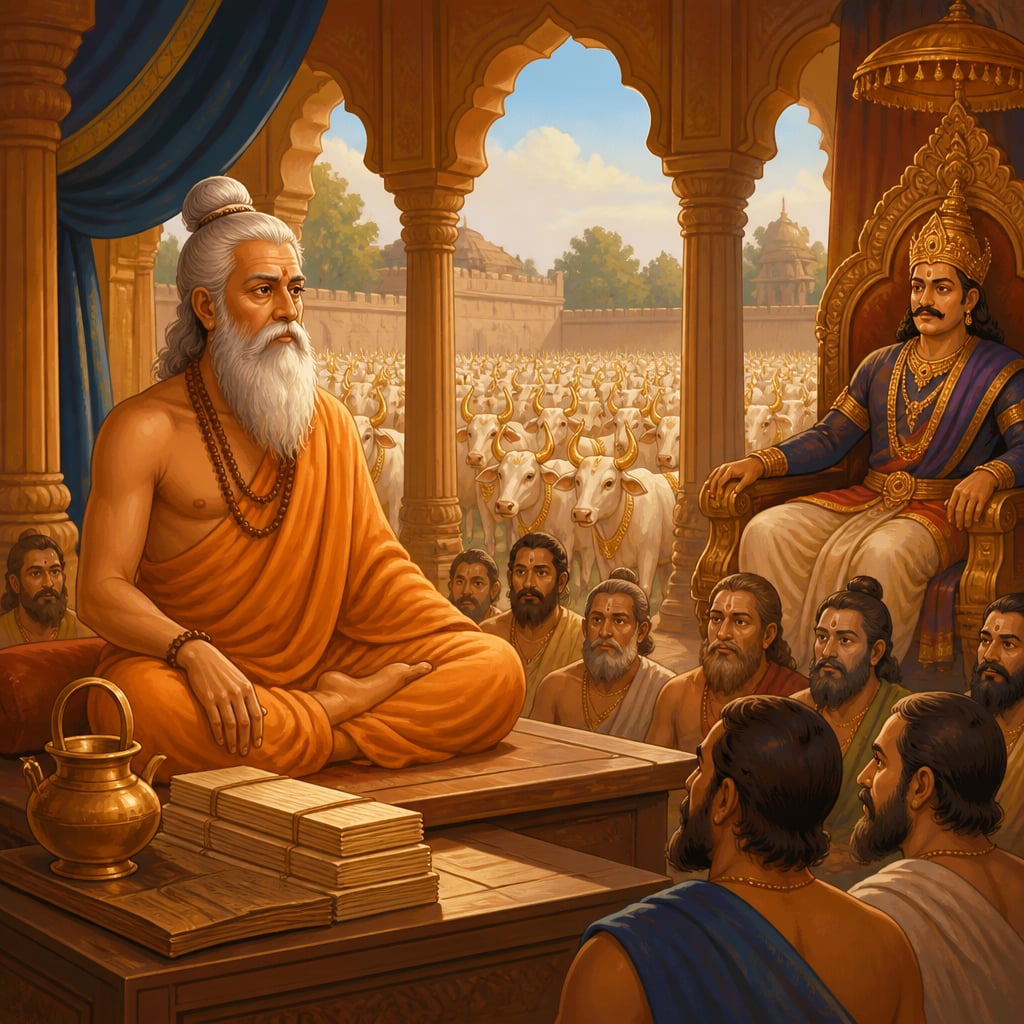
Yajnavalkya in King Janaka's hall at Mithila

Then one man stood up. Yajnavalkya, tall, unhurried, already known as a sage. He turned to his student and said, drive these cows home. Before the student could take a step, the challenges began.

Ashvala, the king's own priest, rose first. Then Artabhaga. Then Bhujyu. Then Ushasta. Then Kahola. Each of them asked a hard question. Each time, Yajnavalkya answered without raising his voice. Each time, the questioner sat back down.
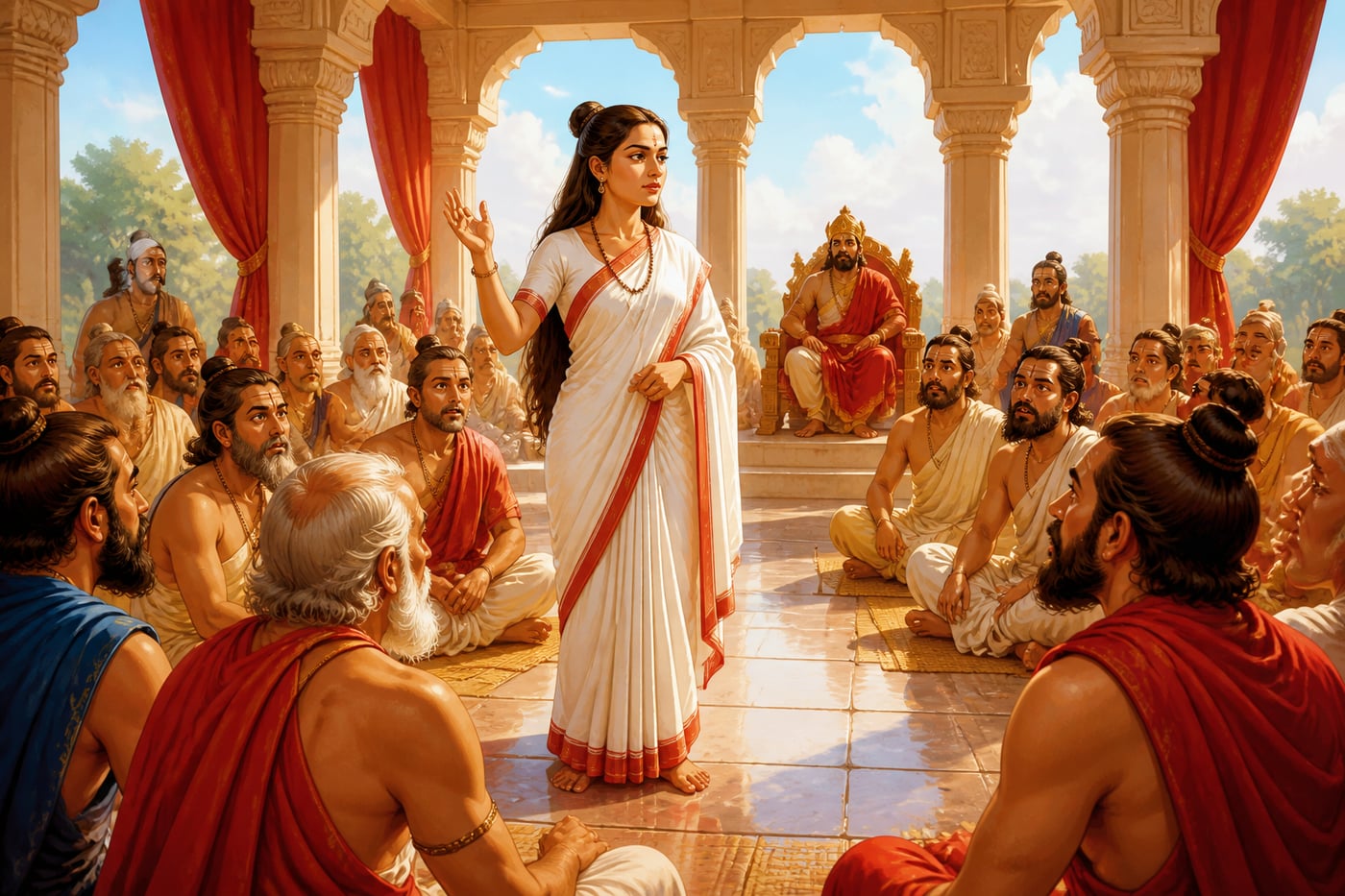
Gargi standing to question Yajnavalkya

Then Gargi Vachaknavi stood up.

She was not there to admire him. She was there to break him.

"Yajnavalkya," she said, "if everything in this world is woven, warp and woof, on water, in what is water woven?"

"In air, Gargi."

"And air?"

"In the atmosphere."

"And the atmosphere?"

She kept climbing. World after world. Yajnavalkya answered each one calmly. Twelve or thirteen rungs up, he finally held up his hand.

"Gargi, do not ask beyond this. Your head will fall off."

The whole court watched. She sat down.

Then she stood up again. She had one more question.

This lesson is about the posture that let Yajnavalkya sit through every one of those challenges without breaking. The Dharmic tradition has a name for that posture. It is a code with three commitments: Satya, Viveka, Sthairya. Truth, discernment, steadiness. The rest of this course will train each one. This lesson names them together, as one instrument.

The First Commitment: Satya

The first thing you notice about Yajnavalkya in that assembly hall is that he does not bluff. He does not pretend to know more than he knows. When Gargi asks him to climb higher than reality allows, he stops her. He tells her the air is too thin up there. This is Satya, and it is the first commitment of the Dharmic debater.

Satya is not only the absence of lies. Satya is the active refusal to say anything your own tools of knowledge cannot support. If you have not seen it, do not claim you have. If you have not reasoned it through, do not defend it as reasoned. If a trusted source did not say it, do not put those words in their mouth.

This is harder than it sounds. In a live debate, the pressure is constant. The audience is watching. The opponent is pressing. There is always a clever line that almost fits. There is always a half-true claim that would close the gap. Satya is the decision to not reach for it.

The opposite of Satya is not one big lie. It is a thousand tiny bluffs. Puffing up a statistic. Rounding a claim. Saying studies show when you only read one study. Saying everyone agrees when only your circle does. Each small bluff is survivable on its own. Stacked, they turn the debater into a performer and the debate into theatre.

Why this matters first. A Vaada is a search for truth. If you lie during the search, there is nothing left to find. The debate becomes Jalpa in that moment. From Lesson 2, remember that the Guna of your intent decides the type of debate you create. The moment Satya slips, Vaada slips with it.

Under pressure, a debater might say The Satya response
So you admit your tradition teaches X? I am not sure that is accurate. Let me state what my tradition actually teaches.
Every serious scholar now agrees with me. I do not know what every serious scholar thinks. Here is what I know.
You have no evidence for that claim. You are right that I have not produced it yet. Here it is.

The Second Commitment: Viveka

If Satya is the refusal to say what you do not know, Viveka is the ability to see what is actually in front of you. In Sanskrit, the root vi-vic means to separate, to sift. Viveka is discernment. It is the power to tell one thing from another in a live situation.

In the assembly hall, Viveka is everywhere. Yajnavalkya sees which questioners are curious and which are hostile. He sees when Ashvala is testing procedure and when Gargi is probing for a break. He sees the exact moment Gargi has climbed past what can be answered, and he names it. He does not treat every question the same. He reads the question, the questioner, and the room.

A debater without Viveka fights every battle with the same weapon. A debater with Viveka picks the right one each time. Sometimes the right move is a direct answer. Sometimes it is a counter-question. Sometimes it is a calm refusal. Sometimes it is silence. Viveka is what tells you which.

Three sorts the Dharmic debater keeps awake at all times:

In the Mahabharata, Vidura is the figure we will keep returning to. Vidura saw through Shakuni's loaded dice long before anyone else in the court. He saw the shape of the crisis while others still saw only the game. He could tell which counsel Dhritarashtra was ready to hear and which he was not. That is Viveka under pressure. It is why we name Vidura as a model and not a myth.

The Third Commitment: Sthairya

Satya and Viveka are useless if you cannot hold them. A debater who knows the truth but panics when attacked loses the truth at the moment it matters. A debater who can read the room but crumbles under a personal insult loses the reading at the same moment. Sthairya is steadiness. It is what lets the first two survive contact with a real opponent.

Yajnavalkya shows Sthairya the way an anchor shows anchoring. Question after question. Challenger after challenger. He does not raise his voice. He does not shorten his answers. He does not look to the king for help. He does not attack the questioners back. When Gargi reaches the limit of what can be said, he names the limit calmly. When she stands up to ask one more, he is ready.

Sthairya is not stone. It is not pretending nothing happened. A stone opponent is brittle. The debater who refuses to feel anything in a hostile debate will either snap or go cold. Sthairya is closer to what the Gita later calls Sthitaprajna: the one whose clarity holds steady while feelings pass through. You feel the insult. You do not become the insult.

In a modern setting, Sthairya looks like this:

J Sai Deepak arguing at the Supreme Court

Sthairya is built, not inherited. It comes from practice, from losing a few debates without losing your composure, from the quiet confidence that the truth you are holding can take a hit and stay standing.

The Code as One Instrument

Take one string away and the instrument collapses.

The three are one instrument with three strings. The code is not a checklist. It is a single trained state you enter before you speak.

The Oath. I will seek truth, not victory. I will see clearly, not react. I will remain steady, not reactive. I debate to protect Dharma, not to feed my ego.

This is the oath you take every time you enter a serious debate. Not once, in a ceremony. Every time. It is a posture before it is a principle.

Modern Echoes

The three-part code is not a museum piece. J. Sai Deepak, arguing in the Supreme Court of India in the Sabarimala review hearings between 2018 and 2020, showed all three in a live courtroom. Months of primary-source reading, so that when the bench pressed him on a textual claim, he could produce the verse and the commentary. That is Satya as preparation. A careful reading of which line of questioning the court was on, so his answers landed on the real doubt, not the decorated one. That is Viveka under cross-examination. And a calm voice, hour after hour, even when the judges interrupted. That is Sthairya under sustained pressure.

Rajiv Malhotra, in Being Different and Breaking India, carries the same three. He represents the Western Indology position rigorously before he responds to it, the Purva Paksha discipline Chapter 2 will name. That is Satya in the steelman. He picks out which of an opponent's claims is load-bearing and which are decoration. That is Viveka in analysis. And he has continued to write and speak across more than two decades of coordinated academic pushback. That is Sthairya as a career posture. You do not have to agree with every conclusion to see the method at work.

The code ships. It works in a Supreme Court. It works in a television panel. It works in a family WhatsApp group. The three strings are the same instrument in each room.

Back in the assembly hall at Mithila, Gargi had one more question. She would now ask about the imperishable, the akshara, the ground on which all the climbed worlds rested. Yajnavalkya would answer. She would sit back down, turn to the assembled brahmins, and tell them that none of them could defeat this man. The cows went home with Yajnavalkya. What stayed behind, in the court and in the text, was the posture. The code this lesson has now named.

Chapter 2 begins next. You have seen why most debates fail and how a Dharmic debater stands. Now you learn to see the skeleton beneath every argument.

Case studies

Yajnavalkya and Gargi in the Court of Janaka

At King Janaka of Videha's great yajna, as recorded in the Brihadaranyaka Upanishad, a thousand cows stood in the assembly hall, each with ten pieces of gold fastened to its horns. Janaka announced the prize would go to the most learned among the gathered brahmins. Yajnavalkya claimed it first. The other scholars responded by challenging him one at a time. Ashvala, Artabhaga, Bhujyu, Ushasta, and Kahola each asked difficult questions. Yajnavalkya answered each one calmly. Then Gargi Vachaknavi, one of the sharpest minds in the assembly, rose to press him further. She asked her famous cascade of questions: in what is water woven, in what is air woven, and so on, climbing world after world, until Yajnavalkya finally told her to go no further or her head would fall off. She sat down, and then stood up again to ask one more question about the imperishable.

Every move Yajnavalkya made in that hall maps onto the three-part code. Satya: he did not bluff a higher rung than the teaching permitted, he named the limit honestly. Viveka: he read each questioner differently, sorting ritual testers from serious probers. Sthairya: same pace, same voice, question after question, even when the most formidable questioner in the court stood up a second time. Gargi's role is equally important. She models the honest adversary. The code is not built for polite disagreements. It is built for the moment somebody stands up again.

Gargi, after her final question, turned to the assembled brahmins and told them plainly that none of them could defeat this man. Yajnavalkya drove the cows home. What stayed behind in the text is not the prize. It is the dialogue itself, preserved for twenty-five centuries as the Dharmic tradition's picture of how a truthful debater actually holds a room.

The three-part code was tested and named in public, in an assembly hall, against a relentless questioner. If it survives Gargi returning to the floor, it will survive a modern panel debate.

The Brihadaranyaka Upanishad, where this episode is recorded, is generally dated to roughly the 7th or 8th century BCE, making Gargi one of the earliest named women philosophers in any surviving human text.

J. Sai Deepak at the Sabarimala Review Hearings

Between 2018 and 2020, the Supreme Court of India heard review petitions in the Sabarimala case, which had challenged the temple's traditional restrictions on entry. Advocate J. Sai Deepak appeared on behalf of one of the intervening parties. He was up against senior lawyers, a bench that interrupted frequently, and a question set that ranged across textual sources, temple custom, constitutional doctrine, and comparative religion. Hearings ran for hours at a stretch, sometimes across multiple days. He had to defend a position that ran against a previous majority judgment of the same court.

The three commitments are visible at ground level. Satya: months of primary-source reading meant that when the bench asked for a verse or a commentary, he could cite it accurately rather than gesture at it. Viveka: he read each line of questioning for what the judges were actually doubting, and tuned his answer to the real doubt, not the decorated one. Sthairya: his pace and tone stayed level across long hearings, including when he was interrupted. The Dharmic debater's code, applied in a modern courtroom, looks exactly like this.

The Sabarimala review hearings did not resolve in 2020. The matter was referred to a larger bench. Whatever the eventual outcome, JSD's oral arguments are now widely circulated as a study in how to argue a tradition-side case in a hostile contemporary forum without losing either rigour or composure. A generation of young Indian advocates has treated them as a case book.

Satya travels on preparation. Viveka travels on attention. Sthairya travels on practice. You can watch all three on video, hour by hour, and see that the Dharmic debater's code is not a historical artifact. It ships to the Supreme Court and holds up.

Reflection

More in Vaada Kshetra: The Battlefield of Words

All lessons in Vaada Kshetra: The Battlefield of Words ยท Vaada Shastra: The Dharmic Art of Debate course