The Spectacle vs The Substance

Why Volume Beats Evidence on Modern Platforms

Social media and prime-time formats reward performance, not truth. Platforms incentivize Vitanda and Jalpa over Vaada. See the machine for what it is before you try to fight it.

The Headlines Came Before the Paper

On the fifth of September 2019, the journal Cell published a paper with a careful title: An Ancient Harappan Genome Lacks Ancestry from Steppe Pastoralists or Iranian Farmers. The lead author was Vasant Shinde of Deccan College in Pune, working with David Reich's lab at Harvard Medical School. The paper had taken seven years of work. It was the first whole-genome sequence ever extracted from a skeleton at Rakhigarhi, the largest known Harappan site, lying on the dry bed of the ancient Saraswati in modern Haryana.

The finding fit in one sentence. The skeleton showed no Steppe ancestry.

That finding mattered, because the Steppe migration of around 1500 BCE has been the central evidentiary leg on which the Aryan Invasion and Migration Theory has rested for more than a hundred and fifty years. If the Harappans did not have Steppe ancestry, the story the textbooks had told for five generations needed rewriting.

Within twenty-four hours, a large share of the Indian press ran its headlines. Many read something like, Study confirms Aryan migration into India. That was the opposite of what the paper said.
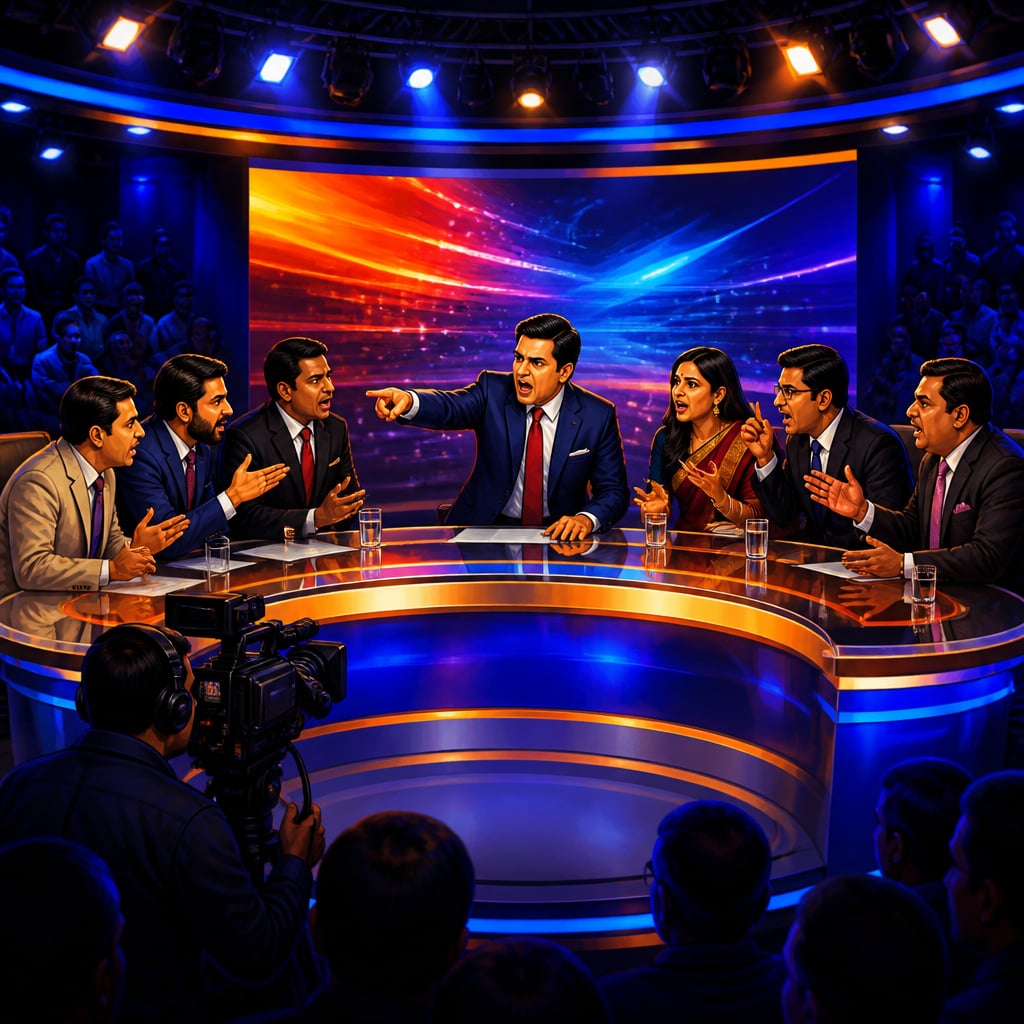
Frenzied modern Indian prime-time news studio with shouting panel

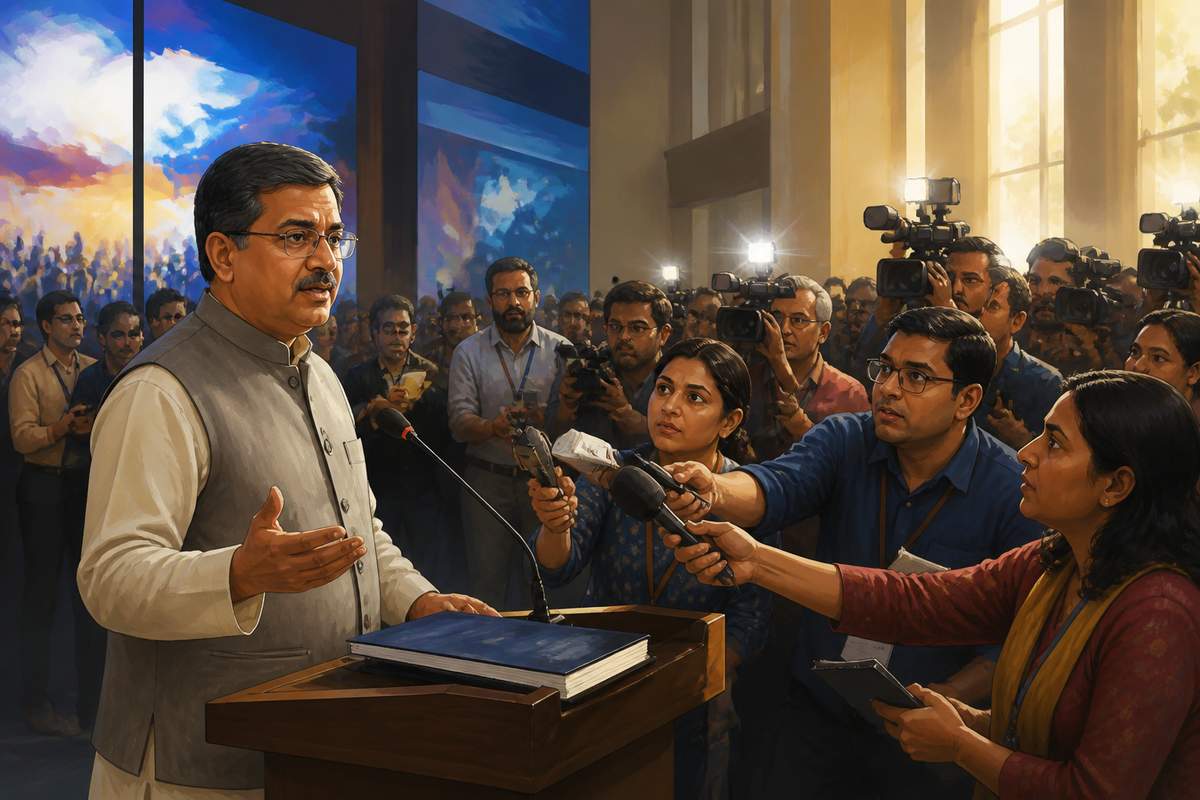
Archaeologist Shinde at the Rakhigarhi press conference

Shinde held a press conference the next day. On the record, in English and in Hindi, he said that the paper did not support an Aryan migration story. He said the Rakhigarhi skeleton's ancestry was indigenous to South Asia. The press conference was covered. The headlines mostly stayed.

This lesson is the fourth layer of the Maya this chapter is peeling. You have already seen the emotional hijack and the word games. This layer is louder than both of them. It is the layer where performance beats substance out loud, in the open, in front of the paper itself. This is Vitanda as spectacle. It is Chapter 3's most civilizationally expensive manipulation.

What a Spectacle Actually Is

Vitanda, in the Nyaya classification, is debate without establishing a counter-position. It attacks, refutes, delays, shouts, and drowns. It does not say, here is my alternative and here is my evidence. The spectacle is Vitanda wearing a good suit.

A modern spectacle has three moving parts.

A debate with all three working against you is not a debate. It is a theatre in which you are the supporting cast.

Why Platforms Reward Vitanda

This is the part that matters for your own behavior online. The reward systems of modern platforms are not neutral. They are engineered to amplify content that keeps users on the platform. Outrage, performance, and conflict keep users on the platform. Careful, evidence-heavy argument does not.

Platform What it structurally favors Why substance struggles
Indian prime-time panels Six to eight guests, 30-second answers, host as participant, maximum decibel No guest can carry a paragraph of evidence in the time slot
Twitter and X Short, high-contrast posts; algorithmic reach weighted to engagement Threads with citations get throttled against outrage replies
YouTube First-mover reaction videos beat later, longer responses A 90-minute rebuttal cannot catch a 10-minute hot take
WhatsApp forwards Emotional image plus short claim plus share button No space for the source, no friction to verify

This is the shape of the battlefield. A Dharmic debater who does not see the shape of the battlefield will keep trying to fight a Shastrartha in a boxing ring.

The AIT Century: How Spectacle Held for 150 Years

The Aryan Invasion Theory is this chapter's anchor story. It is also the longest running demonstration of spectacle beating substance in modern Indian intellectual history.

The theory was constructed in the middle of the nineteenth century by European philologists with almost no archaeological evidence. It was taught as fact in colonial Indian schools. After Independence, it stayed in the textbooks. It shaped an entire century of Indian self-understanding.

The substance side had a lot to say. Satellite imaging showed the dried bed of a mighty river exactly where the Rig Veda had described the Saraswati. Michel Danino, Shrikant Talageri, Subhash Kak, B. B. Lal and others documented the textual and archaeological case for indigenous continuity over decades. The substance was slow, well-sourced, and multi-volume.

The spectacle side had Oxford and Harvard chairs, major publishing imprints, textbook monopolies, and the word consensus. When the substance side published, the spectacle side had two habitual moves. First, call the work nationalist pseudoscience. Second, refuse to cite it in subsequent papers. A citation boycott is a very quiet form of volume.

The 2019 Rakhigarhi paper is a microcosm of the whole century. A careful paper. Seven years of work. A clear finding. A press ecosystem that filed the opposite headline within twenty-four hours. The lead author out-volumed by the headlines he was correcting.

In Lesson 1 of this chapter you saw the honest debater's shock. In Lesson 2 the emotional hijack. In Lesson 3 the word games. Now you are seeing the amplification system itself. In Lesson 5 you will see India's classical Nyaya taxonomy name every move of this hundred-and-fifty-year spectacle with surgical precision.

What the Substance Debater Can Actually Do

A quiet scholar writing paragraph-by-paragraph rebuttal at night

Recognizing the shape of the battlefield is the first move. Here are three more.

Pick your kshetra. Not every platform rewards substance. Chapter 10 will build this out as Kshetra Bodha, battlefield awareness. For now: do not try to win a Shastrartha on a prime-time news panel. Bring substance to long-form writing, to video essays, to podcast conversations, to courtroom filings, to peer-reviewed work. The battlefield where substance can win is the battlefield whose format does not time out against it.

Name the spectacle out loud. Once you name that a show is running on volume, stage, and tempo, its grip loosens. Audiences are not stupid. They often feel the spectacle before they can name it. A debater who calmly says, notice that three assertions were made in thirty seconds and no source was offered for any of them, is doing half the work already.

Do not match the tempo. The spectacle wants you to reply at its speed, because that is the speed at which it wins. A substance debater who answers in two days with a clean, sourced paragraph is often more trusted, over years, than one who answers in ninety seconds with half a citation. The long game is the game substance wins.

Modern Echoes

In 2014, Penguin India agreed to withdraw Wendy Doniger's The Hindus: An Alternative History from the Indian market after a civil case. In the years before the withdrawal, the book had been celebrated as magisterial by the Western press, while Vishal Agarwal had published a detailed, paragraph-by-paragraph rebuttal documenting over one hundred factual and methodological errors. The rebuttal is available. The celebratory reviews are far better known. That is the gap.

In September 2021, a conference titled Dismantling Global Hindutva was co-sponsored online by more than fifty universities. The sponsoring list itself was the spectacle. Indian scholars and diaspora academics who published methodological critiques (the conflation of Hindutva with Hinduism, the selective sourcing, the absence of named respondents from the traditions being discussed) were drowned out by the sheer volume of institutional endorsement. The critiques are public. The volume won that week.

The pattern is the pattern. A substance debater at Rakhigarhi in 2019, a substance debater on the Doniger book through the 2010s, a substance debater on Dismantling Global Hindutva in 2021, all faced the same instrument. A volume-stage-tempo machine against which a careful paragraph cannot win on the day. Substance does win across years. It just does not win on the news cycle.

Back at Rakhigarhi, five years later, Shinde's paper is still the paper. The headlines from that week are already mostly forgotten. Substance, when it is really substance, does outlast spectacle. It outlasts it on a timescale much longer than the news cycle. That is the price of being right in a room that is rewarding something else. In Lesson 5 you will see that the Nyaya Shastra named every move of this spectacle two and a half thousand years ago, and gave you the taxonomy to diagnose it in real time.

Case studies

The AIT Century: How Institutional Spectacle Held for 150 Years

The Aryan Invasion Theory was constructed in the mid-nineteenth century by European philologists, with almost no archaeological evidence. Over the following century and a half, it was taught as settled fact in colonial and then post-independence Indian textbooks. Through this period, the substance side (satellite imaging of the dried Saraswati riverbed, archaeological continuity at Harappan sites, textual analyses of the Rig Veda by Michel Danino, Shrikant Talageri, Subhash Kak, B. B. Lal, and others) produced a steady stream of rigorous, sourced work. The spectacle side held Oxford and Harvard chairs, major publishing imprints, textbook monopolies, and the word consensus. When substance scholars published, spectacle scholars responded in two habitual moves: call the work nationalist pseudoscience, and refuse to cite it in subsequent papers. This is a citation boycott, which is a very quiet form of volume.

The AIT century is Vitanda at civilizational scale. The theory never established a clean positive counter-case to indigenous-origin models; it attacked, redefined, and relabelled. Puspita vak supplied the costume: sweeping language about 'IE migrations' and 'linguistic consensus.' Dambha supplied the authority: chairs, journals, and textbook decisions. The substance side did everything a Dharmic debater is supposed to do, patiently, over decades. It lost in real time, across news cycles and curricula, until the tempo of genetic science finally caught up around 2018 and 2019.

A generation of Indians was raised to doubt the continuity of their own civilization. That is the civilizational cost. The correction is now underway. The 2018 Narasimhan et al. aDNA study, the 2019 Shinde et al. Rakhigarhi paper, and ongoing archaeogenetic work have broken the Steppe-as-source framing that held Indian textbooks for a century. The textbooks themselves are lagging. Spectacle dies slowly.

The substance debater in a spectacle century is not losing because they are wrong. They are losing because the amplification system is built against them. Recognize this, pick your kshetra, outlast the news cycle, and the correction will come. It will just come much later than it should have.

The 2019 Shinde et al. paper in Cell ('An Ancient Harappan Genome Lacks Ancestry from Steppe Pastoralists or Iranian Farmers') found no Steppe ancestry in a Rakhigarhi skeleton. Within 24 hours, many Indian newspapers ran headlines claiming the paper confirmed Aryan migration, which was the opposite of what the paper said.

Platform vs Paragraph-by-Paragraph Rebuttal: Doniger's Hindus

Wendy Doniger's book The Hindus: An Alternative History was published by Penguin in 2009. On release, it was celebrated in the Western press as a magisterial, definitive history of Hindu traditions, boosted by Doniger's University of Chicago chair, the Penguin imprint, and extensive positive reviews in The New York Review of Books, The New York Times, and similar venues. In parallel, the independent scholar Vishal Agarwal published a detailed, paragraph-by-paragraph rebuttal titled A Hindu Critique of The Hindus, documenting more than a hundred factual and methodological errors, including misdated texts, misattributed verses, and systematic mistranslations. The rebuttal ran hundreds of pages and was freely available online. A civil suit filed in Delhi by Dinanath Batra in 2011 led to Penguin India withdrawing the book from the Indian market in 2014 under a settlement.

The Doniger case is spectacle against substance, with a legal intervention disrupting the ordinary run of the machine. The spectacle side had the stage (Chicago, Penguin, NYRB), the volume (dozens of celebratory reviews), and the tempo (reviews landed within weeks of publication). The substance side produced a painstaking, sourced rebuttal of over a hundred specific errors. The rebuttal was available to every reviewer. Almost none of them engaged it on the merits. The existence of a serious scholarly critique was itself mostly not reported.

For years the celebratory reviews defined the public memory of the book. Agarwal's rebuttal circulated in Dharmic and scholarly Indian circles but rarely broke into Western mainstream coverage. The 2014 withdrawal in India shifted the conversation, though much of the Western press framed the withdrawal itself as a free-speech scandal rather than engaging the underlying scholarly critique. The spectacle won the first decade, outright. The paragraph-by-paragraph work exists for anyone who now reads both sides, but most readers still read only the reviews.

A book with a Chicago chair and a Penguin imprint cannot be beaten by a free PDF rebuttal on the day. It can be beaten slowly, by keeping the rebuttal in the record for the next generation of scholars. Do not confuse the day's verdict with the final one. Keep the substance alive.

Dismantling Global Hindutva 2021: Fifty Universities as Stage

In September 2021, a three-day online conference titled Dismantling Global Hindutva was co-sponsored by more than fifty universities, including departments at Harvard, Princeton, Columbia, Stanford, and the University of Chicago. The co-sponsoring list was published prominently as part of the conference's marketing. Indian academics, diaspora scholars, and members of the concerned public published methodological critiques before, during, and after the conference: that it conflated Hindutva with Hinduism without defending the conflation, that its sourcing was selective, that it featured no respondents from the traditions being discussed, and that several named speakers had publicly expressed views that themselves violated the academic-civility norms the conference claimed to uphold. Over a million signatures were submitted on a petition to the co-sponsoring universities objecting to the framing.

DGH is the pure case of stage as argument. The content of the conference was ordinary academic talks. The persuasive weight came almost entirely from the sponsoring list. A reader who saw 'Harvard, Princeton, Columbia, Stanford' next to the title concluded 'this must be serious scholarship' before engaging any specific paper. The substance critics had real arguments. Their arguments were methodological, specific, and sourced. None of this mattered in the week of the conference, because the spectacle's volume dwarfed the content on either side.

The conference ran as planned. No co-sponsoring university withdrew its logo. The academic record of the conference (its papers, its exchanges, its methodological defects) is now what it is. The scholarly critiques are available, published, and will matter to the historiography when the current cycle passes. In the week itself, volume won. In the longer arc, the critiques are what will survive in the record, which is how these things always eventually resolve.

Institutional co-sponsorship is spectacle, not argument. A fifty-logo banner is a strong feeling, not a strong claim. Read the actual papers, the actual methodology, the actual sourcing, and the actual responses. That is where the substance is, whether or not it is currently winning the volume war.

Reflection

More in Maya Vakya: The Illusion Layer

All lessons in Maya Vakya: The Illusion Layer ยท Vaada Shastra: The Dharmic Art of Debate course