The Honest Debater's Shock
When You Realize Truth Is Not the Goal
The moment an honest debater realises the other side is not seeking truth. They are performing. For an audience. For status. For the quiet work of shaping what the next generation will take as settled fact. This lesson opens the chapter's anchor story, the reframing of jati into caste, and names the tradition's word for the discourse that only looks like debate. Anartha.
Goel at His Desk
In a small rented office on Qutab Road in Old Delhi, sometime in 1981, a sixty-year-old publisher named Sita Ram Goel puts down an academic book and sits very still. The monsoon is close. The fan in the ceiling turns slowly. On the desk in front of him is a university-press volume on medieval Indian history, published by a Western academic whose name he has respected for a decade. He has just finished reading the chapter on temple destruction.
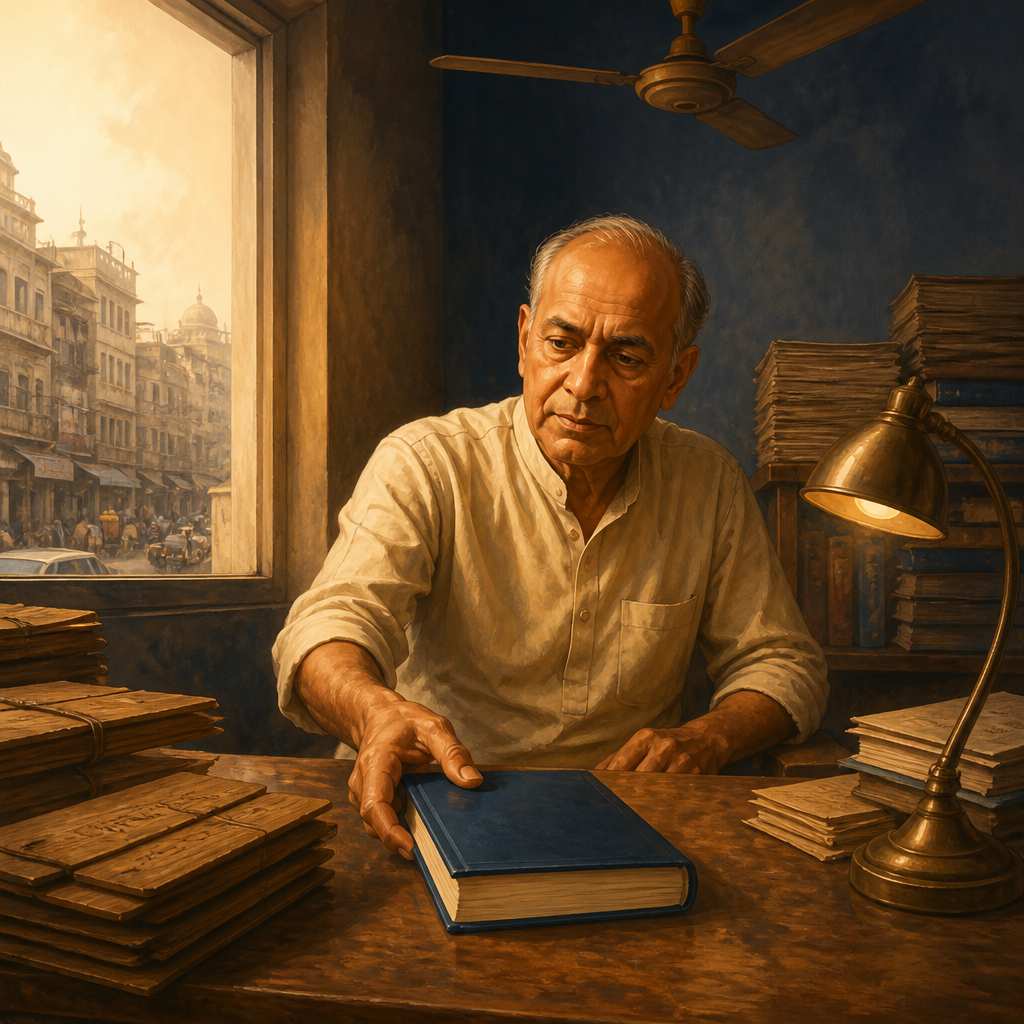
The chapter is not factually wrong. That is not the problem. The problem is subtler. The chapter has done something Goel has not, until this afternoon, fully seen. It has framed the history so that certain questions cannot be asked without the reader seeming to be a partisan. Why were so many temples destroyed. Who wrote the victor's inscriptions, and for whom. What do the Persian chronicles of the invaders themselves say about the numbers. Every one of these questions, the chapter quietly signals, belongs to a fringe. The respectable historian does not raise them. The respectable historian treats the question of motive as closed, and moves on.
Goel has spent twenty years arguing in the mode of Vaada, the truth-seeking debate you met in Chapter 1. He has assumed that if he brought better sources, more careful evidence, and fair engagement with the other side, the field would respond. The field, he now sees, is not set up to respond. It is set up to absorb. His arguments are not being refuted. They are being filed under the category reserved for positions the field does not intend to engage.
He closes the book. Within a year, he will co-found, with his friend Ram Swarup, a small publishing house called Voice of India. It will not be a publishing house. It will be a long, patient response to the afternoon he has just had.
This is the shock that gives the lesson its name.
Anartha: The Tradition's Word for It
Sanskrit has a precise word for the discourse that looks like debate but is not. Anartha. The word is a (not) plus artha (meaning, purpose, substance). An anartha is a thing without real meaning, a motion without substance, a debate that is not a debate. The tradition uses it for speech that wears the costume of argument while serving some other purpose. For performance. For status. For the shaping of what the next generation will take as given.
Most of what an honest debater encounters in public life is anartha. Not all of it. There is still real Vaada, still serious Purva Paksha, still exchange that is open to being changed by the other side. But most of what looks like debate, on television, in peer-reviewed journals, in policy conferences, on social media, is anartha. It has the sentences. It lacks the substance.
The reason this diagnosis matters is practical. If you do not know which kind of exchange you are inside, you will spend yourself, as Goel spent himself for twenty years, arguing in a register the other side has already decided to ignore. The Nyaya tradition would call this wasted Shakti, wasted energy. A Dharmic debater learns, relatively early, to diagnose the room before pouring themselves into it.
The Chapter's Anchor: How Jati Became Caste
The rest of this chapter is an unfolding of a single debate that was not really a debate. It is the reframing of jati into caste.
Before the British census, the Indian subcontinent had thousands of jatis, occupational and kin communities with fluid boundaries, local names, regional particularity, and permission to rise or adjust over generations. The old scriptural category of varna, four broad social orders, existed mostly as a conceptual map. Real Indian society ran on jatis, and jatis ran on what scholars now call contextual hierarchy. A potter was ranked one way near the temple, another way in the bazaar, another way in a famine year. The system was unjust in many places and in many ways. It was also, structurally, not what the British later called caste.

In 1901, the colonial administrator Herbert Hope Risley took charge of the decennial census of India. Risley was an anthropometrist. He believed that human populations could be ranked by physical measurements of the nose, the jaw, the skull. He ordered Indian jatis to be listed, numbered, and fixed on a single all-India scale. The census of 1901 placed every jati into a rigid position, with a single label, one rung on a ladder that had never before been a ladder. The subtle, multi-level, fluid thing became a frozen table.
This is the reframing. The word caste, from the Portuguese casta, already carried European ideas of fixed hereditary rank. The British administrative system fused casta with Indian jati and produced a concept that was neither Indian nor European, but specifically colonial. That concept has been the frame through which India has thought about its own society for a hundred and twenty years.
Indian scholars who argued, at the time and since, that the frame itself was a mistake, were not out-argued. They were marginalised. The shock those scholars felt, over decades, is the same shock Goel felt at his desk in 1981. It is the shock the next four lessons in this chapter will walk you through, layer by layer.
Why the Honest Side Lost
Four reasons. Remember them. They are the reasons honest sides lose most such debates.
- The honest side was arguing inside a frame it did not control. Risley's category had already been accepted as the standard of measurement. Indian scholars who disputed it were accused of defending the indefensible, when they were in fact disputing the measurement.
- The honest side argued facts. The other side argued frameworks. One Indian scholar would produce a careful study of a specific jati's fluid history. The opposing framework would absorb the study as a footnote and proceed as if the broader claim had not been touched.
- The honest side had no institutional home. The framework lived inside universities, textbooks, and government offices. The response lived in pamphlets, private correspondence, and small presses. Over two generations, the infrastructure of reproduction favoured the framework.
- The honest side did not understand it was in Anartha. It kept assuming that one more careful paper, one more conference invitation, one more sincere exchange would turn the conversation. It never did, because the conversation had not been designed to turn.
Look at the list once more. Frame, framework, institution, diagnosis. These are the four places where a Dharmic debater learns to intervene, once they have seen their Goel afternoon. The next four lessons of this chapter are organised around those interventions.
The Shock Has a Gift
The shock is not the end of anything. It is the beginning of a different kind of engagement. Before the shock, the honest debater is exhausting themselves inside a format the other side has chosen. After the shock, the honest debater can, for the first time, choose the format themselves.

Goel founded Voice of India. Koenraad Elst, a Belgian scholar, was quietly frozen out of the Western Indological academy in the 1990s after publishing on Saraswati civilisation and temple destruction. Rather than continue to beg for invitations, he built his own readership. Shashi Tharoor walked into the Oxford Union in 2015, not assuming the room was fair, but making a Purva Paksha-grade case that the room could not ignore. In each case the honest debater's response to Anartha was not more Anartha. It was a shift of ground.
You will learn the specific moves in Chapters 8 and 10. For now, hold just this insight: the shock is information. It tells you that the room you are in is not the room you thought you were in. That information is a gift. It frees you to stop wasting breath on Vaada in a Vitanda room, and to ask, instead, where the room you actually need is, and how to get to it.
Modern Echoes
The sociologist Nicholas Dirks, professor at Columbia, in his 2001 book Castes of Mind, argued that what the twenty-first century calls caste was substantially constructed by the British colonial state, and that the Indian scholarly establishment has, for a century, treated this colonial construct as if it were an uninterrupted traditional reality. Dirks is a Western academic. He is saying, from inside the very field that produced the construct, that the construct is the problem. His book was not welcomed in many of the departments it landed in. It was absorbed and footnoted. Anartha at scale.
The economist Raghuram Rajan has argued, in The Third Pillar, that durable institutions are the ones that protect space for honest disagreement. An institution that absorbs its critics into footnotes and carries on is not a robust institution. It is a brittle one. Rajan was writing about central banks. The same principle applies to academic fields, to newsrooms, to Supreme Court benches. A field that cannot be surprised by its own critics is not alive. It is being maintained.
And Taleb, the Lebanese-American statistician and essayist, has given us the word skin in the game for the missing ingredient in most anartha. When a scholar can build a career on a framework without ever being challenged by someone who can replace them, the framework is free to drift. Purva Paksha is the Dharmic version of skin in the game. You cannot refute me, the Nyaya tradition effectively says, unless you can first represent my position better than I can. The cost of that requirement is what separates Vaada from Anartha. Raise the cost and the room changes.
Back to the Qutab Road Office
In the small office in Old Delhi, Goel has not yet stood up from the desk. The fan is still turning. The book is closed. What he has seen this afternoon he will not unsee. What he will do about it will take him twenty years and a small mountain of printed pages. His shock is the opening door of this chapter. Your own, when it comes, will be the opening door of a different engagement with your own world.
In the next lesson you will learn the first and most common weapon deployed in Anartha, the emotional hijack, and the Yoga Sutra diagnosis of how feeling replaces reason.
Case studies
Sita Ram Goel and the Founding of Voice of India
Sita Ram Goel (1921-2003) was a Delhi publisher who, between the late 1950s and the late 1970s, attempted to engage the Western and Indian academic establishments in straightforward debate on the history of Hindu-Islamic and Hindu-Christian encounter in India. His primary sources were themselves standard, the Persian chronicles of the medieval Sultanates and Mughal courts, the Christian missionary archives. His method was to read the primary sources and quote them at length. His interlocutors, often eminent university professors, did not refute the quotations. They declined to engage. Invitations were not extended. Reviews were not written. Footnotes were not cited. Goel slowly realised that the field was organised to absorb his work without answering it. In 1981, with his friend Ram Swarup, he founded Voice of India, a small imprint that would, over the next twenty-two years, publish more than a hundred primary-source-grounded volumes on Indian religious history.
Goel's twenty-year experience is the paradigm Anartha case in modern Indian intellectual life. In Nyaya terms, he kept attempting Vaada. The field responded with an absence that was, structurally, Anartha. Not Jalpa, because Jalpa requires the opponent to at least argue. Not Vitanda, because Vitanda requires active destruction. The response was a third thing, institutional silence, for which the Nyaya tradition has the word anuttara, the absence of reply. Gautama classes anuttara as one of the twenty-two nigrahasthanas, points of defeat, of the person who cannot answer. But when the silent party is the institution, not the individual, the defeat does not register as defeat. It registers as settled consensus. This is what modern scholars of institutional power now call gatekeeping. The Dharmic debater's diagnosis is older. The cure is also older. Build your own gate.
Voice of India titles are now standard references in Indian nationalist scholarship, cited across the political spectrum, including by some scholars who reject Goel's broader framing but use his archival work. His 1990-91 two-volume Hindu Temples: What Happened to Them remains, whatever one thinks of its conclusions, the most detailed single collation of Persian and Arabic primary sources on the destruction of Indian temples in medieval India. The response to Anartha was durable infrastructure. Twenty years later, the infrastructure is still publishing.
When the institution you are arguing with refuses to engage, do not argue harder. Build a different institution. The response to academic Anartha is not louder academic argument. It is the slow construction of parallel capacity, scholarly, archival, and publishing, that can carry the work across generations. Goel's twenty years were the cost. The library is the return.
Koenraad Elst: A Western Scholar Freezes Out
The Belgian Indologist Koenraad Elst completed his PhD at the Catholic University of Leuven in 1998 on the Aryan Invasion controversy. He was initially welcomed in European Indological circles. In the 1990s he published a series of carefully argued papers challenging the received dating of the Aryan migration, citing evidence from the dried-up Saraswati riverbed and early-1990s satellite imaging. He also published work on the primary-source record of medieval temple destruction. By the early 2000s, he noticed, and later documented in several essays, that he was being quietly removed from the circuits of Western Indological publication and invitation. Journals that had accepted his work stopped. Conference invitations ceased. European publishers moved away. His books continued to appear, almost exclusively, from Indian presses. He was not refuted in print. He was not debated. He was simply absent from the rooms where the field was reproduced.
Elst's experience is the same Anartha pattern as Goel's, with one extra teaching. The pattern is not about the ethnicity or nationality of the debater. It is about the structure of the field. A Belgian trained at Leuven was absorbed and footnoted the same way an Indian scholar in Delhi was absorbed and footnoted, once his arguments moved beyond the field's accepted frame. This rules out the easy reading that the field's silences are simply anti-Indian bias. The silences are framework-protective. Anyone, of any origin, who argues against the framework meets the same response. The Nyaya diagnosis is cleaner than the political one. It is a specific kind of discursive dysfunction, and it operates without regard to the debater's passport.
Elst, like Goel, built his own readership. His books are read across a growing Indic studies ecosystem in India, the US, and Europe. He has been invited to deliver the inaugural lectures of several Indian institutional platforms. His work continues to appear, and continues to be ignored by the Western Indological journals that once reviewed it. The honest debater's response to Anartha was the same as Goel's, a shift of ground, combined with sattvic dhriti over decades.
Anartha is a structural phenomenon, not a tribal one. The test is not who the debater is. The test is whether their argument threatens the framework of the field. A field that silences a Belgian for the same arguments for which it silences an Indian is teaching you something about the field, not about the Belgian or the Indian. Learn to read the structural response. It saves you years of personal grievance.
Shashi Tharoor at the Oxford Union
On 28 May 2015, at the Oxford Union, Shashi Tharoor spoke for the motion that Britain owes reparations to her former colonies. He spoke for fifteen minutes. The speech cited the famine record, the deindustrialisation of Indian textiles, the Bengal drain, the specific per-capita GDP trajectory of British India from 1757 to 1947. Every figure was footnoted. The argument was a textbook Purva Paksha. Tharoor represented the British imperial position more carefully than most British politicians now bother to. Then he refuted it, citing Angus Maddison, Utsa Patnaik, and several British economic historians by name. The speech won the motion with a large majority of the Union's voting members. The recording went viral on YouTube, collecting more than ten million views within a year.
This case is the productive counter-example. Tharoor did not complain that the host civilisation had not examined its own record. He assumed that it had not, and filled the gap himself in fifteen minutes. The Oxford Union is a stage, a platform, an audience, and a mild Anartha risk. Tharoor did not waste shakti on whether the platform would be fair. He brought Vaada-grade preparation into a Jalpa-prone room and overwhelmed the room with the quality of his Purva Paksha. The result was not that he was newly fair-heard. It was that he made the unfair hearing so obvious by contrast that the video itself began to teach the lesson long after he had left the room.
The speech has become a standard teaching clip for Dharmic debaters. It is also, unusually, a success story inside a format that often fails the honest debater. The reason is simple. Tharoor did not expect the format to be fair. He prepared as if it would not be. When the format proved exactly as unprepared as he had expected, his preparation was the difference. The shock had been pre-absorbed. Preparation replaced reaction.
The productive response to anticipated Anartha is not cynicism. It is over-preparation. Assume the format will not be fair. Assume the audience will not have done the reading. Assume the opposing side has not examined its own record. Bring a Purva Paksha so complete that the gap itself becomes the lesson. Tharoor's fifteen minutes at Oxford are what this mode of Dharmic debate looks like when it works.
Economist Utsa Patnaik's peer-reviewed 2018 estimate, cited in Tharoor's speech, places the total wealth transfer from India to Britain between 1765 and 1938 at around 45 trillion US dollars at present-day value. The figure is roughly seventeen times the entire 2023 GDP of the United Kingdom. The debate was not over whether the number is large. It was over whether the audience had been asked the question.
Reflection
- Has there been a moment in your own working life when you realised that the room you were in was not a Vaada room, that your careful arguments were being absorbed without being engaged? What did you do next? Knowing what you know now, what would you do differently?
- Vidura knew Dhritarashtra would not act on his counsel. He kept speaking anyway. Was his speaking wasted? If not, what was the purpose of the speech that he knew would not move the outcome?
- If Anartha is structural, if whole fields can be organised to absorb critics rather than engage them, what responsibility does an honest debater have toward institutions themselves? Is the Dharmic work to reform the institution, to build a new one, or to let the old one die on its own time?