Linguistic Tricks: The Weaponization of Words

Loaded Language, Semantic Shifting, Strategic Ambiguity

Words themselves can be weapons. India's classical logic tradition mapped this terrain 1500 years before George Orwell. The Nyaya Sutras define Chhala (verbal trickery) and break it into three precise sub-types: Vak-Chhala (verbal equivocation), Samanya-Chhala (false generalization), and Upacara-Chhala (literalising a metaphor). Each is in heavy use in modern public discourse: 'secular' for the first, 'caste' for the second, 'Hindutva equals fascism' for the third. The lesson teaches both the diagnosis and the classical counter: Paribhasha, stipulating the definition before defending the position.

The Nine-Blanket Trick

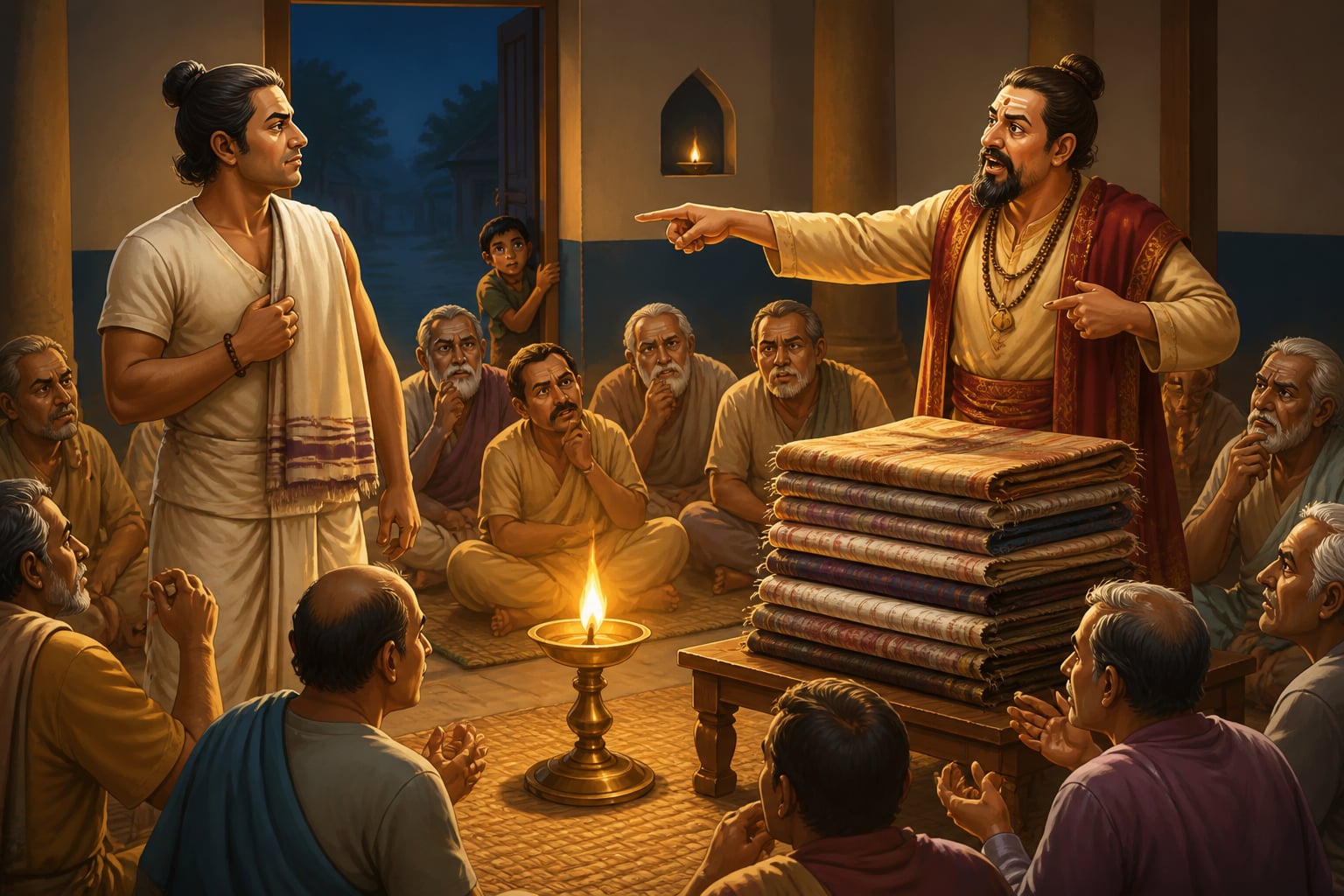
Sometime around the fifth century CE, in a small monastic settlement on the northern Indian plains, the scholar Vatsyayana sat down to write a commentary on Gautama's Nyaya Sutras. He needed an example of the simplest type of word-trickery a debater can pull, and he reached for the smallest household word he could find. Navakambala. "New blanket." A speaker says: "This man has a navakambala." A clever opponent immediately counters: "Nine blankets? But he owns only one. Your claim is false." The Sanskrit word nava means both "new" and "nine." The opponent has just won the round by pretending to mishear.
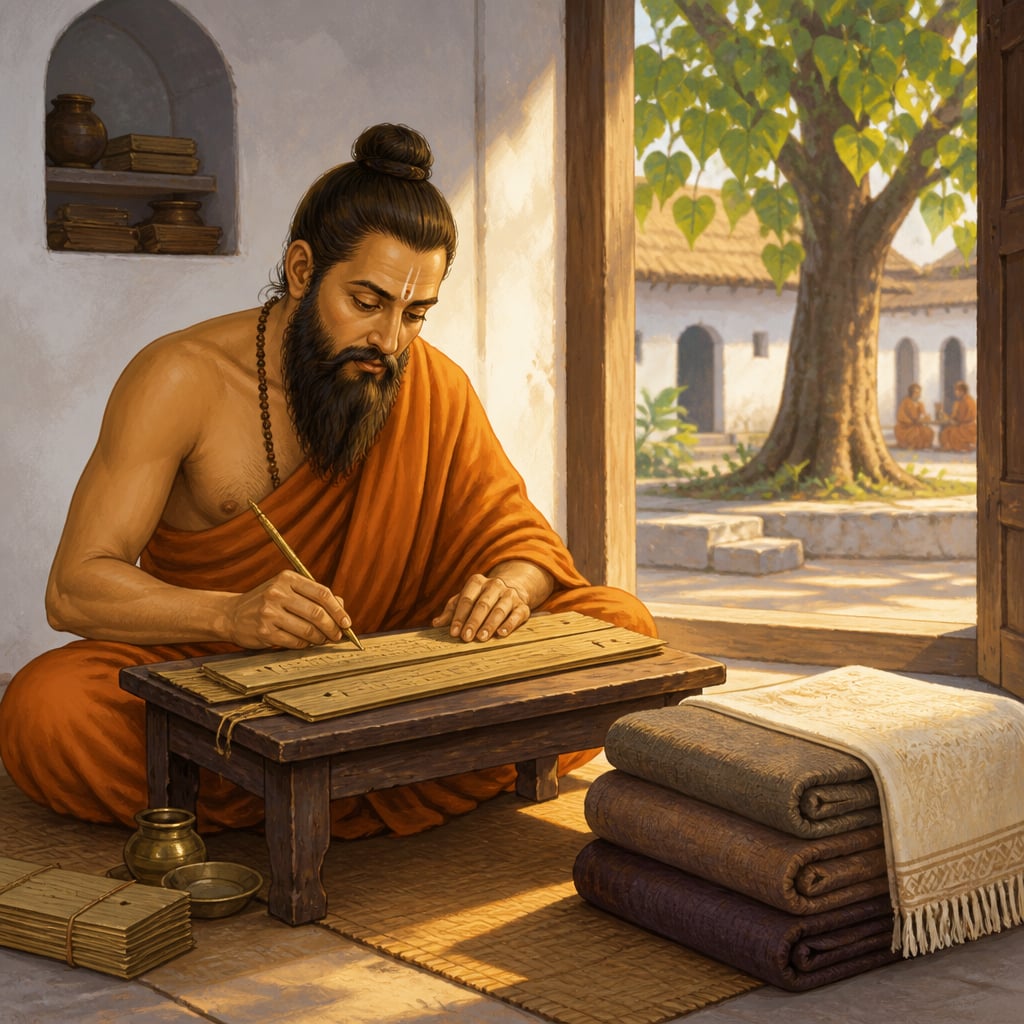
The scholar Vatsyayana writing the nine-blanket example on palm-leaves

The nine-blanket trick playing out in a small sabha hall

Vatsyayana called this Vāk-Chhala, verbal equivocation. The opponent did not refute the actual claim. He shifted the meaning of one word and refuted a different claim that no one had made. The hall laughed. The original speaker fell silent. The audience moved on.

Fifteen centuries later, the trick still works. The vocabulary changed; the move did not. When a TV anchor sorts panellists into "secular" and "communal," or when a column glosses Hindutva as fascism without defining either word, the Chhalavadin from Vatsyayana's example is still in the room. Different blanket, same trick.

What the Nyaya Tradition Mapped

Gautama's Nyaya Sutras, composed by roughly the second century CE, treat Chhala as a precise diagnostic category, not a vague accusation. The tradition's definition reads:

वचनविघातोऽर्थविकल्पोपपत्त्या छलम्।

vacana-vighāto'rtha-vikalpopapattyā chhalam

Chhala is the obstruction of a statement by attributing to it an alternative meaning the speaker did not intend.

Nyaya Sutra 1.2.10

The next sutra divides the move into three sub-types. Each is in active use today.

Bhartrihari composing the Vakyapadiya by a sacred river

The fifth-century language philosopher Bhartrihari, in the Vakyapadiya, pushed the analysis a level deeper. He showed that words carry several layers of meaning at once: the literal sense, the contextual sense, the conventional social sense, and the speaker's intended sense. Chhala works by selecting the wrong layer on purpose. The trick is not random. It is targeted at the specific layer that produces the desired refutation.

Vāk-Chhala Today: 'Secular'

The word secular in English carries a precise European history. It names the separation of church from state, settled in the West by centuries of religious wars. The word arrived in India already loaded with that history.

In 1976, during the Emergency, the Indira Gandhi government inserted the word "secular" into the Preamble of the Indian Constitution through the 42nd Amendment. Parliament was not free at the time; opposition leaders were in jail; there was no real public debate. The word landed in the highest legal text of the country with no agreed Indian meaning attached.

What followed is the textbook Vāk-Chhala outcome. In Indian usage, "secular" came to mean "equidistant from religions." In practice, it has been deployed asymmetrically. State governments administer tens of thousands of Hindu temples through HR&CE departments and route the revenue. The same governments do not administer mosques, churches, or gurudwaras. The Shah Bano case in 1985, the Sabarimala case in 2018, the long-running asymmetry in school funding rules, and the official handling of Waqf properties all show the same pattern. The word secular sits at the centre of each debate. It changes meaning depending on which religious community is being addressed.

This is exactly what Vatsyayana described. Same word. Different meaning per use. Whoever controls the meaning at the moment of decision wins the decision.

Sāmānya-Chhala Today: 'Caste'

The English word caste derives from Portuguese casta, applied to Indian social groups in the sixteenth century. It collapsed three completely distinct Sanskrit concepts into one term: varna (the four-fold civilisational role-grouping in the Vedic literature), jati (the thousands of endogamous community lineages), and asprishyata (the historical practice of untouchability that crystallised in some regions and not others, and which the Indian Constitution explicitly abolished in Article 17).

Three concepts. One English word. The British 1872 census, and especially the 1901 census under Herbert Hope Risley, formalised this collapse as official administrative reality. Risley constructed an elaborate racialised hierarchy ranking thousands of jatis. The categories were imposed; the data were collected; the word caste settled into law and curriculum.

The Sāmānya-Chhala move is now perpetual. Any speaker can switch between varna, jati, and asprishyata depending on which produces the most damaging conclusion. "Hinduism is casteist" can mean "the Vedic varna scheme exists" (a textual fact about role-grouping in classical literature), or "jatis are endogamous" (true of nearly every traditional society on earth, including European ones until recently), or "asprishyata was practised" (a real wound with its own regional history, fought against from inside the Hindu tradition by Basaveshwara, Ramanuja, the Bhakti saints, and constitutionally abolished). The word collapses the three into one. The argument is then defended at whichever level is hardest to refute, even though the original claim was made at a different level.

The classical counter is Paribhāṣā: stipulate the definition before engaging. Ask the speaker: when you say "caste," do you mean varna, jati, or asprishyata? Each is a different conversation. Most speakers cannot answer cleanly. The Chhala depends on never having to answer.

Upacāra-Chhala Today: 'Hindutva = Fascism'

The third type, Upacāra-Chhala, exploits metaphors. A specific recent case is the academic and journalistic equivocation of Hindutva with European fascism.

Wendy Doniger's 2009 book The Hindus: An Alternative History, Christophe Jaffrelot's series of works on Hindu nationalism, and Audrey Truschke's body of public commentary all draw the rhetorical comparison repeatedly, sometimes explicitly, more often by accumulation of vocabulary borrowed from 1930s Europe ("chauvinism," "majoritarianism," "ethno-nationalism," "the project," "the cadre," "the saffron wave"). The vocabulary of one historical movement is metaphorically transferred to another. The metaphor is then asserted as identity.

The Upacāra-Chhala test is simple. Strip the borrowed vocabulary. Ask: what is the actual doctrinal content of Hindutva, in its own primary texts? V. D. Savarkar's 1923 Hindutva: Who is a Hindu? is the foundational document. Read it. Compare its actual claims about citizenship, civilisational identity, and the relationship between religion and territory to the actual doctrines of Italian Fascism (Mussolini's La Dottrina del Fascismo, 1932) or German National Socialism (Hitler's Mein Kampf, 1925, and Rosenberg's Myth of the Twentieth Century, 1930). The metaphors do not survive the comparison. The texts are not similar; the histories are not similar; the institutional structures are not similar.

Note what is being said and not said. This is not a defence of any particular reading of Savarkar. It is a defence of the discipline. Whatever one thinks of Hindutva, the discipline of Vaada requires that it be evaluated on its own primary texts, not through metaphors imported from another continent's history. Upacāra-Chhala is the trick of letting the metaphor decide the verdict.

How to Counter Chhala (Three Moves)

The Nyaya tradition's counter is structural, not improvised.

  1. Define before you defend. When a hot word enters the conversation, stop and stipulate the definition. "When you say secular, do you mean separation of religion and state, or equidistance from religions, or non-participation by religious bodies in public life? Each is a different debate." This is Paribhāṣā in action. Most Chhala collapses the moment the speaker is forced to pick one definition and stay with it.

  2. Restate the speaker's claim in the speaker's own words. Before responding to anything, repeat back the original claim using the speaker's exact phrasing. If the speaker did not actually say what is being attributed to them, this is the moment that becomes visible to the audience.

  3. Refuse to defend a position you did not take. When an opponent attributes an absurd universal claim to you ("so all brahmins are X," "so all Hindus believe Y"), do not defend the universal. Restate your actual particular claim and force the opponent to address that one.

These three moves were taught in the classical Nyaya curriculum as standard discipline. They still work.

Modern Echoes

George Orwell's 1946 essay Politics and the English Language identified roughly the same problem in mid-twentieth-century English political prose. Stuart Chase's The Tyranny of Words (1938) had named it earlier. Both books are excellent. Neither maps the territory as precisely as Gautama and Vatsyayana did fifteen hundred years before either of them was born. The Nyaya distinction between Vāk-, Sāmānya-, and Upacāra-Chhala is more granular than Orwell's general warning, and far more granular than the modern Western fallacy lists, which usually lump all three under the single label "equivocation" without distinguishing the types.

Modern academic linguistics has rediscovered the underlying mechanism in concepts like "polysemy," George Lakoff's "frame semantics," and W. B. Gallie's 1956 notion of "essentially contested concepts." The mechanisms are real. The discipline of countering them is older than any of those names.

Back to the Blanket

The man with the new blanket lost the round. He had no defence prepared because he did not know there was a trick to be defended against. Once you know the three Chhalas, you cannot un-see them. The next lesson moves from words to performance: how social media platforms reward the spectacle that swamps the substance, and how the same Vatsyayana checklist scales from one debate hall to a billion smartphones.

Case studies

'Secular' in Indian Discourse: A Word with No Agreed Meaning

On 18 December 1976, during the Emergency declared by Prime Minister Indira Gandhi, the Indian Parliament passed the 42nd Constitutional Amendment. Among many other changes, it inserted the word 'secular' into the Preamble of the Constitution, between 'sovereign' and 'democratic'. Opposition leaders including Atal Bihari Vajpayee, Jayaprakash Narayan, and Morarji Desai were in jail or under restriction. There was no real public debate. The word landed in the highest legal text of the country with no Indian-context definition attached. Five decades later, the word still has no settled Indian meaning. In the 1985 Shah Bano case, 'secular' was invoked to justify a religion-specific carve-out from a uniform civil code. In the 2018 Sabarimala judgment, it was invoked to justify state intervention in the religious affairs of one community. State HR&CE departments administer tens of thousands of Hindu temples and direct their revenues, while constitutionally protected autonomy is maintained for the institutions of other religions, all under the same word.

This is Vāk-Chhala at constitutional scale. Gautama's Nyaya Sutra 1.2.10 names the move precisely: a statement is obstructed by attributing to it an alternative meaning the speaker did not intend. The 'secular' debate runs identically. A speaker invokes 'secular' meaning equidistance; the next speaker invokes 'secular' meaning state non-interference; a third invokes 'secular' meaning state-led religious reform of one community alone. Each move uses the same word for a different concept. The classical counter, Paribhāṣā, would force a fixed definition before any constitutional argument proceeded. Indian public discourse has never enforced that discipline on this word.

Five decades after the insertion, 'secular' has become one of the most contested words in Indian political vocabulary. Court judgments, election speeches, op-eds, and academic monographs use it with mutually incompatible meanings, often within the same text. The asymmetric outcomes (state administration of one community's religious institutions and not others) have produced repeated litigation, but the underlying linguistic Chhala has not been addressed. The Vatsyayana checklist would have caught it in 1976 and it would catch it now.

When a contested word is inserted into a foundational text without public debate or stipulated definition, every subsequent argument involving that word is structurally vulnerable to Vāk-Chhala. The first repair is not new legislation; it is a clean public Paribhāṣā exercise. Pin the word. Force the speaker to pick one of the available definitions and defend it consistently.

The 42nd Amendment Act, 1976, made approximately 59 changes to the Constitution and is the most extensive single amendment in Indian constitutional history. Of these, the insertion of 'secular' and 'socialist' into the Preamble has been the most contested in subsequent jurisprudence, as documented in the Supreme Court's own Kesavananda Bharati to Minerva Mills line of cases.

'Caste' as a Single Word for Three Distinct Concepts

When Portuguese traders arrived on the western coast of India in the early 1500s, they encountered a complex social order they did not understand and had no vocabulary for. They reached for the Portuguese word 'casta', meaning 'breed' or 'race', and applied it indiscriminately to whatever Indian social grouping was in front of them. The word entered English as 'caste' and slowly absorbed three distinct Sanskrit concepts: varna (the four-fold civilisational role-grouping in the Vedic literature), jati (the thousands of endogamous community lineages), and asprishyata (the historical practice of untouchability that crystallised in some regions and was opposed from inside the Hindu tradition by Basaveshwara, Ramanuja, the Bhakti saints, and was constitutionally abolished in 1950 by Article 17). The British 1872 census formalised the collapse for administrative purposes. The 1901 census under Herbert Hope Risley turned it into an elaborate racialised hierarchy ranking thousands of jatis. The word 'caste' settled into law, school curricula, international academic vocabulary, and every subsequent debate.

This is Sāmānya-Chhala at civilisational scale. The Nyaya Sutra 1.2.13 specifies the move: take a statement made about a particular and treat it as if it were made about a universal, then refute the universal. Now do the inverse with a single English word. 'Hindu society is casteist' can mean any of three things: that varna is described in the Vedic literature (textual fact about role-grouping), that jatis are endogamous (true of nearly every traditional society on earth), or that asprishyata was practised (a real wound with regional history and constitutional remedy). The single word lets the speaker switch among the three depending on which is hardest to refute. The discipline of Vaada requires Paribhāṣā: which of the three are we discussing? The answer should change the entire debate. It rarely does, because the Chhala depends on the question never being asked.

More than a century after Risley's 1901 census, the single English word 'caste' continues to do the work that three precise Sanskrit terms once distinguished. International academic vocabulary, NGO reports, foreign-policy briefings, and even Indian Supreme Court judgments treat the three as one. The cost is that genuine reform of asprishyata (a constitutional and moral imperative) gets entangled in arguments about varna (a textual matter) and jati (a sociological matter), with each side treating the other as evading. The Sāmānya-Chhala is the engine of the entanglement.

When a single word collapses three concepts, every debate using that word is structurally vulnerable. The repair is not to defend or attack the word in the abstract; it is to insist on Paribhāṣā in every conversation that uses it. Ask the speaker: are you addressing varna, jati, or asprishyata? Each is a distinct conversation with a distinct evidentiary basis. The collapse is the trick.

The 1901 census under Risley attempted to rank approximately 2,378 jatis along a racialised hierarchy using the 'nasal index' as a primary measure. The classifications it produced shaped Indian official categorisation for the next half century and are still cited in academic literature, despite the underlying methodology having been comprehensively repudiated by twentieth-century anthropology.

'Hindutva equals Fascism': Borrowed Vocabulary as Argument

Across a body of academic work published since the late 1990s, the comparison between Hindutva (as a 20th-century Indian political philosophy with V. D. Savarkar's 1923 Hindutva: Who is a Hindu? as its foundational text) and European fascism (a distinct 20th-century European political phenomenon with Mussolini's 1932 Doctrine of Fascism and Hitler's 1925 Mein Kampf as its foundational texts) has become a near-default rhetorical move. The comparison appears in Wendy Doniger's 2009 The Hindus: An Alternative History, in Christophe Jaffrelot's series of monographs on Hindu nationalism, in Audrey Truschke's body of public commentary, and in a steady stream of opinion pieces in Western and Indian English-language media. The comparison is usually not argued as a doctrinal claim about parallel ideologies. It is more often performed through the accumulation of vocabulary borrowed from the fascist context: 'chauvinism', 'majoritarianism', 'ethno-nationalism', 'the project', 'the cadre', 'the saffron wave', 'the Sangh Parivar as a fascist front'. The metaphor is built up by repetition until it acquires the texture of a literal identity.

This is Upacāra-Chhala in its purest modern academic form. The Nyaya Sutra 1.2.14 names the move: take a statement made figuratively and treat it as if it were literal, then refute the literal. Modern Hindu studies has done the inverse with the same mechanism: import a metaphor from one historical context, repeat it until the metaphor reads as identity, then proceed as if the identity is established and the burden of proof is on whoever questions it. The classical counter: strip the borrowed vocabulary and require comparison at the level of primary texts. Compare Savarkar's Hindutva (1923), Golwalkar's Bunch of Thoughts (1966), and the RSS shakha curriculum to Mussolini's Doctrine of Fascism (1932) and Hitler's Mein Kampf (1925). Once the texts are placed side by side, the metaphor visibly fails: the doctrines, the institutional structures, the concepts of race and citizenship, and the relationship between religion and state are not analogous.

The comparison has nonetheless succeeded as a rhetorical frame in significant sections of Western academia and Indian English-language media. Once the frame is set, every subsequent discussion takes place inside it; questioning the frame itself is then characterised as defending fascism. This is the sealing move that makes Upacāra-Chhala self-protecting. The discipline of Vaada is to refuse the sealing: insist on the primary-text comparison, do not engage on the metaphor's terms, and let the texts settle the question.

When a comparison is built by accumulated vocabulary rather than by primary-text analysis, the comparison is doing the argument that the analysis was supposed to do. The counter is to require the comparison at its strongest: pull the foundational texts of both terms of the comparison into the same room, place them side by side, and read them. Most Upacāra-Chhala does not survive that test. The ones that do survive are not Chhala anymore; they are real arguments worth engaging.

Savarkar's Hindutva: Who is a Hindu? was originally written in 1923 in Ratnagiri Jail under the title Essentials of Hindutva. Its foundational definition of a Hindu (as one for whom the territory between the Indus and the seas is both pitribhumi, fatherland, and punyabhumi, holy land) is a territorial-civilisational definition with no direct counterpart in the racial doctrines of European fascism, which centred on biological lineage and explicit racial hierarchy.

Reflection

More in Maya Vakya: The Illusion Layer

All lessons in Maya Vakya: The Illusion Layer · Vaada Shastra: The Dharmic Art of Debate course