Emotional Weaponization: Feelings Replace Facts

How Outrage, Pity, and Shame Hijack Reason

How emotion hijacks reason. Outrage. Shame. Pity. Fear. Patanjali's Yoga Sutras named these as Kleshas, the mental afflictions that cloud judgment, twenty-three centuries before behavioural economics rediscovered the same effect. The Vaadin's discipline is to acknowledge the feeling and return to the mechanism.

The Brother Who Was Made A Traitor

The court of Lanka was full. Ravana on the throne. Indrajit at his right hand. Kumbhakarna sleeping somewhere far below. Mahodara, Mahaparshva, and the senior rakshasa generals in their seats. The rumour from the south was now official. A monkey had crossed the ocean, set fire to half the city, and returned. A human prince was building a bridge. The army of Kishkindha was gathering on the far shore.

Vibhishana rose to speak.

He was the youngest of Ravana's three brothers. He was a rakshasa by birth and a dharma-knower by long practice. He spoke carefully. He named what had happened: Sita had been taken by force. The taking was adharma. The path to safety was return: send Sita back to Rama, accept the king's apology, save the city. He cited shastra. He cited statecraft. He cited the omens that had attended Hanuman's escape. He spoke without raising his voice.

The court did not engage a single argument he made.
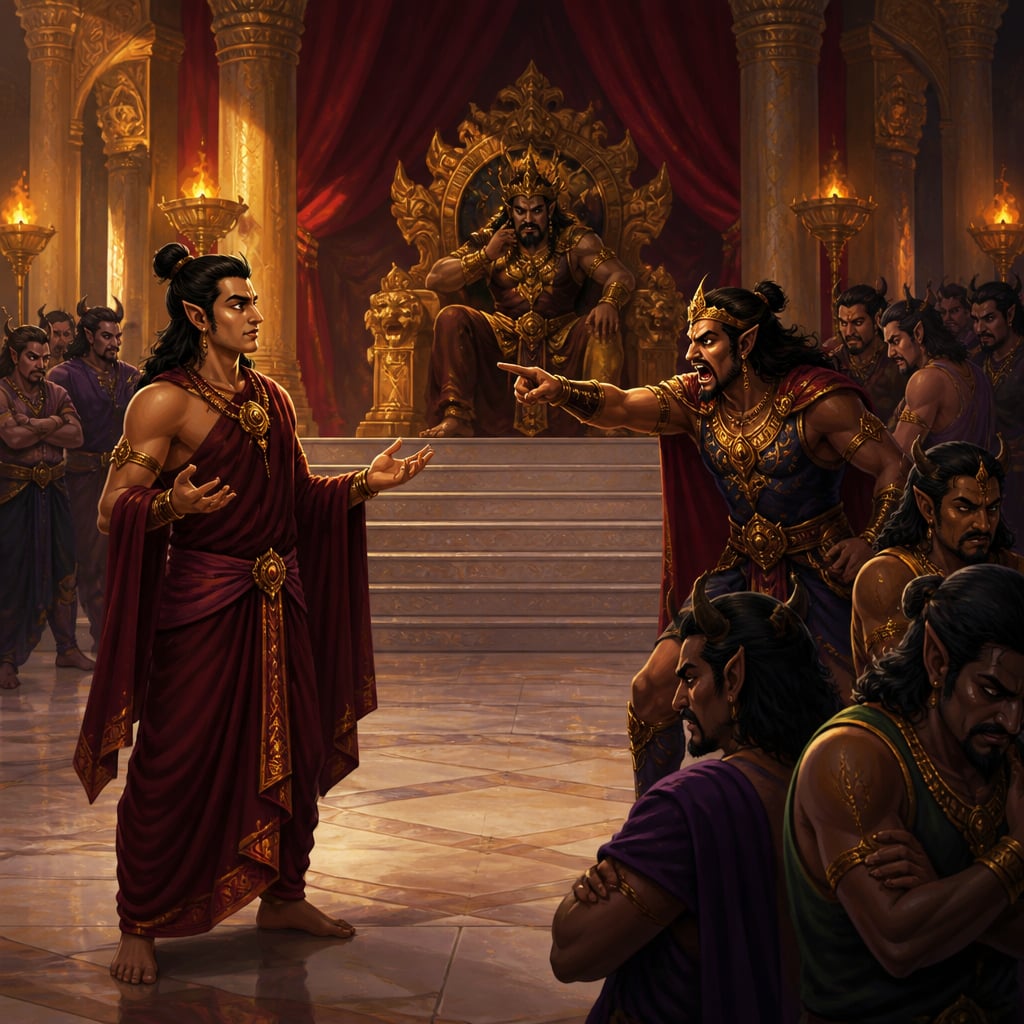
Vibhishana standing in the Lanka court being shouted down by Indrajit

Indrajit answered first. "You speak for the enemy. You wear our blood and serve their cause. There is a name for what you are." The rest of the court took up the line. "Traitor." "Bhaya-bhīta" (frightened by fear). "Speaking for monkeys against your own." The shastra Vibhishana had cited was never addressed. The omens were never discussed. The path of return was never weighed. He had been moved off the field of debate and onto a different field, the field of his own honour, before he could finish his second sentence.

He stood for a moment longer. Then he walked out of his brother's hall, crossed the ocean, and presented himself at Rama's camp. The dharma he had spoken in Lanka had not been refuted. It had been made socially impossible to hold. The court had used a weapon older than the sword.

This lesson is about that weapon.

What Patanjali Saw

Patanjali composing the Yoga Sutras under a banyan tree

The sage Patanjali, somewhere between the second century BCE and the second century CE, sat down to compile the Yoga Sutras. In the second pada, the section on practice, he opened with a list of five.

अविद्यास्मितारागद्वेषाभिनिवेशाः क्लेशाः॥

avidyā-asmitā-rāga-dveṣa-abhiniveśāḥ kleśāḥ

Misperception, ego, attachment, aversion, and clinging to life: these are the five kleshas.

Yoga Sutra 2.3

A klesha is a mental affliction that distorts perception before perception reaches the reasoning mind. The klesha is upstream of the thought. By the time you have a thought, the klesha has already coloured what you saw. Patanjali named five and ranked them. Avidya (misperception) is the root. Asmita (ego, the I-sense) is the first fruit. Raga (attachment, attraction) and Dvesha (aversion, repulsion) are the two great engines that follow. Abhinivesha (clinging to life, the fear of ending) is the deepest and the last to leave.

For the Vaadin, the two that matter most in real-time discourse are Raga and Dvesha. They are the two levers any emotional weapon pulls. Outrage, shame, pity, and fear are not separate weapons. They are different positions of the same two levers. Whoever knows the levers can name the weapon. Whoever can name the weapon can disarm it.

Raga And Dvesha: The Two Levers

Patanjali defines the two engines in two short sutras.

Every emotional weapon ever deployed in debate is a tool that pulls one of these two levers in your audience. Pull Raga and the audience clings to your side. Pull Dvesha and the audience pushes the other side away. Either way, the audience has stopped weighing the evidence. The emotional weapon's whole purpose is to skip the weighing step.

In the Lanka court, the lever pulled against Vibhishana was Dvesha. Indrajit did not argue dharma. He named Vibhishana as something the court should push away. Traitor. The word did its work. The argument was never engaged because the speaker had already been made repulsive.

The Four Common Forms

The Klesha levers show up most often in four named shapes. Each pulls Raga or Dvesha in the audience and bypasses reasoning in the speaker.

Form Lever What it does
Outrage Dvesha against the other side Anger replaces analysis. The opponent is now the enemy.
Shame Dvesha against you, the speaker You are made socially repulsive. Your argument cannot be heard while the shame holds.
Pity Raga toward a sympathetic figure The audience clings to a victim. The systemic question dissolves into the individual story.
Fear Dvesha against an imagined future A worse outcome is dangled. Any move except the speaker's preferred one becomes risky.

Outrage is the easiest to spot because it is the loudest. "How dare they." "This is unacceptable." "There must be consequences." The volume is the tell. A reasoned argument does not need volume. An outrage performance needs nothing else.

Shame is the most effective inside groups. The shame attack does not refute your position. It makes your position socially expensive to hold. Vibhishana was not refuted in Lanka. He was made into a kind of person his own court would not associate with. Once that work was done, his arguments were unheard regardless of their merit.

Pity is the most subtle of the four because it operates through compassion, which is itself a virtue. A genuinely sympathetic story is held up. Any analytical question about the larger pattern feels cruel against the specific suffering. The Vaadin who asks the analytical question is recast as cold-hearted. The pity has done its work.

Fear is the most strategic. It is rarely loud. It is delivered as concerned warning. "If you do not agree to this, X will happen." X is usually large, distant, and difficult to verify. The audience cannot weigh the threat against the present cost because the threat is being held just out of reach. Risk-aversion does the rest.

The Vaadin's Defence: Acknowledge, Then Return

The untrained debater meets emotion with one of two reflexes. They either match the emotion (outrage with outrage, shame with counter-shame) and the room descends. Or they dismiss the emotion ("calm down", "don't be hysterical") and the room descends faster, because the dismissal is itself an attack.

The Vaadin does neither. The Vaadin acknowledges the feeling and returns to the mechanism.

"I hear that this is frightening. Let us still look at what the evidence actually shows." "The shame is real. The argument under it deserves a separate hearing." "The story you have shared is genuinely sad. The policy question it raises is whether other approaches would produce more or fewer such stories." The pattern is the same in each case. Acknowledge the klesha. Do not match it. Do not dismiss it. Return to the question the klesha was deployed to suppress.

Krishna in the Bhagavad Gita names the inner state that makes this possible. The sthitaprajna, the one of steady wisdom, is vita-rāga-bhaya-krodhaḥ, gone beyond attachment, fear, and anger. The Vaadin does not need to be a sthitaprajna in full. The Vaadin needs only enough steadiness to notice the lever being pulled before it pulls them. The notice is the whole defence.

Modern Echoes

In September 2019 a sixteen-year-old named Greta Thunberg stood at the United Nations Climate Action Summit and delivered four minutes of structured outrage. "How dare you." The phrase was repeated. World leaders were named as thieves of childhoods. The speech was extraordinary as performance. As an instrument of debate it was pure Dvesha-deployment. Specific policy questions about energy mix, nuclear power, carbon pricing, and intermittent renewables became impossible to ask in the weeks that followed without being recast as defenders of stolen futures. The lever did its work. It always does.

In January 2023 the BBC released a documentary on the 2002 Gujarat riots that effectively re-litigated whether the then-Chief Minister, by then the Prime Minister, was complicit. The Supreme Court-monitored Special Investigation Team had cleared him in 2012. The Supreme Court itself had upheld that clearance in 2022. After the documentary aired, anyone who pointed to those judicial findings in public conversation was framed as defending the original violence. The shame attack was structured. Any defense of due process was treated as moral complicity. The judicial record, which is the actual evidentiary basis on which a serious person would form a view, became unspeakable in many institutional rooms. The lever did the work the documentary by itself could not.

Vibhishana flying across the strait to the Indian mainland

Back in the court of Lanka, Vibhishana made it across the strait. Rama received him, granted him refuge, and after the war crowned him king of the city he had been forced to leave. The dharma he had tried to speak inside Ravana's hall was vindicated by the war's outcome rather than by the court's reasoning. The court had refused the argument. The world delivered the verdict the court would not. The price was the city itself. Lanka burned because a single brother could not say in his own hall what he could only say in the enemy's camp. The cost of letting Dvesha do the court's thinking was paid in ash.

Case studies

Vibhishana Shamed Out Of His Own Court

In the Yuddha Kanda of the Ramayana, with Hanuman's burning of Lanka still fresh and Rama's bridge under construction, Vibhishana rose in his brother Ravana's full court to advise the only path that could save the city: return Sita, accept the wrong, end the war before it began. He spoke carefully. He cited shastra on the rights of women. He cited the omens that had attended Hanuman's escape. He cited the long-term cost of breaking dharma even when the immediate gain seemed worth it. He named Sita as another man's wife, taken by force, and offered no euphemism for the act. The court did not engage a single one of his arguments. Indrajit answered first by naming Vibhishana a traitor. The senior generals took up the line. The shame attack was structured: Vibhishana was speaking for the enemy, breaking with his own blood, frightened of monkeys. By the second exchange, his arguments were unhearable inside the room. He left, crossed the strait, and presented himself at Rama's camp.

The court of Lanka deployed the textbook shame attack on the textbook target. The lever pulled was Dvesha. The court did not have a counter-argument to Vibhishana's case. It did not need one. By making Vibhishana himself socially repulsive, it removed the case from consideration without ever addressing it. The Klesha chain Krishna names in BG 2.62-63 played out inside Ravana in real time: attachment to Sita produced the desire to keep her, the desire produced anger at any voice suggesting otherwise, the anger produced sammoha (delusion), the delusion produced loss of memory of his own better counsel, and the buddhi that should have weighed Vibhishana's argument was gone before the brother had finished speaking.

Vibhishana joined Rama, was crowned king of Lanka after the war, and ruled the city his brother had refused to save. The dharma he had spoken inside the hall was not refuted, only made socially impossible. The world delivered the verdict the court would not: every argument Vibhishana made was vindicated by the war's outcome. The price of letting Dvesha do the court's thinking was the city itself.

When a room cannot answer your argument and resorts to making you repulsive instead, the room has confessed by its choice of weapon that it has no counter-argument. The shame is the confession. The Vaadin who recognizes this in time can either name the attack or leave the room with the argument intact.

In the Valmiki Ramayana, Vibhishana's advisory speech to Ravana spans roughly 30 verses across Yuddha Kanda chapters 14-16. The court's response engages zero of his shastra citations directly. Every reply is a variant of personal attack on the speaker. The data point is the asymmetry itself: an argument and a shame attack are not the same kind of thing, and the count of one against the other is the giveaway.

Greta Thunberg's 'How Dare You?' Speech (UN, 2019)

On 23 September 2019, at the United Nations Climate Action Summit in New York, the sixteen-year-old Swedish activist Greta Thunberg delivered a four-minute address. The speech was structured around a single phrase, repeated four times: 'How dare you.' She named world leaders as having stolen her dreams and her childhood with their empty words. She did not engage any specific policy lever (carbon pricing, nuclear deployment, intermittent renewables, energy mix transitions, the role of natural gas as a bridge fuel). She delivered four minutes of structured outrage. The footage went global within hours. In the weeks that followed, mainstream coverage of climate policy across most Western media outlets shifted toward moral framing and away from technical-policy framing. Asking specific energy-mix questions in many institutional rooms became socially expensive.

The speech is a textbook deployment of Dvesha-against-the-other-side, with the speaker positioned (by virtue of age and apparent vulnerability) to also activate Raga-toward-the-sympathetic-figure simultaneously. The two-lever combination is more powerful than either lever alone. The audience is pulled toward the speaker and pushed against any named target in the same emotional motion. The Klesha chain runs to completion in roughly four minutes: brooding on threat produces attachment to a particular framing, attachment produces anger, anger produces sammoha in which the policy specifics that would actually weigh different solutions become ungraspable. The reasoning mind has been suspended for the duration.

Specific climate-policy debates moved sharply toward moral framing in 2019-2021. Several technically-defensible positions (the role of nuclear in low-carbon transitions, the bridging role of natural gas, the realistic timelines for grid-scale storage) became socially expensive to defend, even among technical experts. The 2022 European energy crisis, in which countries that had shut down nuclear and gas infrastructure faced acute shortages, was the world's expensive correction to a debate that had been emotionally suspended for three years.

When a speech is built on a single emotional phrase and engages zero policy specifics, the absence of specifics is itself the giveaway. A good-faith speaker has specifics. An outrage-deploying speaker has outrage. The Vaadin's defence is to acknowledge the feeling and then return to the specifics the speaker chose not to address.

The 2023 BBC Modi Documentary And The Shame Attack On Due Process

In January 2023 the BBC released a two-part documentary, India: The Modi Question, that re-litigated the 2002 Gujarat riots and the role of the then-Chief Minister, by then Prime Minister of India. The Supreme Court-monitored Special Investigation Team had cleared Modi in 2012 after a multi-year forensic inquiry. The Supreme Court itself had upheld that clearance in June 2022, less than a year before the documentary aired. Within days of the documentary's release, anyone who pointed in public conversation to those judicial findings was framed as defending the original violence. The shame attack was structured: any defense of due process or of the SIT's evidentiary findings was treated as moral complicity in the riots. The actual judicial record, which is what a serious person would normally consult to form a view on a question of legal responsibility, became unspeakable in many institutional rooms across the United Kingdom, the European Union, and the United States.

This is the shame attack at institutional scale, deployed against an entire mode of inquiry rather than against a single speaker. The lever is Dvesha, aimed not at any individual but at the very category of evidence-based legal reasoning. Once the shame attack landed, the audience's reasoning mind could not return to the SIT report and the 2022 Supreme Court order without first paying a social cost. Most reasoning minds did not pay the cost. The Klesha did the work the documentary by itself could not have done. The documentary supplied the trigger; the audience's pre-existing Dvesha did the rest.

Two and a half years later, the SIT report and the 2022 Supreme Court order remain the legal facts. The shame attack did not change them. It did successfully suspend their relevance in a wide swath of Western institutional discourse for several years. The longer-term consequence was a deepening trust gap between Indian observers, who could read the judicial record directly, and Western institutional observers, who in many cases now could not without absorbing a shame cost. Both audiences are now operating with different facts about the same events.

When the shame attack is aimed not at a person but at the very practice of consulting evidence, it has reached its most dangerous form. The Vaadin's defence is to name the move openly and consult the evidence anyway. The naming may not shift the room. It always shifts the speaker.

Reflection

More in Maya Vakya: The Illusion Layer

All lessons in Maya Vakya: The Illusion Layer · Vaada Shastra: The Dharmic Art of Debate course