Is Your Deepest Self the Same as Everyone Else's?

Tat Tvam Asi meets Jung's collective unconscious.

Chandogya Upanishad vs Jung. Not just a shared unconscious, but a shared being.

The Boy Who Thought He Had Learned Everything

Shvetaketu walked back into his father's courtyard at twenty four, certain he knew everything worth knowing. It was somewhere in the Kuru Panchala country, late Vedic period, and he had been away twelve years at the forest school. His sacred thread hung correctly across his chest. His hair was oiled and knotted in the scholar's style. He carried the posture of a young man who had run out of questions. The household fire was still burning in the corner where his mother had left it that morning. The smell of woodsmoke and boiled rice filled the courtyard.
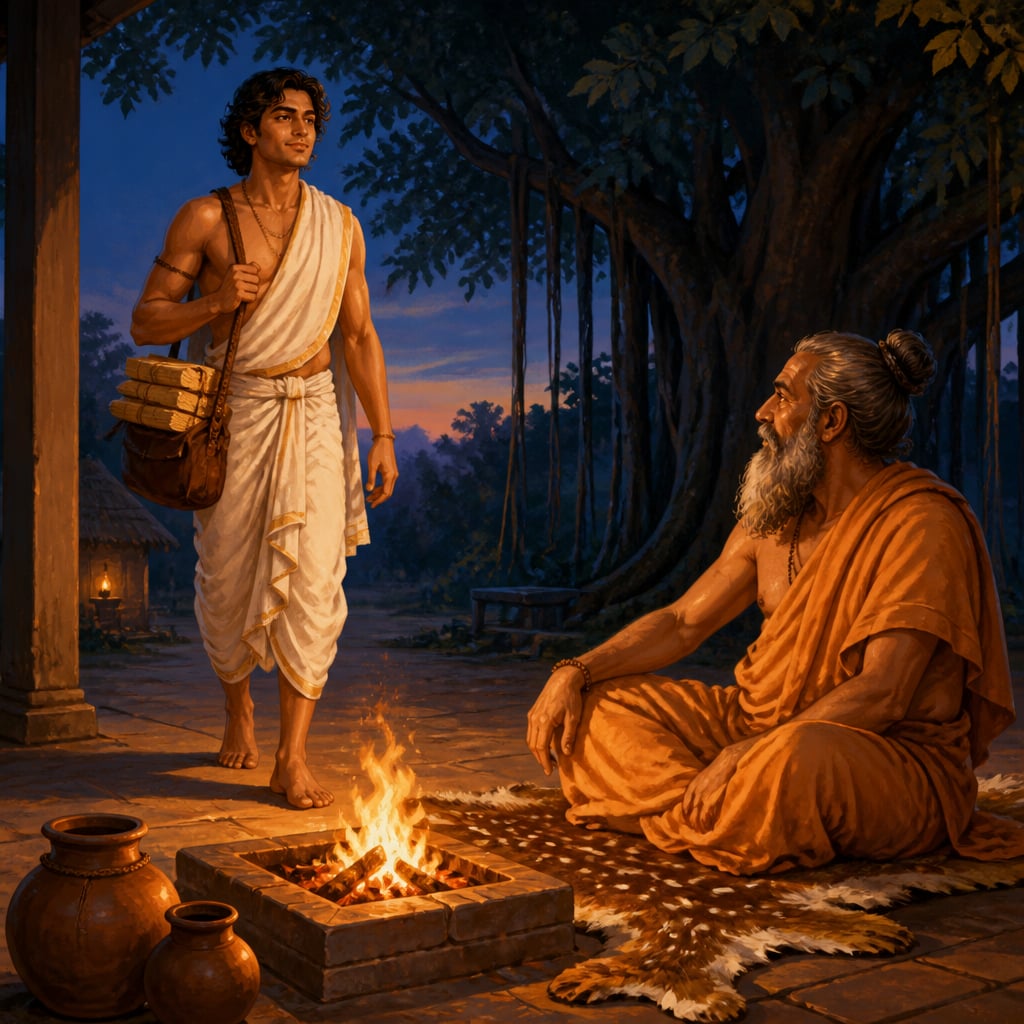
Shvetaketu returning home to his father Uddalaka after twelve years of study

His father, Uddalaka Aruni, looked at him across the fire and saw the problem immediately. 'Did you ask your teacher,' Uddalaka said, 'for the teaching by which the unheard becomes heard, the unthought becomes thought, the unknown becomes known?'

Shvetaketu had not. He had learned facts. He had not learned the thing that makes all facts intelligible. He stood there with his credentials, suddenly aware that twelve years of study had not touched the one question his father was pointing at. And so, in the sixth book of the Chandogya Upanishad, the father becomes the teacher, and one of the most influential dialogues in the history of human thought begins.

The question at stake is simple and vertigo inducing. When you go all the way down, past personality, past thought, past even awareness of being a particular person, what is there? And is the answer the same for everyone?

Uddalaka's Argument

Uddalaka does not lecture. He runs experiments.

He asks Shvetaketu to fetch a fruit from the banyan tree outside. Break it open. What do you see? Seeds. Break a seed open. What do you see? Nothing. Uddalaka pressed the point:

sa ya eṣo'ṇimaitadātmyam idaṃ sarvaṃ tat satyaṃ sa ātmā tat tvam asi śvetaketo That which is the subtle essence, in it all that exists has its self. That is the Real. That is the Self. Tat Tvam Asi. That thou art, Shvetaketu.

Uddalaka demonstrates the salt-water experiment to Shvetaketu

Then another experiment. Dissolve a lump of salt in water. Can you see the salt? No. Taste the water from the top. Salty. From the middle. Salty. From the bottom. Salty. "Throw the salt away," Uddalaka says, "it was always here. You just could not see it. The same way, the Real is present in everything, and it is your own Self." Tat tvam asi. Nine times in the chapter, after nine different demonstrations, the same four words come back: That thou art.

This is the most audacious claim in the Upanishads. The ground of the universe (Brahman) and the ground of you (Ātman) are not similar. They are not parallel. They are the same thing. The apparent distance between "me" and "the world" is a surface feature. Go deep enough into yourself and you arrive at the place from which everything else also arises.

Notice what Uddalaka is not saying. He is not saying your personality is shared. Your memories are yours. Your preferences are yours. Your body is yours. What is shared lies beneath all of that, at the level where there is no longer a "yours" at all. This is the hard part of the teaching. The thing we usually mean by self is exactly what has to be let go before the deeper identity shows up.

Jung's Echo

Carl Jung reading the Upanishads in his Zurich study

Twenty five hundred years later, in Zurich, Carl Jung broke with Freud and proposed something that sounded startlingly Upanishadic. Beneath the personal unconscious (repressed memories, private dreams, individual complexes), Jung argued, there is another layer. A collective unconscious. A stratum of psyche that is not yours or mine but ours. Populated by archetypes, the Mother, the Shadow, the Wise Old Man, the Self, that recur across cultures that never met.

Jung arrived at this through clinical evidence. His patients, with no exposure to ancient myth, produced dreams and delusions that matched the symbolism of the Rig Veda, of Egyptian funerary texts, of Gnostic scriptures. The patterns were too specific to be coincidence. He concluded that the psyche had a shared inheritance, the way the body does.

Jung read the Upanishads carefully. He corresponded with Heinrich Zimmer, the great Indologist. He visited India in 1938. His concept of "the Self" with a capital S, which he placed at the center of the psyche as its organizing principle, borrows its language directly from Vedanta. He gave the Upanishads credit, often.

But he also held back. Jung treated the collective unconscious as a psychological structure. A shared inheritance of the human mind. He was careful not to claim it was metaphysically real in the way the Upanishads claim Brahman is real. When asked directly whether he believed in God, Jung famously replied, "I do not believe. I know." But what he knew, he insisted, was a psychological fact, not a cosmological one.

Where Jung Stops, the Chandogya Continues

This is the gap. Jung gives you shared psychology. The Chandogya gives you shared being.

For Jung, you and another person are two distinct minds that draw from a common reservoir of symbols. The reservoir is shared, but the two of you remain two. The collective unconscious is something you have access to, the way two readers have access to the same library. The readers are still separate.

For Uddalaka, the separation itself is the illusion. The two of you are not two instances drawing from a common source. You are the same source, experiencing itself from what looks like two angles. The difference between Jung and the Chandogya is not a matter of degree. It is a shift in what is being claimed. Jung describes a feature of human psychology. Uddalaka describes what the universe actually is.

There is a reason Jung stopped where he did. He was a scientist trained in the Western tradition. The leap from "humans share a substrate of symbolic material" to "the ground of consciousness is singular and is the same as the ground of reality" is not a small step. It cannot be proved by clinical observation. You cannot fit Tat Tvam Asi into a peer reviewed journal. Jung knew this. He also suspected it was true. Read his later letters and you find him circling the Upanishadic claim without ever quite landing on it.

The Chandogya has no such hesitation. Uddalaka is not presenting a hypothesis. He is pointing to something he takes his son to already be, and inviting him to notice it. The method is not argument but recognition. That is why the teaching is delivered by a father to a son, in a garden, with a fruit and a lump of salt, rather than in a treatise.

Why This Matters Now

This is not a museum piece. The question Uddalaka poses is exactly the question that splits neuroscience today. Is consciousness something the brain produces, separately, in each skull? Or is consciousness the medium within which brains appear, the way water is the medium within which salt appears even when you cannot see it?

If you take the first answer, ethics has to be built from the ground up, starting from strangers. Why should I care about you? Convince me. If you take the second, ethics starts from an already existing connection. The compassion you feel when a stranger is suffering is not a moral achievement. It is a leak of the truth showing through.

You do not have to believe any of this to notice the effect it produces when it is taken seriously. People who have had even a glimpse of this shift (through contemplation, through crisis, through, as we will see, certain clinical experiments) report the same thing: the anxiety of being a sealed off individual lifts. Not because the individual disappears, but because it stops being the whole story.

That thou art. Four words. Nine demonstrations. And a claim that Western philosophy is still, twenty five hundred years later, circling at a safe distance. The mahāvākya that Uddalaka handed his son in that courtyard is the same one Schopenhauer kept on his desk, the same one Jung refused to meet face to face in Tiruvannamalai, the same one the psilocybin studies are quietly measuring in Baltimore.

Shvetaketu had come home believing twelve years of study had filled him. His father showed him, with a fruit and a lump of salt, that the filling was the problem. What he was looking for was not one more fact to add to the collection. It was what had been present the whole time the collection was being built.

Case studies

Schopenhauer and the Oupnekhat

In 1814, the young Arthur Schopenhauer was handed a dusty two volume Latin text by the orientalist Friedrich Majer. It was the Oupnekhat, Anquetil Duperron's Latin translation of fifty Upanishads, made from a Persian translation commissioned by the Mughal prince Dara Shikoh. Schopenhauer read it cover to cover. He then kept it on his desk for the rest of his life. In his essays he wrote, 'In the whole world there is no study so beneficial and so elevating as that of the Upanishads. It has been the solace of my life. It will be the solace of my death.'

What Schopenhauer recognized in the Chandogya was not just a poetic formulation but a philosophical argument he had been groping toward on his own. His central claim in The World as Will and Representation is that the principium individuationis, the principle by which the world looks divided into separate things, is an appearance. Underneath, there is one will expressing itself as many. This is Tat Tvam Asi in Kantian clothes. Schopenhauer built his ethics on the recognition: you are kind to a stranger not because duty demands it but because at the deepest level the stranger is you. 'My own true inner being actually exists in every living creature as truly and immediately as known to my consciousness only in myself.' He credited the Upanishads openly.

Schopenhauer became the conduit through which the Chandogya reached nineteenth and twentieth century European thought. Wagner read Schopenhauer and wrote Tristan. Nietzsche read Schopenhauer and reacted against him, which is still a reaction to the Upanishads. Freud absorbed Schopenhauer's pessimism about the conscious ego. And Jung, reading Schopenhauer as a young man, encountered Upanishadic ideas before he ever read the Upanishads directly. The chain of influence is traceable.

Schopenhauer is the test case for taking Tat Tvam Asi seriously as philosophy, not just as religion. He had no prior cultural commitment to Vedanta. He was a German philosopher trained on Kant. When he encountered the Chandogya he recognized it as better philosophy than anything Europe had produced on the same question. The recognition was not devotional. It was technical. The Upanishads had answered a problem he had been working on, and answered it more cleanly than he had.

Whenever someone claims that the Upanishads are religion while the Western tradition is philosophy, Schopenhauer is the counter example. He was the most influential German philosopher of the nineteenth century before Nietzsche, and he treated the Chandogya as his most important source. The line between Eastern religion and Western philosophy was drawn later, for reasons that had more to do with colonial politics than with intellectual content.

Schopenhauer's copy of the Oupnekhat survives. It is heavily annotated. Chandogya Chapter 6, the Tat Tvam Asi chapter, is marked more densely than any other part of the text.

The Johns Hopkins Psilocybin Studies

Starting in the early 2000s, researchers at Johns Hopkins University began administering carefully controlled doses of psilocybin to healthy volunteers and to patients with terminal cancer, treatment resistant depression, and addiction. The studies used rigorous clinical methodology, including placebo controls and double blind administration where feasible. Participants lay in a softly lit room, wore eye shades, and listened to curated music for several hours while the researchers monitored their vital signs and took notes.

A consistent finding across the studies is what participants call 'ego dissolution.' The sense of being a sealed off, body bound individual loosens. Many report experiences they describe, without prompting, in Upanishadic language: the feeling that 'everything is one,' that 'the separation between me and the world was a mistake,' that 'I was never just this person.' The researchers publish these reports in peer reviewed journals, using language like 'oceanic boundlessness' and 'unity consciousness.' When asked later, participants rate these experiences among the most meaningful of their lives, comparable to the birth of a child or the death of a parent. The therapeutic effects are striking: a single high dose session can reduce end of life anxiety or depression severity for months.

As of the mid 2020s, psilocybin therapy has moved from fringe research to FDA breakthrough therapy designation. The neuroscience is beginning to catch up. Brain imaging during these experiences shows reduced activity in the default mode network, the system that generates the ongoing sense of being a particular self. When that network quiets, the sense of being a bounded individual quiets with it. What remains is what participants keep describing in language the Chandogya would recognize.

Psilocybin does not prove Tat Tvam Asi. It does something more modest and more interesting. It shows that the experience the Upanishads describe is reliably reproducible under clinical conditions. The question of whether the experience reveals something real or generates a pleasant illusion is still open. But the fact that the experience happens, that it feels the way the Chandogya says it feels, and that it leaves durable therapeutic changes, is no longer in dispute. The ancient claim has gained a data point.

For most of the twentieth century, Western psychology treated the experience of unity consciousness as pathology: depersonalization, dissociation, psychotic breakdown. The psilocybin studies have forced a revision. The same phenomenology that looks like pathology in one context looks like therapy in another. The Upanishadic framing, in which this experience is recognition rather than disorder, fits the data better than the pathology model did. A slow rewriting of the textbooks is underway.

In the 2016 Johns Hopkins study of psilocybin for cancer related depression and anxiety, 80 percent of participants showed clinically significant decreases in both conditions at six month follow up. The magnitude of this effect is rarely seen in psychiatric research from a single intervention.

Historical context

c. 800 to 600 BCE (Chandogya Upanishad) / 1875 to 1961 (Jung)

The Chandogya Upanishad belongs to the Sama Veda and is among the oldest of the principal Upanishads. It was composed during the late Vedic period, a time when the ritual centered religion of the earlier Vedas was being interiorized. The questions moved from 'how should this sacrifice be performed' to 'what is the one that makes all sacrifices possible.' The Chandogya reflects this shift. Its teachings unfold in dialogue, often father to son or teacher to student, in forest hermitages and royal courts. The setting is not scholastic. It is intimate. The deepest teachings are not shouted from a pulpit but whispered at the edge of a daily conversation.

Understanding the setting helps explain the method. The Chandogya does not argue Tat Tvam Asi. It demonstrates it, then repeats the formula, then moves to a new demonstration. The goal is not philosophical proof but direct recognition in the listener. This only works in a tradition where the student has trained for years under a teacher whose authority is earned, not assumed. The oral dialogical format is itself part of the content. Reading the text as a series of propositions misses most of what it is doing.

Reflection

More in Who Am I? The Self and Identity

All lessons in Who Am I? The Self and Identity · The Big Questions: Upanishads and the Philosophers Who Followed course