Does Thinking Prove You Exist?
Descartes said 'I think therefore I am.' Yajnavalkya went further.
Brihadaranyaka Upanishad vs Descartes. The Self cannot be an object of its own knowledge, because it is the one doing the knowing. Awareness is more fundamental than thought.
Does Thinking Prove You Exist?
In King Janaka's assembly hall at Videha, sometime in the seventh century BCE, a scholar named Uṣasta Cākrāyaṇa rose from his seat.
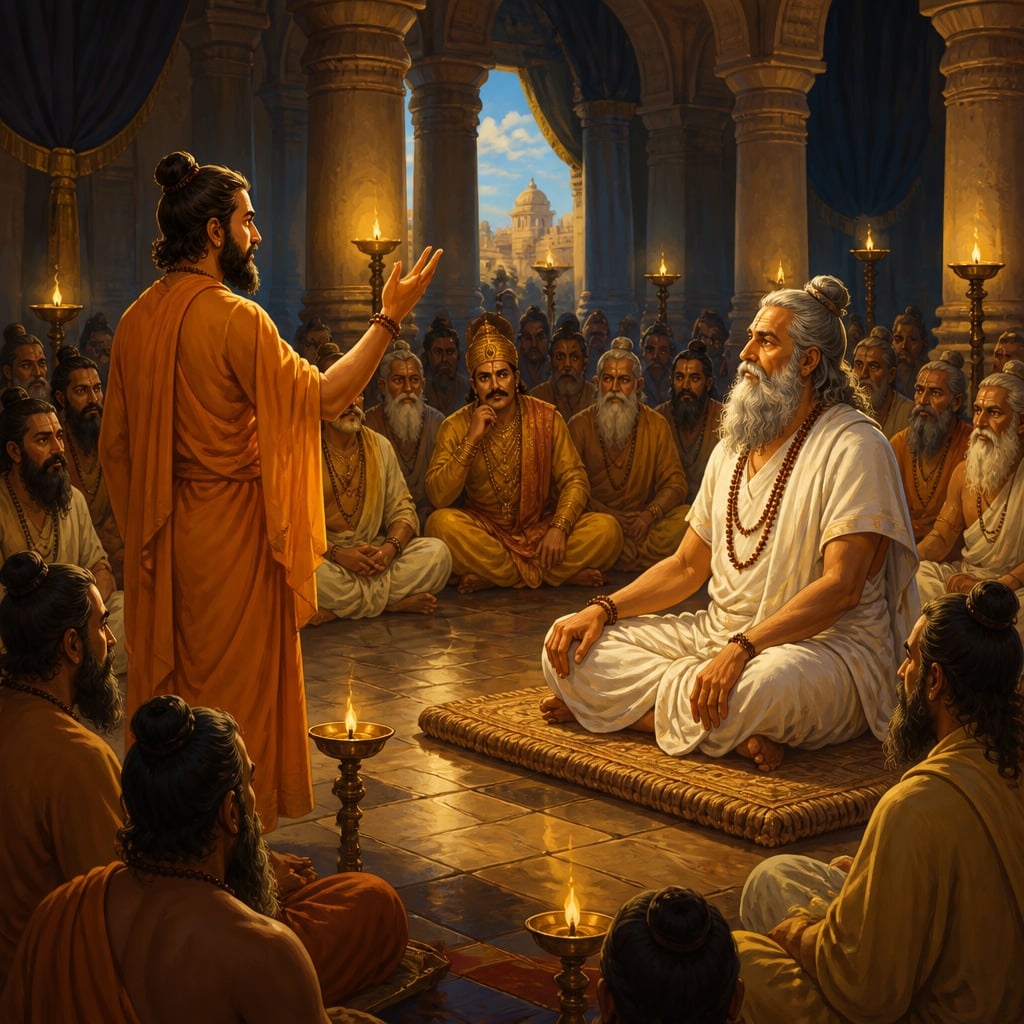
The hall was packed with rishis and philosophers from across the Kuru-Pañcāla heartland. The smell of clarified butter from the morning fire offering hung in the air. Outside, the Ganges plain stretched flat to the horizon under a white winter sky. Inside, the prize, a herd of a thousand cattle with gold-tipped horns, waited in a pen.
Uṣasta pointed at Yājñavalkya, the sage who had already won every round that morning.
"Explain to me the Brahman that is directly and immediately known. The Self that is within all things."
The room went quiet. Uṣasta was not asking an academic question. He was demanding something that looked impossible. Show us the Self. Produce it directly, the way you would lead a cow out of a pen and into the sun. Right now, in front of everyone.
What Yājñavalkya said next has kept philosophers busy for three thousand years. And when a French soldier named René Descartes locked himself in a heated room in Germany in the winter of 1619 and announced what he called the foundation of all knowledge, he was standing inside the same question. He just stopped one step short of where Yājñavalkya had already been.
The Upanishadic Answer
Yājñavalkya appears in the Bṛhadāraṇyaka Upaniṣad, the longest and probably oldest of the principal Upanishads, composed in the second half of the first millennium BCE. He was not a mystic in a cave. He was a public intellectual, the chief theologian at the court of King Janaka, a man who argued his doctrine in open court and won.
His teaching on the Self appears twice in the text. The first time, he is about to leave household life. He sits with his wife Maitreyī and tries to explain what he is walking toward. The second time is the debate with Uṣasta.
Yājñavalkya's answer in both cases is the same, and it is startling. You cannot show the Self, he says, because the Self is the one who would be doing the showing. You cannot see the Self, because the Self is the draṣṭṛ, the seer of seeing. You cannot think about the Self, because the Self is the one who thinks the thought. Every attempt to turn around and catch the Self face-to-face fails for the same reason. The moment the Self becomes an object, the thing looking at it has already slipped behind.
This is not a confession of ignorance. It is a precise philosophical claim. The Self, ātman, is the subject of all knowledge and can therefore never appear as an object of knowledge. It is what Yājñavalkya calls the 'knower of the knower', the 'witness that cannot be witnessed'. In one of the most famous lines in the Upanishad, he asks Maitreyī a question that has the force of a mathematical proof:
na dṛṣṭer draṣṭāraṃ paśyeḥ, na śruteḥ śrotāraṃ śṛṇuyāḥ, na mater mantāraṃ manvīthāḥ, na vijñāter vijñātāraṃ vijānīyāḥ You cannot see the seer of seeing. You cannot hear the hearer of hearing. You cannot think the thinker of thinking. You cannot know the knower of knowing.
And then, to his wife Maitreyī, the line that would become the signature verse of Advaita Vedānta: vijñātāram are kena vijānīyāt, 'by what, dear, should one know the knower?' There is no further instrument. Every instrument you could use is already on this side of the line, being used by the knower.
The teaching has a second edge. If you cannot find the Self as an object, the Upanishad says, it is because you are already it. The search you are conducting is the thing you are searching for. The Brihadaranyaka does not treat this as a paradox to be solved. It treats it as the single most important fact about the structure of consciousness. The knower is not a thing inside you. It is you. And it is the same awareness that looks out through every pair of eyes.
The Western Echo
Fast-forward roughly twenty-three centuries. In the winter of 1619, a 22-year-old French soldier named René Descartes is billeted near Ulm in southern Germany, waiting out the first phase of the Thirty Years War. The story goes that he locks himself in a room heated by a large tile stove, away from any duties, and sets himself a private assignment. He will doubt everything he can possibly doubt. Only what survives the doubt will count as knowledge.

He doubts his senses. They have deceived him before. He doubts the external world. An evil genius, he imagines, could be feeding him false perceptions. He doubts mathematics. Maybe even two plus three equals five is being forced on him by the demon. He doubts, in the end, whether he has a body at all.
And then, at the bottom of the well, he finds something that cannot be doubted. If he is doubting, something must be doing the doubting. The very act of wondering 'am I real?' proves that some thing is there, asking. He writes it down, first in French, later in Latin. Je pense, donc je suis. Cogito ergo sum. I think, therefore I am.
Descartes was not a fool. He knew this was only the first step. What he had shown was that the self is at least a res cogitans, a thinking thing. Extension, motion, color, the body, the world, all of these were still under a cloud. But thought itself was indubitable, because to doubt thought was itself a thought.
For European philosophy, this was a revolution. It relocated the foundation of certainty from scripture and Aristotelian authority to the first-person interior of the thinker. Almost every major Western philosopher after Descartes, from Spinoza to Kant to Husserl, either extends his move or attacks it. The cogito is the door through which modern Western philosophy walks into its own house.
Give Descartes his due. His method is honest, his courage unusual, and his conclusion, within its frame, is correct. Something is there. Something is thinking. He is not wrong about that. He is only incomplete.
The Gap
Here is where the comparison earns its thesis.
Descartes identifies the self with thought. The thing that cannot be doubted, for him, is the thinker. The cogito comes as a package. I think, therefore I am. Strip the thinking and the 'I' loses its proof.
Yājñavalkya had already seen past this move. He would have told Descartes, politely, that thought itself is something you are aware of. Thoughts arise and pass. Doubts arise and pass. The one who notices them is not another thought. It is the awareness that thoughts appear in. If awareness were just another thought, you would need a further awareness to notice that thought, and another beyond that, and you would never arrive anywhere. The regress only closes if awareness is not a thought at all.
The Upanishad calls this awareness the sākṣin, the witness. The witness is not produced by thinking. It is the field in which thinking happens. Descartes, in his stove-heated room, stopped one step short. He caught the content of the mind and called that the self. Yājñavalkya caught the container the content appears in, and pointed out that the container was never an object to begin with.
This is not a small difference. It has three consequences that shape everything downstream.
First, Descartes's cogito leaves the Western tradition with a problem it has never solved: how does this thinking substance relate to the body that carries it around? The 'mind-body problem' haunts philosophy of mind to this day. Yājñavalkya has no such problem, because his Self was never a substance in the first place. It is the awareness that bodies and minds appear in. There is nothing to glue to anything else.
Second, Descartes's cogito gives you one self per thinker. Millions of little cogitos, each shut inside its own head. Yājñavalkya's witness is not plural. Every apparently separate 'I' is the same awareness looking out through a different window. This is the thesis the Chandogya will make famous as tat tvam asi, 'you are that', and it is already implicit in Yājñavalkya's analysis. A container is not multiplied by the things it contains.
Third, Descartes's cogito is an argument. You reach it by reasoning. You can get to the witness that way too, but the Upanishad also opens a second door. The witness can be known by becoming still enough to notice it. Meditation, self-inquiry, the practice of ātma-vicāra, are not metaphors for the Upanishadic sages. They are a second path of verification, independent of reasoning, that arrives at the same place. Descartes had one door. Yājñavalkya had two.
Why It Matters Today
This is not museum philosophy. Every one of the three consequences above is live right now.
A modern large language model can output the sentence 'I think, therefore I am' with perfect grammar. It can even be trained to defend it. Does that mean there is a self in the machine? Descartes's criterion gives a strangely unhelpful answer. If thinking is the proof of selfhood, and the machine is producing thoughts, the cogito seems to qualify it. Most people's intuition says otherwise. Yājñavalkya's framework explains why. The question is not whether thoughts are being produced. The question is whether anything is aware that thoughts are being produced. That question is much harder to answer, and no LLM output settles it.
Neuroscience is in a similar situation. For thirty years, researchers have tried to locate the self in the brain using fMRI and EEG. They find networks that light up during self-reference, memory retrieval, and first-person narrative. They find no central place where a 'self module' sits. Every time they look closer, the self recedes. If you are reading the Upanishad carefully, this is exactly what you would expect. The neuroscientists are looking for an object, and the thing they are looking for is the looking.

And in your own life, the distinction matters whenever you confuse yourself with your thoughts. Anxiety is a thought. Shame is a thought. Ambition is a thought. You can be crushed by any of them if you believe you are them. Yājñavalkya would tell you, gently, to notice who is aware of the anxiety. That awareness is not anxious. It cannot be anxious, because it is the thing the anxiety is appearing in. This is not a coping technique. It is a report on how the structure of consciousness actually works.
Descartes arrived at a real truth. Yājñavalkya arrived at it twenty-three centuries earlier and kept walking, straight past the thinker and into the awareness the thinker was appearing in. When you say 'I am', notice what the 'I' is. It is not what you are thinking. It is what is noticing the thinking. That noticing was never a thing that could be proved. It is what the proving happens in.
Back in Janaka's hall, Uṣasta had asked for the Self to be produced like a cow in sunlight. He had his answer: the one he had asked to see was the one doing the asking.
Key figures
Yājñavalkya
Late Vedic period, traditionally c. 8th to 7th century BCE, court of King Janaka of Videha (modern Mithila, Bihar)
René Descartes
1596 to 1650 CE, France and the Dutch Republic
Ādi Śaṅkara
c. 788 to 820 CE, traditionally born in Kaladi, Kerala
Case studies
Yājñavalkya and Maitreyī: A Farewell Conversation That Changed Philosophy
Some time in the second half of the first millennium BCE, in the court of King Janaka of Videha, the rishi Yājñavalkya announced that he was leaving householder life. He had two wives, Kātyāyanī and Maitreyī. He told them he would divide his property between them before walking into the forest for good. Kātyāyanī accepted. Maitreyī refused. 'If this whole earth with all its wealth were mine,' she asked, 'would I become immortal through it?' Yājñavalkya answered, 'No. Your life would be like the life of the rich. There is no hope of immortality through wealth.' Maitreyī then said, 'What should I do with something that does not make me immortal? Tell me what you know.' The dialogue that followed is recorded in Bṛhadāraṇyaka Upaniṣad 2.4 and 4.5.
Yājñavalkya's teaching to Maitreyī is the locus classicus for the claim that the Self is the subject that can never become an object. He leads her through a sequence of beloved things, showing that each of them is loved not for its own sake but for the sake of the Self that appears in it. He then confronts her with the limit of all knowing: vijñātāram are kena vijānīyāt, 'by what, dear, should one know the knower?' Every faculty of knowing is already this side of the knower. There is no further instrument. In the Advaita reading following Śaṅkara, this is the first formal statement of the doctrine that ātman is self-luminous and beyond all pramāṇa.
The dialogue is the most cited passage in Advaita Vedānta for the doctrine of the witnessing Self. It is also the single clearest case in world philosophy of a woman asking the question that produced the answer. Maitreyī's refusal to accept property drove Yājñavalkya to give the most precise statement of his teaching. Twenty-three centuries later, a French soldier named Descartes would arrive at a similar insight, one level shallower, without ever encountering the text.
The right question matters more than the right answer. Maitreyī did not ask 'what is the Self?'. She asked 'what is worth having?'. The second question forced the first into a form sharp enough to cut. Before you search for answers, check whether you have sharpened the question. Most philosophical dead ends are caused by questions that are nearly right.
Descartes in the Stove-Heated Room, Ulm, Winter 1619
In the winter of 1619, a 22-year-old French soldier named René Descartes was billeted near Ulm in southern Germany, waiting out the opening campaigns of the Thirty Years War. By his own account in the Discourse on the Method, he took shelter in a room warmed by a large tile stove and spent the day alone with his thoughts. In that room he set himself a private assignment. He would doubt everything he could possibly doubt, and see what survived. He doubted the evidence of his senses, which had deceived him before. He doubted the existence of the external world. He imagined an evil genius feeding him false perceptions. He even doubted mathematics. At the bottom of the doubt he found something he could not get rid of. Doubting was itself a mental act. Something was doing the doubting. He wrote the result twice in his life, once in French (je pense, donc je suis) and once in Latin (cogito ergo sum). I think, therefore I am.
Descartes earned his conclusion honestly. The cogito is a rigorous proof that some subject exists whenever doubt is active. Yājñavalkya would not have disagreed with it. What he would have pointed out is that Descartes stopped one level too early. Thoughts, including doubts, are content in the mind. Something is aware of that content. That awareness is not itself a further thought, otherwise the regress never closes. The Upaniṣadic critique, if Yājñavalkya had been in the room, would have been simple: René, the thinking is something you are aware of. Who is the one who is aware? That is what you should have been looking for. Descartes answered 'I am a thinking thing' and closed the book. Yājñavalkya would have asked him to open it again.
The cogito became the founding move of modern Western philosophy. Descartes's Meditations (1641) inherited a tradition grounded in scripture and Aristotle and left behind a tradition grounded in the first-person interior. Almost every Western thinker from Spinoza to Husserl either develops or attacks the cogito. It is also the origin of the mind-body problem, which has never been solved because it was never correctly stated. The Upaniṣadic framework does not face the problem, because its Self was never a substance distinct from body. The gap between Descartes and Yājñavalkya is not a gap of intelligence. It is a gap of how far you can push a question before you decide you have an answer.
When you think you have hit bedrock, knock on it once more. Descartes's genius was his willingness to doubt everything. His limitation was that he stopped at the first thing that resisted the doubt. Sometimes what resists the doubt is itself sitting on something deeper. The habit of asking 'and what is the thing inside which this is happening' is worth more than any answer you will get from asking 'what is this'.
Ramana Maharshi, Madurai, July 1896: A Death Rehearsal That Worked
In July 1896, a 16-year-old Tamil schoolboy named Venkataraman Iyer was sitting alone in his uncle's house in Madurai when he was gripped by a sudden, violent fear of death. He had not been ill. Nothing in the day had warned him. He simply felt that he was about to die. Instead of calling for help, he decided to investigate. He lay down on the floor, went still, and asked himself a single question: what is it that dies? The body can be imagined dead. Thoughts can be imagined to stop. But the 'I' that is running the investigation, he discovered, did not go anywhere. It watched the imagined death from a place that was untouched by it. He got up, understood what had happened, and never returned to his former sense of who he was. He later became Ramana Maharshi, and his teaching method, known as ātma-vicāra or self-inquiry, consisted almost entirely of asking 'who am I?' and watching carefully where the question went.
Ramana never received formal training in Vedānta before his experience. He had not studied the Bṛhadāraṇyaka. When his followers later read Yājñavalkya's dialogues to him, he recognized the content immediately. What he had done alone, on the floor of a house in Madurai, is exactly what Yājñavalkya had done in the assembly of King Janaka: he had refused to confuse the content of experience with the one experiencing it. The investigation that reveals the witness does not require a philosophical background. It requires the willingness to sit still long enough to notice that thoughts are being watched, and that the watcher cannot be turned into a thought.
Ramana lived at the foot of Arunachala mountain in Tiruvannamalai for the rest of his life, from 1899 to 1950. His ashram became one of the most visited contemplative centers in India. Visitors included Carl Jung's friend Heinrich Zimmer, Somerset Maugham, and Paul Brunton, who wrote A Search in Secret India in 1934 and introduced Ramana's inquiry method to the English-speaking world. Ramana's teaching is still practiced globally. It is also the strongest modern evidence that Yājñavalkya's claim was not a theological doctrine but a testable report. The witness is available to anyone who looks.
Some truths are not available through argument but only through direct attention. Descartes's cogito is an argument, so you reach it by reasoning. Yājñavalkya's witness is also reachable by reasoning, but the Upaniṣad opens a second door: stop thinking about the observer and notice who is reading these words. Ramana's story is proof that the second door still works and that no credentials are required to walk through it.
The Modern Hunt for the Self in the Brain
Since the 1990s, cognitive neuroscientists have used functional MRI and EEG to look for the 'self' in the human brain. The hypothesis was simple: if there is a self, there should be a place where it lives. Decades of scanning have produced mixed results. Researchers have identified a Default Mode Network, active when people daydream and think about themselves. They have mapped the cortical midline structures involved in self-reference. They have shown that damage to specific regions changes the sense of agency and ownership. But they have never found a central 'self-spot'. Every region they point to turns out to be processing content, not producing awareness. The philosopher David Chalmers formulated this as 'the hard problem of consciousness': we can explain what the brain does, but we cannot explain why there is a first-person experience of it at all. The problem has not been solved.
If you read Yājñavalkya's BṛU 3.4.2 before walking into a neuroscience lab, you would predict exactly this result. The verse states it formally: you cannot see the seer of seeing. Any instrument used to look for awareness is already being wielded by awareness. The fMRI shows the content of the mind, not the one in whom the content appears. Neuroscience is not failing at a technical task. It is running into a structural limit that Yājñavalkya mapped in the seventh century BCE. The Upaniṣad does not tell neuroscience to stop. It tells neuroscience to not be surprised when the self keeps receding as the resolution improves.
The hard problem of consciousness is, as of the current decade, an open question in every major research program. Panpsychists, integrated information theorists, and illusionists all disagree. The one group that has a non-paradoxical framework is Upaniṣadic, and their framework is not being seriously considered in mainstream consciousness research only because the field is still in the stage of treating awareness as an object to be found. The day a researcher reads BṛU 3.4.2 and takes it as a hypothesis rather than a poem is the day this problem changes shape.
When a search keeps failing, check whether the thing you are searching for is the one doing the searching. Modern neuroscience is looking for the seer in the seen. Yājñavalkya's first move was to point out that the seer is never in the seen, because it is what makes seeing possible. Before you invest another decade of effort in a hunt, verify that the hunter and the prey are in fact different things.
More than thirty years of functional brain imaging have produced no fMRI signature of a central self. The Default Mode Network, the most studied candidate, processes self-related content but has never been shown to produce first-person awareness. The philosopher David Chalmers coined 'the hard problem of consciousness' in 1995. Three decades later, it remains unresolved in any mainstream Western framework.
Historical context
Late Upaniṣadic period (c. 8th to 6th century BCE) for Yājñavalkya; early modern period (1619 to 1641 CE) for Descartes
The second half of the first millennium BCE in northern India was the period of the late Vedic kingdoms, centered on the Kuru-Pañcāla heartland in the west and on Kosala and Videha in the east. Videha, the kingdom of King Janaka, had become the intellectual capital of the time. Janaka hosted philosophical assemblies where rishis from across the subcontinent debated for prizes. Yājñavalkya's teaching happened inside this institution. The court of Janaka is the oldest continuously attested Indian venue for philosophical debate, and the Bṛhadāraṇyaka Upaniṣad preserves several of the transcripts.
The two conversations matter because they are a controlled experiment in the history of thought. Two thinkers, working in civilizations that had no contact with each other, asked the same question and pushed it to different depths. The gap between them is a direct measurement of what a tradition's philosophical vocabulary will allow it to notice. Descartes stopped at the thinker because his tradition had no term for the witness. Yājñavalkya kept going because his did.
Living traditions
Yājñavalkya's argument is the oldest known formal statement of a distinction that remains unresolved in contemporary philosophy of mind. The 'hard problem of consciousness', the Default Mode Network debate in neuroscience, the contemplative neuroscience work on meditation (including studies of long-term practitioners at Harvard, Wisconsin, and Max Planck), and the growing interest in 'witness consciousness' in Western psychotherapy all revolve around the distinction Yājñavalkya made three thousand years ago. Ramana Maharshi's self-inquiry method, directly descended from the Bṛhadāraṇyaka, is taught worldwide in secular form through teachers who trace their lineage to Tiruvannamalai. Every time a meditation app invites you to 'notice the thoughts passing' rather than to identify with them, it is operationalizing Yājñavalkya's distinction between content and witness.
- Mithila (Janakpur and surrounding region): The ancient kingdom of Videha, capital of King Janaka, where Yājñavalkya debated his doctrine of the witnessing Self in the royal assembly recorded in the Bṛhadāraṇyaka Upaniṣad. Mithila remains a living cultural region famous for its painting tradition, Sanskrit scholarship, and the Rāmāyaṇa's Sītā, who is said to have been Janaka's daughter. Sites to visit include Janaki Mandir in Janakpur (just across the border in Nepal), the Madhubani art villages, and Darbhanga's Sanskrit university.
- Sri Ramanasramam: The ashram of Ramana Maharshi, the 20th century sage who rediscovered Yājñavalkya's inquiry method alone in a Madurai house at the age of sixteen. Ramana lived at Tiruvannamalai from 1899 until his death in 1950, and the ashram has preserved his teaching method of ātma-vicāra (self-inquiry) unbroken. The Old Hall where Ramana gave silent darshan, his samādhi shrine, and the Virūpākṣa cave on Arunachala where he meditated for years are all open to visitors. Full-moon pradakṣiṇa of Arunachala remains a powerful pilgrimage practice.
- Sringeri Sharada Peetham: The southern amnāya maṭha established by Ādi Śaṅkara in the 8th century CE and the oldest continuously functioning center of Advaita Vedānta. Śaṅkara's commentary on the Bṛhadāraṇyaka Upaniṣad, including the Yājñavalkya dialogues, is taught and debated here in an unbroken teaching lineage. The Śaradāmbāl temple, the Vidyāśaṅkara temple, and the Tungā river ghats are worth visiting. The present Jagadguru continues to give public discourses on the Upaniṣads.
Reflection
- Right now, as you read this, can you notice the awareness that the reading is happening in? Not the content of what you are reading, but the space in which it is appearing?
- Why do you think Descartes stopped at the cogito? What made 'I think' look like the final answer rather than one step on a longer staircase?
- If the Self is not a thought and not a body, what kind of thing is it? And is the word 'thing' even the right category?