If the Self Is Eternal, Why Do We Fear Death?
Nachiketa debates Death himself. Heidegger calls it Being-toward-death.
Katha Upanishad vs Heidegger. Confronting mortality gives life authenticity, but the Katha disagrees on the conclusion: the Self does not end.
A Boy Walks into the House of Death
Vajasravas had promised to give away everything he owned. The Katha Upanishad opens at a Vishvajit sacrifice, the oldest and most expensive of the public Vedic rites, performed sometime in the late Vedic period in a clearing somewhere on the north Indian plain. Smoke rose from the ceremonial fires in the late afternoon air. Priests chanted around the altar. The donor was supposed to give away all his wealth as a public act of generosity.
Vajasravas cheated. He was giving away only the animals that were too old to be worth keeping. Cows that had drunk their last water, eaten their last grass, given their last milk. The cattle stood still in the dust, ribs showing, waiting for priests who would not want them.
His son Nachiketa watched from the edge of the field. He was perhaps twelve or thirteen years old. Something in the boy refused to let the falseness slide. He walked up to his father and asked a simple question.
'To whom will you give me?'
Vajasravas ignored him. He asked again. And again. Finally the father, shamed into fury by his own child in front of the priests, said what he should not have said. 'To Death I give you.'
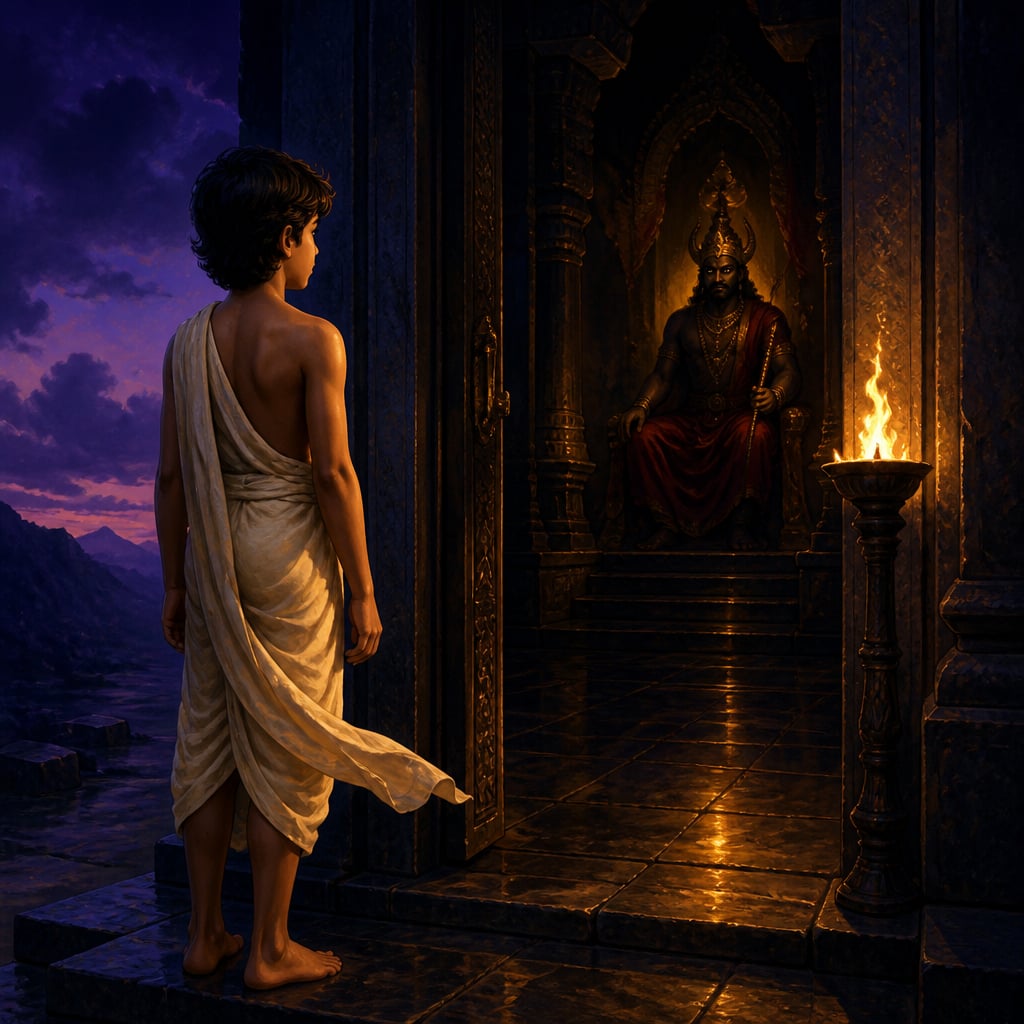
Nachiketa took the word literally. He walked away from the smoking field and went to the house of Yama, the lord of death, and waited there without food or water for three days. When Yama returned, he was struck by the boy's presence and offered three boons to make up for the three days of neglect. Nachiketa asked first that his father receive peace of mind. Granted. He asked second for the knowledge of the fire sacrifice that leads to heaven. Granted, and Yama named the fire after him. Then the third boon. And here the story breaks open.
'When a person dies, some say the Self continues, and some say it does not. I want to know the truth.'
Yama recoiled. He said this question was subtle, that even the gods had trouble with it, and that no one should waste a boon on it. He offered Nachiketa everything else instead. Long life. Sons and grandsons. Cattle and gold. Chariots. Kingdoms. Dancers who moved in forms human beings were not meant to see. Take all of it, said Yama, but not this question.
Nachiketa's reply is the hinge of the entire Upanishad. These pleasures, he said, wear out the vigor of the senses. The longest life is short. Keep your dancers, your horses, your gold. I came to ask about what does not end, and I will not leave without the answer.
The Self that was never born
Yama, pleased by the boy's refusal of every bribe, finally taught. What followed is one of the most concentrated philosophical passages in any scripture. Yama distinguishes two paths: shreyas, the good, and preyas, the pleasant. They often look alike at first. Only the discerning person chooses the good over the pleasant. Then Yama spoke the verses that Shankaracharya would later call the heart of Vedanta.
na jāyate mriyate vā vipaścin nāyaṃ kutaścin na babhūva kaścit ajo nityaḥ śāśvato'yaṃ purāṇo na hanyate hanyamāne śarīre The knowing Self is never born and never dies. It came from nowhere and became nothing else. Unborn, constant, eternal, ancient, it is not slain when the body is slain.
This is the passage that Krishna will later quote almost verbatim in the Bhagavad Gita. The Self is smaller than the smallest, greater than the greatest, seated in the heart of every being, and only the one whose desires have quieted can see it.

Then Yama gives the chariot metaphor, the oldest psychological diagram in the world. The body is a chariot. The senses are the horses. The objects of the senses are the roads the horses run toward. The mind is the reins. The intellect is the charioteer. And the Self is the passenger for whom the whole machinery exists. A bad charioteer with unsteady reins cannot reach the destination. A wise charioteer with steady reins and disciplined horses reaches what Yama calls Vishnu's highest abode, the stillness behind all motion.
The final teaching is practical. Yoga is the steady holding of the senses. When the five senses along with the mind are still, and even the intellect does not stir, that is called the highest state. The fear of death disappears not through belief but through direct recognition. You are not the chariot. You are not the horses. You are not the charioteer. You are the one for whom the entire journey is being taken, and the journey never touches you.
Heidegger in the Black Forest

More than two thousand five hundred years after the Katha Upanishad was composed, a German philosopher named Martin Heidegger sat in a cabin in the Black Forest and wrote a book called Being and Time. It was published in 1927. Europe was still raw from the First World War. Sixteen million people had died in four years. The old confidence in reason, progress, and religion was in pieces. Heidegger looked at the wreckage and asked: what does it mean to be a human being who knows they will die?
His answer is famous. Heidegger argued that most of us live inauthentically, in a mode he called das Man, the anonymous 'they.' We say things like 'one dies eventually,' in the passive tone used for statistics. Death becomes something that happens to other people. The shock and specificity of our own death is smoothed over by the daily noise of tasks, gossip, and distraction. Heidegger called this fleeing.
He argued that the only way to live authentically is to face one's own death head on. Not death in general. Not death as an idea. My death. The fact that I, this exact person, will one day not exist. Heidegger gave this mode a name: Being-toward-death, Sein-zum-Tode. When a person genuinely feels the weight of their own finitude, Heidegger said, life shifts. Priorities reorder. The trivial falls away. You become capable of choosing what is actually yours instead of what the anonymous 'they' has chosen for you. Authentic existence, for Heidegger, is the result of accepting that you are a being whose most fundamental fact is that you will end.
This is an extraordinary diagnosis. Heidegger exposed a psychological pattern no one had quite named before. The twentieth century existentialists, the Stoic revivalists, the hospice movement, even modern productivity writers who tell you to 'remember you will die' all operate inside Heidegger's shadow. He was not wrong. He was incomplete.
The gap between Freiburg and Varanasi
Here is where the two teachings part ways, and the difference is worth your attention.
Heidegger says: face your death, and you will live authentically. He stops there. For Heidegger, death is the absolute terminus. It is what he calls the possibility of the impossibility of existence. There is nothing beyond it, and authenticity consists in holding that nothingness steadily in view without flinching. Heroic, yes. Clarifying, yes. But it leaves you with a finite life made more intense by the awareness that the lights will go out.
Nachiketa asked a harder question. He did not ask how to live well despite death. He asked whether there is something in a person that death does not touch at all. And the answer he was given does not cancel Heidegger's insight; it completes it. The Katha agrees that most people flee their own mortality. That is exactly what Nachiketa's father was doing when he gave broken cows in a sacrifice meant for generosity. That is exactly what Yama's list of bribes represents: wealth, progeny, music, pleasure, the whole machinery that postpones the real question. The Katha also agrees that life becomes authentic only when you stop running. The difference is what you find when you stop.
Heidegger's honest inquirer finds finitude. Nachiketa's honest inquirer finds the atman, the Self that was never born and does not die. The body dies. The ego dies. The chariot, the horses, the reins, the charioteer: all of it decays. But the passenger for whom the machinery exists was never an item inside the machinery. It cannot be killed, because it was never subject to being born.
This is a stronger claim than Heidegger makes, and the Katha is aware of how strong the claim is. It does not ask you to believe it. It gives you the method. Silence the senses. Steady the mind. Still the intellect. What remains is the knower itself, and that knower is not something you will ever find by searching, because it is what is searching. Heidegger got you to the edge of the cliff and told you to stand there bravely. The Katha told you to look down and see that there was never a cliff, only a horizon painted on a wall.
Why the fear survives the knowledge
Notice that the question is not whether the Self is eternal. It is why we fear death even if we suspect it might be. The Katha answers this directly. The fear is not a response to a real threat to the Self. It is a response to a misidentification. As long as you believe you are the body, the mind, the life story, the collection of relationships and roles, death is a genuine catastrophe, because every one of those things will end. The fear is appropriate to what you take yourself to be.
The work is not to suppress the fear but to follow it to its root. Yama's teaching is relentless on this point. You cannot argue yourself out of the fear of death while you still secretly believe you are the thing that dies. The fear will always outrun the argument. What you can do is the long discipline of disentangling the witness from the witnessed, the knower from the known, the passenger from the chariot. When that disentanglement becomes direct, not theoretical, the fear does not need to be fought. It has nothing left to attach to.
Why it matters today
We live in a culture that alternates between denying death and performing fascination with it. We hide the dying in institutions. We laminate obituaries into two paragraphs. And then we stream shows about serial killers and write listicles about our deathbed regrets. The Katha Upanishad was written for people who did not have that option, because death in the ancient world walked through the front door of every house at some point, often through the room of a child. The teaching it produced is not romantic and not comforting. It is technical. It says: the fear you feel is accurate to a mistake, and the mistake is fixable.
Heidegger gave us a language for taking our own death seriously without flinching. That is a gift, and it is worth keeping. The Katha gives us a further step, which is that the seriousness is a doorway, not a destination.
In the field where Vajasravas lit his dishonest fires, a boy walked away from the smoke and went to ask Death a question directly. He walked out again carrying the only answer that has ever been equal to the question. The answer is not that you will not die. The answer is that the one who is asking the question was never in the line of fire to begin with.
Key figures
Nachiketa
Late Vedic Period (c. 800 to 600 BCE)
Yama
Vedic personification, present in texts from the Rigveda onward
Martin Heidegger
Modern (1889 to 1976)
Case studies
Ramana Maharshi and the Sixteen Year Old Who Lay Down to Die
In July 1896, a sixteen year old boy named Venkataraman Iyer was alone in a room in Madurai, South India, when a sudden, intense fear of death gripped him. There was no warning and no medical reason. The fear was absolute. Most people in that situation reach for distraction. Venkataraman did something else. He lay down on the floor, imitated a corpse, stopped his breathing, and began a direct inquiry. If the body is dying, he asked himself, does that mean I am dying? Whose fear is this, and who is asking the question?
What Venkataraman did that afternoon is the Katha Upanishad enacted in a South Indian room in the last decade of the nineteenth century. He refused every evasion the Buddha's charioteer had to point out to the young Siddhartha. He also refused the Heideggerian option of simply feeling his finitude bravely. Instead, he applied Yama's own method. He silenced the senses. He stilled the body. He pressed the question of the fear of death all the way to its root. What he reported afterward is precisely the teaching of Katha 1.2.18: the body died in his awareness, and something else did not. That something did not fit any category he had been given. He would spend the rest of his life calling it the Self, pointing to it with the question 'Who am I?'
The boy on the floor became Ramana Maharshi, one of the most influential sages of modern India. He never left the foothills of Arunachala after walking there weeks later. His central practice, self inquiry, is a compressed version of the Katha's teaching rendered into a single question. Paul Brunton, Carl Jung, Somerset Maugham, and generations of Western seekers made the pilgrimage to Tiruvannamalai to meet him. His death in 1950 was attended by disciples who reported that his last hours were free of fear. When questioned about the pain of terminal cancer, he reportedly said, 'They say I am going. Where can I go? I am here.'
The fear of death is not something to argue with or suppress. It is an instruction to investigate who is afraid. Ramana's experiment shows that the Katha's method is not an ancient ritual. It is a procedure that can be followed by any person, in any room, with nothing but the willingness to stay with the question until it answers itself.
Ramana Maharshi's original self inquiry experience took place over a period of about twenty minutes in July 1896. He was sixteen years old. He left Madurai for Arunachala six weeks later and never returned home.
Terror Management Theory: The Empirical Proof That We Flee Our Own Death
In 1986, three American social psychologists named Sheldon Solomon, Jeff Greenberg, and Tom Pyszczynski began a research program inspired by the anthropologist Ernest Becker's Pulitzer Prize winning book The Denial of Death. Their hypothesis was that human beings spend most of their mental life managing, repressing, and distracting themselves from the awareness of their own mortality, and that this unconscious work shapes behavior across domains that appear to have nothing to do with death. They called it Terror Management Theory.
Over the next three decades, Solomon and his colleagues ran more than a thousand experiments across dozens of countries. Their method was simple: make people briefly aware of their own death through a writing prompt or a subliminal word, then measure how their behavior shifts. The results were consistent and disturbing. When mortality is made salient, people cling more tightly to their cultural group, become more hostile to outsiders, judge moral violations more harshly, spend more money on luxury items, and report stronger religious faith. The effects appear across liberal and conservative, religious and secular, young and old. Heidegger's diagnosis of the flight into inauthenticity received empirical confirmation in a form he would never have imagined: a laboratory. The Katha Upanishad's diagnosis received the same confirmation, centuries ahead of the data. Yama's list of bribes (cattle, gold, sons, nymphs, chariots) maps almost perfectly onto the list of attachments that mortality salience strengthens in modern subjects. We clutch harder at preyas the moment death becomes real to us.
Terror Management Theory is now one of the most cited frameworks in social psychology, with a research base exceeding a thousand empirical studies. The findings have been applied to political behavior, consumer psychology, prejudice research, and clinical work with anxiety disorders. Solomon and his colleagues published a popular summary in 2015 titled The Worm at the Core, which argued that almost every dimension of human civilization is a defense mechanism against the awareness of our own mortality.
Both Yama and Heidegger warned that the mind flees its own death, and the flight shapes everything from what you buy to who you hate. Modern psychology has now measured this flight in controlled experiments. The Katha's contribution is the one the experiments cannot test: the claim that if you stop fleeing and follow the fear to its root, you find that the thing you were afraid for was never what you took yourself to be.
Over 1,000 empirical studies on Terror Management Theory have been published since 1986, consistently showing that mortality salience shifts behavior across cultures, ages, and political orientations.
BJ Miller: The Hospice Doctor Who Teaches Dying Without Fear
BJ Miller is an American palliative care physician who lost three of his four limbs in an electrical accident at Princeton in 1990, when he was a nineteen year old sophomore. After years of rehabilitation, he became a medical doctor and then director of the Zen Hospice Project in San Francisco. His 2015 TED talk on what matters most at the end of life has been viewed more than fifteen million times. His patients are mostly people who have been given weeks or months to live, and his job is to help them face that fact.
Miller is not a Vedantin. He does not quote the Katha Upanishad. But the conversations he describes in his ICU rounds and hospice rooms read like modernized versions of Yama's dialogue with Nachiketa. He refuses to let the patient hide behind euphemism. He gently strips away the pleasantries until the person in the bed can ask the real question. And then, more often than not, the patient discovers that when the fear is met directly instead of fled, something softens in them that they did not know was there. Miller describes patients who spent years in low grade anxiety about dying and who, once the diagnosis became terminal, experienced a paradoxical calm. He attributes this not to denial but to what he calls the gift of limits: the discovery that clarity about what is ending creates clarity about what is still here. This is exactly the Katha's move. The atman, the one that is still here, is uncovered only when the frantic grip on what is ending is finally released.
Miller co founded Mettle Health in 2020, a palliative care consulting service that brings end of life conversations to patients who lack access to specialized hospice care. His book A Beginner's Guide to the End, co authored with Shoshana Berger, is one of the most widely read practical guides to dying in the United States. The Zen Hospice Project under his leadership became a global reference point for compassionate end of life care, and its model has been studied and partially adopted by hospice programs in several countries.
The Katha Upanishad is not only for people sitting in caves. It is for people sitting in hospital beds, and for the people sitting next to them. Miller's work shows that the fear of death does not go away through medication or distraction. It goes away when the person meets it honestly and discovers, sometimes for the first time, what was never in danger.
BJ Miller's 2015 TED talk 'What really matters at the end of life' has been viewed more than 15 million times and is among the most watched TED talks ever given on death and dying.
Historical context
Late Vedic Period, classical composition of the Katha Upanishad (c. 800 to 500 BCE), with comparative material from the twentieth century
The Katha Upanishad belongs to the Krishna Yajurveda school and is one of the principal Upanishads commented on by Shankaracharya. It was composed during a period of intense philosophical activity in northern India, when ritualistic Brahmanism was being complemented and increasingly challenged by inner inquiry. The text shows familiarity with later Vedic ritual (the Nachiketa fire is a named sacrifice) but places the inquiry into the Self above all ritual achievement. This tension between ritual action and interior knowledge runs through the early Upanishads and shapes the entire subsequent trajectory of Vedanta.
The Katha is the first text in world literature to turn death itself into a teacher. Every later tradition that takes mortality seriously as a doorway rather than a terminus, including Heidegger's existentialism, Christian memento mori practice, and the modern hospice movement, is walking in ground the Katha cleared. The priority is a historical fact, not a boast. The Upanishad predates Heidegger by approximately two and a half millennia.
Living traditions
The Katha Upanishad has been continuously studied, translated, and applied for over two and a half thousand years. It influenced the Bhagavad Gita directly, shaped classical Vedanta through Shankaracharya's commentary, and traveled west through nineteenth century translations that affected Schopenhauer, Emerson, and Thoreau. In the twentieth century, Ramana Maharshi lived its central teaching in one unbroken experiment. In the twenty first century, palliative care physicians, cognitive scientists studying consciousness, and hospice workers meeting dying patients are rediscovering the text's practical value. The Katha is one of the rare scriptures whose relevance grows rather than fades with time, because the question it answers is the one question no generation has ever figured out how to avoid.
- Katha Upanishad Recitation in Vedanta Schools: The Katha Upanishad is chanted and studied in every major Vedanta teaching lineage in India. Traditional gurukulas memorize it in full, with Shankaracharya's commentary studied alongside the root text. The verses on the undying Self (Katha 1.2.18 to 1.2.22) are often the first passage a Vedanta student learns by heart, because they are the ones most frequently quoted in later scriptures including the Bhagavad Gita.
- Antyeshti and the Garuda Purana at the Deathbed: In many Hindu households, the last days of a dying family member are accompanied by the reading of selections from the Katha Upanishad, the Bhagavad Gita, and the Garuda Purana. The Katha's verses on the imperishability of the Self are often the final words the dying person hears. The practice is meant to loosen the mind's attachment to the body and allow a peaceful passage.
- Sri Ramana Ashram, Tiruvannamalai: The ashram that grew around Ramana Maharshi at the foot of Arunachala hill. Visitors can see the room where Ramana spent decades in near silence, the shrine over his samadhi, and the hall where his conversations on the Katha Upanishad and self inquiry are still read aloud daily. The ashram library holds his personal copy of Sankara's Vivekachudamani alongside Katha Upanishad editions annotated by devotees.
- Manikarnika Ghat, Varanasi: The principal cremation ground of Varanasi, and possibly the oldest continuously used site for the Hindu last rites anywhere in the world. Dozens of cremations take place here every day. It is the most direct confrontation with death available to a visitor in India, and the practice on the ghat reflects the Katha's teaching that death is not to be hidden but to be met with awareness.
- Sringeri Sharada Peetham: One of the four principal monasteries established by Shankaracharya in the eighth century. Vedanta scholars here regularly study the Katha Upanishad with Shankara's commentary. The institution has preserved an unbroken line of Vedanta teachers for more than twelve centuries, making it one of the oldest continuously active philosophical schools in the world.
Reflection
- When you imagine your own death, what specifically feels most threatened? Is it the body, the people you love, the unfinished projects, the story of who you are? What does the answer tell you about what you currently take yourself to be?
- Nachiketa turned down every bribe Yama offered: wealth, long life, progeny, music, celestial pleasure. Which of those bribes would be hardest for you to refuse if the price of refusing was answering the question of death directly?
- Heidegger ends with finitude faced honestly. The Katha ends with finitude seen through. What evidence, if any, would help you decide which view is more accurate, and is that the kind of question that evidence can settle at all?