Are You the Same Person You Were Ten Years Ago?

The Taittiriya's five sheaths vs Hume's bundle theory of self.

Taittiriya Upanishad vs Hume and Parfit. Five layers of being, and the real you is what remains when all layers are peeled away.

Bhrigu Goes Back to His Father

Bhrigu was a young man when he walked into his father's ashram with a student's confidence and asked to be taught Brahman, the ultimate reality. His father Varuna was a rishi and, in the older Vedic layer of the story, the god of the cosmic waters. The Taittiriya Upanishad sets the scene without ceremony. A forest hermitage in the late Vedic period, smoke from the morning fire, a son expecting a lecture.
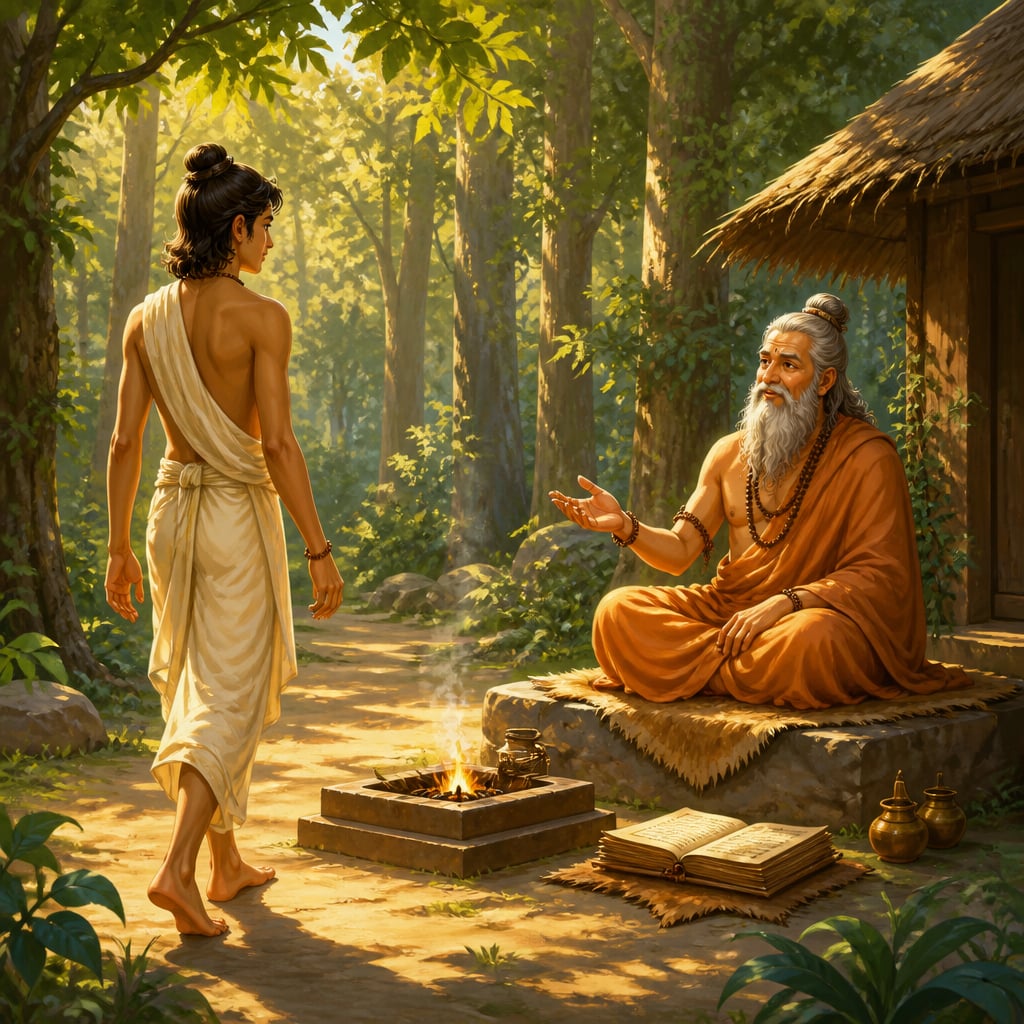
Young Bhrigu returning to his father Varuna's forest hermitage

Varuna did not give a lecture. He handed his son a question.

That from which beings are born, by which they live, and into which they return when they die. Inquire into that.

Then he sent him away to do tapas, the heat of sustained contemplation. Bhrigu came back with an answer. 'Food is Brahman.' Everything is born from food, lives by food, returns to food when it dies. Varuna did not praise him and did not correct him. He said one sentence. Inquire further. Bhrigu went back into the forest.

He came back four more times. Breath is Brahman. Mind is Brahman. Discerning wisdom is Brahman. Finally, bliss is Brahman. Each answer was true at its own layer, and each time Varuna sent him deeper. By the end, Bhrigu had walked through the five sheaths the Taittiriya would lay out as a map for every seeker who came after him. The point of the story is not that Bhrigu arrived somewhere. The point is that he kept finding one more room below the floor.

The Taittiriya Opens a Map

Around 600 BCE, long before any Greek philosopher asked this question, the Taittiriya offered an answer that did not flinch from the facts. Yes, the body changes. Yes, the mind changes. Yes, the emotions change. The Taittiriya insists that noticing this forces a deeper question rather than dissolving the inquirer. The text opens its sheath chapter with a single line that sets the target:

satyaṃ jñānam anantaṃ brahma Brahman is truth, knowledge, infinity.

The answer the Upanishad builds toward that line is the Pancha Kosha: five nested sheaths, each finer than the last, wrapped around what you actually are.

The five sheaths of being, the Pancha Kosha

Annamaya kosha. The food sheath. The flesh, the bones, the blood. Literally made of what you ate last Tuesday. It changes constantly. This is the layer modern scientists point to when they say you are not the same person biologically after seven years.

Pranamaya kosha. The life breath sheath. The energetic system that keeps the body animated: breath, circulation, metabolism. Present in plants and animals as well. Still changing, still impermanent, but deeper than bone.

Manomaya kosha. The mind sheath. Thoughts, moods, emotions, desires. The layer Hume examined when he looked inside and found only a bundle of fleeting impressions. He was right about this layer. He just stopped looking too soon.

Vijnanamaya kosha. The sheath of discerning wisdom. The intellect that knows it is thinking. The part of you that can watch a thought and say 'that thought is unkind, I will set it aside.' This layer is already subtler than anything Hume located.

Anandamaya kosha. The bliss sheath. Not the pleasure you feel at a good meal, but the quiet stability that remains even in deep dreamless sleep, when no meal, no thought, no worry exists. Something was there. Something noticed the absence of thoughts. That something is the bliss sheath.

Behind all five sheaths, the Taittiriya points to what it calls simply Atman: the witness that observes all five layers changing without itself being any of them.

Hume Looks Inside and Finds Nothing

David Hume writing his treatise in 1739 Edinburgh

Fast forward to 1739. David Hume, age 28, publishes A Treatise of Human Nature. Writing in Edinburgh, responding to Descartes and Locke, Hume decides to look for the self the way an empiricist should: by introspection.

He finds a problem. 'For my part, when I enter most intimately into what I call myself, I always stumble on some particular perception or other, of heat or cold, light or shade, love or hatred, pain or pleasure. I never can catch myself at any time without a perception, and never can observe anything but the perception.'

His conclusion is bold. There is no self, just a bundle of perceptions succeeding each other with great rapidity. What feels like 'you' is a memory-stitched illusion, a rope made of frayed threads pretending to be continuous.

It is a remarkable piece of philosophical honesty. Hume does not fudge. He looks, he fails to find the self, and he reports the finding. Two hundred and fifty years later, Derek Parfit elaborated the same view with his teletransporter thought experiment, arguing that personal identity simply does not matter as much as we think.

Where Hume Stopped, the Taittiriya Kept Walking

Here is the gap. Hume looked inside and found only impressions. The Taittiriya looked inside and found impressions too. The Taittiriya agrees: at the mind layer, there really is nothing but a bundle. Hume described the manomaya kosha accurately.

But Hume, following the rules of 18th century empiricism, could only describe what he found. He could not ask the next question: who is the one doing the finding? The reporter cannot be one of the impressions, because impressions do not observe themselves. There has to be an unobserved observer. Not a new impression to chase, but the one to whom all impressions show up.

The Taittiriya is willing to sit with this. The rishi says the observer is not an object at all. You will never catch it by introspection, because introspection is what it does. It is prior to every thought. It is the still ground in which thoughts arise. It is the anandamaya kosha and the Atman beyond.

Parfit, centuries later, ran into the same wall and concluded that identity 'is not what matters.' That is one way to handle it. The Taittiriya's way is different. It says identity is not a chain of events you can point to, and it is not nothing. It is the witnessing in which the events occur.

Why This Matters Today

In 1984, the Oxford philosopher Derek Parfit published Reasons and Persons and argued, with a teletransporter thought experiment, that personal identity is not what we think it is and therefore 'is not what matters.' Around the same time, the American psychologist Steven Hayes was building Acceptance and Commitment Therapy around a clinical observation: patients who locate their identity in roles, in jobs and relationships and stories, collapse harder when the roles change. Hayes called the alternative self as context. The phrase is a clinical description of what the Taittiriya calls the witness behind the sheaths. Parfit reached the edge of the discovery and shrugged. Hayes turned it into a therapy. Bhrigu's father turned it into a practice.

If you ever lie in bed at night and wonder whether the child in the old photograph is really you, the Taittiriya gives you a working answer. Your body is not you, and that is fine. Your thoughts are not you, and that is fine. Your personality is not you, and that is actually good news, because personalities can be updated without existential terror. What remains is the simple fact of being aware. You were aware at ten. You are aware now. Awareness itself does not age, because it is not the kind of thing that can age.

Back in the forest where the story began, Bhrigu kept walking one more layer inward every time his father said inquire further. The instruction has not changed. The layers are still there, in you, in the order the Taittiriya laid them out. The question Varuna handed his son is still the one worth carrying into your own quiet room.

Case studies

Parfit's Teletransporter and the Copy on Mars

In his 1984 book Reasons and Persons, Oxford philosopher Derek Parfit invites you into a teletransporter on Earth. The machine scans every cell, destroys the original, transmits the data to Mars, and reconstructs an atom-identical copy that walks out the other end. The copy has your memories, your plans, your loves. Is the person who walks out on Mars you? Parfit then introduces a malfunction: the Earth scanner fails to destroy the original, so now two identical versions exist at the same time. Which one is really you? Parfit uses this puzzle to argue that identity does not track anything deep. We are attached to a fiction, and clinging to it causes unnecessary fear.

The Taittiriya does not need to argue against Parfit because it agrees with his data. The annamaya kosha is copyable in principle. The manomaya kosha (memories, associations, moods) is copyable in principle. Even the vijnanamaya is copyable if you accept the premise. But the sākṣin, the witness, is not 'in' the scanned configuration. It is the one to whom the configuration shows up. Two identical sheath bundles can exist without any mystery about which one is 'really you,' because the Self was never located in the sheaths in the first place.

Parfit concluded that personal identity 'is not what matters' and spent his career arguing for a more impersonal ethics built on that finding. The Taittiriya arrives at a similar conclusion from a different direction. Impersonal ethics is possible because the Self is not the person we think it is, and it is also not nothing. The rishi and the Oxford philosopher agree that the panicked question 'which one is really me' is badly posed. They disagree on what replaces it.

When a thought experiment destabilizes your sense of self, notice which layer is being destabilized. Usually it is the annamaya or the manomaya. The inquiry does not end there.

Parfit's Reasons and Persons was cited in more than 6,000 academic papers in the decade after its publication, making it one of the most discussed works of analytic philosophy in the 20th century. The Taittiriya's sheath chapter predates it by roughly 2,500 years.

Phineas Gage and the Iron Rod

On September 13, 1848, a 25 year old railroad foreman named Phineas Gage was tamping gunpowder into a drilled hole in Cavendish, Vermont when the charge exploded. An iron rod, three feet seven inches long and an inch and a quarter thick, passed through his left cheek, behind his left eye, and out the top of his skull. He survived. He walked to the cart, spoke coherently, and was treated by Dr. John Martyn Harlow. Over the following months his personality changed dramatically. He became impulsive, profane, unable to plan or hold down his old responsibilities. Friends famously said 'Gage was no longer Gage.'

Every neurology textbook uses Gage to argue that personality is in the brain. The Taittiriya accepts the premise. Damage the annamaya and you can lose features of the manomaya and vijnanamaya. What the textbooks do not notice is which layer was damaged and which was untouched. Gage kept speaking. He kept forming memories of the accident and of his doctor across years of visits. A reporter who could say 'I was different before' was still present the entire time. The mind sheath was broken. The witness behind it remained, to notice the breakage.

Gage lived twelve more years, held several jobs including driving a stagecoach in Chile, and died in 1860 after a series of seizures. His skull sits in the Warren Anatomical Museum at Harvard. Neuroscience treats him as proof that the self is in the frontal lobe. A Vedantic reading treats him as proof that the self is precisely what Gage did not lose: the bare capacity to be a subject of experience across the damaged layers.

'Gage was no longer Gage' is a true description of one layer. Holding the loss at that layer, instead of collapsing all of personhood into it, is what the five sheath map makes possible.

The Long Goodbye: A Caregiver's Dilemma

A spouse of fifty years sits beside a hospital bed. The person in the bed no longer recognizes her face. Does not remember the wedding. Does not remember their children's names. On a good day there are flashes of something familiar. On a bad day there is a stranger in a hospital gown. Friends tell her the person she loved is 'already gone.' The doctors use the phrase 'long goodbye.' She is alone with a question no medical chart has room for: is my husband still here?

The manomaya is failing. Memory, language, recognition, the whole story stitched sense of 'the person we married.' All of that lives in the layer Alzheimer's attacks hardest. But the Taittiriya asks her to notice what is still present. A body that startles at touch. A chest that settles when music plays. A witness who is experiencing this present moment even without the ability to narrate it. The outer sheaths of identity are dissolving. The inner sheaths are thinner than usual, but they are not absent.

Caregivers who learn the kosha framework often report that the 'long goodbye' story becomes less binary. The spouse stops oscillating between 'he is still here' and 'he is gone' and settles into something quieter: the layers she used to recognize him by are going, and the layer that is just him, here, is what she is keeping company with. A growing number of Indian and Western hospices now teach caregivers this kind of layered presence, whether or not they call it Vedanta.

Love does not have to track the manomaya. The Taittiriya's map gives caregivers a more humane place to stand than 'he is still the same person' or 'he is already gone.'

The 2024 World Alzheimer Report estimates that 55 million people worldwide live with dementia, and that roughly 11 million family caregivers carry the daily emotional weight of the 'long goodbye.' Most care philosophies give them a binary: present or gone. The five sheath model offers a third option.

Reflection

More in Who Am I? The Self and Identity

All lessons in Who Am I? The Self and Identity · The Big Questions: Upanishads and the Philosophers Who Followed course