Who Is the Knower Behind All Knowing?

Pippalada's students asked six questions. Husserl spent a lifetime on the same one.

Prashna Upanishad vs Husserl and Nagel. The knower can be known, but only by turning inward.

Six Students, One Year of Silence

The Prashna Upanishad opens with an unusual scene. Six men arrive at the forest hermitage of the rishi Pippalada. They are not strangers to each other. They have already spent years studying the Vedas. They are grown, accomplished, respected in their own right. Yet they come to Pippalada's door carrying firewood in their hands, the traditional sign of a student approaching a teacher. The Upanishad names them carefully: Sukesā Bhāradvāja, Śaibya Satyakāma, Sauryāyaṇī Gārgya, Kauṣalya Āśvalāyana, Bhārgava Vaidarbhi, Kabandhi Kātyāyana. Each carries a question he has not been able to answer.
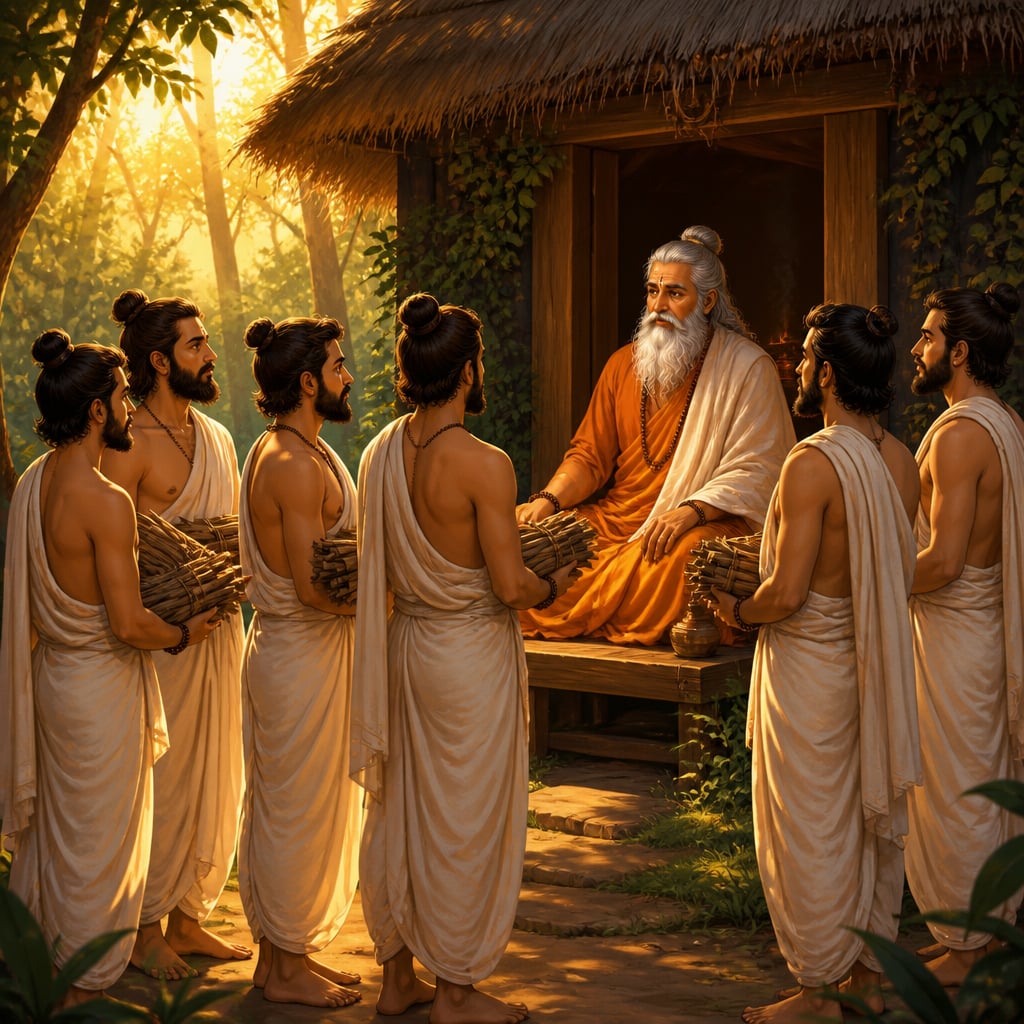
Six seekers arriving at the rishi Pippalada's hermitage with firewood

Pippalada does not answer them immediately. He tells them to stay with him for a year, to perform tapas, to live in brahmacarya (disciplined continence), to hold their questions inside them while their ordinary restlessness burns off. Only after the year is complete does he agree to take up the questions one by one. Six questions, six answers, six progressively deeper probes into the same mystery. The structure is deliberate. Each question presupposes the one before it. Each answer opens the ground for the next.

The first five questions work their way through the cosmos in a widening spiral. Kabandhi asks where creatures come from. Bhārgava asks which power in the body is the foundation of life. Kauṣalya asks about the nature of breath (prāṇa). Sauryāyaṇī asks about the three states of waking, dreaming, and deep sleep. Śaibya asks about the syllable Om and what meditation on Om accomplishes. Each answer is substantial on its own. Each draws the questioner further inward from the external cosmos into the internal cosmos and from the internal cosmos into the states of consciousness themselves. By the time Sukesā asks the sixth question, five rings of the inquiry have already been completed.

The Sixth Question

Sukesā does not open with his own question. He opens with a confession. Years ago, he says, a prince named Hiraṇyanābha of Kosala came to him and asked: 'Do you know the Person of sixteen parts?' And Sukesā, faced with a question he could not answer, did the one honest thing. He said he did not know. He did not guess. He did not construct a pleasing fiction. He sent the prince away and carried the question inside him until he could find someone who could answer it. Now, after a year of silence at Pippalada's hermitage, he asks the question at last.

The question itself is odd on first hearing. Who is the Person (puruṣa) of sixteen parts (kalās)? The sixteen parts are a traditional list: breath, faith, sky, air, fire, water, earth, the senses, the mind, food, vigor, tapas, mantras, works, worlds, and name. They are everything the Vedic seer uses to think about what a human being consists of. To ask about the Person of sixteen parts is to ask: when you add up everything a human being is, whose person is it? Who is the one in whom all these pieces hang together? Who is the knower that the knowing belongs to?

This is the question of the lesson. It is deceptively simple. You can know an apple by looking at it. You can know a thought by thinking it. You can know a feeling by feeling it. What you cannot do is know the one who is doing the looking, thinking, and feeling, because the moment you try to look at the looker, the looker becomes something that is looked at, and the actual looker has quietly stepped behind the new object and is looking at it. Every attempt to catch the knower in the net of knowledge misses its target by one step. The Prashna's sixth question is asking about that one step.

Pippalada's Answer

Pippalada does not answer with an argument. He answers with an image. Imagine the great rivers of the world, he says. They are flowing. Each has its name. Each has its form. Ganga, Yamuna, Sarasvati, and all the others. When they reach the ocean, what happens? The names dissolve. The forms dissolve. What was the Ganga a moment ago is now simply ocean, and the word 'Ganga' no longer picks out anything the senses can find. In the same way, Pippalada says, the sixteen parts that make up a human being flow toward the Person. When they reach the Person, they dissolve. Their names and forms are broken, and what remains is called simply Person. And that Person, Pippalada concludes, is now partless (akala) and deathless (amṛta).

Notice what the image does. It does not tell you to add up the sixteen parts and call the sum the knower. It tells you the opposite. The knower is what remains when the parts go silent. The knower is not found by looking among the parts. The knower is found by noticing that the parts are all looked at by something that is not itself a part. The river is not the ocean. The parts are not the Person. And yet the river is nothing other than the water that, at the moment of reaching the ocean, is already ocean. The parts are nothing other than the Person appearing locally as parts.

This is a structurally unusual answer. It is not the answer to the question 'what is the knower' as you would answer 'what is a tree' (by listing features). It is the answer to the question 'where do I find the knower' (by describing a procedure: follow the parts inward until they dissolve, and whatever is left is the knower). The Prashna is not offering a definition. It is offering a direction. If you turn inward all the way, past the senses, past the mind, past the states of waking and dreaming and deep sleep, past everything that could be an object, what is left is the Person. And what is left cannot be further described, because there is nothing further by which to describe it.

The Brihadaranyaka Upanishad makes the same point in a single sentence that has become famous. Yajnavalkya tells his interlocutor: 'You cannot see the seer of seeing, hear the hearer of hearing, think the thinker of thinking, know the knower of knowing. This is your Self, which is within all.' By what, Yajnavalkya asks elsewhere, could one know the Knower? The question is rhetorical. There is no such thing. Knowing requires an object, and the Knower is precisely not an object. You do not know the Knower the way you know the parts. You are the Knower, and the way you come to recognize this is by noticing that every attempt to make it into an object fails in a specific and illuminating way.

Husserl and the Return to the Things Themselves

Edmund Husserl bracketing the world in his Freiburg study

Twenty five centuries later, in Freiburg, a German philosopher named Edmund Husserl was building a project he called phenomenology. Husserl had started in mathematics and logic. He turned to philosophy because he thought the sciences of his day had lost touch with the one thing they were supposed to study: human experience itself. Physics is something known, he argued. It is known by somebody. You cannot skip over that somebody and still be doing science. 'Zu den Sachen selbst,' he wrote. Back to the things themselves.

His method was the epoché, the bracketing. You take the ordinary assumption that the world is out there independently of your experiencing it, and you do not deny it, you suspend it. You attend to experience purely as experience and ask what its structures are. When you do this, Husserl argued, you find that every experience has the same peculiar shape. It is always consciousness of something. A thought is always a thought about something. A seeing is always a seeing of something. He called this property intentionality. Consciousness is never a free-floating glow. It is always directed at an object.

Now comes the problem Husserl spent the rest of his career on. If every consciousness is consciousness of something, what is the consciousness itself? It is the thing doing the directing. You cannot make it into another object of consciousness without needing a further consciousness to direct at it, and so on, forever. Husserl followed the problem inward. He started talking about the transcendental ego, the pure I behind all particular thoughts. By his late work he was circling something that looked a great deal like what the Prashna had called the Person. He never quite got there. He died in 1938 with the problem still open.

Thomas Nagel and the Bat

Thomas Nagel imagining what it is like to be a bat in flight

In 1974, an American philosopher named Thomas Nagel published a fifteen-page paper called 'What Is It Like to Be a Bat?' It has been cited tens of thousands of times and made a simple point that has been very hard to argue away.

Imagine, Nagel said, that you want to know what it is like to be a bat. A bat navigates by echolocation. It has a body and a way of being in the world no human has ever had. There is, Nagel insisted, something it is like to be a bat. The bat is not merely a biological machine. It has an inside. And the inside of a bat is exactly what no amount of third-person scientific knowledge can capture. You can know everything about bat neurons, bat wings, bat brain chemistry, and still not know what it is like, from the inside, to be a bat. The subjective character of experience is not reducible to any objective description of the system that has it.

Nagel was not making a mystical claim. He was a secular analytic philosopher in a respectable journal. The argument was strictly logical. Subjective experience has a first-person character. Objective science is, by construction, third-person. Any attempt to explain the first-person entirely in third-person terms will leave something out. The gap is structural.

Notice what Nagel has stumbled onto. The subject is precisely what cannot appear among the objects. He uses a bat because bats are strange enough to make the point vivid, but the same argument applies to you. The knower at the center of your knowing is exactly what third-person science cannot see, because third-person science sees only what can be made into an object. And the knower is what does the objectifying.

Where the Upanishads Go Further

Husserl and Nagel, each in his own vocabulary, arrived at the doorstep of the Prashna's sixth question. They saw that the knower cannot be known the way objects are known, and that every attempt to catch the subject in the net of objective description leaves the subject behind. What they did not have was a method for the next step.

The Prashna does not stop at 'the knower cannot be caught in objective language.' It says: good, now turn inward and notice that you are the knower, and that the noticing is not another object. This is the move Husserl circled for decades without making. He kept hoping to catch the transcendental ego in some kind of reflective grasp. The Upanishads would tell him, kindly, that grasping is the wrong posture. The knower is not grasped. The knower is the one grasping. The only way to recognize it is to relax the outward reach and rest in the fact that you are already the one reaching.

The Vedantic tradition called this direct recognition sākṣin, the witness. The witness is not another level of consciousness behind ordinary consciousness. The witness is what ordinary consciousness always is, once you notice that every thought, feeling, and perception is being witnessed by something that is not itself a thought, feeling, or perception. The noticing is not technically difficult. The mind keeps trying to make the witness into another object, and the practice is letting that attempt drop. When the attempt drops, what is left is already the answer.

There is a second difference. Husserl and Nagel treat the knower as a personal, local thing: your knower is yours and the bat's knower is the bat's. The Upanishadic claim goes further. The knower in you, once recognized, is not a small private glow belonging to your biography. It is the one Person the Prashna is talking about. Rivers reaching the ocean do not argue about whose drop is whose. They are ocean now. What you call your knowing is the one Knower appearing locally as you. This is not a metaphor the Upanishad is reaching for. It is the experiential finding it is trying to report.

Why This Matters Now

Modern consciousness studies is stuck in what the philosopher David Chalmers calls the hard problem of consciousness: how any physical system could give rise to subjective experience at all. Nagel's paper is one of the canonical statements of it. The problem is hard because it is structurally the same problem Pippalada was answering for Sukesā. The subject cannot be derived from the objects, because the subject is not another object. Start with a complete objective description of the brain, and you will never reach the fact that there is something it is like to be the person whose brain it is. Something has to be added, and what has to be added is not more physics. It is a different kind of knowing altogether.

The Upanishadic answer is not a solution to the hard problem in the sense academic philosophy is looking for. It is a dissolution of the problem in a different key. You will not find the subject among the objects, because the subject is not in that category. But you do not have to find it. You are it. The only question is whether you are willing to turn your attention inward long enough to notice.

This matters practically. Most of the suffering a modern person carries is built on silent identification with the sixteen parts. You think you are your body, your feelings, your thoughts, your history, your reputation, your plans, your failures. When any of these is threatened, you suffer as if you yourself were being destroyed. The Upanishad is not asking you to deny that the parts are yours. It is asking you to notice that the one who has them is not the same as the parts. Rivers reach oceans. The parts reach the Person. And the Person, the Upanishad insists, is partless and deathless, and is already what you are. The recognition does not take away the body's pain or the mind's sorrow. It takes away the confusion of the witnessing self with the witnessed experience, and that confusion is where most avoidable suffering lives.

Back at the hermitage, Sukesā set down his question. The year of silence had earned the answer. The river had reached the ocean.

Case studies

Pippalada and the Six Students

Six accomplished Vedic scholars arrive at Pippalada's forest hermitage carrying firewood. They are not novices. They already know the Vedas by heart. They have taught others. They have sat at other teachers' feet. And they have each arrived at a question that their prior learning has not been able to answer. The Upanishad names them: Kabandhi Kātyāyana, Bhārgava Vaidarbhi, Kauṣalya Āśvalāyana, Sauryāyaṇī Gārgya, Śaibya Satyakāma, Sukeśā Bhāradvāja. Pippalada does not immediately agree to teach. He tells them to stay with him for one year, performing tapas, living in disciplined restraint, holding their questions inside themselves without acting on them. Only after the year is complete does he take up the six questions one by one, in an order that moves from the external cosmos progressively inward. The sixth question, Sukesā's question about the Person of sixteen parts, is the climax of the sequence.

Read the year of silence as the real teaching. The answers Pippalada gives are already available in existing Vedic texts. What is not available in the texts is the capacity to hear the answers in a way that does not reduce them to more information. That capacity is what the year of tapas is cultivating. The six students are not being tested for endurance. They are being prepared so that when Pippalada finally speaks, his words can actually land rather than being absorbed into the existing mental furniture. The sequence of the six questions is also not accidental. The first question is cosmogony: where do creatures come from. It sends the questioner outward toward the widest horizon. The next four questions draw the questioner progressively inward: through the body, through the breath, through the states of consciousness, through the symbol Om and what meditation on Om reveals. By the time the sixth question is asked, the entire outward world has been traversed and the questioner has nowhere else to go but directly to the knower. That is when Pippalada gives the rivers and ocean answer. The Upanishad is teaching a method of sequencing. You cannot ask the sixth question well without having first asked the previous five.

After Pippalada finishes answering the sixth question, the six students prostrate to him and say: 'You are our father indeed, you who have taken us across to the further shore beyond ignorance.' The closing line of the Upanishad is one of gratitude and recognition. The text does not dwell on what the students did next, whether they returned to the world or stayed in the forest, whether they taught or kept silent. The Upanishad does not need to. The transformation has already happened in the receiving of the answers, and the rest of the story is whatever life the recognition goes on to produce. Pippalada disappears from the text the way Yama disappears from the Katha. The teacher has served his function. What remains is the student and the recognition.

The Prashna is teaching that the question of the knower is not a question that yields to more information. It is a question that yields only to a particular quality of attention that has to be cultivated before the answer becomes audible. This is the hardest part of the Upanishad to transmit to a modern reader, because the modern expectation is that any question worth asking should be answerable by reading the right book. The Prashna is saying, gently, that this question is not one of those. You can read the Prashna a hundred times and still not hear the answer. The year of tapas is not an ancient superstition the modern reader is allowed to skip. It is the minimum preparation without which the rivers and ocean image cannot do its work. The six students are a model. They came already learned. They still needed the year.

Modern education is structured almost entirely around the assumption that questions are answered by accumulating information. The Prashna's structure is a quiet correction. Some questions, the ones that matter most, are not answered by more information. They are answered by a different quality of attending, which cannot be transmitted through reading alone and which takes time to cultivate. Any modern seeker who has tried to figure out the question of consciousness by reading more papers, and noticed that the reading never quite lands the question, is in the position the Prashna's six students were in before they went to Pippalada. The Upanishad's suggestion is not to read less. It is to read with the kind of attention that can come only from the same inward turn the students were being prepared for.

The Prashna Upanishad is the shortest of the ten principal Upanishads commented on by Shankara, coming in at roughly four pages of Devanagari text. Despite its brevity, it is considered one of the most philosophically complete, precisely because its six question structure covers the full range of the inquiry from cosmogony to the inward turn in a deliberate sequence. Shankara's commentary treats it as one of the clearest sources for the Advaita position on the unobjectifiable nature of the Self.

Thomas Nagel's 'What Is It Like to Be a Bat?' (1974)

In October 1974, the philosophical journal The Philosophical Review published a fifteen page paper by the American philosopher Thomas Nagel. The paper was titled 'What Is It Like to Be a Bat?' Its central argument was deceptively simple. Nagel pointed out that a bat has a way of being in the world that no human has ever had. A bat navigates by echolocation. Its sensory world is structured around the reflection of its own high frequency cries. There is, Nagel insisted, something it is like to be a bat, from the inside. The bat is not merely a biological machine. It has an experience of its own life. And that experience, the inside of being a bat, is exactly what no amount of third person scientific knowledge can capture. You can know everything there is to know about bat neurons, bat wings, bat echolocation, bat sonar processing, and still not know what it is like, from the bat's own standpoint, to be a bat. The subjective character of experience, Nagel argued, is not reducible to any objective description of the physical system that has the experience. The gap is not a gap in our current knowledge. The gap is structural, built into the difference between the objective and the subjective.

Nagel is not a Vedantin. He is a secular analytic philosopher working at NYU, suspicious of both religious and mystical approaches to the mind. That is exactly what makes his argument useful to the Prashna's case. Nagel has arrived at the edge of the Upanishadic insight by following strict analytic reasoning, without any of the motivations the Upanishadic tradition is usually accused of projecting onto the problem. His conclusion is that the knower, the one for whom there is 'something it is like' to be having experience, cannot be made an object of third person description. This is the same structural point Yajnavalkya makes in the Brihadaranyaka when he says you cannot see the seer of seeing or know the knower of knowing. Nagel does not take the next step the Upanishads take, which is to turn inward and recognize that what cannot be made an object is not nothing, it is what you already are. But he does establish, with maximum philosophical rigor, that the next step has to be taken somehow. You cannot stay where modern science wants you to stay, which is in the third person view from nowhere. If you do, you will leave out exactly the thing you were trying to study.

Nagel's bat paper has been cited tens of thousands of times and is now one of the most influential papers in modern philosophy of mind. It is routinely taught in undergraduate philosophy courses and cited in neuroscience textbooks. Its argument has generated a substantial secondary literature, including responses from functionalists, physicalists, and eliminativists, none of which has succeeded in making the bat problem go away. David Chalmers, in 1995, generalized Nagel's point into what he called the hard problem of consciousness: the problem of explaining why any physical system should give rise to subjective experience at all. The hard problem is now the central challenge of the field. It is, structurally, the same problem Pippalada was answering for Sukesā twenty five centuries earlier, which is why the Upanishadic treatment of the question remains directly relevant even to readers who arrive at it through contemporary philosophy of mind.

Nagel matters for this lesson because his argument is entirely independent of the Upanishadic tradition and yet arrives at the same structural observation. Subjective experience is not reducible to objective description. The knower cannot be caught in the net of knowing. A reader who is skeptical of ancient texts, who finds the Prashna's sixteen parts and dissolving rivers too exotic to take seriously, can read Nagel's fifteen page paper instead and end up at exactly the same philosophical place. Once there, the reader has two options. Option one is to stay at the paper and treat the hard problem as a permanent puzzle that science will either solve or fail to solve in some distant future. Option two is to notice that the Upanishadic tradition has been describing the way past the puzzle for two and a half millennia, and that the way past it is not more philosophy but a disciplined inward turn. Nagel gives no guidance on which option to take. The Prashna gives detailed guidance and a specific method. That is not a coincidence. It is what traditions are for.

The modern reader who wants to understand what the Upanishads mean by the unobjectifiability of the knower can begin with Nagel's paper. It is short, secular, and rigorously argued, and it lands the reader in exactly the position from which the Prashna's sixth question becomes a live question rather than an ancient curiosity. The Upanishad then offers the continuation Nagel's argument does not. Read together, they are a natural pair: Nagel for the Western philosophical framing of the problem, the Prashna for the direction of the resolution. Neither alone is sufficient for a modern seeker. Together they turn out to be remarkably complete.

As of 2024, Nagel's 1974 paper has been cited approximately sixteen thousand times according to Google Scholar, and is routinely listed among the ten most influential papers in twentieth century philosophy of mind. Its central argument, that subjective experience is irreducible to third person description, has been accepted as at least a prima facie challenge by nearly every major position in the field, including positions that ultimately attempt to explain the challenge away.

Ramana Maharshi's 'Who Am I?' Self Inquiry

In 1896, a seventeen year old Tamil Brahmin boy named Venkataraman Iyer was sitting alone in an upstairs room of his uncle's house in Madurai when he suddenly became convinced, without any external cause, that he was about to die. Instead of panicking, the boy did something unusual. He lay down on the floor, stiffened his body as if dead, held his breath, and then asked himself: 'The body will die. But am I the body? If I am not the body, then what am I?' He stayed with the question. What he reported, decades later, was that the question had no verbal answer. What it had was a recognition. The body, he found, was an object. Objects appear and disappear. But the one who was watching the body was not itself an object. It did not appear and disappear. It was whatever was left when every object had been removed. The boy got up from the floor a different person. He left his family home a few weeks later, traveled alone to the sacred hill of Arunachala, and spent the rest of his life there as the sage later known to the world as Ramana Maharshi.

Ramana's entire teaching can be summarized in four words: 'Who am I?' He treated this question not as a philosophical puzzle to be argued but as a specific meditative practice. The practice is: whatever thought, feeling, or perception arises, ask who is aware of it. Then, instead of accepting any verbal answer, ask the same question of the awareness itself. Who is aware of the awareness? Keep asking until the questioning dissolves into the awareness that was always already there. Ramana called this method ātma vicāra, self inquiry, and he taught it to every visitor who came to him, whether they were Indian pandits or Western seekers or confused tourists passing through. The method is exactly the operational form of the Prashna's sixth question. Where Pippalada used the rivers and ocean image to point at the Person of sixteen parts, Ramana reduced the entire pointing to a single question that could be carried through any moment of the day. The method is the Upanishad turned into a portable practice.

Ramana lived at Arunachala from 1896 until his death in 1950, rarely leaving and almost never traveling. His ashram at Tiruvannamalai became a destination for seekers from India and the West. Carl Jung, Somerset Maugham, Paul Brunton, and Arthur Osborne all visited or wrote about him. Brunton's book A Search in Secret India (1934) introduced Ramana to a Western audience and became a minor sensation. Ramana wrote very little himself. His recorded conversations, collected in books like Talks with Sri Ramana Maharshi, consist almost entirely of variations on the same theme: do not argue about the Self, inquire directly into who you are. Ramana's death in 1950 did not slow his influence. The ashram continues to function, the books continue to circulate, and the method of self inquiry has become one of the most widely practiced contemplative techniques in the modern spiritual world, adopted by teachers ranging from strict Advaitins to loose neo Vedanta popularizers.

Ramana is the living demonstration that the Prashna's sixth question can be asked and answered in the present tense, not in an ancient forest hermitage but in a hill town in twentieth century Tamil Nadu. His life is the Upanishadic claim under experimental conditions. A seventeen year old with no formal training turned the question inward, found what the Prashna said he would find, and spent fifty four years afterward pointing other people toward the same finding. He did not build a philosophical system. He did not argue with anyone. He simply answered every question with the same question, which was the question of who was asking. This is what it looks like when the Prashna's inward turn is taken all the way. The tradition is not an archive. It is a repeatable procedure, and Ramana is the twentieth century repetition.

For a modern seeker who finds the Prashna's ancient idiom difficult to enter, Ramana's method is the bridge. It uses the same language a modern person already speaks. It has been tested under modern conditions by thousands of practitioners. It does not require belief in any particular cosmology. It asks only for the willingness to hold a single question (who is aware of this) long enough for it to cease being a question and become a recognition. The Upanishadic tradition has been transmitting this method, in one form or another, for twenty five centuries. Ramana is the most accessible contemporary point of entry. The seeker who wants to know what the Prashna's sixth question actually feels like, rather than merely what it philosophically argues, can begin with a half hour of Ramana's self inquiry and have a better idea by the end of the half hour than by reading any amount of academic philosophy of mind.

Ramana Maharshi's recorded conversations at Sri Ramanasramam span roughly twenty five years and have been collected in multiple volumes totaling thousands of pages. His method of self inquiry is taught today by a wide range of teachers including Mooji, Gangaji, and Adyashanti, and a number of contemporary neuroscience researchers on meditation, including Richard Davidson and Sam Harris, have referenced it. The method's central move, turning attention back on the one attending, is structurally identical to what Husserl was trying to accomplish through the phenomenological epoché, but with a different sense of what counts as completion.

Historical context

c. 800 to 400 BCE (Prashna Upanishad) / 1900 to present (Husserl and Nagel)

The Prashna Upanishad belongs to the Atharva Veda and is one of the principal Upanishads commented on by Shankara. Its name means 'Question,' and the text is built around six questions asked by six students of the rishi Pippalada. The six questions are arranged in a deliberate widening and then narrowing spiral: creation, the foundation of life, the nature of prāṇa, the three states of consciousness, the syllable Om and its meditation, and finally the Person of sixteen parts. Each question sets up the next. By the time the sixth question arrives, the questioner has already been led from the external cosmos into the structure of consciousness itself. The Prashna is one of the most systematically architected Upanishads, and the sixth question is its culmination. Shankara's commentary on the Prashna treats it as one of the clearest statements of the Advaita position that the Self is not an object and cannot be known the way objects are known.

The dialogue form of the Prashna is not decorative. It is doing philosophical work. The fact that the questioners are already accomplished scholars, rather than beginners, is important. The Upanishad is showing that the question of the knower cannot be answered by more scholarship. It can only be answered by a particular turning inward that the scholars themselves had not made until they spent a year in silence with Pippalada. The year of tapas is the condition under which the sixth question can be heard. Without it, the rivers and ocean image is just another clever metaphor. With it, the image is a direct pointer to something the students can now recognize in themselves.

Reflection

More in What Can We Know? The Limits and Nature of Knowledge

All lessons in What Can We Know? The Limits and Nature of Knowledge · The Big Questions: Upanishads and the Philosophers Who Followed course