What Are the States of Consciousness, and Do They Reveal Different Truths?
The Mandukya mapped four states of consciousness 2,500 years before phenomenology.
Mandukya Upanishad vs William James and Husserl. Each state reveals a different relationship between knower and known, and the fourth reveals the knower itself.
A King Cannot Sleep
Mithila, in the years when King Janaka still ruled there. The new moon sacrifice has been performed, the priests have gone home, and the torches have burned low in the great hall. Yajnavalkya, the most respected sage in the kingdom and the king's chosen teacher, is gathering his shawl to walk back to the forest.
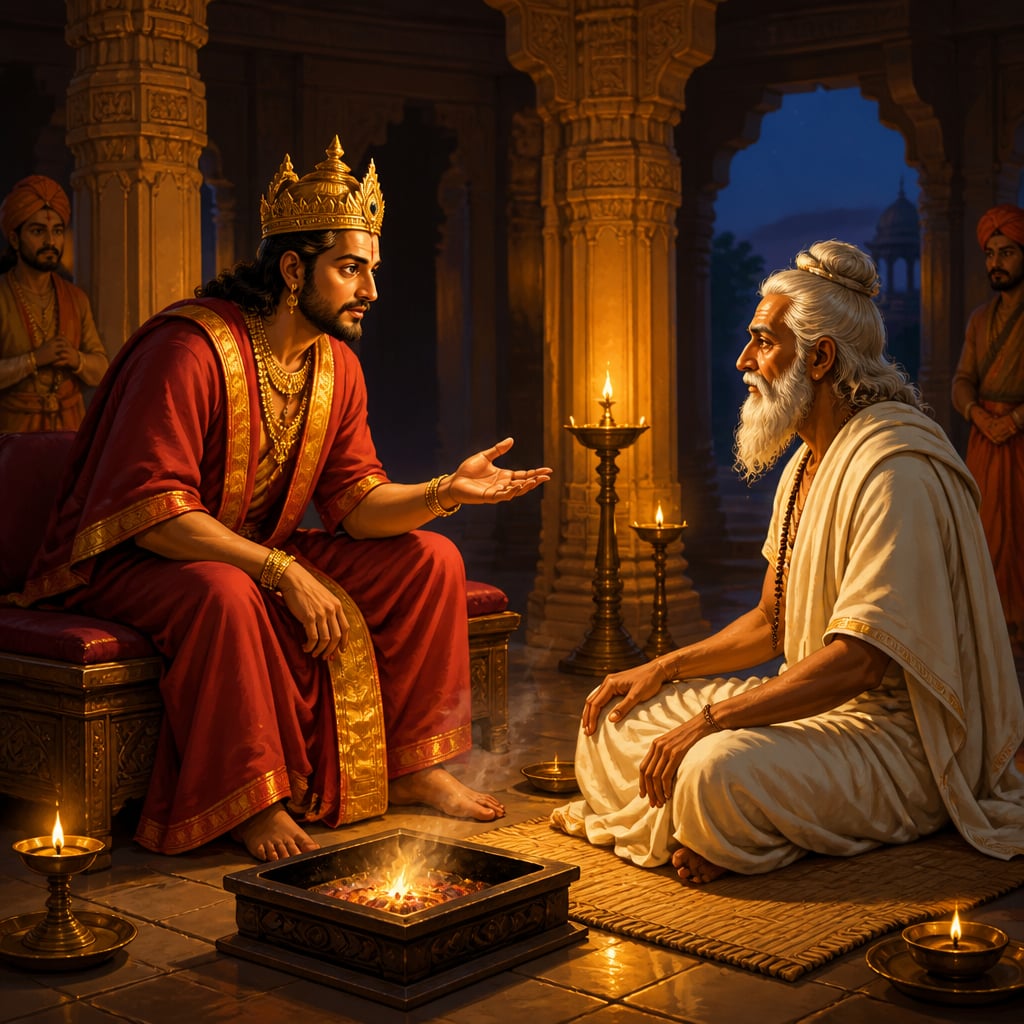
The king stops him at the door. 'Stay one more night, Yajnavalkya. There is a question I cannot get out of my head.'
The two have had this conversation before, in different forms. Janaka is a rare king. He rules a wealthy land, performs the rites, sits on a throne, and yet the questions of the rishis live inside him as if he were a forest renunciate. Tonight the question is small and sharp.
'When I lie down to sleep,' the king says, 'and the dreams stop, and there is no thought, no image, no sound, what happens to the one who knows? In the morning I say I slept well. Who is it that knows the night was peaceful?'
Yajnavalkya does not answer immediately. The fire crackles. Outside, the city is quiet. He has been asked this question by many seekers. He has watched students give up on it. He sits down again.
What he tells Janaka over the next hours, recorded in the fourth chapter of the Brihadaranyaka, is the most careful map of consciousness anyone has ever drawn. Many centuries later, after the dialogue had been preserved, recited, and turned over by generations of teachers, twelve dense verses would crystallize the teaching into a tiny text called the Mandukya Upanishad. Among the one hundred and eight Upanishads, the Mandukya is the shortest. It is also the one the tradition says, alone, is enough for liberation. Twelve verses. One claim. Consciousness has four quarters.
Four Quarters of the Self

The second verse sets the frame. Sarvaṃ hy etad brahma, ayam ātmā brahma, so'yam ātmā catuṣpāt. 'All this is Brahman. This Self is Brahman. This Self has four quarters.' The rishi is not describing states of the body. He is describing the structure of the knower. The first quarter is jāgrat, the waking state, where consciousness turns outward through the senses and grasps the gross world. The second is svapna, the dream state, where consciousness turns inward and projects a world from memory and impression. The third is suṣupti, deep dreamless sleep, where consciousness rests without object, and yet the rishi insists it is not nothing. Something is there. Something knows, in the morning, that the night was peaceful.
Then comes the fourth. Turīya. The word simply means 'the fourth,' as if the rishi refuses to name it, because any name would reduce it to a member of the list. Verse seven of the Mandukya is the most audacious negation in Indian philosophy. Turīya is not inwardly cognitive, not outwardly cognitive, not both, not a mass of cognition, not cognition, not non-cognition. It is unseen, ungraspable, indefinable, unthinkable, unnamable. And then one final word: śiva, adviata. Auspicious. Non-dual. The fourth is not a fourth state alongside the other three. It is the witness that is present in all three, the consciousness that makes waking, dreaming, and deep sleep possible in the first place. You do not reach turīya. You recognize that you never left it.
The Mandukya also maps this onto the sacred syllable AUM. A is waking. U is dreaming. M is deep sleep. And the silence that follows AUM, that resonant quiet into which the sound dissolves, is turīya. Say the syllable slowly and you are traversing the entire structure of consciousness. The rishis built a cosmology into a single breath.
The Western Echo

Twenty-five centuries later, a Harvard philosopher named William James was trying to take religious experience seriously as data. His 1902 Gifford Lectures, published as The Varieties of Religious Experience, are still the founding text of the modern psychology of consciousness. James had attended the 1893 Parliament of the World's Religions in Chicago, heard Swami Vivekananda speak, and read Vivekananda's Raja Yoga soon after. When James sat down to classify mystical states, he cited the Vedantins explicitly. He argued that ordinary waking consciousness is only one type of consciousness, and that 'parted from it by the filmiest of screens, there lie potential forms of consciousness entirely different.' It was a staggering admission from a working scientist in Boston in 1902.
A generation later in Freiburg, Edmund Husserl was building phenomenology. His method, the epoché, asked the philosopher to bracket every assumption about the external world and attend only to consciousness itself, to the pure structure of experiencing. Husserl called this the phenomenological reduction. He wanted to get beneath the natural attitude and find the transcendental ego, the pure consciousness that underlies all acts of knowing. Husserl got strikingly close to something the rishis would have recognized. He even wrote, in his later notebooks, of a consciousness that was not the object of any intentional act but its precondition.
James and Husserl were serious. They were not borrowing anything. They had arrived, independently and through rigorous philosophical work, at the recognition that consciousness is not a single homogeneous thing. It has layers. It has modes. Studying its contents is one kind of work. Studying consciousness itself is another kind of work entirely.
The Gap
Here is what the Mandukya offers that James and Husserl did not quite reach.
First, the Mandukya gives a complete map. Four states, explicitly enumerated, with the fourth explicitly distinguished from the first three. James catalogued mystical states as variations on ordinary consciousness. Husserl described the transcendental ego as the ground of experience but continued to treat it as a kind of refined object of reflection. The Mandukya says turīya is not a refined mode of the first three. It is their witness. The three ordinary states arise and dissolve within it, the way waves arise and dissolve within the ocean.
Second, the Mandukya accounts for deep sleep. This is the test case Western theories almost always fail. If consciousness is a stream of contents, deep dreamless sleep should be a gap in the stream, a discontinuity, a little death every night. But we never experience the gap. We wake and report on the sleep. Something was there, witnessing the absence of content. The Mandukya was built around this observation. Suṣupti is not consciousness gone dark. It is consciousness without an object. And precisely because there is no object, it points most clearly toward the witness that makes all objects possible.
Third, and most important, the Mandukya offers a path. Not just a theory. Husserl could describe consciousness but had no method for resting in it. James could catalogue mystical experiences but approached them as data rather than as destinations. The Upanishadic tradition developed practices for every layer of the map. The syllable AUM is not metaphor. It is a meditative technique. Recite it with attention and you traverse the four quarters in a single breath. The rishis were not only theorists. They were empiricists of consciousness, and the laboratory was the meditator's own awareness.
Why It Matters Today
Modern neuroscience has, in the last seventy years, mapped the three ordinary states in extraordinary detail. Aserinsky and Kleitman discovered REM sleep in 1953. Sleep labs track the neurological signatures of dreaming, of slow-wave sleep, of the transitions between them. EEG studies of experienced meditators keep finding a puzzling fourth signature, a mode of awareness that is not drowsy, not dreaming, not ordinarily alert, and yet lucid. The Mandukya mapped this territory before any lab existed.
The practical point is this. You already know four different ways of being conscious, even if you have never named them. When you are absorbed in this paragraph, that is one mode. When you are daydreaming about your weekend, that is another. When you collapse into dreamless sleep tonight, that is a third. And in rare moments, in deep meditation or in the instant you recognize yourself as the one who has been present through all of it, you touch the fourth. The Mandukya is not asking you to believe anything. It is asking you to notice what is already the case. Consciousness is not one thing. And the one who notices it is itself the most interesting thing there is.
In Mithila, the fire had died down. Janaka did not abdicate. He went on ruling his kingdom, but he ruled it knowing that the throne was something happening inside the witness, not the other way around.
Case studies
Gaudapada and the Karika that turned twelve verses into a world
Around the sixth or seventh century CE, centuries before Shankara, a teacher named Gaudapada took the twelve verses of the Mandukya Upanishad and wrote the Mandukya Karika, a commentary in two hundred and fifteen verses. Gaudapada was Shankara's paramaguru, the teacher of his teacher. His Karika is the first fully articulated Advaita Vedanta text, and every subsequent Advaitin, including Shankara, writes in its shadow.
Gaudapada's reading of the Mandukya is radical. He takes the four quarters seriously enough to ask what the first three have in common, and his answer is that waking and dreaming are structurally identical. Both present a world that seems real from inside the state and unreal from outside it. You wake from a dream and the dream world dissolves. You wake from waking into turīya, and the waking world is revealed to be of the same order. Gaudapada calls this ajātivāda, the doctrine of non-origination. Nothing has ever really arisen. Multiplicity is the apparent play of the one consciousness.
The Karika did for the Mandukya what Euclid did for geometry. It turned a cryptic core text into a system. Shankara's commentary on the Mandukya is in fact a commentary on Gaudapada's Karika, and the Karika's framework shaped every major Advaita debate for the next twelve centuries. A text of twelve verses became, through Gaudapada, the root of an entire tradition of inquiry into consciousness.
The Mandukya is not a text to be read once. It is a seed. Gaudapada showed that sitting with the four quarters long enough yields a complete philosophy of reality, knowledge, and liberation. The brevity of the original is the invitation.
William James, Vivekananda, and the birth of modern consciousness studies
In 1893, Swami Vivekananda spoke at the Parliament of the World's Religions in Chicago. Among the audience and the wider circle of scholars who engaged with Vivekananda's work was William James, then the most influential psychologist in America and a professor at Harvard. James read Vivekananda's Raja Yoga with care. Eight years later, in 1901 and 1902, he delivered the Gifford Lectures in Edinburgh, published as The Varieties of Religious Experience.
James's famous passage in Varieties has become the opening text of modern consciousness studies. He wrote that rational waking consciousness 'is but one special type of consciousness, whilst all about it, parted from it by the filmiest of screens, there lie potential forms of consciousness entirely different. We may go through life without suspecting their existence, but apply the requisite stimulus, and at a touch they are there in all their completeness.' The paragraph echoes the Mandukya almost word for word. James even cited Vedanta explicitly when discussing the states, acknowledging that Indian thought had been there first.
Varieties of Religious Experience became the founding document of the psychology of religion and one of the most influential books in modern consciousness studies. Every researcher today who takes altered states, meditation, psychedelic experience, or mystical experience seriously as data is drawing on a permission slip that James issued, and James issued it in part because the Upanishads had issued it first. The Mandukya's claim that ordinary waking consciousness is only one mode quietly became a starting premise of modern inquiry.
When a rigorous Western scientist encountered the Upanishadic map, he did not reject it as mysticism. He recognized it as a serious hypothesis and built a new field of study on it. The Mandukya's authority in James's work was not traditional. It was empirical.
Csikszentmihalyi and the flow state that echoes turīya
In the 1970s, a University of Chicago psychologist named Mihaly Csikszentmihalyi began interviewing artists, athletes, chess masters, and surgeons about the experience of being fully absorbed in their work. He noticed that the descriptions kept converging. Subjects reported a loss of self-consciousness, a distortion of time, a merging of action and awareness, and a quiet joy that did not depend on the outcome. Csikszentmihalyi gave this mode of consciousness a name. He called it flow.
Flow is not identical to turīya, but it rhymes with something the Mandukya anticipated. In flow, the ordinary separation between knower and known softens. The violinist and the violin are one process. The distance between subject and object, which defines ordinary waking consciousness, temporarily collapses. The Mandukya would say flow is a natural, spontaneous shift toward what the Upanishad calls ekātma-pratyaya-sāram, the essence of the conviction of a single Self. It is not full recognition of turīya. It is a taste of what happens when the boundary between the witness and the witnessed is no longer being maintained.
Csikszentmihalyi's book, Flow, published in 1990, sold over a million copies and influenced fields from education to corporate management to positive psychology. Researchers now map flow states with EEG and functional MRI. What they find is striking. Flow correlates with reduced activity in the prefrontal cortex regions associated with self-referential thought. The experiential reports of flow, measured by rigorous modern science, include exactly the thinning of the separate self that the Mandukya describes as prapañca-upaśama, the cessation of the phenomenal play.
You do not need to be a contemplative to touch the territory the Mandukya describes. Anyone who has been fully absorbed in a difficult task has had a glimpse. The map applies to pianists and programmers as much as to meditators. What flow reveals accidentally, the Upanishadic tradition aims to reveal by design.
Johns Hopkins and the laboratory study of the fourth
In 2006, Roland Griffiths and his team at Johns Hopkins University published the first modern, rigorously controlled clinical study of psilocybin-occasioned mystical experience. Volunteers, screened carefully, received the compound in a supportive setting. Fourteen months later, most described the session as one of the most meaningful experiences of their lives. In the years that followed, the Hopkins group and similar labs at NYU and Imperial College London built one of the most surprising research programs in contemporary neuroscience, using neuroimaging to map what subjects were calling ego dissolution.
The researchers were not Advaitins. They were clinicians studying depression, addiction, and end-of-life anxiety. But the language their subjects kept returning to was unmistakable. Volunteers described the boundary between self and world thinning. Time and space felt irrelevant. The ordinary separation of knower and known gave way to a unified awareness that was noetic, peaceful, and auspicious. Subjects were, in effect, reporting experiences that mapped onto the Mandukya's description of turīya as ekātma-pratyaya-sāram, śāntam, śivam, advaitam. The Upanishadic vocabulary was not imposed on them. It was the vocabulary they reached for when the experience had to be described.
By the mid 2020s, the FDA had granted psilocybin-assisted therapy breakthrough designation for treatment-resistant depression. Neuroscience papers on the default mode network, ego dissolution, and the neural correlates of mystical experience filled top journals. The practical clinical stakes were enormous. What the Mandukya had claimed twenty-five centuries earlier, that ordinary waking consciousness is only one of several modes, was now being tested in laboratories and used to treat suffering. The tradition was not vindicated, because the tradition never required vindication. But the modern evidence pointed in the same direction the rishis had pointed long before.
The Mandukya's map is not a museum piece. It describes territory that is still being explored, now with brain scanners and clinical trials. When the most advanced tools of modern neuroscience are turned toward the fourth quarter, what they find keeps resembling what the rishis already said.
Reflection
- Of the three states you experience every day, which one feels most like 'really you,' and why?
- Why do you think the rishis refused to give turīya a descriptive name and simply called it 'the fourth'?
- If consciousness has four quarters, does that suggest consciousness is a property of the brain or that the brain is an appearance within consciousness?