Is There Knowledge Beyond Reason?

The Mundaka's para vidya vs Bergson's intuition.

Mundaka Upanishad vs Bergson and William James. A knowing that is not thinking about something but becoming it.

Firewood at the Forest's Edge

Picture the hermitage at first light. Smoke from the morning fires curling through the trees. The smell of wet leaves and ash. A wealthy householder named Shaunaka has walked the long road from his estate, and he is carrying a bundle of firewood in his arms. The firewood is the sign. It tells the rishi at the door of the hut what kind of visit this is. Shaunaka is rich, established, learned in the four Vedas. But he has come the long way and he has come carrying the wood of a student, because he has reached the end of what wealth and learning can answer.
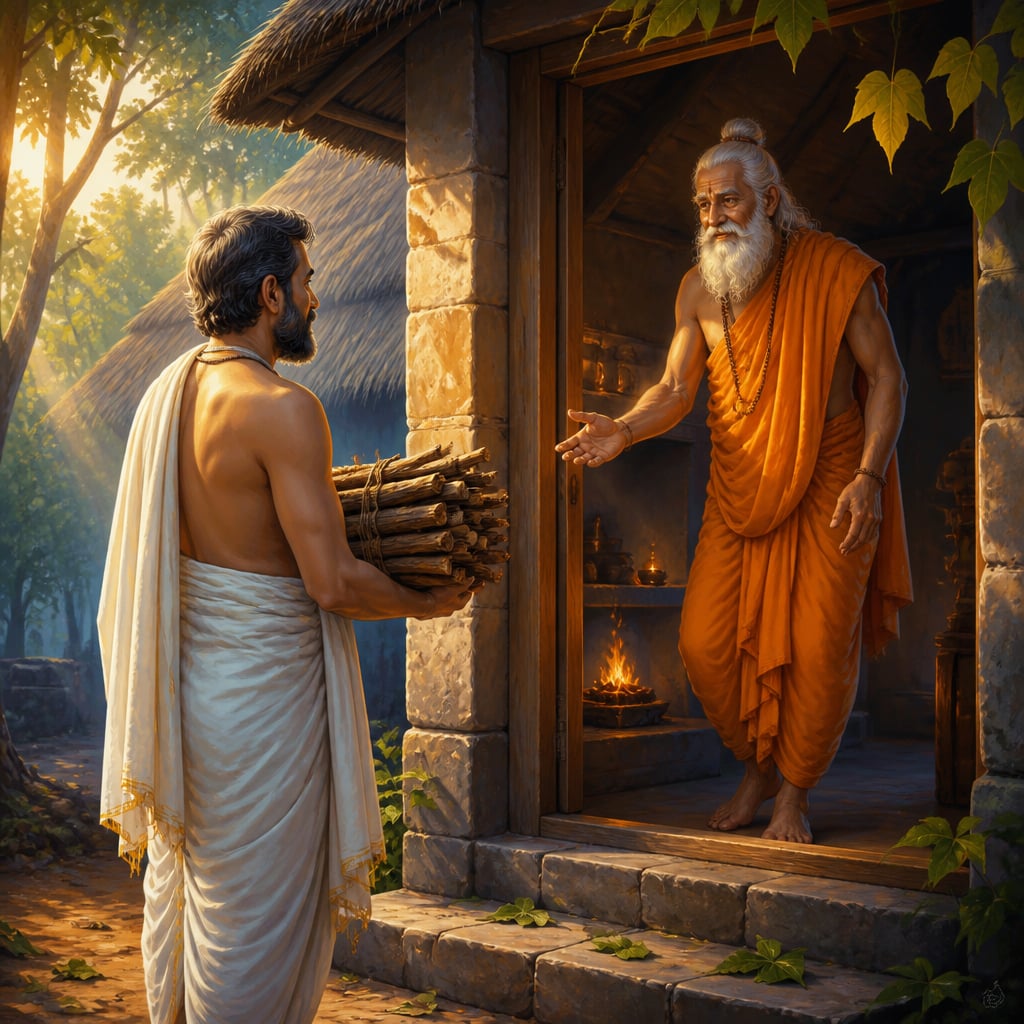
Shaunaka arriving at a forest hermitage carrying firewood at dawn

The sage Angiras sees him at the door. The two have known each other a long time. Angiras waits.

Shaunaka kneels and asks one question. 'Tell me, sir, that by knowing which everything else becomes known.'

It is a strange question. Shaunaka already knows a great deal. He can recite the hymns. He can perform the rituals. He can argue grammar and meter at any assembly in the land. He is asking for something else. He is asking whether there is a single knowing that makes the rest fall into place, and whether that knowing is even the same kind of thing as everything he has spent his life learning. Angiras's answer will draw a line through the middle of human knowledge. On one side, every fact a person can ever learn. On the other side, the one thing the facts cannot reach.

The Mundaka Upanishad drew that line more than two and a half thousand years ago. A French philosopher named Henri Bergson and an American psychologist named William James walked up to it from the other side in the early twentieth century. They saw the same line. They did not know what to do with it. The Mundaka did.

The Two Vidyas

Angiras's answer divides all human knowledge into two categories. One he calls aparā, the lower. The other parā, the higher. Aparā includes the four Vedas. It includes grammar, etymology, meter, phonetics, ritual, astronomy. In modern terms, it includes everything you can find in a library, load on your phone, or argue about at a dinner party. The Mundaka is not dismissing any of this. It is real knowledge. But it is knowing about.

Parā is the second kind. It is the direct knowing of the akṣara, the imperishable ground of everything. It is not reached by study. It is not reached by reasoning. It is not reached by hearing more discourses. Mundaka 3.2.3 states the point with a bluntness that has startled readers for millennia. This Self is not attained by instruction, nor by intellect, nor by much listening. It is attained only by the one whom it chooses.

That last clause is not a theological flourish. It is an epistemological claim. Some kinds of truth cannot be grabbed by the grabbing mind. They can only be prepared for, waited for, and then recognized when they arrive.

The Mundaka gives an image. A bow, an arrow, a target. The bow is the sacred syllable OM. The arrow is the self, sharpened by meditation. The target is Brahman. You do not deduce Brahman. You aim, you release, and if you are true, the arrow becomes one with the target. The Sanskrit phrase for this merging is tanmayo bhavet, 'one should become of that nature.' Knowing, here, is not about something. It is becoming it.

The Western Echo

Henri Bergson lecturing at the Sorbonne in 1907

Paris, 1907. A philosophy professor named Henri Bergson publishes Creative Evolution and becomes, improbably, the most famous philosopher in the world. Crowds block the streets outside his lectures. The Pope reads him. Einstein argues with him. He wins the Nobel Prize, though the committee hands it to him for literature, not philosophy, because they cannot decide what else to do with him.

Bergson's central move is a distinction. Intelligence, he says, is wonderful at handling solids. You chop the world into discrete things, compare them, calculate them, build machines with them. But there is one thing intelligence cannot touch without killing it. Time. Not clock time, which is just spatial intervals, but lived time, the continuous flow of becoming. To know flow, you need a different faculty. Bergson calls it intuition. He defines it carefully. Intuition is 'the sympathy by which one places oneself within an object in order to coincide with what is unique in it and consequently inexpressible.'

Read that sentence again. Place yourself within. Coincide. Inexpressible. Bergson is describing tanmayo bhavet in French.

At roughly the same moment, across the Atlantic, William James is giving the Gifford Lectures in Edinburgh. They become The Varieties of Religious Experience, a founding text of the psychology of religion. James is a hard-nosed empiricist who distrusts metaphysics. He does something radical. He takes mystical experience seriously as data. He lists four characteristics of mystical states. Ineffability, noetic quality, transiency, passivity. Of these, noetic is the load-bearing term. Mystical states, James insists, are not emotions. They are states of knowledge. 'They are illuminations, revelations, full of significance and importance, all inarticulate though they remain.'

James had read the Upanishads. He called Vedanta 'the most incredible thought ever uttered.' He understood, as few of his peers did, that the noetic claim of the Upanishads is not primitive superstition. It is a rival epistemology.

The Gap

So why is the Mundaka the more complete text?

Three reasons. First, Bergson and James arrived at intuition as an add-on. Reason was the main road. Intuition was the side trail you took when reason dead-ended. The Upanishads start the other way around. Parā is the foundation. Aparā is the scaffolding you use while you build. When the temple is done, the scaffolding comes down. The priority is exactly the opposite of the Western default.

Second, the Upanishads provide a method. Bergson tells you to 'place yourself within.' He does not tell you how. James describes mystical states after the fact but cannot prescribe their arrival. The Mundaka's bow-arrow-target is not a poetic flourish. It is a compressed manual. Meditation on the praṇava, purification of the arrow-self through ethical practice and study, and a teacher who holds the lineage. Do these things, the text says, and the target comes into range.

Third, and most important, the Upanishads are honest about what happens to the knower in the process. Bergson's intuition yields insights that the intuiting philosopher can then write down and publish. The Mundaka's parā vidya does something stranger. It dissolves the difference between knower and known. You do not come back from parā with a paper to present. You come back as someone who cannot fully articulate what they saw, because the one who would articulate it is the very thing that changed. The ineffability James noticed is not a limit of vocabulary. It is a structural feature of a knowing in which the subject-object frame has collapsed.

Bergson and James peeked at the door. The Mundaka walked through it and described the other side.

Why It Matters Today

Ramanujan receiving mathematical insight before the shrine of Namagiri at dawn

If you think this is mysticism and has nothing to do with your life, watch yourself the next time you have a real insight. A problem you have been chewing on for weeks. A person you have been trying to understand. A decision that has not come clean. The breakthrough, when it arrives, rarely arrives at the end of an argument. It arrives in the shower, on a walk, between sleep and waking. The deliberate mind sets the table. Something else serves the meal.

Modern research calls this incubation. Psychologists study it. Neuroscientists image it. The default-mode network lights up when you stop trying. What the laboratory is catching up to, the Mundaka described as a fully worked epistemology two and a half millennia ago. There is a knowing that is not thinking harder. It is a knowing that happens when you have thought hard enough to earn the right to stop thinking.

The practical implication is simple. Stop treating reason as the whole instrument. It is the bow. You still need the arrow, and you still need to let go.

Shaunaka set down his firewood and listened. The line had been drawn. What the householder did with it after he walked back out of the hermitage, the Mundaka leaves for the rest of his life.

Case studies

Kekulé and the Snake-Biting-Its-Tail Dream

In 1861, the German chemist August Kekulé was struggling to work out the structure of benzene. The molecule had six carbons and six hydrogens, but every linear arrangement chemists tried violated known valency rules. Kekulé later described sitting by the fire in his study, half-dozing, when he saw long chains of atoms 'twisting and turning in snake-like motion.' Then, as he wrote in an 1890 address, 'one of the snakes had seized hold of its own tail, and the form whirled mockingly before my eyes.' He woke, and he had the answer. Benzene was a ring. The entire edifice of aromatic chemistry, and much of organic synthesis after it, rests on a structure that arrived as an image rather than as a deduction.

Kekulé had already done years of aparā vidya. He knew the atoms, the bonds, the failures of every linear model. That work was not wasted. It was the sharpening of the arrow. What he could not do from within the rational frame was release it. The dozing state loosened the rational grip, and the solution presented itself as a whole rather than as a sum of steps. The Mundaka would say the long years of tarka earned him the right to a moment of anubhava. The image of the ring was not the answer. It was the form the answer took as it crossed from the higher knowing into the lower, where it could finally be written down.

Kekulé published the benzene ring structure in 1865. It became one of the foundational insights of modern chemistry. For the rest of his life he told and retold the snake story, and was careful never to present the insight as pure rational deduction. He understood that something had happened in that armchair that rational chemistry alone could not explain, and he refused to tidy it up for public consumption.

Break through work usually requires both long discipline and a moment of letting go. The Mundaka's map gives you a vocabulary for the relationship between the two, instead of pretending the letting go is a lucky accident.

Kekulé's 1890 Benzolfest address, delivered 25 years after the original insight, is one of the most widely cited descriptions of scientific intuition in the history of chemistry. His decision to talk about it publicly, in front of the assembled German chemical establishment, signaled that the rational-only account of science was already a polite fiction.

Poincaré on the Step of the Bus

In the early 1880s the French mathematician Henri Poincaré had been struggling for fifteen days to prove the existence of what he called Fuchsian functions. Each day he would sit at his desk for hours, working through possibilities, and each day the proof refused to come. Deciding to take a break, he set out on a geological excursion to Coutances. As he was stepping onto the bus to leave, without any conscious thought of mathematics, the answer arrived. He described it in a 1908 lecture: 'the idea came to me, without anything in my former thoughts seeming to have paved the way for it, that the transformations I had used to define the Fuchsian functions were identical with those of non-Euclidean geometry.' He did not even verify the insight on the spot. He knew it was right. He went on his trip. Days later, back at his desk, he wrote out the proof that had arrived whole at the bus step.

Poincaré himself drew a careful lesson from the experience. He distinguished two stages of mathematical work. A stage of conscious effort, in which the pieces are studied, rearranged, and exhausted. And a stage of 'sudden illumination' that happens only after the conscious stage has been pushed to its limit. The Mundaka's vocabulary is almost embarrassingly precise for what he was describing. The conscious work is aparā vidya at its finest. The illumination belongs to a different order of knowing. Poincaré, like Angiras, saw that the second order cannot be forced, but it can be prepared for.

Poincaré became one of the greatest mathematicians of the nineteenth and early twentieth centuries. The psychologist Jacques Hadamard later used his bus-step account as the centerpiece of his 1945 book The Psychology of Invention in the Mathematical Field. That book, in turn, became one of the most cited sources for the modern research programme on incubation and insight. The Upanishads anticipated the entire programme by two and a half millennia.

If you are stuck on a hard problem, do the conscious work until it is exhausted. Then, deliberately, let it go. Take the walk. Board the bus. Sleep on it. The Mundaka would call this the practice of the arrow at rest.

Ramanujan and the Goddess Namagiri

Srinivasa Ramanujan, born in 1887 in the small town of Erode in what is now Tamil Nadu, had almost no formal mathematical training. He worked from a single nineteenth century synopsis of results, and he produced, between 1903 and 1920, more than three thousand theorems. Many of them were so advanced that G. H. Hardy, the Cambridge mathematician who eventually brought him to England, said Ramanujan's formulas 'defeat me completely. I had never seen anything in the least like them before.' When asked where the formulas came from, Ramanujan said, repeatedly and without apology, that the goddess Namagiri of Namakkal appeared to him in dreams and wrote the theorems on his tongue. He prayed to her before work. He credited her in public. Hardy, a confirmed atheist, had no framework for this, but he also could not deny the mathematics.

Whatever one makes of the goddess, the structure of Ramanujan's reports is the structure the Mundaka describes. A purified instrument, formed by years of ritual discipline and intense practice. A waiting rather than a forcing. An arrival of the result as a whole rather than as a chain. The Upanishads would not read this as superstition. They would read it as a clean case of parā vidya expressed through the symbolic language Ramanujan had available. The theorems themselves, verified line by line by Hardy and later mathematicians, are the data. They did not get there by tarka alone.

Ramanujan died in 1920 at the age of 32. His notebooks, partially published in the decades after his death and fully annotated only by the early twenty-first century, still yield new theorems a century later. In 2012, physicists at Emory University proved that a conjecture Ramanujan had scribbled in his final year, about 'mock theta functions,' describes the behavior of black holes. He could not have known about black holes. He said the goddess told him.

When a knower is purified enough in one domain, knowings arrive in that domain that the rational frame cannot produce. Ramanujan did not give up tarka. He just knew that tarka was not the source of the theorems. The Mundaka would say he knew exactly which bow he was holding and which target he was aiming at.

Ramanujan's notebooks contain approximately 3,900 results. As of 2026, mathematicians estimate that fewer than two-thirds of them had been fully proved and published at the time of his death. The remainder have been verified, one by one, by later generations of mathematicians, usually after the original insight. None of them have been shown wrong.

Reflection

More in What Can We Know? The Limits and Nature of Knowledge

All lessons in What Can We Know? The Limits and Nature of Knowledge · The Big Questions: Upanishads and the Philosophers Who Followed course