Does the Universe Have a Purpose, or Is It Just Process?
Leibniz asked 'why is there something rather than nothing?' The Prashna asked it first.
Prashna and Svetasvatara Upanishads vs Aristotle and Leibniz. Is the cause time, nature, necessity, chance, the elements, or spirit?
Seven Words in Hanover
Hanover, 1714. The court of the Elector of Brunswick. An old philosopher in a long curled wig sits at his writing table by candlelight, surrounded by stacks of paper that no one in the court reads. His name is Gottfried Wilhelm Leibniz. He has invented calculus, but the credit is going to Newton in London. He has built mechanical calculators, drafted plans for libraries and academies, written more letters than any other thinker of his century. Tonight, in a short essay he is calling the Principles of Nature and Grace, Based on Reason, he is writing down the question that has followed him his entire life. He puts it in seven words.
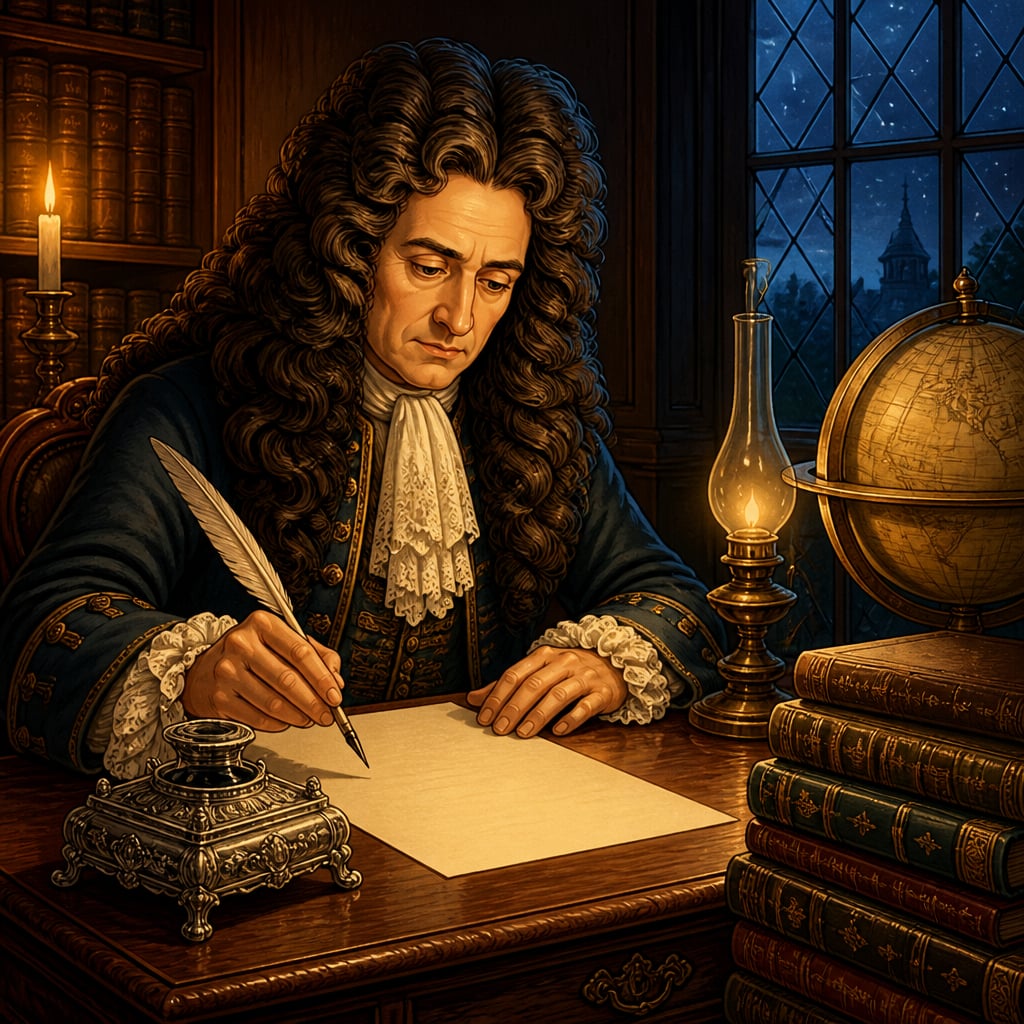
'Why is there something rather than nothing?'
He writes the line and then writes the next sentence, which is the harder one. 'For nothing is simpler and easier than something.' If non-existence were the default, the universe should not be here. And yet here it is. Galaxies, grass, the candle burning beside his ink. The question is the largest a human being can ask, and Leibniz is the first European to put it this nakedly. The essay will be read after his death. It will become one of the founding texts of metaphysics. Leibniz himself will die two years later, in 1716, mostly forgotten by the court he served.
Twenty-three centuries before Leibniz dipped his pen, in a forest hermitage on the other side of Eurasia, six men had already sat down with the same question and asked it of an old rishi named Pippalada. The Upanishad records their names: Kabandhi Katyayana, Bhargava Vaidarbhi, Kausalya Asvalayana, Sauryayani Gargya, Saibya Satyakama, Sukesha Bharadvaja. They had spent a year in tapas before Pippalada agreed to take their questions. Kabandhi spoke first. His voice was steady but his question was Leibniz's, asked in older words. 'From where, revered sir, are all these creatures born?'
This lesson is about that question. The Prashna Upanishad, where Kabandhi asks it, and the Svetasvatara Upanishad, which lists every candidate answer human thought has ever proposed, met it head-on. Aristotle and Leibniz met it from the West. The Upanishads got there first, and they answered it differently.
Pippalada's Answer

Pippalada's answer is strange and beautiful. Prajapati, the lord of creation, desired progeny. He performed tapas, burning inward concentration, and from that heat he produced a pair: rayi and prana. Matter and life. The female and the male principle. From their union, everything that exists was born. The universe begins with desire, not accident. With asymmetry, not stillness.
The Svetasvatara Upanishad picks up the same question and makes it even more precise. Its opening verse is one of the most remarkable in all philosophy because it lists every candidate answer that human beings have ever proposed. 'What is the cause? Is it time? Is it svabhava, own nature? Is it niyati, necessity? Is it yadrccha, chance? Is it the elements? Is it purusha, spirit?' That list was compiled more than two and a half thousand years ago, and it is still the list. Physicists today argue over exactly these candidates. The Upanishadic rishis had already tabled them.
The Svetasvatara's answer, reached over its six chapters, is this: none of the first five candidates can be the ultimate cause by itself. Time presupposes a sequence to be measured. Svabhava presupposes a thing that has a nature. Niyati presupposes a lawgiver. Yadrccha, mere chance, explains nothing. The elements are themselves products. What remains is what the Svetasvatara calls devatma-shakti, the self-power of the Divine, the Ishana who makes the brahma-chakra, the wheel of the cosmos, turn. Not a distant watchmaker but the very ground of being, expressing itself as time, nature, necessity, chance, and matter all at once.
The point is not that the Upanishads dismissed the other candidates. The point is that they saw them as aspects of a single deeper cause. The universe has a purpose in the sense that it is the self-expression of consciousness. Process is real. Purpose is real. They are not rivals.
The Western Echo

Aristotle, roughly a thousand years after the older Upanishads were already being recited, sat and watched acorns. He watched them become oak trees. He watched chicks emerge from eggs as chickens, not as ducks. He watched wounds heal as if the body knew what it was supposed to look like. And he formalized an idea that had been floating in Greek thought: things have a telos, a final cause, a direction they are trying to go. An acorn is directed toward oakness. A human being is directed toward flourishing, toward eudaimonia. The universe, for Aristotle, was saturated with teleology. Every natural thing had a function, a point, a built-in aim.
Two thousand years after Aristotle, Leibniz at his Hanover desk grounded the same intuition in pure logic. His answer to the seven-word question was the principle of sufficient reason: nothing happens without a reason. The universe itself must therefore have a reason, and that reason must lie outside the chain of ordinary causes. He called it God, but he reached it through inference, not through revelation.
Aristotle and Leibniz represent the two great Western defenses of purpose. Aristotle grounds it in observation: things act as if they are aiming at something. Leibniz grounds it in logic: existence requires justification. Both men were sharp, both were serious, and both were responding to intellectual environments where mechanistic explanations were starting to squeeze purpose out of the picture.
The Gap
Here is what the Upanishads offer that Aristotle and Leibniz do not.
Aristotle's telos is external to the observer. You look at an acorn, you notice it is becoming an oak, and you infer a final cause. The telos is out there in the thing. The Upanishads go further. They say the question 'does the universe have a purpose?' cannot be answered from the outside at all. The questioner is not separate from what is being questioned. You are the universe asking itself what it is for. Any purpose you discover is a purpose that includes you as the one discovering it. The Svetasvatara's final answer is not a proposition about the cosmos. It is an invitation to experience the cosmos from the inside of its own cause.
Leibniz's principle of sufficient reason demands an explanation for why there is something rather than nothing, and then posits God as that explanation. The move is logically clean, but it leaves the seeker standing outside the answer. God is the reason, fine, but you are still you and God is still God, and the question of why your particular consciousness exists in this particular body at this particular time remains. The Upanishads collapse this gap. The very consciousness asking 'why does anything exist?' is not a bystander. It is the same consciousness that is doing the existing. The question is the answer, turned around.
There is also a specific technical gap. Aristotle's telos and Leibniz's sufficient reason are both structural, both about the architecture of why there is anything. Neither gives the seeker a path. The Upanishads list the candidate causes in the Svetasvatara's opening verse, and then the rest of the text is a practical map: meditation, restraint, inquiry, surrender. The answer is not something you think your way to. It is something you become. Aristotle wrote about eudaimonia as a life well-lived, which is close, but the Upanishadic claim is deeper: at the core of a life well-lived is the recognition that you are not separate from the ground of all being. Purpose is not a goal you reach. It is a identity you recover.
Why It Matters Today
Modern physics has quietly returned to the Svetasvatara's list. The fine-tuning problem asks whether the physical constants of the universe are a result of necessity, chance, or something else. The multiverse hypothesis is a candidate answer in the chance family. Anthropic reasoning is a candidate answer in the svabhava family. The idea of cosmic evolution tending toward complexity, championed by thinkers like Teilhard de Chardin, is a candidate answer in the purpose family. The Svetasvatara tabled all of these options more than two thousand years before anyone looked through a telescope.
And the personal stakes have not changed. When someone you love dies, when a child asks why they were born, when you lie awake at three in the morning and the whole thing feels meaningless, you are asking the Prashna's first question and the Svetasvatara's opening verse. The Upanishads do not tell you the answer is easy. They tell you the answer is real, the answer is available, and the answer is closer to you than your own breath. The universe is not just process. But you will not see that from the outside. You have to turn the question around and ask it from within.
Leibniz wrote his seven words and put down his pen. He did not have a method for what to do next. The Prashna and the Svetasvatara did. They told their seekers to stop asking the question from the outside, and become the question, and let the answer arrive as recognition rather than as proof.
Key figures
Pippalada
Rishi of the Prashna Upanishad · Ancient (pre-500 BCE)
Kabandhi Katyayana
First questioner in the Prashna Upanishad · Ancient (pre-500 BCE)
Aristotle
Greek philosopher, the father of Western teleology · 384-322 BCE
Gottfried Wilhelm Leibniz
German polymath, defender of sufficient reason · 1646-1716
Case studies
Leibniz's 1697 Essay: Why Is There Something Rather Than Nothing?
Cosmological Fine-Tuning and the Anthropic Debate
Teilhard de Chardin's Omega Point
Reflection
- Read the Svetasvatara's opening list of candidate causes: time, own nature, necessity, chance, the elements, spirit. Which candidate does your own worldview most rely on? What would change in your life if that candidate turned out to be only a partial answer?
- Leibniz's question 'why is there something rather than nothing' can be dismissed as unanswerable or taken as the deepest question in philosophy. Which is it for you, and why? Notice what your answer says about what you take seriously.
- The Upanishadic claim is that the question of cosmic purpose cannot be answered from the outside, because you are part of what you are trying to explain. Try to sit with that for five minutes. Does the question of purpose feel different when you stop pretending you are a spectator?