Is There a Final Answer, or Is the Question Itself the Point?

Yajnavalkya fell silent. Socrates said he knew nothing. Wittgenstein pointed to the unsayable.

Yajnavalkya at King Janaka's court, a thousand cows with gold on their horns, and Gargi pressed to the edge of what words can hold. The Brihadaranyaka and Kena Upanishads end twenty-five lessons with a silence Socrates, Wittgenstein, and Ramana Maharshi all reach by their own routes.

Janaka's Cows

At the court of King Janaka of Videha, sometime in the eighth or seventh century BCE, a thousand cows are standing in the palace yard. Gold coins have been tied to their horns. King Janaka has summoned the greatest Vedic scholars of his kingdom to his court. The cows are the prize. Whichever of them is the most learned in Brahman will drive the herd home at the end of the day.

The hall is already restless when Yajnavalkya arrives. He is a senior Brahmin, already famous, already feared in debate. He looks around the assembly. Then he turns to his student and gives a short instruction: drive the cows back to our ashram.
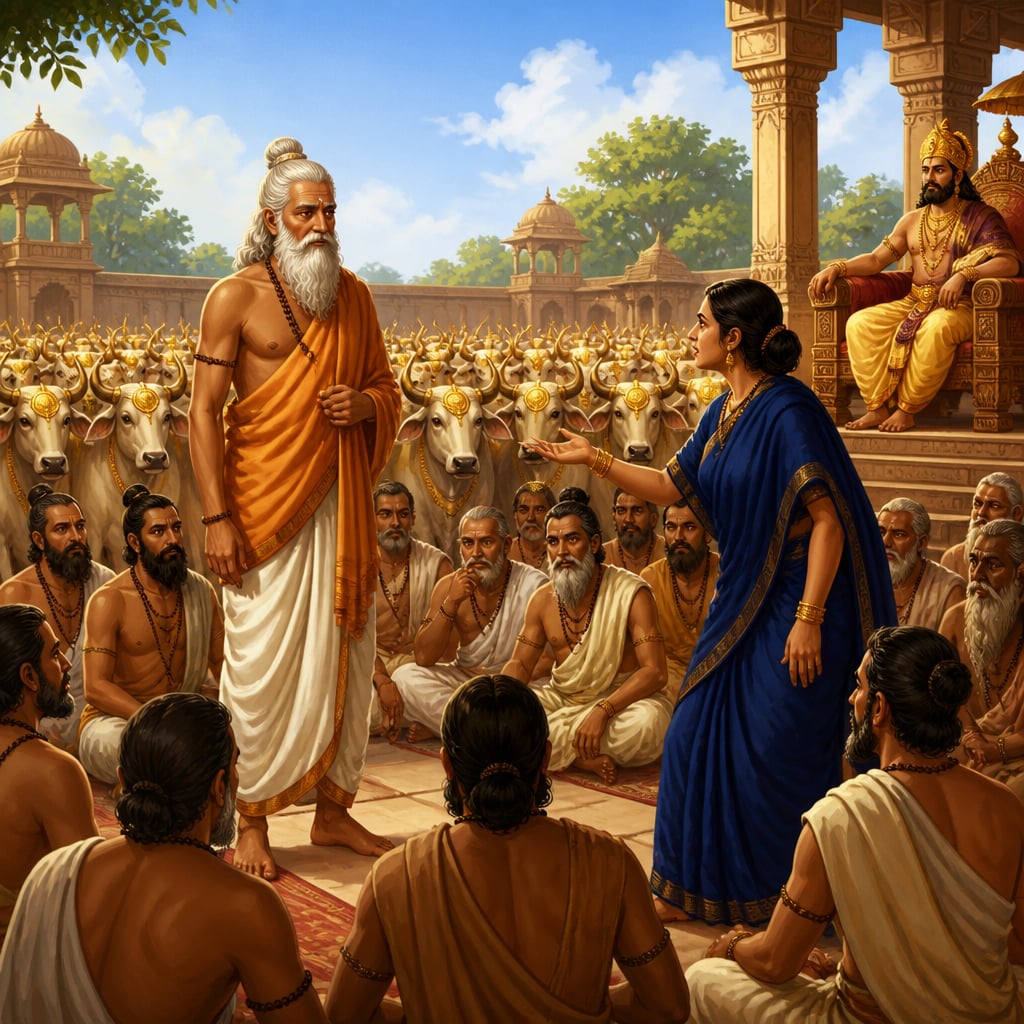
Yajnavalkya at King Janaka's court of debate

The hall erupts. The cows have not been won yet. The contest has not even begun. One by one the other scholars rise to put him to the test. Aśvala will ask about ritual. Artabhāga will ask about death. Bhujyu will ask about the afterworld. Uṣasta will ask about the Self. Kahola will ask about the immortal. And Gārgī Vācaknavī, a woman philosopher of such staggering precision that the men around her have learned to pause before disputing with her, will rise from her seat and ask twice. The second time, her question will press Yājñavalkya so deep that he will warn her, in front of the whole court, that if she asks one more step beyond where she now stands, her head will fall off.

She will stop. Shakalya, who asks the question that follows hers, will not.

This lesson is the last in a twenty-five lesson course, and the question it has to ask is the one King Janaka's hall was built to ask. Is there a final answer at the end of all this questioning, or is the silence at the bottom of the conversation the real teaching? The Brihadaranyaka's answer, in one scene, is both at once. What follows is why Socrates and Wittgenstein, centuries later, would reach the same wall by their own routes, and why the Upanishadic walk through that wall was something neither of them quite made.

The Upanishadic Answer

The scene in King Janaka's hall is known as the great interrogation, and it occupies the whole of Brihadaranyaka chapter 3. When it is Gargi's turn, Yajnavalkya answers her final question with what tradition calls the akshara Brahmana, the discourse on the Imperishable. His method there is the one the Upanishads are most famous for. Neti neti. Not this, not this. He strips every possible label off the real until only the unlabelable is left. Gargi hears the warning and sits down. Shakalya does not.

Then comes Shakalya. Shakalya starts with a basic question about the gods. Yajnavalkya answers. Shakalya asks another. Yajnavalkya answers. The back and forth escalates. Yajnavalkya finally says to Shakalya, 'If you ask one more question beyond what can be asked, your head will fall off.' Shakalya asks one more question. The text tells us that his head did, in fact, fall off. Whether we read this literally or as an image, the point is unmistakable. There is a threshold beyond which the question cannot be answered in words without destroying the questioner.

The Kena Upanishad has a shorter and even more piercing version of the same idea. In its second chapter, verse three, it says: 'He by whom It is not thought of, by him It is thought of. He who thinks he knows It does not know It. It is unknown to the one who knows and known to the one who does not know.' This is not wordplay. It is a careful description of a specific kind of knowing. Ordinary knowing has a subject and an object. The knower looks at the known. But the Upanishadic claim is that the ultimate reality is not something you can stand back from and examine. It is what is doing the looking. Any attempt to make it an object of thought automatically falsifies it, because the act of objectifying it puts it on the wrong side of the subject-object line.

So what is the Upanishadic method? Neti neti. Not this, not this. The sage strips away every possible label until the seeker is left with nothing but awareness itself, awake and unpackagable. Then the teaching pauses. It does not offer a final statement because a final statement would re-create exactly the problem it was trying to dissolve. Yajnavalkya's silence is not failure. It is the teaching.

The Western Echo

Socrates speaking at his trial in 399 BCE Athens

Nine centuries after the older Upanishads had been memorized and transmitted across India, a man in Athens walked into court to be tried for his life. Socrates had spent his whole career asking questions and exposing the ignorance of people who believed themselves wise. In the Apology, his defense speech, he says that the oracle at Delphi had declared no one was wiser than Socrates, and he had spent years trying to prove the oracle wrong. He had interviewed politicians, poets, craftsmen, anyone reputed to be wise. He had found in every case that they thought they knew things they did not actually know. Only one thing distinguished Socrates from them, he said. He at least knew that he did not know.

This is not false modesty. It is an epistemological stance. Socrates believed that the beginning of wisdom is the clean recognition of your own ignorance. And his entire method, the Socratic method that still runs through law schools and philosophy departments, was not a method for arriving at answers. It was a method for exposing the emptiness of the answers you thought you had.

Wittgenstein finishing the Tractatus in a 1921 schoolhouse room

Fast forward to 1921. A young Austrian philosopher named Ludwig Wittgenstein publishes a book called the Tractatus Logico-Philosophicus. It is one of the most rigorous works in the history of analytic philosophy, built of numbered propositions that try to define the exact limits of what language can meaningfully say. Most of the book is technical logic. But the book climaxes in proposition 7, the entire content of which is a single sentence: 'Whereof one cannot speak, thereof one must be silent.' Wittgenstein had concluded that the most important things cannot be said at all. They can only be shown, pointed toward, gestured at. Trying to speak them directly turns them into something they are not.

Wittgenstein spent the rest of his life working out the implications of that insight. In his later work, the Philosophical Investigations, he returned again and again to the idea that philosophical problems are not solved by answers but dissolved by seeing clearly how language was tricking us. His famous line, 'philosophy leaves everything as it is,' was not resignation. It was the recognition that once you see through the confusion, there is nothing to do except go on living with clearer eyes.

Socrates and Wittgenstein did not know each other, and neither of them had access to the Upanishads as we have them now. Both arrived at the same wall by their own route. Both concluded that the deepest form of wisdom is not possession of an answer but a particular quality of not-knowing that is more awake than most people's knowing.

The Gap

Here is what the Upanishads offer that Socrates and Wittgenstein do not.

Socratic ignorance is almost entirely negative. Socrates strips away false beliefs and leaves the interlocutor humbled, emptied, and slightly wiser. But there is no positive content at the end. The famous early Platonic dialogues often end in aporia, a state of being stuck. You know that you did not know what courage was, or what piety was, or what justice was. You do not now know any better. You just know, more clearly, that you do not know. That is valuable. It is not the same thing as what the Upanishads are pointing at.

The Upanishadic not-knowing is different in kind. The Kena's statement that 'it is unknown to the one who knows and known to the one who does not know' is not a description of confusion. It is a description of a specific kind of awareness that arises when the subject-object structure of ordinary knowing temporarily collapses. The sage is not ignorant in the Socratic sense. The sage has directly experienced something that cannot be packaged as a proposition, and the silence that follows is not empty but full. Shankaracharya called this anubhava, direct experience, and insisted that it was the goal of all Upanishadic study. Yajnavalkya's silence is not a failure to answer. It is an invitation to stop needing an answer and look directly.

Wittgenstein got closer. His idea of showing rather than saying, and his concept of things that can be pointed to but not stated, are genuine parallels to the neti neti method. But even Wittgenstein stopped at the wall. He said 'whereof one cannot speak, thereof one must be silent,' and there he stopped. The Upanishads agree that you cannot speak it, but they then say: now sit down, quiet the mind, turn attention back on itself, and find out what is left when all the speaking has been set aside. The Upanishads offer a practice, not just a cautionary note about language. Wittgenstein pointed at the door. The Upanishads walk you through it.

There is also a structural difference. The Western tradition, by and large, treats the final silence as a terminus, a place where thought exhausts itself and gives up. The Upanishadic silence is not terminal. It is generative. It is the silence in which the next insight arises. Teachers in the Advaita tradition speak of silence as the most advanced form of teaching, more powerful than any word, because it leaves no residue for the student's ego to latch onto. Ramana Maharshi would simply sit with seekers for hours and answer their deepest questions without speaking. Many of them reported that whole knots of confusion dissolved in that silence. The Upanishadic silence is not the end of a conversation. It is a richer form of conversation.

Why It Matters Today

You are finishing a course whose entire premise was comparative. You have now read twenty-five lessons pairing Upanishadic insights with Western parallels. If the course has done its job, you do not have twenty-five answers in a notebook. You have a different relationship to the questions themselves.

The modern world is saturated with content. Every question has an answer waiting one tap away. Podcasts, videos, courses, experts, influencers, all promising to tell you the truth about consciousness, meaning, love, death, and the universe. The Upanishadic tradition is saying something unsettling in that context. It is saying that the most important questions in your life cannot be answered by taking in more content. They can only be lived with. They can only be sat with, honestly, until something in you settles into a different relationship with the question itself.

That is why this course is ending the way it began: with a question. The Upanishads did not spend thousands of years producing a final answer. They spent thousands of years producing people who could hold the question without needing to escape it. If you take one thing from this entire course, let it be this: the Upanishads asked the question first. And the reason they asked it first is not so you would finally stop asking. It is so you would learn how to keep asking, all the way to the bottom, and discover that the bottom is not a place to stand but a way of standing.

At King Janaka's court, the cows were already being driven home before the contest had begun. Yajnavalkya had been standing that way from the start.

Key figures

Yajnavalkya

The greatest sage of the Brihadaranyaka Upanishad · Ancient (pre-700 BCE)

Gargi Vachaknavi

Philosopher in the court of King Janaka · Ancient (pre-700 BCE)

Socrates

Athenian philosopher, father of the Western philosophical tradition · 470-399 BCE

Ludwig Wittgenstein

Austrian-British philosopher of language · 1889-1951

Case studies

Krishnamurti Dissolves the Order of the Star, 1929

Nagarjuna's Catuskoti

Godel's Incompleteness Theorems, 1931

Ramana Maharshi's Silence

Reflection

More in The Whole Picture: Consciousness, Cosmos, and the Ultimate

All lessons in The Whole Picture: Consciousness, Cosmos, and the Ultimate · The Big Questions: Upanishads and the Philosophers Who Followed course