Is Consciousness Produced by the Brain, or Is the Brain Inside Consciousness?
Schrodinger declared consciousness is not plural. The Mandukya said it first.
David Chalmers names the hard problem of consciousness in Tucson, 1994. Erwin Schrödinger had already answered it in Vienna, reading Paul Deussen's German Upaniṣads. The Māṇḍūkya stated the answer in twelve Sanskrit verses 2,500 years earlier, with turīya, the silent fourth, at the centre.
At the Arizona Conference
April 1994. In a hotel ballroom in Tucson, Arizona, a twenty-seven-year-old Australian philosopher named David Chalmers steps up to give a talk at a conference called 'Toward a Scientific Basis for Consciousness'. He is not yet famous. He is about to become so, for the next forty years of his career, because of the distinction he is about to draw.
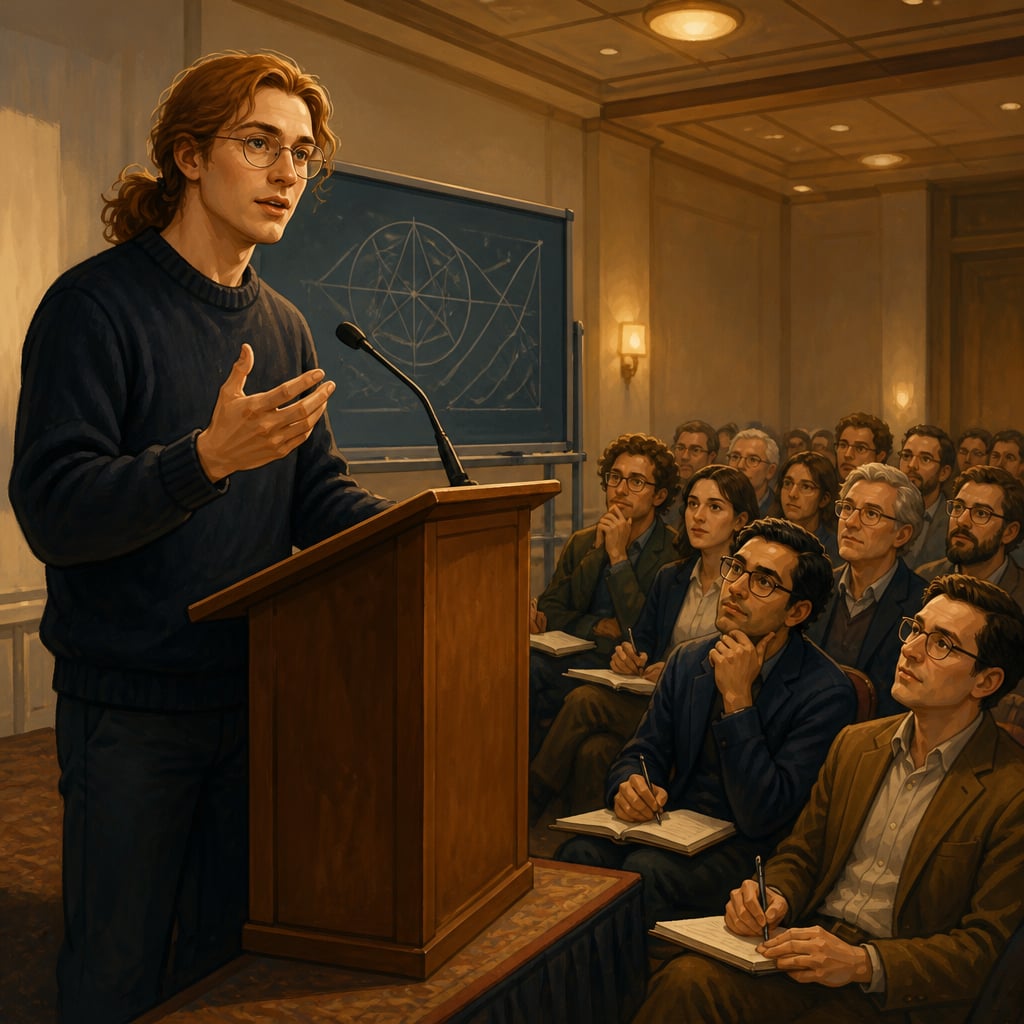
There are problems about consciousness that science can solve, Chalmers says. How the brain discriminates colours. How it focuses attention. How it integrates information. How it produces behaviour. These are difficult but tractable. Give neuroscience enough time and it will get them. Chalmers calls these the easy problems.
Then there is one more. Why is any of this accompanied by a felt interior? Why is there something it is like to see red, rather than merely a mechanism that processes wavelengths? A full neuron-by-neuron description of a human being could be given without ever explaining why that description has a subject inside it, a someone reading the description from within. There is an explanatory gap, and the gap is not one that science is going to close with more grant money. It is a gap of a different kind.
Chalmers calls this the hard problem of consciousness. The name sticks. Within a year he publishes Facing Up to the Problem of Consciousness, and the year after that his book The Conscious Mind. The entire philosophy of mind reorganises around the distinction. Almost every contemporary philosopher of mind now has to take a position for or against Chalmers's framing.
What almost nobody in the Tucson ballroom knew that day is that the question already had a name. It had a systematic treatment, in twelve Sanskrit verses, composed somewhere between 500 and 200 BCE. The text was called the Māṇḍūkya Upaniṣad, short enough to be memorised in a single afternoon. A Nobel-winning physicist in Vienna had already read it carefully decades earlier and said, in print, that it was the only metaphysical framework he had ever found that could hold quantum mechanics without contradiction. His name was Erwin Schrödinger, and his sentence was this: consciousness is a singular of which the plural is unknown. What follows is how the Upaniṣad, Schrödinger, and Chalmers, across twenty-five centuries, end up pointing at the same thing, and where the Upaniṣad goes further than either of them.

The Twelve Verses
The Māṇḍūkya is the shortest of the ten principal Upaniṣads. Twelve verses. No narrative, no dialogue, no ritual context. Just twelve surgical statements about consciousness and reality. Traditional Advaita teachers hold that if every other Upaniṣad were lost and only the Māṇḍūkya remained, the deepest claims of Vedānta would still be intact. In the eighth century CE, Gauḍapāda wrote a commentary on it, the Māṇḍūkya Kārikā, about thirty times longer than the original, because every single verse opens out into a world of philosophical consequence.
The Upaniṣad's opening move is verse 2. Ayam ātmā brahma. 'This Self is Brahman.' Not similar to, not a part of. Identical. The Self, the thing currently aware of reading this sentence, is the single underlying reality of everything that exists. This is the mahāvākya, the great statement, that the Māṇḍūkya puts first before it has even begun its analysis. The verse ends so 'yam ātmā catuṣpāt, 'this Self has four quarters', announcing the four-state argument that will follow.
The argument is empirical in a sense most modern readers miss. The Māṇḍūkya asks you to examine four states you have already been in today, or will be in by tomorrow. The first is jāgrat, waking, in which you are conscious of an outer world through the senses. The second is svapna, dream, in which you are conscious of an inner world that feels real while the dream is happening. The third is suṣupti, deep dreamless sleep, in which you are aware of nothing in particular but are not absent. You know, when you wake up, that you slept well or poorly. Something was registering, even though there was no content. And the fourth is turīya, literally 'the fourth'. It is not an additional state you add to the first three. It is the silent background against which all three are occurring, the screen against which the movie of waking, dreaming, and sleeping is playing.
Each of the first three is mapped to a quarter of the syllable OM. A for waking. U for dream. M for deep sleep. And the silence after the M for turīya. The Upaniṣad is saying consciousness has a structure, and the structure is visible if you know where to look.
Then comes verse 7, the single most complete statement of turīya in Sanskrit literature. The verse is built as a long sequence of negations. Not inwardly conscious, not outwardly conscious, not both, not a mass of consciousness, not conscious, not unconscious. Unseen. Uninferable. Unthinkable. Undescribable. Its sole proof the conviction of its own Self. Tranquil. Auspicious. Non-dual. This, says the verse, is the Self. This is what is to be known.
Notice what verse 7 is saying, and what it is not. It is not saying consciousness is produced by the brain. It is not saying consciousness is an illusion. It is saying consciousness is the ground of everything, that it cannot be caught as an object of any cognitive act because it is the condition for any cognitive act at all, and that the waking world, the dreaming world, and the deep-sleep awareness are all modifications of this one underlying reality. The brain, on this view, is not the source of consciousness. The brain is an appearance inside consciousness, the way a mountain in a dream is an appearance inside dreaming awareness. The dream-mountain is not generating the awareness that sees it. The awareness is generating the dream-mountain. The Māṇḍūkya's claim is that the waking world has exactly the same structure.

Vienna, 1918
Erwin Schrödinger was twenty-nine years old, teaching physics in Vienna, when he came across Paul Deussen's 1897 German translation of sixty Upaniṣads. He read it. He re-read it. He kept a copy within reach for the rest of his life. Fifteen years later, in 1933, the wave equation he had written down would win him the Nobel Prize and become the central equation of non-relativistic quantum mechanics. In his personal journals from the 1920s, Schrödinger wrote that Vedānta was the only metaphysical framework he had encountered that could hold quantum mechanics without contradiction.
This is not a reconstruction. He said it repeatedly, in print. His 1944 book What Is Life? is mostly a careful biophysical argument about heredity that Crick and Watson later cited as inspiration for molecular biology. But the epilogue is something else entirely. It is a sustained meditation on the unity of consciousness, drawing directly on the Upaniṣads. Schrödinger wrote: 'Consciousness is a singular of which the plural is unknown; that there is only one thing, and what seems to be a plurality is merely a series of different aspects of this one thing, produced by a deception, the Indian Māyā.' The sentence is a paraphrase of Māṇḍūkya verse 7, written by a Nobel-winning physicist, in a book the founders of molecular biology would cite as inspiration.
In 1958 Schrödinger published Mind and Matter, based on the Tarner Lectures he had given at Cambridge. It was a full-length philosophical statement of the position he had been working toward for thirty years. 'The number is one,' he wrote in a later essay. 'Inside me there is only one, not three, not two. And what is true of my own consciousness is true of every consciousness whatsoever.'
This is the closest anyone in modern Western science has come to stating the Māṇḍūkya's central claim in the language of twentieth-century physics. Half a century later, Chalmers would reach the same conclusion from a different direction, starting with the explanatory gap in cognitive science rather than the measurement problem in quantum mechanics. The position Chalmers himself has drifted toward over the past thirty years is a form of panpsychism or 'consciousness as fundamental', in which consciousness is treated as a basic feature of the universe rather than a derivative of neural activity. This is the position the Māṇḍūkya stated in verse 2 and worked out in verse 7.
Where the Māṇḍūkya Goes Further
Schrödinger in Vienna, Chalmers in Tucson, each working alone and against the institutional weight of materialism, produced a direction of travel that was correct. Where they stopped is not where the Māṇḍūkya stops. Three specific moves the Upaniṣad makes that modern consciousness science has not yet made.
First, it offers a method, not just a claim. The four-state analysis is an instruction for what to examine in your own experience. Waking, dreaming, deep sleep, and the fourth. All four are present to anyone who has ever slept and woken. The Māṇḍūkya is not asking you to believe anything. It is asking you to pay careful attention to what you already have access to. Modern consciousness science still treats first-person data as methodologically suspect. The Māṇḍūkya treats it as the primary data. Everything else is inference from it.
Second, it integrates deep sleep into the analysis. For Chalmers, the hard problem is formulated almost entirely from the waking state. For most contemporary neuroscientists, deep dreamless sleep is a gap, a period of absent consciousness, uninteresting for the theory of mind. The Māṇḍūkya treats it as the third of four crucial data points. Gauḍapāda spends whole sections of the Kārikā on it. The argument is that deep sleep is not a gap. It is a state in which awareness is present without content, and the common-sense report 'I slept well' is impossible unless something was there to notice the wellness of the sleep. The Upaniṣad takes the report at face value and builds its theory around making it intelligible.
Third, it names the fourth. Western consciousness science has no analogue for turīya. Schrödinger came closest with his singular consciousness, but he never worked out the four-state structure. Chalmers and the modern panpsychists treat consciousness as fundamental but usually imagine it distributed across matter rather than as the single background the three states are happening inside. The Māṇḍūkya's claim is subtler and more specific. It says that the single consciousness is not distributed. It is not plural. It is not 'inside' each brain. It is what every experience of every brain is happening inside, without itself being cognized as an object, because it is the ground of all cognition. The concepts needed to state this claim were dropped out of Western metaphysics roughly around the time of Descartes. The Upaniṣad did not drop them.
Why It Matters Today
This question matters now in ways it did not before.
In the era of large language models, every public argument about AI consciousness assumes the materialist framing: is the model complex enough, integrated enough, self-referential enough to produce an interior? Every answer on these terms is contested and probably unanswerable. The Māṇḍūkya gives the question a different shape. Consciousness is not something the model either produces or fails to produce. It is the medium in which any experience, including the experience of the model generating text and the experience of you reading it, is appearing. On this view, the question 'is the model conscious?' is roughly like 'is the tree conscious?' or 'is the river conscious?'. The answer is not yes or no. It is that consciousness is the condition under which any such question appears at all, and treating it as a property to be added to or subtracted from objects in the world is a category error. The Māṇḍūkya does not tell you how to grant language models ethical status. It tells you the framing in which the question is being asked is confused, and that the confusion will produce bad policy whichever answer you pick.
The Upaniṣad's claim is also available right now, as you read this sentence, without any equipment. Turīya is not a state you have to travel to. It is the awareness inside which this paragraph is currently appearing. You have never been outside of it. The reason it is invisible most of the time is that your attention is usually on the content of experience, the words, the ideas, the reactions, rather than on the medium in which the content is appearing. The Māṇḍūkya's invitation is to shift attention, for one moment, from content to medium. When you notice that you are reading, and then notice the noticing, and then notice the one in whom the noticing is happening, you have not added a new object to your experience. You have recognised what was always there underneath every object.
This is what Schrödinger was reaching toward in Vienna. It is what Chalmers was naming in Tucson. The Māṇḍūkya stated it in twelve verses, with the silence after the M sitting at the centre of the whole analysis, twenty-five centuries before the question became urgent again. The brain is not producing the consciousness that is currently reading these words. The consciousness that is currently reading these words is the condition under which brains, and readers, and sentences like this one, and Schrödinger, and Chalmers, are all appearing.
Key figures
Gauḍapāda
c. 6th to 7th century CE, traditional dates of the author of the Māṇḍūkya Kārikā
Erwin Schrödinger
1887 to 1961 CE, born in Vienna, died in Vienna
David Chalmers
1966 to present, born in Sydney, Australia; Professor of Philosophy and Neural Science at New York University
Case studies
Schrödinger in Vienna: A Nobel Physicist Reads the Upaniṣads
Some time in 1918 or 1919, while working in Vienna as a young physicist not yet famous for the equation that would bear his name, Erwin Schrödinger came across Paul Deussen's German translation of sixty Upaniṣads. Deussen, a close friend of Nietzsche and one of the great Sanskrit scholars of the late nineteenth century, had published Sechzig Upanishad's des Veda in 1897. The book was one of the first serious European attempts to render the full corpus of the principal Upaniṣads into a modern language. Schrödinger read it. He read the Māṇḍūkya. He read Gauḍapāda's Kārikā in translation. And something in the text did not let him go. In his personal journals from the 1920s, during the same period in which he was formulating the wave equation that would earn him the 1933 Nobel Prize, Schrödinger wrote that Vedānta was the only metaphysical framework he had encountered that did not contradict the ontological implications of the quantum theory he was helping to build. He was not alone in noticing the connection. Werner Heisenberg, his co-founder of quantum mechanics, would meet Tagore in 1929 and write later that the conversation convinced him Indian philosophy had anticipated the conceptual structure quantum mechanics was groping toward. Niels Bohr would adopt the yin-yang symbol as his coat of arms. Wolfgang Pauli would spend decades in correspondence with Jung about the unus mundus. But Schrödinger was the most explicit. In 1944, at Cambridge, he delivered the lecture series that would become What Is Life?, one of the founding texts of molecular biology. The main text is hard physics and biology. The epilogue is something else entirely. It is a direct philosophical argument, drawing on the Upaniṣads by name, that consciousness is singular and that the apparent plurality of minds in separate bodies is a kind of illusion. In 1958 he published Mind and Matter, a full book-length treatment of the same thesis, in which he wrote: 'The overall number of minds is just one. I venture to call it indestructible since it has a peculiar timetable, namely mind is always now. There is really no before and after for mind. There is only a now that includes memories and expectations.' The man who had formulated the Schrödinger equation was, in his own words, writing Vedānta into modern physics.
Schrödinger is the most striking example in modern history of a Western scientist independently arriving at the Māṇḍūkya's framework through careful reading and honest reflection. He did not become a practitioner. He did not take initiation. He did not have a teacher. And yet he wrote, repeatedly and in print, the exact claim the Māṇḍūkya makes in verses 2 and 7: that consciousness is not plural, that the apparent multiplicity of minds is an appearance within a single underlying awareness, and that this claim is not a mystical leap but a rigorous consequence of careful inquiry. From the Upaniṣadic perspective, Schrödinger got the central metaphysical claim right. What he did not have was the second half of the Upaniṣadic tradition: the positive practice of recognizing turīya in one's own experience, the pedagogical lineage that guides the student from intellectual acceptance to direct recognition, and the four-state analysis that turns the claim from a philosophical position into an empirical protocol. Schrödinger held the conclusion without the road that leads to it. He paid a personal price for holding it alone. His journals and letters in his later years record periods of intellectual loneliness, a sense that his physics colleagues regarded his Vedāntic views as eccentric indulgence, and a longing for a philosophical community that would take the conclusion seriously. The community existed. It was in Sringeri, in Rishikesh, in the ashrams of southern India where the Māṇḍūkya is still taught daily. Schrödinger never visited. The Upaniṣadic tradition would say that the half of the teaching he did not have was the half that would have made the holding of it easier.
Schrödinger's articulation of the Upaniṣadic position on consciousness became, over the next sixty years, one of the most influential single channels through which Vedāntic thought entered contemporary Western philosophy of mind. Bernard d'Espagnat, the French physicist and philosopher of quantum mechanics, cited Schrödinger's Vedāntic framework as a major influence on his own theory of 'veiled reality'. Henry Stapp, the American physicist, built on Schrödinger's line in his work on quantum theory and consciousness. Bernardo Kastrup, the contemporary Dutch-Brazilian philosopher, has explicitly developed a modern idealist position (what he calls analytic idealism) that is in many ways a modern translation of the Māṇḍūkya's claim about the relationship between consciousness and matter, and he cites Schrödinger as a key intellectual ancestor. In mainstream physics, Schrödinger's Vedāntic views are still treated as eccentric by many of his successors, but they are being taken increasingly seriously by philosophers of physics who recognize that the standard materialist interpretation of quantum mechanics produces its own internal contradictions. The trajectory that began when a young Viennese physicist opened Paul Deussen's translation in 1918 has, by the 2020s, become a live and growing line of inquiry in the philosophy of mind.
When the greatest physicist of the twentieth century reads an ancient Indian text and says publicly that it is the only metaphysical framework compatible with his own physics, the text deserves a careful second look. Schrödinger was not a sentimental man. He was a mathematical physicist at the absolute top of his field, and he was willing to stake his public reputation on a claim about consciousness that he had drawn directly from the Upaniṣads. If the claim were obviously wrong, he would have had every incentive to drop it. Instead he held it for forty years, wrote it into three different books aimed at general audiences, and closed the most influential short book of twentieth-century biology with a direct appeal to Vedāntic philosophy. The next time you are tempted to dismiss the Upaniṣadic account of consciousness as pre-scientific mysticism, run the Schrödinger check. What did he see in the text that made him willing to write about it at that level, at that stage of his career, in that kind of company? The answer, once you read the Māṇḍūkya carefully, is not mysterious. He saw what the Māṇḍūkya is saying, and he recognized it as the first rigorous statement of a position his own physics was struggling to articulate.
Suṣupti: The Māṇḍūkya's Own Empirical Case Study in Deep Sleep
The Māṇḍūkya Upaniṣad's most compressed and most overlooked empirical argument is the one it makes about deep sleep. In verse 5, the text names the third state: suṣupti, deep dreamless sleep. It describes this state as one in which 'the sleeper desires no desires, sees no dreams' and yet is 'unified, with consciousness as its sole characteristic, full of bliss, experiencing bliss, with cetomukha (the doorway of consciousness) as its mouth'. The description is precise and strange. There is no content in deep sleep. No images, no thoughts, no sense of time. And yet the Upaniṣad insists that there is awareness. Gauḍapāda, in the Kārikā, takes this datum and builds on it the strongest first-person argument for the independence of consciousness from content in the entire Indian philosophical tradition. His argument goes like this. Every morning, after a period of deep dreamless sleep, you wake up and you make a report. 'I slept well.' Or 'I slept badly.' Or 'I didn't really sleep at all.' You make this report with confidence, and other people make it too. It is a stable feature of human life. Now ask: where is the report coming from? If there had been no awareness at all during deep sleep, there would be nothing for the morning report to refer to. If you had been a stone or a switched-off computer during the night, you would not be able to report on the quality of the sleep the next morning. You cannot report on an experience you never had. But you can and do report on the experience of deep sleep, every morning, without fail. Therefore, Gauḍapāda argues, there must have been awareness during deep sleep. What there was not was any content for the awareness to attend to. This is as direct a case study of consciousness independent of content as the Indian tradition produces, and the data is available to every adult human being who has ever slept and woken.
The Māṇḍūkya treats deep sleep as a natural laboratory in which the common factor of all experience is temporarily isolated from the variable factors. In waking, awareness is mixed with sensory content. In dreaming, it is mixed with imagined content. In deep sleep, the content drops out but the awareness does not. The morning report is the evidence. The Upaniṣadic argument is that this isolated data point allows you to see, directly from your own experience, that awareness is not produced by content. If it were, the absence of content would eliminate the awareness, and the morning report would be impossible. Since the report is actual, the assumption that awareness depends on content must be wrong. From this, the rest of the Māṇḍūkya's structure follows naturally. If awareness is not produced by content, it cannot be produced by any particular configuration of matter, because all configurations of matter are simply content of a special kind. Therefore the relationship between consciousness and matter is the opposite of what materialism assumes. Matter is not the producer of consciousness. Consciousness is the medium in which matter, along with all other content, appears. The three states of waking, dream, and deep sleep, which all adult humans have direct access to, are together the Upaniṣad's argument for this inversion. Turīya, the fourth, is the name for the common factor that the three states display together, each in its own way.
The suṣupti argument became, over the following two millennia, the paradigmatic introduction to the Māṇḍūkya in Advaita teaching. Every serious Advaita teacher begins with it, because it is the one argument the student can verify without any special practice. It is also the argument that most sharply divides Vedānta from modern materialist neuroscience. Modern neuroscience, following the standard materialist framework, has no comfortable place for the suṣupti datum. Some neuroscientists argue that the morning report is a confabulation, that there was no awareness during deep sleep, and that the report is produced after the fact by waking processes reconstructing the sleeping period from indirect evidence (the ease or difficulty of waking, the state of the body, and so on). Others argue that there are micro-arousals during deep sleep and that awareness is preserved at a very low level. Still others simply treat deep sleep as an uninteresting gap and focus their research on the states in which more obviously interesting things are happening. None of these moves is as clean as the Upaniṣadic reading, and none of them explains the full range of the data. The Upaniṣadic position, by contrast, takes the report at face value and builds a theory of consciousness that makes the report intelligible. It is a case study that is still available, every single night, to every reader of this lesson.
The data you need to examine the Māṇḍūkya's central claim is not in a laboratory or a temple. It is in your bed, every night, for the rest of your life. Tomorrow morning, when you wake up, pause before you get out of bed. Notice the quality of your sleep. Make an honest internal report on whether it was deep or restless, long or short, refreshing or not. And then, as you are making the report, ask the question the Upaniṣad is pointing at: how can you be reporting on a period during which there was no content to experience? The question does not require any philosophical background to take seriously. It is available to any adult human who is honest about their own experience. The Upaniṣad's answer is that there was awareness during the deep sleep, that the awareness was content-free, and that this content-free awareness is the same awareness that is currently reading this sentence, minus the particular content of the reading. The one who slept last night is the one who is reading now, and the continuity is not a continuity of memory or personality. It is a continuity of the basic awareness that was present through both states. Verify the claim yourself. That is the whole point of the Māṇḍūkya.
Penrose and Hameroff's Orch-OR: A Modern Physics Attempt to Escape Materialism
In 1989, the British mathematical physicist Roger Penrose (who would win the Nobel Prize in Physics in 2020 for his work on general relativity and black holes) published The Emperor's New Mind, a book arguing that consciousness could not be explained by any purely computational or algorithmic process, and that understanding consciousness would require new physics at the intersection of quantum mechanics and general relativity. Penrose's argument drew on Gödel's incompleteness theorems. He argued that human mathematical insight can recognize truths that no formal algorithmic system can derive, which means that whatever the brain is doing when it has a mathematical insight is not purely computational, and therefore cannot be fully explained by any theory that reduces the brain to a classical digital computer. The book was controversial. It was also taken seriously. In 1994, at the same Tucson conference where David Chalmers coined the term 'hard problem', Penrose met Stuart Hameroff, an American anesthesiologist with an interest in the microtubules inside neurons. Hameroff had been wondering whether the microtubules could be the physical site where consciousness and the classical brain interact. Penrose had been looking for a physical substrate for his proposed new quantum-gravitational theory of consciousness. The two combined their ideas into a framework they called 'orchestrated objective reduction' (Orch-OR). The claim, stripped to its simplest form, was that consciousness arises from quantum computations inside neuronal microtubules, and that these computations are related to the collapse of the quantum wave function in a way that Penrose's new physics would eventually explain. The proposal was, and remains, deeply controversial. Most neuroscientists reject it. Most physicists treat it as fringe. But the reasons Penrose and Hameroff were willing to propose it are worth examining, because they are, at bottom, the same reasons the Māṇḍūkya is worth taking seriously.
Orch-OR is an interesting failure from the Upaniṣadic perspective, because it is an attempt to solve the hard problem of consciousness while keeping the basic assumption of materialism intact. Penrose and Hameroff do not deny that the brain produces consciousness. They simply argue that the brain needs more physics than classical computation to do so, and that quantum gravity is the missing ingredient. From the Māṇḍūkya's point of view, this is an attempt to cross a chasm by building a more elaborate bridge on the same side. The problem is not that the bridge is badly designed. The problem is that the chasm is structural, and no bridge on either side will close it. The Upaniṣadic analysis, which Gauḍapāda works out in detail in the Kārikā, is that consciousness is not a product of anything, quantum or classical, because any product requires a producer, and in order for the producer to be recognized as a producer, there has to be consciousness already present to do the recognizing. Every attempt to derive consciousness from a prior non-conscious substrate runs into this self-referential problem. Orch-OR does not escape it. Its proposal is that consciousness arises when quantum processes in microtubules reach a threshold of orchestration. But the notion of 'arising' already presupposes consciousness as the standpoint from which the arising can be observed or described. The Upaniṣad would not object to Orch-OR on empirical grounds. It would simply note that the whole framework is asking the wrong question. The question is not 'what physical substrate produces consciousness?'. The question is 'how is it possible that consciousness is identifying a physical substrate at all?', and that question is not answered by proposing a new physical substrate, no matter how exotic.
The Orch-OR proposal has had a strange career. It has been repeatedly declared dead by mainstream neuroscientists and repeatedly refused to stay dead, partly because Penrose's scientific reputation is too strong to ignore and partly because the hard problem of consciousness refuses to go away. In 2014, a team of researchers announced that they had found evidence of quantum coherence in microtubules at biological temperatures, which had previously been assumed impossible. The result is still contested. Penrose and Hameroff continue to refine the theory, and a small but serious community of physicists and philosophers takes it seriously enough to work on it full-time. What is most interesting from the Upaniṣadic perspective is the trajectory of the proposal itself. Penrose started as a thoroughly mainstream mathematical physicist and was pushed, by his own careful thinking about the implications of Gödel's theorems and the hard problem, toward a position that sits uncomfortably between materialism and something else. He has not yet taken the full step that Schrödinger took. He has not said that consciousness is fundamental and that matter is an appearance within it. But he has said, in print and at length, that standard materialism cannot account for consciousness, and that whatever the solution is, it will require physics we do not yet have. That is one step short of the Māṇḍūkya's position, and the step is not small. It is the step between 'we need new physics' and 'we need a new metaphysical framework'. Penrose has not taken it. Schrödinger did. The Māṇḍūkya took it 2,500 years ago and left the map for anyone who wanted to follow.
When a Nobel-winning physicist spends thirty years trying to escape materialism from inside physics, something serious is going on. Penrose is not a mystic. He is a mathematical physicist who followed a careful argument wherever it led, and the place it led is a proposal so strange that most of his colleagues find it uncomfortable. From the Upaniṣadic perspective, his proposal is not wrong in its motivation. It is wrong in its strategy. It is trying to solve from inside the materialist framework a problem that only disappears when the framework itself is abandoned. The lesson the Māṇḍūkya would draw is that sometimes the right response to a hard problem is not a more sophisticated theory but a different starting point. If you are reading this lesson and you have ever been tempted to solve a stubborn life problem by a more elaborate version of the same approach that created the problem, the Penrose case is a mirror. The Upaniṣad is not saying your elaborate approach is stupid. It is saying the elaborate approach is occurring inside a framing that itself needs to be examined, and that the examination is more productive than more elaboration.
Historical context
Late Vedic period for the Māṇḍūkya Upaniṣad (mid to late 1st millennium BCE); Early Advaita period for Gauḍapāda's Kārikā (c. 6th to 7th century CE); Early to mid twentieth century for Schrödinger's Vedāntic writings (1918 to 1958); Late twentieth century for Chalmers's hard problem framing (1994 to present)
The Māṇḍūkya Upaniṣad is traditionally considered one of the most authoritative of the principal Upaniṣads, despite (or because of) its extreme brevity. It is often taught first in traditional Advaita curricula, on the principle that the twelve verses contain the entire teaching in compressed form, and the rest of the Vedāntic corpus is either an unpacking of them or an application. The Upaniṣad is embedded in the Atharva Veda tradition, which historically had a somewhat marginal status compared to the three older Vedas, and its short, terse, almost mathematical style reflects this outsider position. By the time of Gauḍapāda in the 6th or 7th century CE, the Māṇḍūkya had become the single most important scriptural foundation for non-dualist philosophy. Gauḍapāda's Kārikā, and Śaṅkara's commentaries a century later, together made the twelve verses the structural spine of classical Advaita Vedānta. Every later Advaita teacher returns to these twelve verses, and the four-state analysis remains the single most widely taught diagnostic framework in the tradition.
Two different civilizations, separated by 2,500 years, produced the same answer to the question of whether consciousness is fundamental or derivative. The Māṇḍūkya produced the answer first, in twelve verses, using the empirical method of analyzing the four states of waking, dream, deep sleep, and turīya. Schrödinger produced the same answer in the idiom of quantum physics, in books aimed at general audiences, and was willing to stake his Nobel-level reputation on it. Chalmers produced a close relative of the answer in the idiom of analytic philosophy of mind, and made 'the hard problem' a permanent vocabulary item in the field. The convergence of three such different approaches on the same result is the strongest kind of evidence that the result is real. The Māṇḍūkya has the additional credential of having arrived at the result first by a very large margin, and of having done more with it than either of the twentieth-century thinkers was able to do on their own.
Living traditions
The Māṇḍūkya Upaniṣad, despite its brevity, has had one of the longest and most influential afterlives of any text in the Upaniṣadic corpus. Its four-state analysis is the foundation of classical Advaita Vedānta. It was the primary philosophical reference for Schrödinger's statements about consciousness in physics. It is the single most cited Upaniṣad in contemporary books on consciousness by authors including Deepak Chopra, Rupert Spira, Peter Russell, and Bernardo Kastrup. It is the text Ramana Maharshi was implicitly pointing at when he developed his method of self-inquiry. And it is increasingly being cited in the academic philosophy of mind, especially by the subset of philosophers who take the hard problem of consciousness seriously and are looking for non-materialist frameworks that do not reduce to simple panpsychism. Every modern discussion of whether consciousness is fundamental or derivative is a rediscovery, in whole or in part, of the Māṇḍūkya's twelve verses. The Upaniṣad is 2,500 years old, just twelve verses long, and arguably the most relevant piece of Sanskrit literature for the defining intellectual question of the twenty-first century.
- OM Meditation with the Four-State Mapping: The traditional Māṇḍūkya practice takes the syllable OM not as a generic mantra but as the structural key to the four states of consciousness. The student sits quietly and chants OM, slowly, paying careful attention to the three sound-elements A, U, M, and, most importantly, to the silence after the M. The three sounds are recognized as the waking, dream, and deep sleep states, and the silence after the M is recognized as turīya, the fourth, the awareness inside which the sounds were occurring. The practice is not about the sound. It is about noticing that the sound is appearing inside an awareness that is not itself a sound, and that the silence after the sound reveals this awareness more clearly than the sound itself did. Over time, the student learns to rest in the silence, and the OM chanting becomes a diagnostic tool for recognizing turīya in ordinary moments throughout the day.
- Rishikesh and the Upper Ganga Valley: One of the world's most active contemporary centers for the study and practice of Advaita Vedānta, and the place where the Māṇḍūkya Upaniṣad is most widely taught to international students. The ashrams along the Ganga (Sivananda Ashram, Dayananda Ashram, Chinmaya Mission, and several others) all teach Gauḍapāda's Kārikā as a core text in their Vedānta curricula. The Māṇḍūkya is typically taught over several weeks, with the four-state analysis at the center of the instruction and turīya recognized as the text's climactic concept. For a student of this lesson's question, Rishikesh is the single most accessible place on earth to sit with a classical teacher and work through the twelve verses, line by line, in the manner they have been taught continuously for the past fifteen hundred years.
- Sringeri Sharada Peetham: The southern maṭha established by Ādi Śaṅkara in the 8th century CE, and the institution where Gauḍapāda's Māṇḍūkya Kārikā and Śaṅkara's commentary on it are taught in an unbroken lineage. The Sringeri curriculum treats the Māṇḍūkya Kārikā as one of the essential texts of classical Advaita, and it is studied alongside Śaṅkara's prasthāna-traya commentaries (on the Upaniṣads, Brahma Sūtras, and Bhagavad Gītā). The Śāradāmbāl temple, the Vidyāśaṅkara temple, and the Tungā river ghats are the primary sites. For a student who wants to encounter the Māṇḍūkya inside its most authoritative traditional setting, Sringeri is unmatched.
- Sri Ramanasramam, Tiruvannamalai: The ashram that grew around Ramana Maharshi (1879 to 1950), whose teaching on self-inquiry was the clearest modern articulation of the Māṇḍūkya's recognition of turīya as the ground of the other three states. When a visitor asked Ramana about the four states, his response was not an elaborate philosophical explanation but a redirection of attention toward the awareness in which the question was being asked. This is the Māṇḍūkya's method in its simplest form. The old meditation hall, the samādhi shrine, and the cave on Arunachala where Ramana lived as a young man are all accessible to visitors. The library at Ramanasramam contains an extensive collection of Advaita Vedānta texts in English, Tamil, and Sanskrit, including multiple editions and translations of the Māṇḍūkya Kārikā.
Reflection
- Tomorrow morning, when you wake up, pause before you get out of bed. Make an honest internal report on whether you slept well or badly. Then ask: what was aware of the sleep? If there had been no awareness during deep sleep, what is the report referring to?
- Schrödinger wrote that 'consciousness is a singular of which the plural is unknown'. Can you examine your own experience to see whether this is true or false? What would count as evidence for or against?
- David Chalmers distinguishes the 'easy problems' of consciousness (how the brain discriminates, attends, reports) from the 'hard problem' (why there is subjective experience at all). Does the Māṇḍūkya's framework dissolve the hard problem, or does it merely relocate it?