Do You Have Free Will, or Is Everything Determined?
Schopenhauer called the Upanishads 'the consolation of my life.' Then he wrote about will.
Benjamin Libet's 1983 lab finds that the brain decides before the conscious 'I' catches up. The Svetasvatara Upanishad, Spinoza, and Schopenhauer all reach a stranger answer. Freedom is not a lever the ego pulls. It is a place the witness stands.
The Lab at Midday
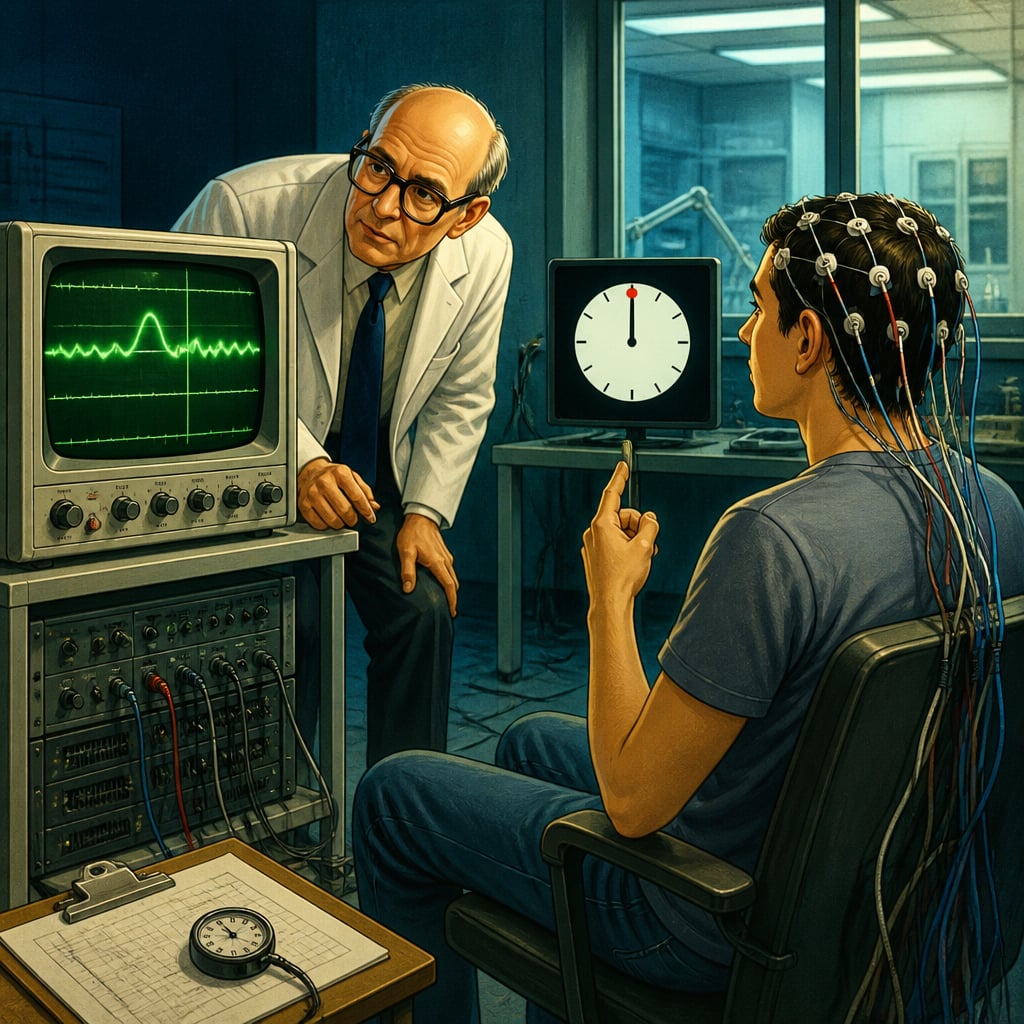
Sometime in 1983, in a fluorescent-lit room at the University of California, San Francisco, a neurophysiologist named Benjamin Libet is fitting a volunteer with scalp electrodes. The protocol is simple. The volunteer will flex her wrist whenever she feels like it, any time in the next half minute. As she does it, she will watch a rotating dot on a clock face on the wall and, afterwards, tell Libet exactly where the dot was at the moment she first felt the urge to move.
The volunteer flexes. The dot sweeps. Libet writes down the number. He does this hundreds of times, with dozens of volunteers. When he finishes his analysis, the result is strange enough that it will be argued about for the next forty years. There is a telltale brain signal, the readiness potential, that begins roughly 350 milliseconds before the volunteer becomes conscious of wanting to flex. The brain has already started. The 'you' who experiences deciding is catching up.
The experiment is cited, rightly or wrongly, as one of the great modern embarrassments for the idea of free will. If the brain is going first and the conscious 'I' is going second, where exactly is the freedom of the person supposed to live? The legal system assumes you are free. Physicists tell you the universe since the Big Bang has been running on equations that do not leave a gap for anything extra. And now the neuroscience lab, too, has a stopwatch that does not leave one either.
The Upanishad that will answer Libet's question is nearly twenty-five hundred years older than his clock face. It was composed around 400 BCE by a rishi called Śvetāśvatara, in the generation after the Buddha. Its answer is not the one most Western readers expect from an ancient religious text. It does not say 'of course you are free, God gave you a will.' It says something closer to this: yes, you are on a wheel you did not start and cannot stop, and the freedom you are looking for is real, but it is located somewhere you have not been looking. What follows is where.
The Upanishadic Answer
The Svetasvatara opens, unusually for an Upanishad, with a group of people sitting together and arguing. 'What is the cause? Is it Brahman? Whence are we born? By what do we live? Where are we established?' The text answers its own opening question in installments, and the installments are a study in how to hold determinism and liberation together without letting either one collapse.

The key image is a wheel. Chapter 1, verse 6. There is a great wheel of Brahman. In this wheel, every living being turns. The text calls the individual soul a haṃsa, a swan, and says the swan is 'whirled' by the wheel. This is not a romantic flourish. The verb is literal. You are tossed. You are not driving. Then the verse makes its critical move. As long as the swan thinks of itself and the mover of the wheel as separate, it remains tossed. The moment it knows itself and the mover as one, it becomes immortal.
Two things are being said at once, and both matter. First, the wheel is real. The causation is real. The tossing is not an illusion to be cheerfully denied. Second, the knowing of the mover is what the text calls liberation. Not a new power to push back against the wheel, but a shift in where the knower locates itself.
The Svetasvatara then does something that will sound eerily familiar to anyone who has read nineteenth century German philosophy. In Chapter 4, verse 10, it says: 'Know māyā as prakṛti, and know the wielder of māyā as the great Lord.' Two sentences. Twelve syllables in Sanskrit. They split the universe into the driven web of appearances and the consciousness that wields them. The Svetasvatara does not leave the swan alone with this diagnosis. Chapter 6, verse 11, promises that the one God is 'hidden in all beings, all-pervading, the inner self of all, the overseer of action, the witness, conscious, alone, free of qualities.' Witness and overseer. The verse lists both on the same line.
This is not the answer of a thinker who believes free will is a property of the individual ego. It is the answer of a thinker who has noticed that the individual ego is itself part of the wheel, and that the question 'does the ego have freedom' is therefore badly posed. The freedom is not the ego's. It is the witness's. And the witness is not the ego.
The Western Echo
Amsterdam, 1670s. A Portuguese Jewish lens-grinder named Baruch Spinoza writes the Ethics, a book so carefully argued and so deeply threatening to the religious establishment that it has to wait for posthumous publication. Spinoza's central claim is that there is one substance, which he calls God or Nature, and everything that exists is a mode of this substance. Nothing is outside it. Nothing can act against it. Every event, including every choice you think you are making, is a necessary consequence of the preceding state of the system.
So is there any freedom in Spinoza? There is. But it is a strange kind. Spinoza says freedom is the understanding of necessity. You are not free when you escape causation. You are free when you see it clearly enough that you no longer experience it as an alien force. A person who acts from a clear understanding of their situation acts from the ground of their own nature. A person who acts from fear and confusion is acted upon. The difference is not whether the chain of causes runs through you. It is whether you can see the chain.

Two centuries later, in Frankfurt, Arthur Schopenhauer is reading a book. The book is called the Oupnek'hat, and it is Anquetil-Duperron's 1801 Latin translation of a Persian translation of the Upanishads. Schopenhauer keeps a copy next to his bed for the rest of his life. He writes, in a famous passage, that 'it has been the solace of my life and will be the solace of my death.' He reads it every evening.
What he takes from the Upanishads becomes the spine of his own system. In The World as Will and Representation, Schopenhauer argues that underneath the world of appearances, which he calls Vorstellung (representation), there is a single blind driving force, which he calls Wille (will). The phenomenal world is the will's objectification. You experience yourself as a willing being, desiring, struggling, reaching, because you are an expression of this universal will. You do not have a will. You are willed.
Is there freedom in Schopenhauer? A little. He locates it in the saint and the artist, who manage, briefly, to turn away from the will and rest in disinterested contemplation. In aesthetic experience and ethical compassion, the individual catches a glimpse of the witness behind the willing. The rest of the time, the will runs the show.
The Gap
Schopenhauer, more than any other Western philosopher, stood at the door the Svetasvatara had opened. He had the right vocabulary. He had the right diagnosis. He even cited the source. But three things keep his system shy of the full Upanishadic answer.
First, his will is blind. The Svetasvatara's maheśvara is not blind. It is jña, a knower. The wheel is not a pointless machine. It is the activity of a consciousness. Schopenhauer read this in the Oupnek'hat but could not fully accept it, because nineteenth century European philosophy had no easy place for a conscious cause that was not a person-shaped God. So he kept the determinism and removed the knower.
Second, his freedom is negative. Freedom in Schopenhauer is turning away. The saint denies the will. The artist steps briefly out of it. The best life is the one most thoroughly withdrawn from willing. The Svetasvatara's freedom is different in kind. It is not a retreat. It is a recognition. The swan does not stop turning on the wheel when it knows the mover. It continues to turn, but now it is at home. The wheel becomes the Lord's activity, which is also the swan's own deepest nature. Action is not denied. It is seen through.
Third, and most important, Spinoza and Schopenhauer both treat the free-will question as an intellectual puzzle. Is there freedom, yes or no, and if so of what kind. The Svetasvatara treats the question as a practice. Knowing the mover is not a proposition to affirm. It is a way of standing in one's own experience. The verse ends 'juṣṭas tatas tenāmṛtatvam eti,' 'favored by that, one attains immortality.' The 'favoring' is the knower waking up inside itself. Until it happens, the puzzle stays a puzzle.
Why It Matters Today
The Libet experiment you watched at the start of this lesson became one of the most discussed findings in the philosophy of mind, and it is often cited as the death blow to free will. Neuroscience, the argument runs, has shown that your conscious choices are post-hoc stories the brain tells itself after it has already acted. The swan has no say. The wheel turns. End of inquiry.
Notice how Upanishadic this 'end of inquiry' actually is. If the ego is a post-hoc story layered on top of causally determined processes, then the ego was never where freedom lived in the first place. The Svetasvatara agreed with this twenty-five hundred years ago. What it disputes is the further claim that, because the ego is not free, there is no freedom at all. Libet himself eventually noticed something his popularizers often leave out. The conscious will seems to retain a veto. Between the unconscious initiation of an act and the act itself, there is a window in which awareness can cancel. 'Free won't,' some writers started calling it. The Svetasvatara would smile at the clumsy phrase and recognize the structure. The witness is free. The actor is driven. The freedom was never where we were looking.
This is not abstract. The next time you catch yourself about to lose your temper, or eat the third biscuit, or refresh an app you decided to delete, the Upanishadic practice is not to strain against the impulse with willpower you do not really have. It is to notice the impulse, see the wheel turning, and locate yourself as the one noticing. That locating is the only freedom there is. And the Svetasvatara and Spinoza and Libet, across twenty-five hundred years, all keep pointing at the same place.
Libet's volunteer, watching the dot on the clock face, was already standing there. So are you, every time you notice an impulse before you ride it.
Case studies
Schopenhauer and the Oupnek'hat
In 1814, a 26 year old Arthur Schopenhauer picked up a two-volume Latin text called the Oupnek'hat. It was Abraham Hyacinthe Anquetil-Duperron's 1801 translation of a Persian translation of fifty Upanishads, commissioned by the Mughal prince Dara Shikoh in the 1650s. The chain of transmission was long: Sanskrit to Persian to Latin, with idiosyncratic choices at every stage. Schopenhauer did not care. He read a copy every night for the rest of his life. He wrote, in Parerga and Paralipomena, that 'from every sentence deep, original and sublime thoughts arise, and the whole is pervaded by a high and holy and earnest spirit.' The famous line came later: 'It has been the solace of my life, and it will be the solace of my death.' The book was by his bedside the night he died in 1860.
The Svetasvatara offered Schopenhauer the vocabulary for a position he was already reaching toward by a different road. He was trying to articulate that underneath the world of appearances there is a single driving force, and that freedom consists in a specific kind of turning away from this force. The Svetasvatara told him: yes, this is how it works, and there is a second step you have not yet taken. The driving force is itself a consciousness. The turning away is not enough. What completes the teaching is recognizing that you and the driving force share the same witnessing nature. Schopenhauer took the first step publicly. He stopped just short of the second, and his successors argued for the next hundred years about why.
Schopenhauer's fusion of Upanishadic language and European idealism became the single most influential Western introduction to Indian philosophy. He shaped Nietzsche, Wagner, Thomas Mann, Samuel Beckett, Einstein, Freud, and Borges. Every later Western engagement with the Upanishads, from Emerson through Aldous Huxley through Joseph Campbell, runs through Schopenhauer in one way or another. Later scholarship has been harder on Anquetil-Duperron's translation, which is frequently misleading, but Schopenhauer read through the errors to the structure, and the structure was intact.
A teaching survives bad translation if its architecture is intact. Schopenhauer's contact with the Upanishads was through a Latin translation of a Persian translation, and he still recognized what was in front of him. What mattered was not the vocabulary. It was the shape of the answer.
The Oupnek'hat contains fifty Upanishads rather than the ten or twelve that later scholars consider canonical, including several Yoga and Sannyasa Upanishads that are chronologically much later than the principal ones. Schopenhauer could not easily tell which were which, and it barely mattered to his reading. The central teaching he drew from the text is from the principal Upanishads, the Svetasvatara prominent among them.
Libet's Readiness Potential and the 350 Millisecond Gap
In 1983, the neurophysiologist Benjamin Libet at the University of California, San Francisco published one of the most discussed experiments in the history of consciousness research. Volunteers sat in front of a fast-moving clock and were asked to flex their right wrist whenever they felt like it, and to note the clock position at the exact moment they became aware of the intention to flex. EEG electrodes recorded a brain signal called the Bereitschaftspotential, the readiness potential, which reliably began around 350 milliseconds before the volunteer reported conscious awareness of intending to flex. The brain had begun the motion before the 'I' who felt itself deciding had shown up at all.
For most of its popularizers, Libet's experiment settled the free will question: there is none. What the ego experiences as a decision is a post-hoc narration of a process that was already underway. A Svetasvatara reading takes this finding seriously and then notices what the popular account leaves out. If the 'I' who thought it was deciding is actually a catcher-up, then the 'I' was never where freedom lived. The Svetasvatara said exactly this twenty-five hundred years ago. The swan is whirled. The ego does not drive the wheel. Bondage is not the absence of freedom; it is the misidentification of what we are. Libet's instruments confirmed, in microseconds, what the Upanishad stated in Sanskrit. Libet himself noticed something his popularizers usually do not. The conscious mind could still issue a veto in the roughly 150 milliseconds between readiness potential and muscle activation. 'Free won't,' philosophers later called it. The witness retained a say the initiator did not.
Libet's experiment is now standard material in philosophy of mind seminars and neuroscience lectures around the world. It has been replicated, refined, and disputed, and its exact interpretation is still contested. What is not contested is that it reframed the free will question. 'Does my ego initiate action?' has quietly been replaced by 'What is the relationship between conscious awareness and the processes that produce action?' That is the question the Svetasvatara opens with. It is a question about the location of the knower, not the power of the chooser. Libet ended his career arguing that his findings were consistent with a dignified account of conscious agency. He did not reach for Vedantic language, but the move he made in defense of freedom is the move the Svetasvatara spent six chapters working out.
When a scientific finding seems to abolish your freedom, check what picture of freedom it is abolishing. Usually the picture is an ego at the top of a chain of command, issuing instructions that the body then carries out. That picture was never the Upanishadic account. The freedom the Upanishad defends is the freedom of the witness. Libet's experiment does not touch it.
Libet's original 1983 paper (Brain, Volume 106, pages 623 to 642) has been cited more than six thousand times as of 2026. Almost none of its citations mention the Upanishads. Almost all of its citations wrestle with a version of the same question the Svetasvatara asked in Chapter 1 Verse 6.
Reflection
- Think of a recent moment when you felt you had no choice. What was driving you? Where were you, inside your experience, while it happened?
- Svetasvatara 1.6 says the swan is freed when it stops thinking of itself and the Mover as separate. What would it be like, for you, to not think of yourself and the forces in your life as separate? Is that a thought, a feeling, or a kind of standing still?
- If Libet's experiments show the brain decides 350 milliseconds before conscious awareness, does that falsify free will, or does it just falsify a specific picture of what 'you' are? What picture is doing the falsifying, and what picture survives?