Is the Universe Conscious?
Sarvam Khalvidam Brahma. All this is Brahman. Modern panpsychism rediscovers an ancient truth.
Uddālaka teaches Śvetaketu with a cup of salt water in the Chandogya Upaniṣad. Consciousness is not a late arrival in evolution. It is the ground of everything, a claim modern panpsychism is now reaching again.
The Morning After
A young man walks out of his father's house at dawn in the valley of the Sarasvatī, sometime in the seventh century BCE. His name is Śvetaketu. He is twenty-four years old, newly finished with twelve years of Vedic study, and proud of everything he now knows. His father has just done something that confused him.
The evening before, his father Uddālaka Āruṇi had handed him a lump of rock salt and a clay bowl of water. 'Drop the salt in the bowl,' Uddālaka had said. 'Leave it overnight. Come back in the morning.'
Now it is morning. The lump of salt is gone. The water looks the same as any other water. Uddālaka is waiting.
'Bring me the salt you put in last night,' he says.
Śvetaketu reaches into the bowl. There is nothing to grasp. The salt has dissolved.
'Taste it from the top.' Salty. 'From the middle.' Salty. 'From the bottom.' Salty. Present in every drop. Visible in nothing.
'In just this way,' Uddālaka tells his son, 'the finest essence is everywhere, and you cannot see it. That is the Self of all this. That is reality. That is the Self. Tat tvam asi, Śvetaketu. That thou art.'
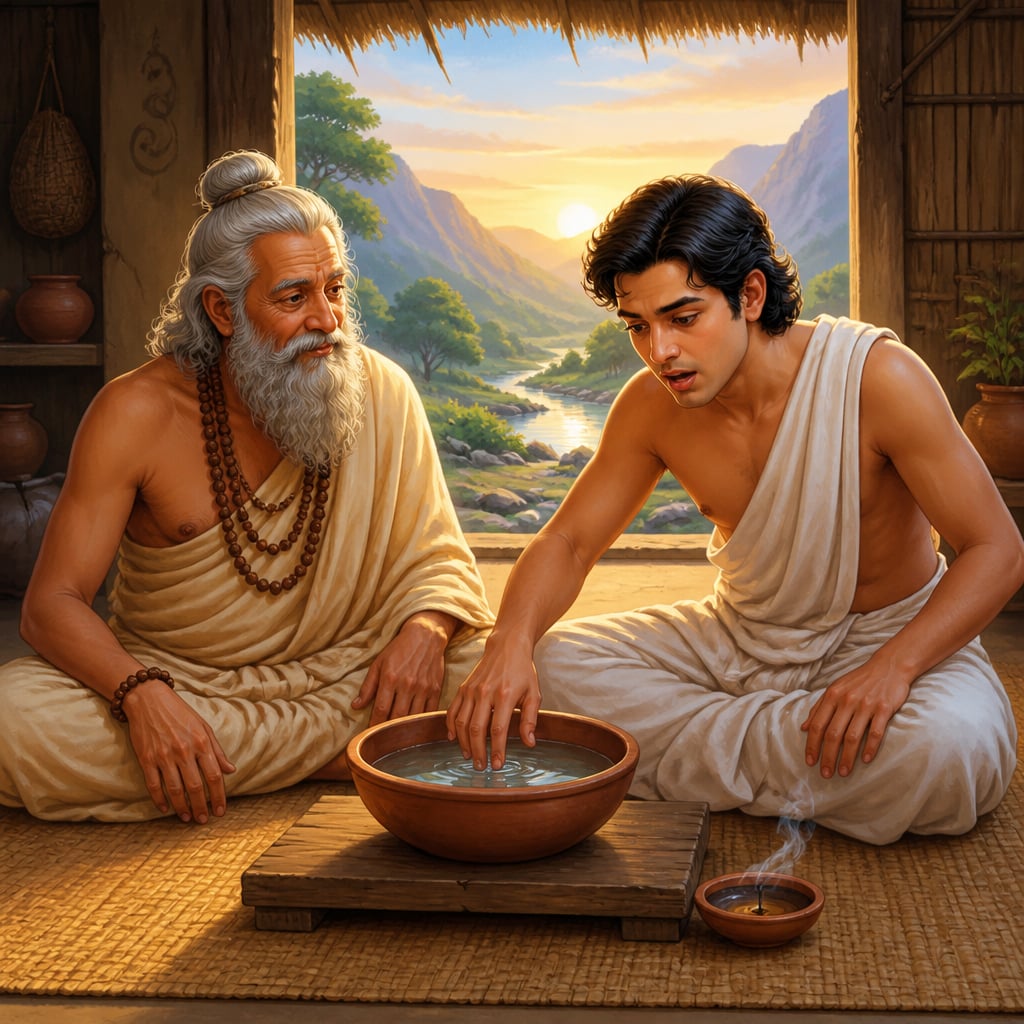
Twenty-five centuries later, a philosopher at a conference in Tucson, Arizona will give the question Uddālaka has just answered a new name: the hard problem of consciousness. How can mindless atoms produce an inside, a felt quality, an experiencer? The Chandogya Upaniṣad, in the demonstration you just watched, has already refused the question's premise. Consciousness is not something matter learned to do. It is the water the salt has dissolved into. What follows is the story of how this answer, dismissed for centuries as mysticism, is being reached again in our own lifetimes, slowly and reluctantly, by the most rigorous analytic philosophy in the West.
The Upanishadic Answer
In the Chandogya Upanishad, one of the oldest and longest of the principal Upanishads, the rishi makes the boldest claim in Indian philosophy in four words. Sarvaṃ khalv idaṃ brahma. 'All this is indeed Brahman.' Every stone, every star, every breath, every thought, every cell of your body. All of it is the same single reality. Consciousness is not a rare property that appeared late in evolution on one small planet. It is the substance of which everything is made.
The full verse is more careful than the slogan suggests. 'All this is indeed Brahman. It is that from which all this is born, into which all this dissolves, by which all this breathes.' The rishis compressed this into a single compound word, tajjalān, which means born from it, dissolving into it, breathing in it. One word, three verbs, one reality. The verse then adds an instruction. 'Therefore one should meditate in peace.'
Back up one step. Before Uddālaka handed his son the cup of salt water, he had set the larger claim that the whole sixth chapter of the Chandogya rests on. 'In the beginning, dear boy, this was Being alone, one only, without a second.' Sat eva somya idam agra āsīd ekam eva advitīyam. Not two kinds of stuff, not matter and mind, not physical and mental. One reality, showing up as many.
The salt was not the only demonstration. Earlier the same evening, Uddālaka had asked Śvetaketu to fetch a fruit from the nyagrodha tree, split it open, and split one of its tiny seeds. Inside the seed was nothing visible. 'That subtle essence you cannot see,' Uddālaka said, 'from that the great nyagrodha tree arises.' The seed and the salt were his way of pressing an abstract claim into something Śvetaketu could touch and taste. Tat tvam asi was not a conclusion at the end of an argument. It was the rest of a sentence his son was now living inside. The teaching stands as one of the four mahāvākyas, the great statements of Vedanta. You are not a stranger standing outside a conscious universe. You are the universe in one of its moments of recognizing itself.
The Western Echo
For most of modern philosophy, the Chandogya's claim sounded like mysticism. The dominant Western picture, running from Descartes through Newton into twentieth-century science, was what the philosopher Galen Strawson has called 'the great mistake.' Divide reality into two. On one side, mindless matter governed by physics. On the other, mind, consciousness, experience. Figure out how the first produces the second. The result, after four centuries of effort, is what David Chalmers named in 1995 the hard problem of consciousness. We have no account of how any arrangement of mindless particles could produce an inside, a felt quality, an experiencer.

A quieter tradition in Western philosophy always held that the premise was wrong. Alfred North Whitehead, the Harvard mathematician and philosopher, argued in Process and Reality in 1929 that every actual occasion in the universe has two poles, a physical pole and an experiential pole. Experience is not added to matter at some late stage. It goes all the way down. Bertrand Russell, in his Analysis of Matter in 1927, pointed out that physics tells us only the structural properties of things, not their intrinsic nature. The intrinsic nature could, for all physics says, be experiential. In 2006, Galen Strawson published a paper arguing that if you take physicalism seriously, you are logically forced toward panpsychism. If consciousness is real, and if consciousness cannot emerge from a base that is utterly non-conscious, then the base must itself involve experience. The Chandogya's conclusion, reached three thousand years earlier, became the forced conclusion of rigorous Western analytic philosophy.
This is not a fringe view anymore. Panpsychism is discussed in top journals. Leading philosophers of mind take it seriously, not because it is ancient or attractive, but because the alternatives keep failing.
The Gap
What does the Chandogya offer that modern panpsychism does not yet reach?
The first difference is grammatical. Western panpsychism is typically pluralist. Every particle, or every fundamental entity, has its own tiny bit of experience. The universe is then an aggregate of countless small experiences. This leads to what philosophers call the combination problem. How do many small experiences combine into one unified human experience? The problem is real and unsolved. The Chandogya does not have this problem because it does not start from many. It starts from one. Ekam eva advitīyam, one only without a second. Consciousness is not the sum of countless particles of experience. It is a single reality appearing as many. Individual minds are not building blocks combining into something larger. They are local vantage points on a seamless whole.
The second difference is experiential. Modern panpsychism is argued in journal articles. The Chandogya is taught through practices. Uddālaka does not just tell his son that reality is one. He has him taste the saltwater. He has him look at the seed. The teaching is designed to be verified in experience, and the tradition that grew out of it developed thousands of years of meditative techniques aimed at direct recognition. The claim is not only a conclusion. It is a door.
The third difference is ethical. If everything is the same reality, then the person across from you is not a stranger. The animal you meet is not a resource. The river is not an object. The Upanishadic claim carries ethical weight that panpsychism has not yet unpacked. Tat tvam asi is not a metaphysical footnote. It is a way of seeing that, fully absorbed, changes how one acts.
Why It Matters Today
The hard problem of consciousness is not going away. Neuroscience has mapped the neural correlates of experience in extraordinary detail, and the gap between correlation and explanation remains untouched. When scientists tell you that consciousness just is brain activity, they are not solving the problem. They are refusing to look at it. A growing number of philosophers, biologists, and physicists are starting to look again. When they do, they are arriving at conclusions that the Chandogya stated in four words.
The practical point of this lesson is not that you should adopt panpsychism. It is that the question 'is the universe conscious?' is not a question science has answered. It is a question science has, until very recently, refused to ask. The Upanishadic tradition asked it, answered it, and built a whole philosophy around the answer. You do not have to accept the answer to take the question seriously. But if the Chandogya is even partially right, then the atoms of the stone and the atoms in your body are not two kinds of thing. They are the same reality, briefly separated, each one a place where the whole is looking back at itself.
Śvetaketu, at dawn in the Sarasvatī valley, had already tasted this. The rest of us are still catching up.
Case studies
Uddālaka, Śvetaketu, and the salt in the water
A young man named Śvetaketu returns home after twelve years of Vedic study. He has memorized the scriptures, learned the rituals, and considers himself thoroughly educated. His father, the sage Uddālaka Āruṇi, asks him a question. 'Have you asked for that teaching by which the unheard becomes heard, the unthought becomes thought, the unknown becomes known?' Śvetaketu has not. He does not even understand what his father is talking about. Uddālaka spends the sixth chapter of the Chandogya Upanishad teaching him.
Uddālaka's method is empirical before the word existed. He does not lecture. He sets up experiments. He tells Śvetaketu to bring a fruit from the nyagrodha tree, split it, split the seeds inside, and look at the invisible center from which the enormous tree grows. Then he asks Śvetaketu to put a lump of salt in water and come back the next morning. The salt has dissolved. Śvetaketu cannot see it. Uddālaka has him taste the water from the top, the middle, the bottom. Salt is everywhere in the water, invisible in every drop, present in every sip. 'In just this way,' Uddālaka says, 'Being is everywhere in this world, invisible, and you do not perceive it.' Each demonstration ends with the same refrain, tat tvam asi, that thou art, repeated nine times in the chapter until the words wear a groove in the student's mind.
The Chandogya's sixth chapter became the single most influential passage in the history of Indian non-dual philosophy. It provided the scriptural foundation for Advaita Vedanta, the starting point for Gaudapada's ajātivāda, the anchor of every Shankara commentary, and the model of how difficult metaphysical truths ought to be taught. Nearly three thousand years later, the passage is still read in Sanskrit classrooms, in meditation retreats, in philosophy seminars on the nature of consciousness. Uddālaka's experiments with salt and seed are still performed, literally or in imagination, by every serious student of Vedanta.
The oldest known argument for the consciousness of the universe is not a proof. It is a demonstration you are invited to repeat with your own hands and your own tongue. The Upanishadic tradition treats metaphysics as something to be tested, not something to be believed.
Galen Strawson and the return of panpsychism
In 2006, the British philosopher Galen Strawson, now at the University of Texas, published a paper titled 'Realistic Monism: Why Physicalism Entails Panpsychism.' The thesis was that if you take physicalism seriously, meaning you believe everything is physical, and if you take consciousness seriously, meaning you believe experience is real, then you are logically forced to accept that the base layer of reality already involves experience. You cannot get experience out of something that has none.
Strawson was not drawing on the Upanishads. He was drawing on rigorous analytic philosophy and the failure of fifty years of emergence-based theories of consciousness. But the conclusion he reached was recognizably Upanishadic. If consciousness is real and irreducible, and if nothing non-conscious can turn into something conscious by mere rearrangement, then consciousness must be part of the ground floor of reality. The Chandogya said this in four words, sarvaṃ khalv idaṃ brahma. Strawson said it in a forty-page technical paper. The machinery differs. The conclusion is the same. The universe is not a dead system that accidentally produced minds. It is a reality in which experience is fundamental.
Strawson's paper reopened the panpsychism question in mainstream Western philosophy for the first time in a century. It triggered a wave of work from Philip Goff, Annaka Harris, David Chalmers, Hedda Hassel Mørch, and others. By the early 2020s, panpsychism had become a live option in top philosophy of mind journals, taught in graduate seminars at Oxford, NYU, and the Australian National University. The hard problem of consciousness, which had once been treated as a puzzle about brain science, was increasingly being treated as a problem that might require a new metaphysical starting point. That starting point kept resembling what the Upanishads said three thousand years ago.
When the most rigorous modern analytic philosophy follows the logic of consciousness all the way down, it arrives at the neighborhood of the Chandogya's claim. The route is different. The destination is not.
Michael Levin and the cognition of cells
At Tufts University, the developmental biologist Michael Levin has been running some of the strangest experiments in modern biology. His lab has shown that groups of cells, separated from their original organism and placed in a new environment, can reorganize themselves into novel forms his team calls xenobots. These cellular assemblies, with no neurons and no brain, exhibit coordinated behavior that looks remarkably like goal-directed problem solving. Levin has argued, in peer-reviewed papers and public talks, that cognition is not confined to brains. It is a property of any system that can take in information, model its environment, and act to preserve or extend itself.
Levin is careful with his language. He does not claim that xenobots are conscious in the human sense. But he does claim that the intelligence we associate with nervous systems is a special case of a much more general phenomenon that appears throughout the living world. A single cell navigates its environment. A tissue regenerates to a specific target shape. A slime mold solves mazes. The pattern of intelligent behavior extends downward, through scales of organization, into domains where classical biology insisted only mechanism could exist. The Chandogya's claim that aṇiman, the subtle essence, is present throughout the living world is not a mystical decoration on Levin's findings. It is a thesis that modern basal cognition research is, in its own vocabulary, rediscovering.
Levin's papers in journals like Frontiers in Psychology and in interviews on major science podcasts have changed how many biologists think about the distribution of cognition. The hard line between thinking systems and non-thinking systems, so important to the twentieth-century picture, is becoming blurry. If a cell can be said to pursue goals, and a tissue can be said to solve problems, then the concept of mind that was reserved for humans and a few animals is opening up. The Upanishadic tradition never drew the hard line in the first place. The Chandogya's claim that Being is the Self of all this, including the seed, the water, the fire, was always meant literally.
Modern biology is running into a fact the rishis named long ago. Awareness is not something a few creatures have. It is something the living world does at every scale. Levin's xenobots do not prove the Chandogya. They point, in a laboratory, at a direction the Chandogya pointed in words.
Reflection
- If you took seriously the possibility that everything around you is the same consciousness that you call 'I,' what would change in how you move through a single ordinary day?
- Why did Uddālaka insist on a physical demonstration with salt and water rather than simply telling Śvetaketu the answer?
- If consciousness is fundamental rather than emergent, what happens to the distinction between living and non-living matter?