The Conversion Machine & How the Nexus Operates
Joshua Project, Inculturation, and the Mutual Legitimation Machine
How the Western academic-evangelical-NGO nexus operates as a self-reinforcing conversion machine. From the Joshua Project's targeting database to inculturation theology, from rice Christianity to USCIRF reports, this lesson maps the system that turns India's diversity into a conversion opportunity and exposes the circular legitimation that sustains it.
The 10/40 Window: India as Target Zero
In 1990, a Christian strategist named Luis Bush presented a concept at the Lausanne II Congress in Manila that would reshape global evangelism for the next three decades. He called it the 10/40 Window, the rectangular band of territory between 10 and 40 degrees north latitude stretching from West Africa to East Asia. This strip of the planet contained the majority of the world's unreached non-Christian populations. It also contained the majority of the world's Hindus, Buddhists, and Muslims.
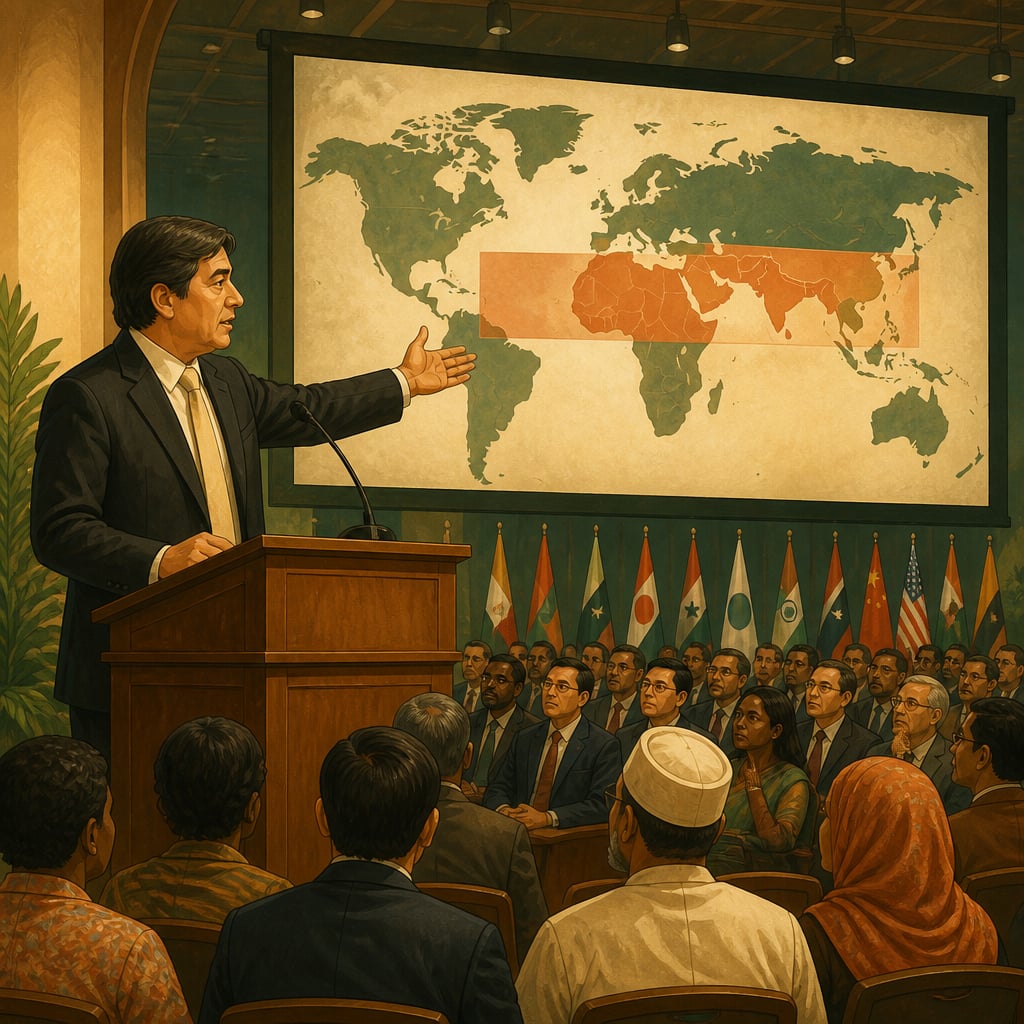
The framing was deliberate. Bush did not present this as a geographic observation. He presented it as a strategic targeting framework. The 10/40 Window was where the "spiritual battle" needed to be fought. Resources, personnel, and funding needed to be redirected from already-Christianized regions toward this zone.
India sat at the center of that rectangle. With over 800 million Hindus, thousands of distinct community groups, and a democratic system that permitted religious activity, India was not just inside the 10/40 Window. It was the single largest target. The logic was straightforward: China was closed to foreign missionaries. The Islamic world was hostile to conversion. India was open, diverse, and penetrable. By the mid-1990s, India had become what missiologists openly called the most important mission field on earth.
This was not a conspiracy theory. It was a stated strategic priority, published in mission journals, discussed at conferences, and funded accordingly.
Joshua Project: The Database of Souls
The strategic vision needed an operational tool. It got one in the form of the Joshua Project, conceived by missionary researcher Ralph Winter and formalized in 1995. Winter had introduced the concept of "unreached people groups" at the 1974 Lausanne Congress, arguing that evangelism should not think in terms of countries but in terms of ethnolinguistic communities. A people group was "unreached" if it lacked a self-sustaining indigenous Christian community, typically defined as less than 2% evangelical Christian.
The Joshua Project took this concept and turned it into a database. It catalogued every identifiable people group on the planet, assigned each a progress rating on a scale from unreached to reached, and provided demographic data to help mission organizations allocate resources. As of 2024, the database lists over 17,000 people groups globally.
India dominates the database. The Joshua Project identifies over 2,500 people groups in India, more than any other country. Each entry includes population estimates, primary language, primary religion, percentage of Christians, and a progress level indicator. Scheduled Castes and Scheduled Tribes receive particular attention because they are classified as most receptive to conversion.
The database is openly accessible at joshuaproject.net. It is not hidden. Mission organizations use it as a planning tool the way a corporation might use market research. The terminology is revealing: groups are described in terms of "engagement" status, "progress" levels, and "gaps" in missionary coverage. The language of souls has been replaced by the language of market penetration.
What makes the Joshua Project significant is not its existence alone but what it enables. It allows thousands of independent mission organizations to coordinate without central command. Each organization can identify an "unreached" group, check what other agencies are already working there, and deploy resources to fill gaps. It is a decentralized targeting system operating with the efficiency of a centralized one.
The Conversion Toolkit
Strategy and databases need methods. The conversion apparatus that operates in India relies on several proven techniques, each calibrated to exploit specific vulnerabilities.
Rice Christianity is the oldest and most straightforward. The term dates to the colonial period, when missionaries in China and India offered material benefits (food, clothing, money, employment) to impoverished communities in exchange for conversion. The method persists because it works. In tribal regions of Jharkhand, Chhattisgarh, and Odisha, conversion often follows a pattern: a local organization establishes a presence through material aid, builds dependency, and then introduces religious instruction. The convert receives tangible benefits. The mission organization reports a new soul. Both parties have an incentive to continue.
This is not speculation. Field studies and journalistic investigations across central and northeastern India have documented the pattern repeatedly. The Niyogi Committee, appointed by the Madhya Pradesh government in 1956, investigated missionary activities and found systematic use of material inducements. Its findings have been contested but never substantively refuted.
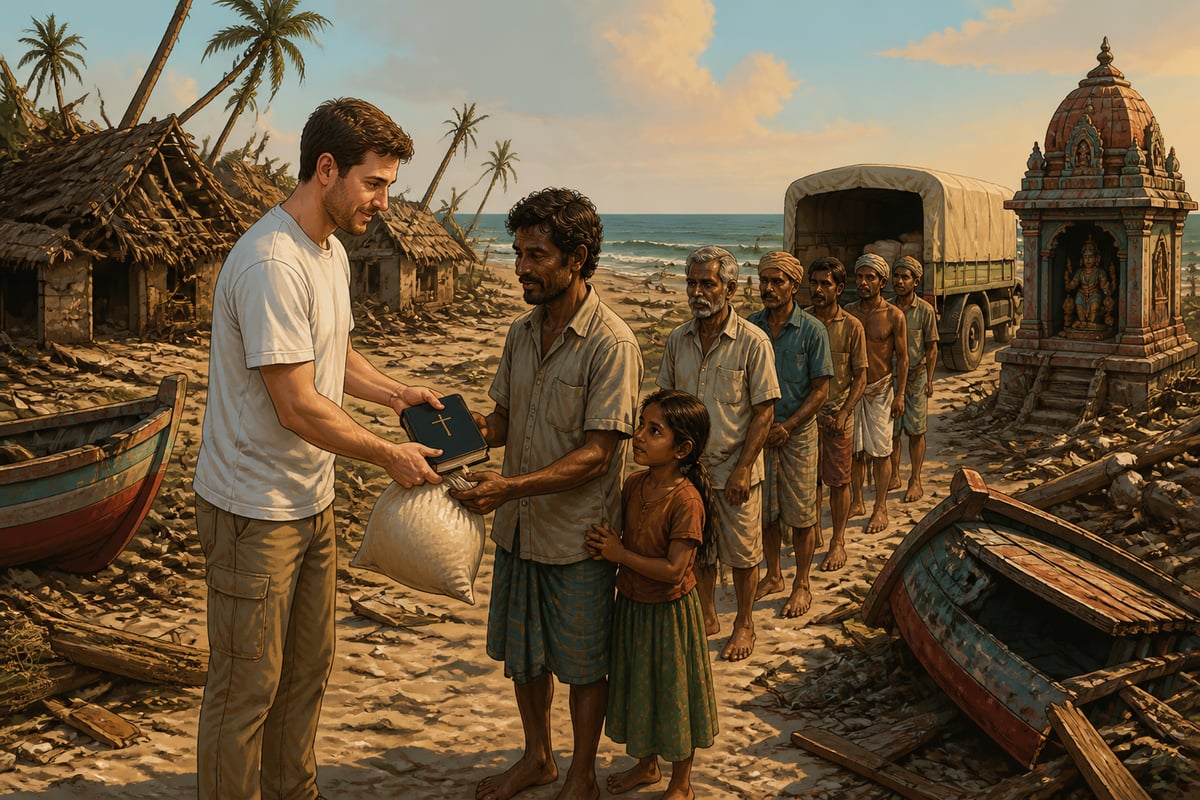
Disaster exploitation follows a similar logic at compressed timescales. When the 2004 Indian Ocean tsunami devastated coastal Tamil Nadu, foreign missionary organizations flooded the affected areas. Some provided genuine humanitarian aid. Others made aid conditional on religious participation or used the chaos to establish footholds in communities that had previously been inaccessible. Reports from survivors described being told that the tsunami was divine punishment and that conversion would provide protection. The pattern repeated after the 2013 Uttarakhand floods and the 2018 Kerala floods. Disaster creates vulnerability. Vulnerability creates opportunity.
Medical missions operate as a gateway. Organizations establish clinics or hospitals in underserved areas, provide real medical care, and embed evangelism into the service delivery model. Patients receive treatment alongside religious literature. Staff are trained to share their faith during consultations. The medical service is genuine, which makes the conversion component difficult to separate from the humanitarian one. This blurring is intentional.
Education as pipeline is perhaps the most consequential long-term method. Missionary-run schools in India number in the tens of thousands. Many provide excellent education, particularly in rural and tribal areas where government schools are absent or dysfunctional. The educational quality is real. But the institutional environment shapes identity over years. Students absorb a worldview through curriculum, chapel services, and the social environment. The conversion may not happen at school. It happens a generation later, when the student's children grow up in a household where Christian institutional culture has already been normalized.
Each of these methods works independently. Together, they constitute a system.
Inculturation: The Theological Trojan Horse
The most sophisticated conversion methodology is not material but cultural. It is called inculturation, and its Indian template was established four centuries ago by a Jesuit priest named Roberto de Nobili.
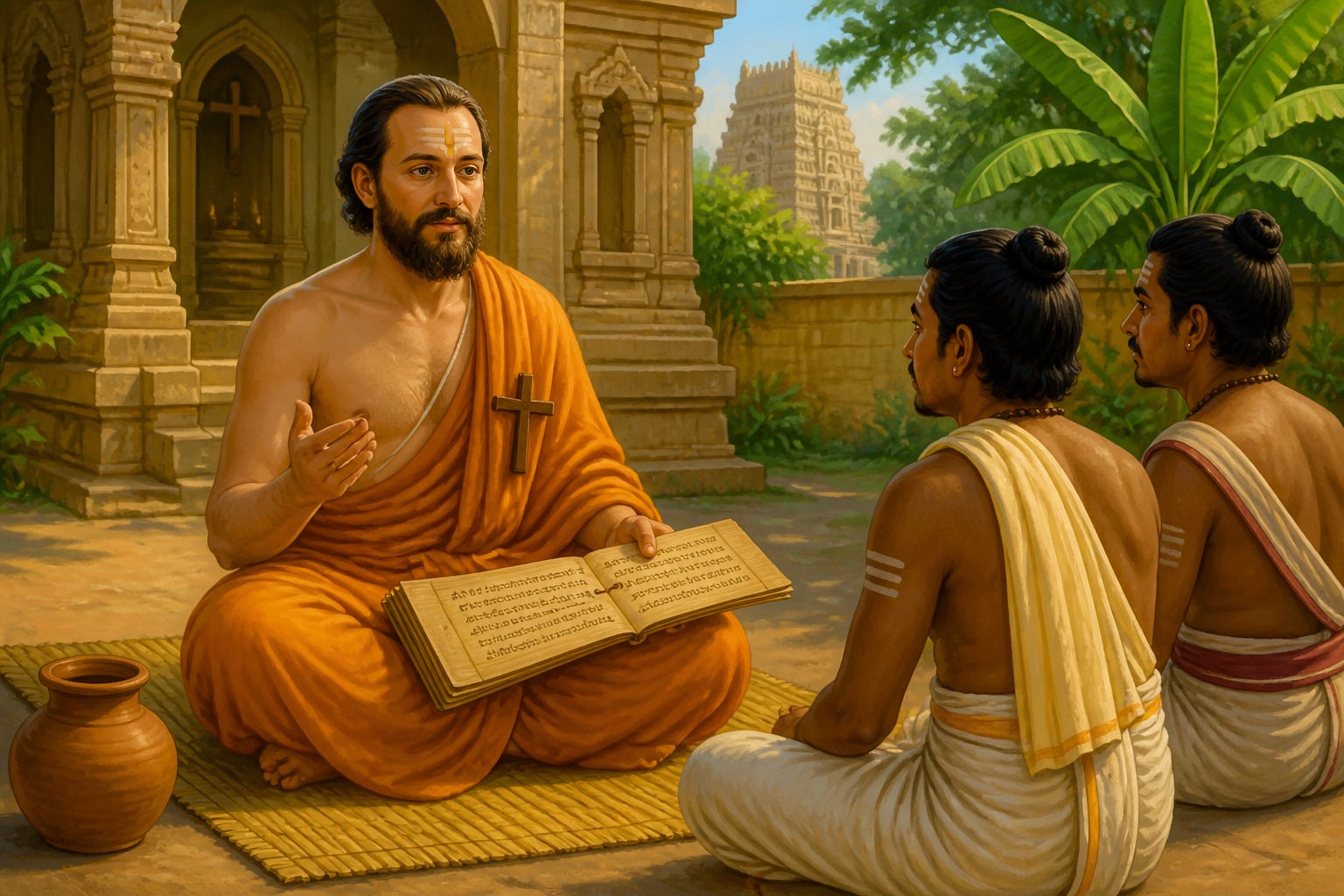
De Nobili arrived in Madurai in 1606 and recognized that European Christianity repelled upper-caste Hindus. So he adapted. He wore ochre robes, applied sandalwood paste, learned Sanskrit and Tamil, adopted a vegetarian diet, and presented himself as a "Roman Brahmin." He repackaged Christian theology in Vedantic vocabulary, arguing that this was not deception but legitimate cultural adaptation. The strategy worked well enough that the Vatican debated it for decades before partially censuring it.
De Nobili's template has been modernized and scaled. Modern inculturation in India operates on multiple levels simultaneously.
At the architectural level, churches in South India are built with gopuram-style towers that make them visually indistinguishable from Hindu temples. The intent is to lower the psychological barrier to entry for Hindu visitors who might resist entering a building that looks foreign.
At the personnel level, some Christian clergy adopt saffron robes, the traditional color of Hindu renunciants. They are sometimes called "saffron fathers." The visual coding signals Hindu identity while the theological content remains Christian.
At the linguistic level, Christian concepts are systematically mapped onto Sanskrit and Vedic terminology. God becomes Prajapati. The Holy Spirit becomes Shakti. Salvation becomes Moksha. Jesus is presented not as a foreign deity but as the fulfillment of Vedic prophecy. The "Jesus as Prajapati" framework, promoted by certain Indian Christian theologians, argues that the Purusha Sukta hymn of the Rig Veda is actually a prophecy of Christ's sacrifice. This is not mainstream Christian theology. It is a conversion tool designed specifically for Hindu audiences.
At the ritual level, Christian worship services incorporate aarti, bhajan-style music, and puja-like ceremonial elements. The form is Hindu. The content is Christian. The convert does not feel that they have left their culture. They feel that they have discovered its "true meaning."
The theological term for this is fulfillment theology: the claim that Hinduism contains partial truths that find their completion in Christianity. It was articulated by missionaries like J.N. Farquhar in his 1913 book "The Crown of Hinduism." The implication is that Hinduism is not wrong. It is simply incomplete. Christianity is its upgrade.
This is the most dangerous methodology precisely because it is the hardest to detect. Material inducement is visible. Inculturation is designed to be invisible.
The Mutual Legitimation Machine
The conversion apparatus does not operate in isolation. It is embedded in a larger system with three interlocking arms, each providing what the others need.
The first arm is Western academia. Scholars in religious studies, South Asian studies, and human rights departments at Western universities produce intellectual frameworks that characterize Hinduism as an oppressive caste system and frame conversion as liberation. This is not a fringe position. It is the mainstream analytical lens in many major universities. The academic output generates a body of literature that treats Hindu resistance to conversion as "persecution" and treats conversion itself as an expression of individual agency and human rights. Key concepts like "Brahmanical hegemony," "caste apartheid," and "Hindu nationalism" originate in or are amplified by this academic ecosystem.
The second arm is the evangelical mission complex. Organizations like Gospel for Asia, Every Home for Christ, and hundreds of smaller agencies execute the actual conversion work on the ground. They use the methods described above. They report their results in terms that mirror the academic frameworks: they are "liberating" Dalits, "empowering" tribals, "freeing" women. The language maps directly onto the categories that Western academia has established as legitimate.
The third arm is the NGO and institutional advocacy layer. Organizations like the United States Commission on International Religious Freedom (USCIRF) translate the academic framework and the missionary reports into policy pressure. USCIRF publishes annual reports that place India on watchlists, recommend sanctions, and pressure the Indian government to ease restrictions on foreign-funded religious activity. Its commissioners have included individuals with direct ties to evangelical organizations. The commission's mandate is ostensibly to protect religious freedom worldwide. In practice, its India recommendations consistently align with the interests of the conversion apparatus: more access, more funding, fewer regulations.
Here is how the circle closes. Academia produces the framework: Hinduism is oppressive, conversion is liberation. Evangelicals execute on the ground using that framework as justification. NGOs and USCIRF take the evangelical reports, filter them through the academic framework, and present them to policymakers as human rights concerns. Policymakers pressure India. India loosens restrictions. Evangelicals gain more access. They produce more reports. Academia cites those reports. The cycle continues.
Each arm legitimates the other two. Academics point to USCIRF reports as evidence. USCIRF points to academic literature as its analytical basis. Evangelicals point to both as proof that their work is internationally recognized. No single arm could sustain itself alone. Together, they form a self-reinforcing system.
This is not coordination in the conspiratorial sense. It does not require secret meetings. It requires only shared assumptions, aligned incentives, and institutional inertia. The participants may genuinely believe they are doing good work. The system functions regardless of individual intent.
Following the Money
Systems of this scale require funding. The financial infrastructure is substantial and partially traceable.
India's Foreign Contribution Regulation Act (FCRA) requires organizations receiving foreign donations to register and report their receipts. FCRA data, while imperfect and often delayed, provides a partial picture. Between 2006 and 2018, organizations classified under religious or social purposes received tens of thousands of crores in foreign contributions. Christian organizations consistently ranked among the largest recipients. In FY 2019-20 alone, organizations associated with Christian missionary activity received an estimated Rs 5,000-7,000 crore in foreign contributions, though exact figures depend on classification methodology.
The funding flows through multiple channels. Direct transfers from Western church networks to Indian partner organizations represent the most visible pipeline. Intermediary organizations registered in tax-friendly jurisdictions serve as pass-through entities, obscuring the ultimate source. "Development" funding that is formally secular but operationally linked to evangelism represents another channel. An organization might receive funding for "education" or "healthcare" while embedding conversion activity into those programs.
The scale is significant. India is one of the top five destination countries for American evangelical missionary funding. The total American Protestant missionary budget exceeds $8 billion annually, with India capturing a meaningful share. These numbers do not include Catholic missionary funding, European sources, or South Korean churches, which have become major funders of India-focused mission work.
The 2020 tightening of FCRA regulations by the Indian government, which required organizations to maintain their FCRA accounts at a designated branch of the State Bank of India in New Delhi, was a direct response to concerns about foreign funding of conversion activity. The regulations triggered sharp criticism from the NGO and advocacy layer, which framed them as an attack on civil society. This reaction itself illustrates the mutual legitimation dynamic: restrictions on foreign funding for religious conversion are recast as human rights violations.
The Defense: Seeing Through the Machine
Understanding the system is the first step toward countering it. The conversion apparatus is powerful but not invincible. It has structural dependencies that can be addressed.
Map the money. FCRA data is public. Every organization receiving foreign contributions files returns that can be accessed through the Ministry of Home Affairs. Citizens, journalists, and researchers should systematically track which organizations receive foreign funding, from which sources, and for what stated purposes. Transparency is the simplest counter to opaque funding networks.
Distinguish genuine service from conversion pipelines. Not every Christian school, hospital, or NGO is a conversion vehicle. Many provide excellent service with no strings attached. The defensive posture should not be blanket hostility but precise identification. The test is simple: does the organization condition its services on religious participation? Does it embed evangelism into service delivery? Does it report its work in terms of "souls saved" or "people groups reached"? Organizations that fail these tests should be treated differently from those that pass.
Build competing infrastructure. The conversion toolkit exploits vacuums. It works where government services are absent, where education is poor, where healthcare is unavailable, and where disasters go unaddressed. The most durable counter-strategy is to fill those vacuums with indigenous institutions. Hindu organizations, government agencies, and community groups that provide education, healthcare, and disaster relief without conversion agendas eliminate the dependency that the conversion apparatus exploits. Every school built, every hospital opened, every disaster response team deployed reduces the surface area available to conversion pipelines.
Counter the academic arm. The intellectual framework that treats Hinduism as uniquely oppressive and conversion as uniquely liberating is sustained by institutional dominance, not by the strength of its arguments. It can be challenged through rigorous scholarship that presents alternative frameworks, through endowment of academic positions that bring different perspectives, and through public engagement that exposes the circular reasoning of the mutual legitimation machine. This requires sustained investment in intellectual infrastructure, not reactive outrage.
Expose mutual legitimation. When USCIRF issues a report on India, trace its sources. When an academic paper frames Hindu practices as human rights violations, check who funded the research. When an NGO advocacy campaign targets India's religious freedom record, identify its institutional affiliations. The power of the mutual legitimation machine depends on each arm appearing independent. Demonstrating the connections between them is not conspiracy theorizing. It is institutional analysis, and it dissolves the appearance of independent corroboration that gives the system its credibility.
The conversion machine is not a secret. Its strategy documents are published. Its databases are online. Its funding is partially reportable. Its academic output is peer-reviewed and citeable. The system's greatest advantage is not secrecy but the assumption that no one is paying attention. The first act of defense is simply to pay attention.
Case studies
2004 Tsunami Conversion in Tamil Nadu
On December 26, 2004, the Indian Ocean tsunami devastated Tamil Nadu's coastline, killing thousands and displacing hundreds of thousands of people from traditional fishing communities such as the Meenavar and Pattinavar. In the weeks that followed, multiple foreign and domestic missionary organizations flooded the disaster zones. Documented reports from Hindu Munnani, VHP volunteers, and local journalists described cases where relief materials, including food, clean water, shelter, and rebuilding funds, were distributed with religious conditions attached. Survivors separated from their temples, priests, and community elders found themselves in relief camps run by evangelical organizations where attendance at prayer meetings or agreement to baptism was tied to continued support.
From the Arthashastra perspective, this represents a classic exploitation of 'vyasana' (calamity) to weaken an adversary. Kautilya warns that an enemy will strike when a kingdom faces natural disaster, and here the conversion machine treated a humanitarian crisis as a strategic opening. The targeting of communities severed from their dharmic infrastructure mirrors the principle that people are most vulnerable when cut off from their support systems.
Several coastal villages in Kanyakumari, Nagapattinam, and Cuddalore districts saw significant conversion activity during the relief period. Hindu organizations like the Mata Amritanandamayi Math, RSS-affiliated seva groups, and Sringeri Sharada Peetham also mobilized large-scale relief without religious conditions, creating a visible contrast. The episode prompted renewed calls for anti-conversion legislation in Tamil Nadu.
Disaster zones become conversion zones when communities lose access to their spiritual and social infrastructure. Dharmic organizations must build permanent disaster-response capacity so that vulnerable populations are never left dependent on organizations with conversion agendas.
Every major natural disaster in India, from the 2013 Uttarakhand floods to the 2018 Kerala floods, has seen similar reports of conditional aid. Building robust Hindu humanitarian networks remains an urgent strategic priority.
The 2004 tsunami killed over 10,000 people in India, with Tamil Nadu's Nagapattinam district alone accounting for over 6,000 deaths. Reports documented at least 50 to 60 evangelical organizations operating in tsunami-affected areas within the first month of the disaster.
Modern Inculturation Churches in South India
Across Tamil Nadu, Kerala, and Karnataka, a growing number of churches have adopted Hindu architectural and ritual aesthetics. These churches feature gopurams (temple towers), mandapams (pillared halls), and sanctum designs modeled on Hindu temples. Priests wear saffron robes and rudraksha beads, apply vibhuti (sacred ash), and conduct services incorporating Bharatanatyam dance and Sanskrit chanting. Jesus is presented using Hindu theological vocabulary: as 'Prajapati' (Lord of Creation), 'Sadguru' (True Teacher), or 'Ishaputra' (Son of God, using Sanskrit). 'Christian ashrams' offer meditation retreats where Hindu contemplative practices are repackaged with substituted Christian theology.
This is chadmavesha (disguise) applied at an institutional level. In the Arthashastra tradition, Kautilya describes agents who adopt the dress and customs of the target population to operate undetected. The inculturation strategy treats Hindu sacred aesthetics as a delivery mechanism for an exclusivist theology that ultimately demands the rejection of the very traditions it mimics. It exploits Hinduism's openness and lack of rigid institutional gatekeeping.
Many rural and semi-urban Hindus, especially those with limited access to traditional temple networks, have been drawn into these churches believing they are participating in a Hindu-compatible spiritual practice. Over time, the theological content shifts toward exclusivist Christian doctrine. Communities that once practiced Hindu festivals and rituals gradually disengage from their ancestral traditions.
Inculturation is designed to make conversion feel like continuity rather than rupture. Recognizing the difference between genuine interfaith respect and strategic theological camouflage is essential for dharmic self-defense.
Social media has made inculturation tactics more visible, with Hindu awareness groups documenting and sharing examples. However, the strategy continues to evolve, now incorporating yoga classes, Ayurveda references, and even Vedantic vocabulary into evangelical outreach.
Researchers have documented over 200 inculturation-style churches and Christian ashrams operating across South India. The 'Saccidananda Ashram' (Shantivanam) in Tamil Nadu, originally founded by French Benedictine monks in 1950, remains one of the most prominent examples of this model.
The Academic-Evangelical Funding Loop
Researcher Rajiv Malhotra and others have traced a circular funding and legitimation system connecting evangelical organizations, Western academia, NGOs, and international policy bodies. The cycle works as follows: foundations with evangelical roots (such as the Templeton Foundation) fund academic research in religion departments at major universities. This academic output frequently frames Hindu practices like caste and temple traditions as systems of oppression, positioning conversion as liberation. NGOs then cite this academic work to lobby governments and international bodies. Organizations like USCIRF (United States Commission on International Religious Freedom), whose commissioners have included individuals with documented evangelical ties, issue reports critical of India. When India pushes back or attempts anti-conversion legislation, the resistance is reframed as 'persecution of religious minorities,' generating new cycles of academic study and NGO activism.
This circular system is a modern form of what Kautilya would recognize as 'kuta-yuddha' (covert warfare). Each arm of the nexus appears independent, lending the illusion of multiple unrelated sources confirming the same narrative. The paraspara-pramanya (mutual validation) between academia, activism, and evangelism creates a self-reinforcing loop that is difficult to break from any single point.
This loop has successfully shaped international discourse on India, resulting in India being placed on watchlists by USCIRF multiple times. It has also generated sustained pressure against anti-conversion laws, FCRA regulations, and Hindu organizational activities. The narrative of Hindu 'intolerance' has become a standard frame in Western media coverage of India.
The nexus derives its power from the appearance of independent confirmation across multiple institutional domains. Countering it requires building parallel intellectual, legal, and media infrastructure rather than responding to each arm in isolation.
India's 2020 FCRA amendments, which tightened regulations on foreign funding to NGOs, directly targeted one arm of this loop. The intense international backlash to those amendments demonstrated how deeply embedded the funding cycle had become.
Between 2006 and 2018, India received an estimated $2.4 billion in FCRA-registered foreign contributions annually. A significant portion was directed to organizations involved in religious conversion activities, education, and advocacy work in tribal and Dalit communities.
Reflection
- Have you personally encountered inculturation tactics or conversion pressure in your own community, family, or social circle? What form did it take, and how did people around you respond?
- Hinduism's principle of sarva-dharma-sambhava (equal respect for all paths) is often cited as a civilizational strength. But when facing an organized conversion machine that exploits this openness, does this principle become a vulnerability? Can openness and self-defense coexist?
- What is the most dharmic response to organized conversion: counter-organizing with Hindu missionary movements, legally restricting predatory conversion, or focusing on internal spiritual strengthening and education? Can these approaches work together, or do they conflict?