Media and Information Warfare
Global Media Narratives, Toolkit Journalism, and Digital Warfare
Media warfare against India operates through a five-layer machine: academic framing, legacy media translation, NGO amplification, fact-checker gatekeeping, and toolkit coordination. This lesson dissects how narratives travel from Western university seminars to global headlines to social media content moderation, and reveals the Arthashastra framework for building information sovereignty.
See It Today: When the Toolkit Leaked
On February 3, 2021, Swedish climate activist Greta Thunberg tweeted her support for the Indian farmer protests against three agricultural reform laws. That tweet was unremarkable. What followed was not.
Thunberg shared, then quickly deleted, a Google Document titled "Toolkit." Before deletion, the document was archived. Its contents revealed something far more significant than one activist's opinion. The toolkit was a detailed operational manual for an international campaign targeting India.

The document contained pre-written social media posts, a calendar of coordinated action days, instructions for contacting politicians in multiple countries, a list of media contacts for amplification, and specific hashtags to trend at scheduled times. It named organizations, mapped out a media escalation strategy, and included sections for "prior actions" that revealed the campaign had been running well before Thunberg's tweet. Several of those scheduled dates preceded the events they were supposedly responding to, indicating that the "reactions" were planned before the "provocations."
The Delhi Police filed an FIR. Journalists traced the document through multiple edits and contributors. The trail led through a network of diaspora organizations, advocacy groups, and social media coordination cells spanning Canada, the UK, and the United States. A separate toolkit linked to the same network referenced Khalistan, revealing geopolitical objectives buried beneath the humanitarian framing.
This was not grassroots activism. This was information warfare infrastructure, complete with operational playbooks, media coordination, and strategic escalation timelines. The toolkit did not emerge from the farmer protests. The farmer protests were identified as an opportunity by a pre-existing information warfare network.
The question this lesson addresses is not whether such networks exist. The toolkit proved they do. The question is: how does the larger machinery work? What is the architecture of the media and information warfare system that targets India?
The Mechanism: The Five-Layer Narrative Machine
Media warfare against India operates through a five-layer system. Each layer performs a distinct function, and together they create narratives that appear organic, independent, and authoritative but are in fact produced through a coordinated pipeline.
Layer 1: The Academic Foundation
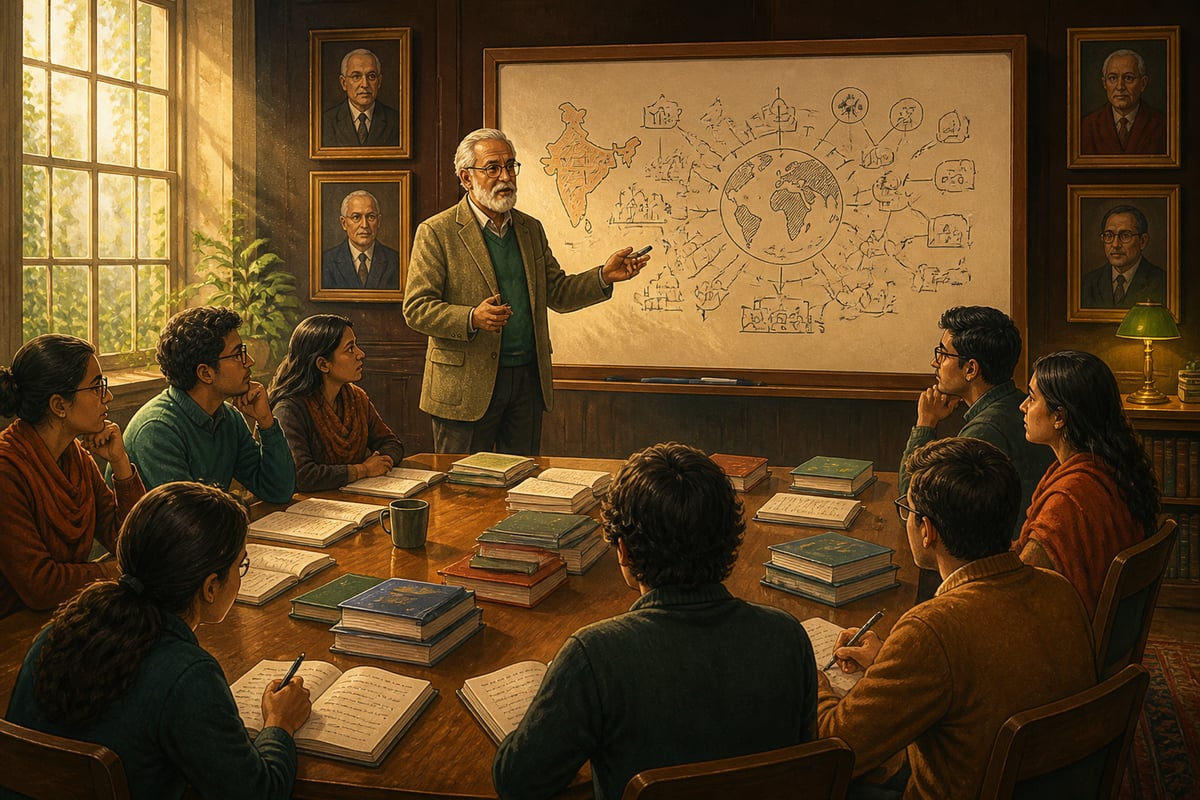
Every durable media narrative begins with academic legitimacy. Scholars in Western universities produce papers, books, and conference presentations that establish intellectual frameworks. Terms like "Hindu nationalism," "saffronization," "majoritarian democracy," and "Brahmanical patriarchy" are coined or amplified in university departments before they ever appear in a newspaper headline.
This is not conspiracy. It is the normal function of knowledge production. The problem arises when this knowledge production is systematically one-directional: Western scholars interpreting Indian civilization through frameworks developed for European contexts, with minimal input from Indian intellectual traditions. Lesson 04_01 examined how Western Indology captured the study of India. This lesson examines where that capture leads.
Academic papers become the sourcing material for media narratives. When a journalist at the New York Times or The Guardian needs an "expert quote" on India, they contact scholars embedded in this ecosystem. The scholar provides the frame. The journalist provides the amplification. Neither needs to coordinate consciously. The system self-organizes because both draw from the same intellectual assumptions.
Layer 2: Legacy Media Translation
Major Western newspapers, broadcasters, and magazines translate academic frameworks into news narratives. The BBC, New York Times, Washington Post, and The Guardian maintain India bureaus staffed by correspondents who, through training, sourcing networks, and editorial culture, consistently frame Indian events through the lenses provided by Layer 1.

The BBC's 2023 documentary "India: The Modi Question" is a precise example. The documentary drew on academic scholarship, NGO reports, and selective witness testimony to construct a narrative product with global distribution. When India's government blocked the documentary, the ban itself became the story, generating a second wave of coverage about "press freedom" that amplified the original narrative. The documentary was not journalism in the traditional sense. It was narrative manufacturing with the production values and institutional authority of a state-funded broadcaster.
This is not limited to a single outlet. Wire services like Reuters and Associated Press control the baseline narrative. When Reuters files a story from its New Delhi bureau, that story becomes the foundation for coverage in hundreds of newspapers worldwide that lack their own India correspondents. A single bureau's framing decisions shape global perception.
Layer 3: The NGO Amplification Loop
International NGOs, human rights organizations, and advocacy groups amplify media narratives by producing "independent" reports that cite the same academic sources and media coverage. These reports are then cited by the media as independent verification, creating a circular citation loop.
The process works like this: an academic publishes a paper. A journalist writes a story citing the academic. An NGO produces a report citing both the paper and the story. A second journalist writes a story citing the NGO report as "independent confirmation." Each citation appears to add an independent data point, but the entire chain traces back to a single source.
This is the mechanism Rajiv Malhotra documented in "Breaking India": academia justifies, media amplifies, NGOs verify, and the cycle repeats. Each component appears independent. The system functions as a unified narrative machine. Lesson 04_02 examined how the nexus operates. This lesson reveals the media pipeline through which it speaks.
Layer 4: Fact-Checkers as Gatekeepers
The most recent addition to the narrative machine is the fact-checking ecosystem. Organizations certified by the International Fact-Checking Network (IFCN) partner with social media platforms like Meta, Google, and Twitter/X to moderate content. Their "fact-checks" determine what content is suppressed, labeled, or amplified on platforms used by billions.
The gatekeeping function works in two directions. Narratives produced by the five-layer machine are rarely fact-checked because they originate from "authoritative" sources: established media, credentialed academics, certified NGOs. Counter-narratives challenging the machine are aggressively fact-checked, labeled as "misleading," or suppressed.
This creates an asymmetric information battlefield. The narrative machine's output flows freely. Counter-narratives face structural obstacles at every step. A fact-checker does not need to be biased in any conscious sense. If the "authoritative sources" all share the same framework, honest fact-checking against those sources will systematically favor the machine's narratives.
Layer 5: Toolkit Coordination
The final layer is the operational coordination that the 2021 toolkit exposed. Activist networks, diaspora organizations, and social media coordination cells synchronize the amplification of narratives across platforms. They schedule hashtag campaigns, coordinate contact with politicians, organize protest actions timed for media coverage, and create the appearance of organic, widespread outrage.
This layer is the most visible but least important. The toolkit is the symptom, not the disease. Even without explicit coordination, Layers 1 through 4 produce a self-reinforcing narrative machine. The toolkit simply adds operational efficiency to a system that would function, albeit more slowly, without it.
The Pattern: How "Fascist India" Was Manufactured
To see the five-layer machine in action, trace the journey of the phrase "Fascist India" from academic seminar to global media consensus.
The academic foundation was laid over decades. Scholars like Christophe Jaffrelot built careers on the framework of "Hindu nationalism as fascism," drawing parallels between European fascist movements and Indian political organizations. Books like Jaffrelot's "Hindu Nationalist Movement" (1996) and subsequent works provided the intellectual architecture. Audrey Truschke's work on Mughal history and her confrontational engagement with Hindu organizations generated controversy that media outlets framed as "academic freedom under threat from Hindu nationalists."
These academic frameworks were translated by legacy media into a consistent editorial position. The New York Times' India coverage over the 2014-2024 period shows a systematic pattern: democratic processes in India are framed as "majoritarian," economic reforms as "crony capitalism," cultural assertion as "Hindu supremacism." An analysis of NYT headlines over this period reveals that positive developments (space missions, digital infrastructure, poverty reduction) receive significantly less coverage than negative framings (religious violence, press freedom concerns, minority persecution).
NGOs produced reports that validated the media framing. International organizations issued annual reports ranking India's "democratic backsliding," its "press freedom decline," and its "minority rights violations." These reports cited the same academic sources and the same media coverage they were supposedly independently verifying.
Fact-checkers completed the circuit. When Indian commentators pushed back against the "Fascist India" narrative, their social media posts were fact-checked against the very reports and articles produced by the machine. Counter-narratives were labeled "misleading." The machine's output was labeled "verified."
The result is a globally distributed, institutionally validated narrative that frames the world's largest democracy through the vocabulary of European fascism. The narrative is not wrong because it is manufactured. It is wrong because it applies European frameworks to a non-European civilization, ignoring Indian civilizational categories, democratic traditions, and internal complexity.
Dharmic Wisdom: Gudhapurusha and the Battle of Perception
The Arthashastra dedicates extensive attention to Gudhapurusha: the science of intelligence, perception management, and information warfare. Kautilya understood that controlling the narrative is often more decisive than controlling the battlefield.
In the Arthashastra's framework, a king who controls information controls reality. The appointment of Gudhapurushas (covert agents) was not merely for espionage but for Karna Japa: whispered propaganda that shapes public perception without the target population being aware of the source.
What the five-layer media machine accomplishes is essentially Karna Japa at global scale. The population being influenced does not see the machine. They see "reputable media," "independent NGOs," "credentialed academics," and "certified fact-checkers." The perception of independence is the most potent weapon in the arsenal. An openly hostile propagandist is easy to dismiss. A system that appears objective while systematically producing one-directional narratives is nearly impossible to counter without exposing the system itself.
The Nitisara of Kamandaka, building on Kautilya, distinguishes between Prakasha Yuddha (open warfare) and Kutayuddha (covert warfare). Media and information warfare is the modern form of Kutayuddha. It operates beneath the threshold of what target populations recognize as conflict. People consume news, read reports, and scroll social media feeds without recognizing that they are on a battlefield.
The Panchatantra teaches the same principle through story. In the tale of the jackal who set the lion and the bull against each other, the weapon is information. The jackal whispers different stories to each party, manufacturing mistrust between natural allies. Neither the lion nor the bull sees the jackal as the enemy. Each sees the other. This is the precise mechanism of media warfare: making Indians fight each other over narratives manufactured elsewhere.
The Defense: Building Information Sovereignty
Individual: Become Your Own Fact-Checker
Do not outsource your discernment to any institution, regardless of its credentials. When you encounter a claim about India in international media, apply a three-step test:
Source the claim. Who said it first? Trace the citation chain back to its origin. You will frequently discover that a claim presented by five outlets traces back to a single academic paper or a single NGO report.
Check the framework. Is the analysis using Indian civilizational categories, or is it imposing European frameworks? When someone calls India "fascist," ask: does this term, developed to describe 1930s European movements, actually apply to a diverse democracy with universal franchise, independent judiciary, and robust electoral competition?
Follow the funding. Who pays for the academic department, the NGO, the media bureau, the fact-checking organization? Funding does not automatically create bias, but it creates incentive structures. Knowing the incentive structure helps evaluate the output.
Community: Build Alternative Knowledge Infrastructure
The narrative machine's greatest advantage is that it has no serious competitor. Building alternatives requires investment in three areas:
Media infrastructure. Support Indian-owned, Indian-edited media outlets that cover India for global audiences with Indian civilizational frameworks. Not propaganda outlets. Rigorous, data-driven, analytically sharp media that competes on quality.
Academic infrastructure. Support Indian universities, research institutions, and scholars who study Indian civilization using Indian intellectual categories. The Indic Academy, Bhandarkar Oriental Research Institute, and similar institutions represent the beginning of this counter-infrastructure.
Digital infrastructure. Build platforms, fact-checking organizations, and content distribution networks that are not dependent on Western certification systems for legitimacy.
Institutional: Legal and Regulatory Frameworks
Nations that take information sovereignty seriously build legal frameworks for it. India has begun this process with FCRA amendments (regulating foreign NGO funding), IT rules (requiring social media platforms to trace the origin of certain content), and broadcasting regulations. These are not attacks on free speech. They are the information equivalent of border security: a nation's right to know who is funding what narrative campaigns within its borders.
The lesson from the toolkit is clear: information warfare is organized, funded, and strategically deployed. The defense must be equally organized, equally funded, and equally strategic. Viveka (discernment) at the individual level, counter-infrastructure at the community level, and regulatory sovereignty at the institutional level. Together, these three layers constitute information Vyadhikshamatva: civilizational immunity in the information domain.
Case studies
BBC 'India: The Modi Question' and the Western Media Pipeline
In January 2023, the BBC released a two-part documentary titled 'India: The Modi Question,' produced by its state-funded apparatus and sourced heavily from academic frameworks critical of Hindu nationalism. The documentary followed a precise pipeline: academic sourcing (citing scholars whose work frames India through a 'majoritarian danger' lens), documentary production (the BBC's prestige lending authority to the narrative), global distribution (leveraging BBC World Service's reach across 42 languages), and then the critical amplifier. When India's government blocked the documentary under emergency IT rules, the ban itself became the story. A second wave of international coverage reframed the issue from the documentary's claims to 'press freedom under Modi,' spawning over 100 follow-up articles in outlets including The Guardian, The New York Times, and The Washington Post. The ban generated more viewership than the documentary ever would have achieved organically. Millions viewed it through VPNs and mirror links. The pipeline had a built-in escalation mechanism: resistance to the narrative becomes proof of the narrative.
The Arthashastra describes Karna Japa, the technique of whispered propaganda that derives its power from appearing authoritative and organic rather than orchestrated. Kautilya noted that the most effective information warfare does not announce itself as an attack. It presents itself as neutral observation. The BBC documentary exemplifies this: a state-funded broadcaster (the UK government funds the BBC through mandatory license fees) presenting a geopolitical narrative as independent journalism. The Arthashastra would classify this as Karna Japa at institutional scale, where the whisper carries the authority of the institution doing the whispering. The secondary 'press freedom' narrative is a second layer of Karna Japa: the target's defensive reaction is reinterpreted as confirmation of the original accusation.
The documentary was viewed millions of times globally despite being blocked in India. Student screenings at JNU and Jamia Millia became protest events, generating further domestic media coverage. The 'press freedom' framing persisted for weeks across international outlets, reinforcing the original narrative without requiring any new evidence. The BBC faced no accountability for sourcing or editorial bias, while India's attempt to block the content was cited in press freedom indices as evidence of democratic backsliding.
State-funded media institutions can function as soft-power instruments while maintaining the appearance of editorial independence. The pipeline (academic sourcing to documentary to ban to 'press freedom' coverage) is self-reinforcing. Each stage generates the fuel for the next. Blocking content within this pipeline often amplifies it. Effective counter-strategy requires competing at the narrative layer, not the distribution layer.
The BBC pipeline is a template that operates repeatedly against India. Al Jazeera, Deutsche Welle, and other state-funded broadcasters use similar models. The pattern reveals that media warfare against India is not freelance journalism but institutional infrastructure funded by foreign governments with geopolitical interests in the subcontinent.
The BBC operates on approximately 5.3 billion pounds in annual revenue, primarily from mandatory UK license fees collected under threat of criminal prosecution. Despite this state-funding model, it markets itself globally as 'independent' media. The documentary spawned over 100 follow-up articles across Western outlets within two weeks of the Indian government's ban, demonstrating how content suppression functions as a narrative amplifier in the modern media ecosystem.
The Greta Thunberg Toolkit: Anatomy of a Coordinated Information Operation
On February 3, 2021, during India's farmer protests against three agricultural reform laws, Swedish climate activist Greta Thunberg tweeted support for the protests and accidentally shared a Google Doc 'toolkit' that revealed the operational infrastructure behind what had been presented as a spontaneous solidarity movement. The toolkit contained pre-planned hashtag campaigns, detailed media outreach strategies with journalist contact lists, protest coordination timelines for actions outside Indian embassies, and escalation schedules with specific dates. Several of those dates preceded the events they were supposedly responding to, indicating that the 'reactions' were planned before the 'provocations.' The trail of contributors and editors led through diaspora organizations in Canada (Poetic Justice Foundation), the UK, and the United States. A linked version of the toolkit contained explicit references to Khalistan, the movement for a separate Sikh state, revealing geopolitical objectives beneath the humanitarian framing of 'farmer rights.' The document had been collaboratively edited by over 50 contributors across multiple countries and time zones.
The Panchatantra's Mitrabheda (The Loss of Friends) tells the story of the jackal Damanaka who turns the bull Sanjeevaka and the lion Pingalaka against each other through carefully planted information. Damanaka does not lie outright. He selects truths, frames contexts, and whispers to each party separately, making each believe the other is a threat. The toolkit operation mirrors this precisely: real farmer grievances existed, but external actors selected, framed, and amplified them to serve objectives (Khalistan separatism) that had nothing to do with agricultural policy. The farmers became Sanjeevaka, the Indian state became Pingalaka, and the toolkit operators were Damanaka, engineering conflict between natural allies for their own strategic ends.
Delhi Police filed an FIR related to the toolkit. Activist Disha Ravi was briefly arrested, which generated a 'press freedom' counter-narrative similar to the BBC pattern. The toolkit exposure briefly revealed the operational mechanics of international information campaigns targeting India, but the media cycle quickly shifted to framing the Indian government's investigation as 'authoritarian overreach,' burying the substance of what the toolkit revealed about coordinated foreign interference.
Modern information warfare operates through collaborative digital infrastructure that can coordinate actors across continents in real time. The toolkit revealed that what appears as organic, spontaneous global solidarity is often pre-planned, pre-scripted, and connected to geopolitical objectives entirely separate from the stated cause. The accidental exposure was significant precisely because such infrastructure normally remains invisible.
The toolkit model has become standard for information campaigns targeting India. Coordinated hashtag campaigns, pre-written social media posts, journalist contact lists, and embassy protest schedules appear with suspicious speed around every major Indian controversy. The 2021 toolkit leak provided a rare look at the operational back-end of this system, confirming that coordination, not coincidence, drives these campaigns.
The Google Doc had 50+ contributors across multiple countries with edit histories showing pre-planned action dates that preceded the events they were framed as responses to. The Poetic Justice Foundation, a key organization in the trail, was founded by Mo Dhaliwal, who has publicly expressed pro-Khalistan views. Delhi Police filed an FIR under sedition and criminal conspiracy charges.
The Academic-to-Media Pipeline: How Seminar Room Frameworks Become Social Media Policy
French political scientist Christophe Jaffrelot has been constructing the 'Hindu nationalism as fascism' framework since his 1996 book 'The Hindu Nationalist Movement in India.' Over three decades, he has published more than 200 articles in Western media outlets including Le Monde, The Indian Express, The Carnegie Endowment, and The Washington Post. American academic Audrey Truschke, a Rutgers University professor specializing in Mughal history, has built a parallel track reframing Mughal rulers like Aurangzeb as misunderstood administrators, generating significant controversy by characterizing traditional Hindu narratives of temple destruction as 'exaggerated.' Their academic work feeds a circular citation loop that functions as a self-validating information system. The cycle works as follows: a scholar publishes a paper framing Hindu nationalism as fascist. A journalist at The New York Times or The Guardian cites the paper in an op-ed. An NGO like Amnesty International or Human Rights Watch cites both the paper and the article in a report, adding the label 'independent verification.' A second journalist then cites the NGO report as a separate source, not realizing (or not caring) that it traces back to the same original academic paper. This circular citation creates the appearance of multiple independent sources confirming a single framework. The framework then migrates into content moderation policy: social media platforms hire 'trust and safety' consultants from the same academic ecosystem, who then classify content challenging these frameworks as 'misinformation' or 'hate speech.'
The Arthashastra identifies knowledge capture as a form of Bheda. Kautilya understood that controlling what a population knows about itself is more powerful than any military conquest, because a people who have lost their own narrative will not resist even obvious subjugation. The academic-to-media pipeline is Bheda through epistemological capture. It does not attack India with armies. It attacks India's self-knowledge by establishing a monopoly on how India is described, analyzed, and categorized in global discourse. When Indian voices challenge these frameworks, the pipeline's circular citation structure delegitimizes them as 'nationalist propaganda' since the pipeline has already defined what counts as legitimate scholarship.
The 'fascist India' framework has migrated from academic seminars to mainstream media to content moderation policy. Social media platforms have hired advisors from this academic ecosystem to shape their India-related content policies. The framework now influences how algorithms surface or suppress India-related content for billions of users. Usage of the term 'Hindu nationalism' in The New York Times increased roughly 300% between the periods 2004-2014 and 2014-2024, tracking not with any measurable increase in religious violence in India but with the election of a government that challenged the existing Western narrative framework.
The most powerful information warfare does not look like propaganda. It looks like scholarship, journalism, and human rights advocacy. The circular citation loop creates a closed system where the same framework validates itself through multiple institutional channels, each lending credibility to the others. Breaking this loop requires building alternative knowledge infrastructure, not merely debunking individual claims.
The academic-to-media pipeline now extends into technology governance. When former academics from this ecosystem join social media trust-and-safety teams, content moderation becomes an extension of the same framework. Indian users find their content flagged, suppressed, or removed based on policies shaped by scholars whose foundational assumption is that Hindu civilizational assertion is inherently dangerous. The pipeline has evolved from shaping what newspapers print to shaping what algorithms allow.
Christophe Jaffrelot has published over 200 articles in Western media outlets and policy journals since 1996, constructing the 'Hindu nationalism as fascism' framework across three decades. The New York Times' usage of 'Hindu nationalism' increased approximately 300% comparing 2004-2014 with 2014-2024. This increase correlates with political change in India, not with any measurable increase in religious violence, suggesting the framing is driven by narrative supply rather than ground-level data.
Reflection
- Think about a time you consumed a Western media narrative about India and accepted it without questioning the framing. What was the moment you realized the story was shaped by external assumptions rather than Indian realities? What triggered that recognition, and how did it change what you read afterward?
- If a free press is essential to democracy, how do you distinguish between genuine journalism and narrative warfare? Can the same institution be both at different times or on different topics? What criteria would you use to tell the difference?
- The Arthashastra teaches that information warfare is a legitimate tool of statecraft. If India builds its own narrative counter-infrastructure, does it risk becoming what it opposes? Where is the line between civilizational defense and propaganda?