Indology as Civilizational Weapon
Western Indology, Distorted Sanskrit, and Academic Hinduphobia
Western Indology was not built as neutral scholarship. From Max Mueller's EIC-funded translations to modern academic conferences targeting Hindu civilization, this lesson traces the two-century infrastructure of academic narrative capture and the Dharmic frameworks for countering it.
See It Today: When 50 Universities Target One Civilization
In September 2021, a coalition of over 50 American and European universities co-sponsored a conference titled "Dismantling Global Hindutva." Harvard, Stanford, Princeton, Columbia, Berkeley, and dozens more lent their institutional names to an event explicitly dedicated to dismantling a political expression of Hindu civilization.
No equivalent conference has ever been organized at Western universities to "dismantle" any other civilization's political expression. No "Dismantling Political Islam" conference. No "Dismantling Christian Nationalism" conference. No "Dismantling Zionism" conference. The asymmetry is not accidental. It reflects a specific infrastructure of academic authority that has been built over two centuries, one that claims the right to define, diagnose, and dismantle Hindu civilization from the outside.

The conference was not organized by fringe activists. It was hosted within mainstream academic departments: Religious Studies, South Asian Studies, Political Science. The organizers included tenured professors at elite institutions. The institutional endorsements came through official university channels. This was the academic establishment acting in its official capacity.
When Hindu organizations protested, the academic response was revealing. Rather than engaging with the substance of the objections, the response framed all Hindu opposition as "Hindutva harassment of scholars." The pattern was precise: the academy claims the exclusive right to interpret Hinduism, and when Hindus object to that interpretation, the objection itself is classified as evidence of Hindu pathology.
This is not a story about one conference. It is the visible tip of a two-century-old infrastructure. Western Indology, the academic study of India and its civilizational traditions, was not built as neutral scholarship. It was built as a tool of civilizational control. Understanding how that tool was forged, how it operates today, and how it can be countered is essential for anyone who wants to understand the "Breaking India" dynamic.
The Mechanism: How Western Indology Became a Civilizational Weapon
Phase 1: The Colonial Construction (1780s-1900s)
The Western study of Sanskrit and Indian civilization began not in a university seminar room but in the administrative offices of the East India Company. William Jones founded the Asiatic Society of Bengal in 1784, and while Jones himself admired Sanskrit literature, the institutional purpose was clear: understand the colonized to govern them more effectively.

The key figure in transforming this administrative interest into a civilizational weapon was Friedrich Max Mueller. In 1847, the East India Company commissioned Mueller to translate the Rigveda. His correspondence reveals the strategic intent behind this seemingly scholarly project. In an 1868 letter to his wife, Mueller wrote: "This edition of mine and the translation of the Veda will hereafter tell to a great extent on the fate of India... It is the root of their religion, and to show them what that root is, I feel sure, is the only way of uprooting all that has sprung from it during the last 3,000 years."
This was not a private eccentric's fantasy. Mueller's project was institutionally funded and strategically positioned. The Boden Professorship of Sanskrit at Oxford, the chair Mueller competed for (and lost to Monier Monier-Williams), was endowed with an explicit purpose stated in Colonel Boden's will: "to promote the translation of the Scriptures into Sanskrit, so as to enable his countrymen to proceed in the conversion of the natives of India to the Christian religion."
The institutional architecture is precise. Chairs of Sanskrit at European universities were funded by colonial and missionary interests. The scholars who occupied those chairs produced translations that filtered Indian texts through Christian theological categories. Those translations then became the "authoritative" versions that Indians themselves were taught in colonial schools.
Mueller's dating of the Rigveda to 1200 BCE (chosen to fit Biblical chronology rather than any textual evidence), his framing of Vedic religion as "primitive nature worship," and his Aryan Invasion Theory all served a single strategic function: they made India's civilizational heritage appear derivative, primitive, and in need of Western intellectual stewardship.
Phase 2: The Institutional Lock-In (1900s-1990s)
By the early twentieth century, Western Indology had achieved institutional dominance. The major Sanskrit dictionaries (Monier-Williams), the standard translations of key texts (Mueller, Griffith), and the foundational historical frameworks (Aryan Invasion Theory, caste-as-race) were all products of this colonial academic infrastructure.
This created a self-reinforcing system. New scholars were trained using these translations and frameworks. To get published, they had to cite the existing literature. To get tenure, they had to be approved by scholars already embedded in the system. The result was an academic ecosystem that could perpetuate colonial-era interpretive frameworks long after formal colonialism ended.
Sheldon Pollock exemplifies this phase. His influential 2001 essay "The Death of Sanskrit" argued that Sanskrit ceased to be a productive intellectual language around 1100 CE. More significantly, Pollock's broader body of work systematically links Sanskrit literary culture to structures of political domination. In his framework, Sanskrit is not a vehicle of philosophical inquiry but a tool of Brahmanical political power.
The effect of this framing is precise. If Sanskrit is a dead language of oppression rather than a living language of philosophy, then Indians seeking to revive Sanskrit are not recovering their intellectual heritage. They are reviving a tool of domination. Pollock's academic work provides the intellectual justification for opposing Sanskrit revival, temple education, and the reintegration of traditional knowledge into modern curricula.
Phase 3: The Psychoanalytic Turn (1990s-Present)
The most recent phase introduced psychoanalytic and postcolonial theory into the study of Hinduism. The Religion in South Asia (RISA) group within the American Academy of Religion became the institutional center of this approach.
Rajiv Malhotra's documentation of the RISA ecosystem, published as "Invading the Sacred" (2007), revealed a systematic pattern. Hindu deities were analyzed through Freudian frameworks. Ganesha's trunk became a phallic symbol. Kali's imagery was read as pathological violence. Shiva's linga was reduced to sexual anatomy. Sacred narratives were treated not as philosophical texts but as clinical specimens revealing civilizational neuroses.
The academic defense of this approach is instructive. When Hindu scholars and practitioners objected, the standard response was that they lacked the "critical distance" to study their own tradition objectively. Only Western-trained scholars, applying Western theoretical frameworks, could provide "real" analysis. The colonized subject's self-understanding was, by definition, unreliable.
S.N. Balagangadhara of Ghent University identified the deepest layer of this mechanism. In "The Heathen in His Blindness" (1994), he argued that the Western "study of religion" is not a neutral academic discipline. It is itself a secularized Christian theological framework that assumes all cultures have "religions" structured like Christianity (with scripture, doctrine, clergy, and conversion). When this framework is applied to Dharmic traditions, it systematically distorts them, because Dharmic traditions do not operate on the Abrahamic model of exclusive truth claims and institutional authority.
This means the distortion is not a bug in Western Indology. It is a feature. The very categories through which Western academia studies Hinduism are borrowed from Christian theology. The lens itself is the weapon.
The Pattern: From Mueller to the Classroom
The pattern connecting 1847 to 2021 follows a clear three-stage pipeline.
Stage 1: Academic Production. Scholars at elite Western universities produce interpretive frameworks about Indian civilization. These frameworks consistently position Indian traditions as primitive (Mueller), oppressive (Pollock), pathological (RISA school), or dangerous (Dismantling Global Hindutva). The frameworks are published in peer-reviewed journals, giving them the authority of "science."
Stage 2: Institutional Amplification. These academic frameworks are adopted by textbook publishers, international media, human rights organizations, and policy bodies. The California textbook controversy (2005-2016) demonstrated this pipeline directly. When Hindu parents objected to their children's textbooks describing Hinduism through a caste-oppression-only lens while treating other religions respectfully, Harvard professor Michael Witzel organized a counter-petition signed by dozens of Indologists. The message was clear: academic authority overrides community self-understanding.
Stage 3: Policy and Political Weaponization. Academic frameworks become the basis for policy interventions. The United States Commission on International Religious Freedom (USCIRF) regularly cites academic Indological work to justify placing India on religious freedom watchlists. NGOs use academic publications to justify intervention campaigns. Separatist movements cite academic work to legitimize their claims.
The pipeline is efficient because each stage legitimizes the next. Policy makers cite academics ("Harvard says..."). Academics cite peer-reviewed literature. The literature is produced within institutions built on colonial-era frameworks. At no point in this chain does an Indian voice have veto power over how India is described.
Consider the contrast with how other civilizations are studied. Islamic Studies departments at Western universities routinely employ Muslim scholars and treat Islamic self-understanding as a legitimate starting point. Jewish Studies programs center Jewish voices and perspectives. East Asian Studies increasingly incorporates Chinese, Japanese, and Korean scholarly traditions on their own terms.
South Asian Studies, by contrast, still operates on a model where Western theoretical frameworks are applied to Indian materials, and Indian objections to those frameworks are treated as evidence of the "fundamentalism" being studied. The studied subject has no standing to challenge the studier's conclusions.
Vishwa Adluri and Joydeep Bagchee documented this in "The Nay Science" (2014), demonstrating that German Indology's supposedly "scientific" methods were not neutral. They were directly borrowed from 19th-century Protestant biblical criticism, designed to strip sacred texts of their theological authority. When applied to the Mahabharata or the Vedas, these methods did exactly what they were designed to do: reduce living philosophical traditions to historical artifacts suitable for academic dissection.
Dharmic Wisdom: Vidya and Avidya as Civilizational Categories
The Isha Upanishad draws a fundamental distinction between Vidya (knowledge) and Avidya (ignorance), warning that those who pursue Avidya enter darkness, but those who delight in Vidya alone enter an even greater darkness. The verse points to something subtle: incomplete knowledge that believes itself to be complete is more dangerous than simple ignorance.
Western Indology operates precisely in this zone. It is not simple ignorance. It is sophisticated knowledge production that is systematically incomplete. It knows the grammar of Sanskrit but not the Anubandhas (metalinguistic markers) that encode Panini's deeper framework. It can parse a Vedic hymn linguistically but cannot access the Adhyatmic (spiritual-experiential) dimension that makes the hymn meaningful within its tradition.
The Arthashastra addresses this dynamic in strategic terms. Kautilya warns that the most dangerous enemy is not the one who attacks openly but the one who captures your Mantri Parishad (council of advisors). When the enemy controls your sources of knowledge, every decision you make using that knowledge serves the enemy's purpose.
This is precisely what has occurred. When Indian universities teach Indian philosophy using Western Indological frameworks, when Indian courts cite Western academic authority on Hindu practices, when Indian media uncritically adopts Western analytical categories, the civilizational Mantri Parishad has been captured. India makes decisions about its own heritage using knowledge systems designed by those who sought to undermine that heritage.
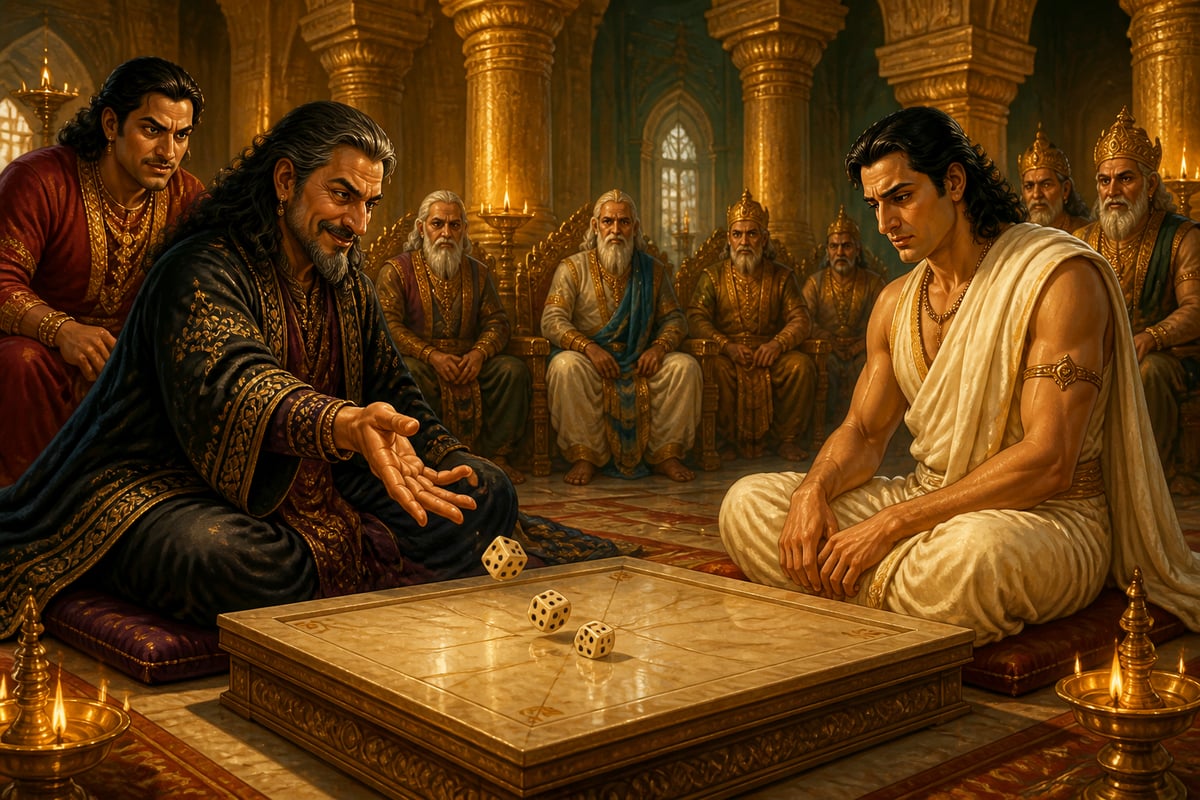
The Mahabharata offers the image of Shakuni, who did not defeat the Pandavas through superior strength but through controlling the game itself. The dice were loaded. In academic Indology, the methodological dice are loaded: the categories, the theoretical frameworks, the standards of "rigor," and the institutional gatekeeping mechanisms all favor interpretations that diminish Indian civilizational claims.
The Defense: Reclaiming the Right to Interpret Yourself
Three levels of defense are necessary against academic civilizational warfare.
Build indigenous scholarship infrastructure. The most effective counter to Western Indological authority is not protest but competing scholarship. Institutions like the Indian Council of Philosophical Research, the Chinmaya Vishwavidyapeeth, and independent research bodies need to produce scholarship that meets international standards of rigor while working from within Dharmic epistemological frameworks. The goal is not to replace Western scholarship with propaganda but to create a genuine alternative rooted in Pratyaksha (direct experience), Anumana (inference), and Shabda (testimony of authoritative texts) rather than borrowed Freudian or Marxist categories.
Demand academic reciprocity. If Islamic Studies centers Jewish and Muslim voices, if East Asian Studies increasingly incorporates Asian scholarly traditions, then South Asian Studies must give standing to Indian scholarly voices and Dharmic epistemological frameworks. This is not a demand for censorship. It is a demand for the same academic norms applied to every other civilization.
Develop critical literacy at scale. Every educated Indian should understand the history of Western Indology, its colonial origins, its institutional incentives, and its methodological biases. This is not about rejecting all Western scholarship. Some Western Indologists (like Jan Houben, Johannes Bronkhorst, or Frits Staal) have produced valuable work. Critical literacy means being able to distinguish genuine scholarship from civilizational weaponry. It means knowing that when someone cites "academic consensus" about Hinduism, you can trace that consensus to its institutional origins and evaluate its methodological foundations.
The Indological weapon is powerful precisely because it wears the mask of neutral scholarship. The first defense is removing that mask. The rest of this chapter will trace how this academic infrastructure connects to the evangelical conversion machine, the NGO-industrial complex, and the global media narrative pipeline to form the complete "Breaking India" nexus.
Case studies
Max Mueller and the Colonial Construction of 'Vedic Religion'
In 1847, the East India Company commissioned German scholar Friedrich Max Mueller to translate the Rigveda into English. Mueller's project was not purely academic. In an 1868 letter to his wife, he wrote: "This edition of mine and the translation of the Veda will hereafter tell to a great extent on the fate of India... It is the root of their religion, and to show them what that root is, I feel sure, is the only way of uprooting all that has sprung from it during the last 3,000 years." The Boden Professorship of Sanskrit at Oxford, the chair Mueller competed for, was endowed by Colonel Boden's will explicitly to promote "the conversion of the natives of India to the Christian religion." Mueller dated the Rigveda to 1200 BCE (to fit Biblical chronology), framed Vedic thought as "primitive nature worship," and relied heavily on Sayana's indigenous commentary while claiming Indians lacked the capacity to understand their own texts.
Kautilya's Arthashastra identifies knowledge capture as the most potent form of Bheda. When you control how a people understand their own heritage, you control their civilizational self-confidence without firing a single shot. Mueller's project followed this logic precisely: reinterpret the foundational texts through a foreign lens, make that reinterpretation the "authoritative" version, and teach it back to the colonized population through colonial education. The indigenous Vyakhyana tradition of Sayana, which Mueller himself depended upon, was sidelined in favor of Mueller's own theological framework.
Mueller's translations and frameworks became the foundation of Western Indology for over a century. His dating of the Vedas, his Aryan Invasion Theory, and his characterization of Vedic religion shaped how generations of Indians learned about their own heritage in colonial and post-colonial schools. The interpretive infrastructure he built outlived both him and the British Empire.
Academic infrastructure outlasts political empires. The British Raj ended in 1947, but Mueller's interpretive frameworks continued to dominate Indian universities for decades after independence. Challenging political colonialism without challenging epistemic colonialism leaves the deepest colonial structures intact.
Mueller's frameworks remain embedded in NCERT textbooks, university curricula, and popular understanding. The Aryan Invasion Theory, though increasingly challenged by genetic and archaeological evidence, still shapes how millions of Indians learn their own civilizational history.
Mueller's Rigveda translation project was funded over 24 years (1849-1873) by the East India Company and later the British Crown. The Boden Professorship's endowment, explicitly created for missionary purposes in 1832, funded Sanskrit scholarship at Oxford for nearly two centuries.
Dismantling Global Hindutva: 50 Universities Target One Civilization
In September 2021, over 50 American and European universities co-sponsored a three-day academic conference titled "Dismantling Global Hindutva." Harvard, Stanford, Princeton, Columbia, Berkeley, University of Chicago, and dozens more lent their institutional names to the event. The conference was organized within mainstream academic departments (Religious Studies, South Asian Studies, Political Science) and featured panels on dismantling Hindu political expression. No equivalent conference has been organized at Western universities to "dismantle" any other civilization's political expression. When Hindu organizations protested, the academic response framed all Hindu objections as evidence of "Hindutva harassment of scholars," effectively making any Hindu pushback proof of the problem being studied.
The Arthashastra describes a technique where the attacker frames any resistance as further justification for attack. The DGH conference operated on this logic: Hindu civilizational expression was defined as the problem, and any Hindu defense of that expression was classified as further evidence of the problem. This creates a closed system where the target cannot defend itself without confirming the attacker's thesis. Kautilya would recognize this as an advanced form of Sama combined with Bheda: the conciliatory language of "scholarship" masking the divisive intent of delegitimizing an entire civilization's political agency.
The conference proceeded despite organized Hindu opposition. It demonstrated the institutional power asymmetry: 50 elite universities could target Hindu civilization specifically, and the combined response of Hindu organizations worldwide could not prevent it. The conference also revealed the academic-activist pipeline, where scholarly frameworks directly fuel political action.
Institutional prestige is the most powerful weapon in academic civilizational warfare. The DGH conference would have had no impact without Harvard and Stanford brand names lending it authority. Building counter-institutions with comparable prestige is the only long-term defense.
The DGH conference model has been replicated in smaller academic events since 2021. The framework of treating Hindu political expression as uniquely dangerous continues to shape Western academic and policy discourse about India.
Over 50 universities co-sponsored the event. Hindu-American organizations representing over 1.5 million community members filed formal protests, none of which prevented the conference from proceeding.
RISA Lila: When Scholarship Becomes Psychoanalysis of a Civilization
Beginning in 2003, Rajiv Malhotra documented how the Religion in South Asia (RISA) group within the American Academy of Religion systematically applied Freudian and postcolonial frameworks to Hindu traditions. Ganesha's trunk was analyzed as a phallic symbol. Kali's imagery was read through the lens of pathological violence. Shiva's linga was reduced to sexual anatomy. Sacred narratives were treated not as philosophical texts but as clinical specimens revealing civilizational neuroses. This body of work was compiled and challenged in the 2007 book "Invading the Sacred," co-authored by multiple scholars. When Hindu practitioners and scholars objected, the standard academic defense was that Hindus lacked the "critical distance" necessary to study their own tradition objectively.
The RISA approach applies exactly the Pramana substitution that Balagangadhara identified. Dharmic traditions evaluate their symbols through Adhyatmic (spiritual-experiential) Pramanas. The RISA school substitutes Freudian psychoanalysis as the Pramana, then declares the original Pramana invalid. This is not a scholarly disagreement. It is an epistemological coup: replacing one knowledge system's self-understanding with another's external diagnosis. The Nyaya school's insistence on Pramana Praamanya (the self-validity of valid knowledge means) provides the philosophical framework for resisting this substitution.
"Invading the Sacred" documented the pattern and brought it to public attention. Some scholars modified their approach, but the institutional infrastructure remained intact. RISA continues to operate within the AAR. The Freudian and postcolonial frameworks remain standard methodological tools in Western Hindu Studies programs.
Documenting the problem is necessary but not sufficient. Malhotra's work created awareness but could not dismantle the institutional infrastructure. Building competing scholarship that meets international standards of rigor while operating from within Dharmic epistemological frameworks is the next essential step.
The RISA approach continues in university syllabi, textbooks, and academic publishing. Graduate students in Hindu Studies at Western universities are still primarily trained in Western theoretical frameworks rather than in Mimamsa, Vyakarana, or Vedantic hermeneutics.
"Invading the Sacred" (2007) documented work by over a dozen Western academics applying psychoanalytic frameworks to Hindu traditions. The American Academy of Religion, which houses RISA, has over 10,000 members and is the largest professional organization for religious studies scholars in the world.
Reflection
- Think about how you first learned about Hinduism, Vedic philosophy, or Indian civilization in a formal setting (school, college, or books). Were the sources predominantly Western academics or Indian scholars working within Dharmic frameworks? How did that framing shape your understanding of your own heritage?
- What happens to a civilization when the authority to interpret its own texts, symbols, and traditions is held by outsiders who operate from fundamentally different epistemological assumptions? Can a civilization remain intellectually sovereign when its self-understanding must be validated by external academic institutions?
- Is truly 'objective' scholarship about a living philosophical tradition possible, or does every scholar inevitably interpret through their own civilizational lens? If objectivity is impossible, what should replace it as the standard for rigorous scholarship about Dharmic traditions?