Breaking the Breaking India Infrastructure
Academic Counter-Infrastructure, Legal Defenses, and Following the Money
India's counter-infrastructure against civilizational attack is emerging across four pillars: academic, legal, media, and financial transparency. From Swadeshi Indology conferences to FCRA amendments, this lesson maps the counter-offensive drawing on Vidyaranya's Vijayanagara model and Kautilya's strategic framework.
See It Today: The Counter-Offensive Begins
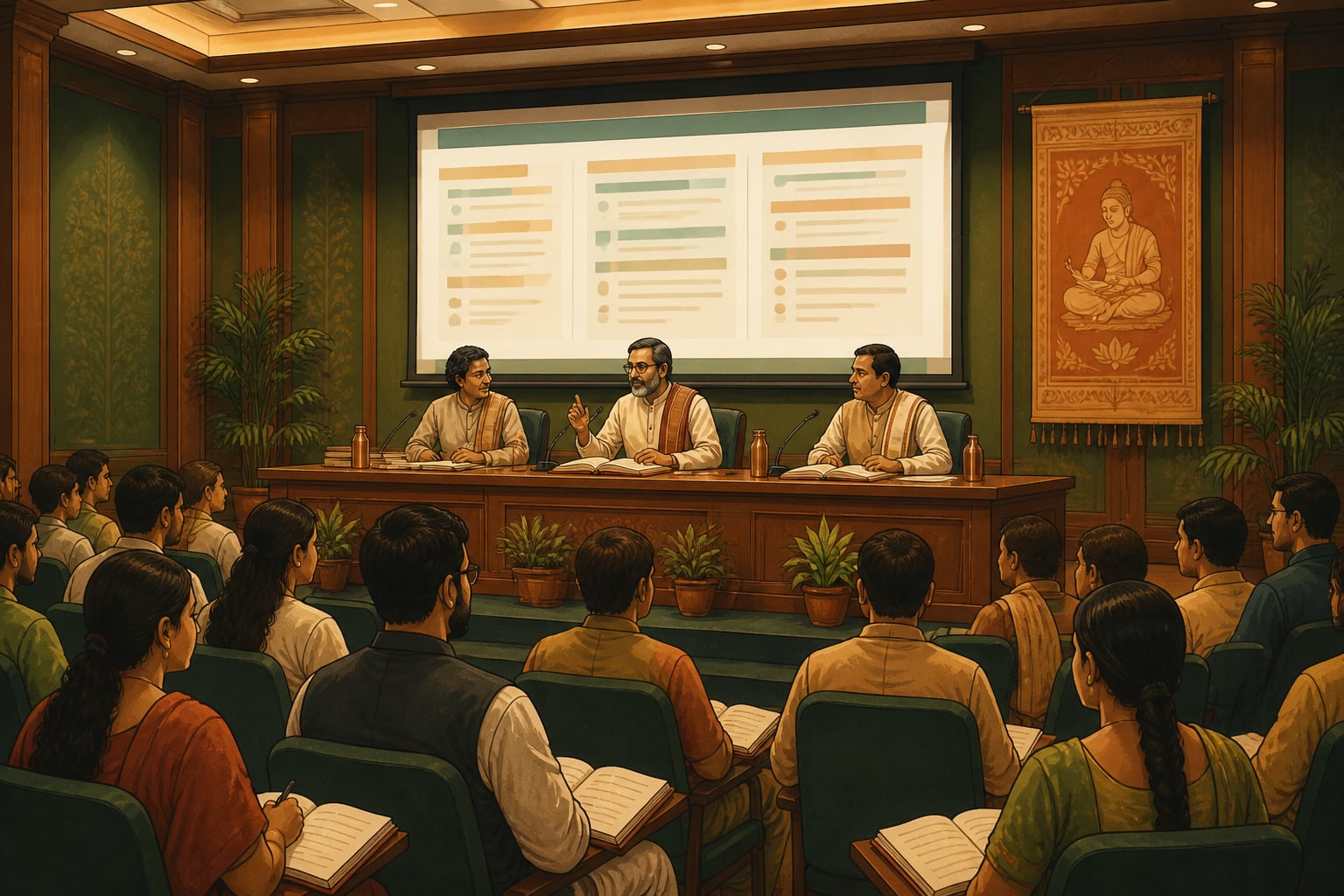
In 2016, something unprecedented happened in Indian academia. A group of Indian scholars organized the first Swadeshi Indology conference. Their target was specific: the work of Sheldon Pollock, a Columbia University professor who had built an influential framework portraying Sanskrit as a tool of political oppression rather than a vehicle of knowledge. The conference produced rigorous, peer-reviewed papers dismantling Pollock's thesis point by point, creating what Western Indology had never faced before: a systematic Indian counter-response on scholarly terms.
The same period saw India's Parliament pass the FCRA Amendment Act of 2020, tightening regulations on foreign-funded NGOs. The results were immediate. Over 6,000 NGOs lost their licenses to receive foreign funding. Organizations that had operated for decades with minimal scrutiny suddenly had to account for every rupee. The amendment did not ban foreign funding. It demanded transparency. And transparency, it turned out, was the one thing many of these organizations could not survive.
Meanwhile, the Infinity Foundation had spent over two decades building intellectual counter-infrastructure: funding original research, publishing books that exposed the academic-evangelical nexus, supporting Indian scholars who challenged Western narratives, and creating frameworks that named what was happening. The phrase "Breaking India forces" itself came from this ecosystem.
Three responses. One academic, one legal, one intellectual-activist. Together, they represent the first coordinated counter-infrastructure against the system exposed in the previous four lessons. The question is no longer whether India can respond. It is whether the response can scale fast enough.
The Mechanism: Four Pillars of Counter-Infrastructure
The Breaking India infrastructure operates through four channels: academia, evangelism, NGOs, and media. An effective counter-strategy must address all four. Not with mirror-image aggression, but with what the Arthashastra calls pratikaara: measured, strategic counter-action.
Pillar 1: Academic Counter-Infrastructure
Western Indology has dominated the study of Indian civilization for over two centuries. The counter-strategy is not to reject Western scholarship wholesale, but to end the monopoly. This requires three things.
First, building Indian centers of Indological research that produce scholarship at international standards. Institutions like the Indian Institute of Advanced Study, Indica Academy, and university departments that take civilizational study seriously on Indian terms. Not as cultural nationalism, but as rigorous scholarship produced by people who understand the civilization they study from within.
Second, training a generation of scholar-intellectuals who can engage Western academia in its own language while bringing perspectives that Western scholars structurally cannot access. The Swadeshi Indology conferences demonstrated this is possible. J. Sai Deepak's legal-historical work shows how professional expertise combines with civilizational scholarship to create a powerful new model: the practitioner-scholar who defends civilization with evidence, not emotion.
Third, reclaiming platforms. Indian scholars must publish in international journals, speak at global conferences, and build citation networks that cannot be ignored. Knowledge power follows the same rules as any other form of power: if you are not at the table, you are on the menu.
Pillar 2: Legal Defenses
The legal front has seen the most tangible progress. The FCRA amendments created a framework for financial transparency that every democracy should want. But legal defense extends further.
Anti-conversion laws in several Indian states address predatory proselytization at the ground level. Court challenges to foreign-funded interference in domestic policy (like the cases around Kudankulam and Sterlite) have established important precedents. J. Sai Deepak's advocacy before the Supreme Court, combined with his book series "India That Is Bharat," represents a new model: the lawyer-intellectual who fights in the courtroom and in the court of public opinion simultaneously.
Legal defense is not just about winning individual cases. It is about establishing the intellectual and constitutional framework within which civilizational rights are recognized, argued, and protected for the long term.
Pillar 3: Media Counter-Narratives
When the global narrative machine portrays India through a single lens, the counter-strategy is not to build one alternative voice. It is to build an ecosystem.
Digital-first platforms like OpIndia and Swarajya have broken the monopoly of legacy media. They report what legacy outlets refuse to cover: the funding behind protests, the foreign connections behind "grassroots" movements, the academic papers that quietly become activist manifestos.
YouTube channels, podcasts, and independent commentators have created a distributed counter-narrative network that no single organization controls. This is actually a strength. A centralized counter-media can be captured, co-opted, or discredited through a single pressure point. A distributed ecosystem is resilient precisely because it has no single point of failure. Shut down one voice, and ten others continue.
Pillar 4: Following the Money
Every infrastructure runs on funding. The Breaking India infrastructure is no exception. Understanding the money trail is not conspiracy theory. It is basic investigative journalism applied to geopolitical influence operations.
FCRA data reveals clear patterns: which countries fund which types of organizations, which organizations fund which types of activities, and which activities target which specific communities and regions. When transparency watchdogs tracked the operations of organizations like Compassion International, they found that "charitable" spending correlated precisely with conversion activity in specific districts.
The counter-strategy here is simple but powerful: demand transparency, analyze publicly available data, and publish findings. When the public can see that a "human rights" organization receives the vast majority of its funding from evangelical foundations, the organization's claims of neutrality collapse under the weight of its own financial records.
The Pattern: From Colonial Funding to Vijayanagara's Renaissance
The Colonial Funding Trail
The money trail behind civilizational intervention has deep colonial roots. In the 19th century, the Church Missionary Society and London Missionary Society funneled funds from British congregations to conversion operations across India. These organizations operated under charitable cover while pursuing explicitly civilizational objectives: the replacement of Hindu, Buddhist, and tribal religious systems with Christianity.
The structure was straightforward. European churches raised funds. Missionary societies distributed them. Field missionaries executed conversion operations. And academic institutions provided intellectual justification, portraying Indian civilization as backward, oppressive, and in need of Western salvation. This four-part architecture is nearly identical to what operates today. The Church Missionary Society has evolved into organizations like Compassion International. The London Missionary Society's successors include Gospel for Asia. Theology departments have repositioned themselves as South Asian Studies programs. The names have changed. The architecture has not.

Sita Ram Goel, through his Voice of India publications in the 1980s and 1990s, was among the first to document this continuity with meticulous scholarship. His work connecting colonial missionary operations to their modern successors created the intellectual foundation upon which later analyses could build. He proved that the present is not an accident but a continuation.
The Vijayanagara Response
But India has faced civilizational devastation before and responded with more than documentation. When the Delhi Sultanate's invasions shattered South Indian Hindu institutions in the 14th century, the response came not from military force alone.
Vidyaranya, the scholar-sage of Sringeri Matha, understood that civilizational survival required intellectual and institutional rebuilding on a massive scale. Under his guidance and the Sangama dynasty's patronage, Vijayanagara became perhaps the greatest counter-infrastructure project in Indian history. Destroyed temples were rebuilt and new ones erected. Sanskrit scholarship was patronized across the empire. The arts flourished with unprecedented royal support. Commentaries on dharmic texts were composed to preserve and transmit knowledge that invasion had nearly destroyed. A new administrative system drew consciously on dharmic principles of governance.

Vijayanagara flourished for over three centuries because it built something magnificent, not merely because it opposed something terrible. The lesson for today's counter-infrastructure builders is clear: the goal is not to become the mirror image of what you fight. The goal is to build institutions so vibrant, so intellectually rigorous, so culturally rich that they make the Breaking India narrative irrelevant through sheer creative force.
Dharmic Wisdom: Kautilya's Counter-Strategy Framework
Kautilya's Arthashastra is not merely a manual of offense. It is equally a manual of defense. Two concepts speak directly to the task of building counter-infrastructure.
Pratikaara (counter-action) is fundamentally different from mere reaction. Kautilya distinguishes between scrambling to respond after an attack lands and building systems in advance that make attacks structurally less effective. Counter-infrastructure is pratikaara in its highest form. It does not wait for the next distorted academic paper or the next foreign-funded campaign. It builds the academic, legal, media, and financial transparency systems that neutralize such attacks before they can gain traction.
Kosha (the treasury) represents resource strength. Kautilya insists that no strategy survives without adequate resources. "The treasury is the root of all state power," he writes. This is the theoretical basis for "following the money" as a defensive strategy. Understanding where the opponent's resources originate and how they flow is not paranoia. It is foundational intelligence. Equally, building your own resource base for counter-infrastructure is essential. Institutions that depend on external goodwill for survival cannot defend a civilization.
The Mahabharata offers a complementary insight. Before Kurukshetra, Krishna does not merely prepare armies. He conducts diplomatic missions, builds alliances, exposes the funding and alliances behind Duryodhana's coalition, and ensures that the Pandava cause has both moral legitimacy and material resources. The effective counter-strategy is never purely intellectual or purely material. It must be both.
As the Niti tradition teaches: the one who plans for future threats and the one who thinks clearly in the present moment both prosper. The fatalist, who says "whatever will happen will happen," perishes. For decades, India's civilizational response was largely fatalistic. The emergence of organized counter-infrastructure marks the shift from fatalism to strategic action.
The Defense: Your Counter-Infrastructure Contribution
The counter-infrastructure described above sounds institutional and large-scale. But every large system is built from individual decisions and actions. Here is what you can contribute at every level.
Individual Level: Become Informed, Then Inform Others
Read primary sources. Do not rely on summaries of what Western Indologists claim. Read their work directly, then read the Indian counter-arguments. Intellectual self-defense starts with first-hand knowledge, not second-hand outrage.
When you encounter a media narrative about India, develop the habit of asking three questions: Who wrote this? Who funded the research behind it? What framework are they operating from? These three questions will reveal more about a piece of journalism than its content ever will.
Support counter-narrative platforms financially. OpIndia, Swarajya, Indica Academy, and similar organizations survive on reader support. Subscribing, donating, and sharing quality analysis is a direct contribution to counter-infrastructure. A civilization that will not fund its own intellectual defense has already surrendered.
Community Level: Build Local Knowledge Networks
Organize reading circles around civilizational texts. Not only ancient scriptures, but modern analytical works. A group that has read and discussed "Breaking India," "India That Is Bharat," and "Being Different" together has built a local intellectual defense network that no algorithm can suppress.
Support temple-based education programs that teach dharmic knowledge alongside modern skills. The temple was historically India's primary institution for knowledge transmission, community welfare, and cultural continuity. Reviving this function, even partially, rebuilds civilizational infrastructure at the most local and resilient level.
Document foreign-funded operations in your area using publicly available data. FCRA registrations are searchable on the Ministry of Home Affairs website. RTI (Right to Information) requests can reveal funding flows at the district level. Local knowledge creates local accountability that national-level analysis cannot.
Institutional Level: Demand Sovereignty
If you are in academia, resist the assumption that Western Indology represents the default scholarly position and Indian scholarship represents mere "native perspective." Insist on intellectual parity. Publish, present, build citation networks, and mentor the next generation of scholar-defenders.
If you are in law, study the legal frameworks that protect civilizational rights. Anti-conversion laws, FCRA regulations, and constitutional provisions on religious freedom are tools that need skilled practitioners to wield them effectively.
If you are in media, practice the discipline of tracing the money trail on every story about India that originates from foreign-funded research or advocacy. Source transparency should be standard journalism, not activism.
If you are in business, consider supporting civilizational infrastructure directly. Endow chairs at Indian universities for civilizational studies. Fund scholarships for students studying Indology on Indian terms. Support digital platforms that produce rigorous counter-narratives.
The Breaking India infrastructure took decades to build. The counter-infrastructure will take decades too. But unlike the colonial era, India now has the economic resources, technological capabilities, and growing intellectual confidence to build it. The only question is will. As Vidyaranya demonstrated six centuries ago: when the will exists, civilizations can be rebuilt even from devastation. The counter-offensive has begun. The question is whether you will be part of it.
Case studies
The FCRA Crackdown and the Fall of Compassion International: India Follows the Money
Compassion International was one of the world's largest evangelical child sponsorship organizations, with an annual budget exceeding $800 million and operations spanning 26 countries. In India, it funded over 580 child development centers, reaching nearly 150,000 children across some of the country's most economically vulnerable regions. On paper, the mission was poverty alleviation: nutrition, education, and healthcare for sponsored children. But Indian investigators and journalists began asking a question that the organization's glossy reports did not answer: why did the geographic distribution of Compassion's 'child development centers' correlate so precisely with districts showing the highest rates of religious conversion? The FCRA (Foreign Contribution Regulation Act) framework provided the tool to find out. Between 2011 and 2017, Indian regulators progressively tightened scrutiny of Compassion's funding flows. Audits revealed that funds routed through Compassion's Indian partners were reaching local churches and pastors whose primary activity was evangelism, not education. The organization's own internal communications, revealed during investigations, showed that 'child development' and 'evangelism' were treated as integrated objectives, not separate programs. In 2017, Compassion International was forced to cease India operations entirely after its Indian partners' FCRA registrations were not renewed.
This case is kosha-niti (treasury analysis) applied as civilizational defense. Kautilya would have recognized the strategy instantly: follow the money, and the money reveals the mission. Compassion International's stated purpose was charitable. Its funding architecture told a different story. The FCRA framework functioned exactly as Kautilya's intelligence apparatus was designed to function: not by banning foreign engagement outright, but by making funding flows transparent enough that the gap between stated mission and actual activity became publicly visible. The genius of the FCRA approach was that India did not need to prove intent. It simply demanded transparency. And transparency destroyed the cover story. This is pratikaara through institutional design: building a legal system that makes covert civilizational intervention structurally difficult rather than trying to detect and stop each individual operation.
Compassion International shut down all India operations in March 2017, affecting nearly 150,000 sponsored children. The organization accused India of 'religious nationalism.' International media framed the closure as a humanitarian crisis and an attack on religious freedom. But the FCRA data told the underlying story: funds labeled as child welfare had been systematically channeled toward conversion activities in specific tribal and Dalit communities. The Compassion case became a template. Between 2015 and 2023, over 20,000 NGOs lost their FCRA registrations, and foreign funding to Indian NGOs dropped significantly as organizations that could not survive transparency requirements withdrew. India had not banned foreign NGOs. It had made their funding visible, and visibility was lethal to operations that depended on opacity.
The Compassion International case demonstrates that the most effective counter-infrastructure is not dramatic confrontation but structural transparency. India did not wage a public campaign against evangelical organizations. It built a regulatory system that required foreign-funded organizations to show exactly where the money went. Organizations with nothing to hide adapted. Organizations whose operations depended on the gap between their stated mission and their actual activities could not. This is the Kautiyan principle in action: the best defense is not a wall but a mirror. When an organization is forced to see its own funding flows publicly displayed, the gap between rhetoric and reality becomes self-evident. The FCRA model is now studied by other nations as a framework for managing foreign influence operations conducted through NGO infrastructure.
India's FCRA reforms are now studied by other nations seeking to regulate foreign-funded influence operations without outright bans. The structural transparency approach, requiring disclosure rather than prohibition, has become a model for balancing civil society freedom with sovereignty protection.
Between 2015 and 2023, over 20,000 NGOs lost their FCRA registrations after India tightened transparency requirements. Compassion International, with an $800 million annual budget and 580 child development centers in India, ceased all operations in March 2017 when its Indian partners' registrations were not renewed.
Vidyaranya and the Vijayanagara Counter-Infrastructure
By the early 14th century, the Delhi Sultanate's invasions had devastated Hindu institutions across South India. The great temple complexes of the Hoysala and Kakatiya kingdoms were destroyed or damaged. Sanskrit scholarship was disrupted. Traditional governance systems were overrun. The institutional infrastructure that had sustained Hindu civilization for centuries was in ruins. It was arguably the lowest point for Hindu civilization in South India.
Vidyaranya, the pontiff of Sringeri Matha and one of the great Vedantic scholars of his age, understood that the threat was not merely military but civilizational. Military defense without institutional rebuilding would only delay destruction. He guided the Sangama brothers Hakka and Bukka in founding the Vijayanagara Empire with a dual mission: military defense of Hindu civilization and comprehensive institutional rebuilding. This was pratikaara at the civilizational scale. Temples were not just rebuilt but expanded as centers of education, arts, and economic activity. Sanskrit scholarship received massive royal patronage. Commentaries on Vedantic texts were commissioned to preserve knowledge. New administrative systems incorporated dharmic principles. The result was not a defensive huddle but a confident, creative, expansive civilization.
Vijayanagara flourished for over three centuries (c. 1336-1646), becoming one of the largest and most prosperous cities in the world by the 15th century. Foreign travelers described it with awe. Its cultural output in literature, temple architecture, music, and dance traditions shaped South Indian civilization permanently. Even after the empire's eventual decline following the Battle of Talikota in 1565, the institutions and cultural traditions Vidyaranya helped establish continued to sustain Hindu civilization in South India.
Counter-infrastructure succeeds when it is constructive, not merely reactive. Vidyaranya did not build Vijayanagara as an anti-Sultanate project. He built it as a pro-civilizational project that happened to also defend against the Sultanate. The difference matters enormously. Institutions built in opposition to something collapse when the opposition fades. Institutions built to embody something positive endure for centuries. Today's counter-infrastructure builders must learn this lesson: the goal is not to be anti-Breaking India. The goal is to be pro-civilization, with such creative force that hostile narratives become irrelevant.
Vijayanagara's model of constructive counter-infrastructure is visible in modern India's temple restoration movements, Sanskrit revival organizations, and indigenous education initiatives. The principle holds: institutions built around a positive civilizational vision outlast those built merely in opposition to a threat.
The Vijayanagara Empire endured for over three centuries (c. 1336-1646). By the 15th century, its capital had an estimated population of 500,000, making it one of the largest cities in the world. Its ruins now span 26 square kilometers and hold UNESCO World Heritage status.
Reflection
- Given your own skills, profession, and position in life, which of the four pillars of counter-infrastructure (academic, legal, media, financial transparency) could you contribute to most effectively? What is one specific action you could take in the next 30 days?
- How do you build civilizational defense without becoming the mirror image of what you are fighting? When does counter-narrative cross the line into propaganda, and how can you tell the difference?
- Kautilya's Arthashastra treats resource strength (kosha) as the foundation of all power. Does this mean civilizational defense ultimately reduces to economics, or is there a form of strength that transcends material resources?