The Breaking Ecosystem
The Self-Reinforcing System of Academia, Media, NGOs, and Governments
Civilizations are not broken by a single actor but by an ecosystem of interconnected institutions. This lesson reveals how academia, media, NGOs, churches, and governments form a self-reinforcing system where each node legitimizes the others, producing coordinated civilizational pressure without requiring central coordination.
See It Today: The USCIRF Report That Cited Itself
In 2020, the United States Commission on International Religious Freedom (USCIRF) recommended India be designated a "Country of Particular Concern" for religious freedom violations. The recommendation made headlines across Western media. BBC, New York Times, Washington Post, and The Guardian ran stories amplifying the designation. Human Rights Watch and Amnesty International issued statements citing USCIRF's findings. Academic papers in journals referenced these NGO reports as independent corroboration.
But trace the citation chain and a pattern emerges. USCIRF's 2020 report relied heavily on submissions from advocacy organizations like the Indian American Muslim Council (IAMC) and the Federation of Indian American Christian Organizations (FIACONA). These organizations cited academic papers from scholars at institutions like Columbia University. Those academic papers referenced media coverage from BBC and NYT. And the media coverage? It cited USCIRF reports from previous years.
The loop is closed. Academic paper cites NGO report. NGO report cites media coverage. Media coverage cites government commission. Government commission cites academic paper. Each actor in the chain treats the others as independent verification, but they are all drawing from the same well. No new evidence enters the system. The same claims circulate through different institutional letterheads, gaining authority with each pass.
This is not a conspiracy. It is an ecosystem. And ecosystems are more powerful than conspiracies because they do not require central coordination. Each actor pursues its own institutional interests. The academic publishes for tenure. The NGO files reports for donors. The journalist files stories for editors. The government commission justifies its budget. The result is a self-reinforcing system that produces a unified narrative without anyone directing it.

The Mechanism: Anatomy of the Breaking Ecosystem
The Breaking India ecosystem operates through five institutional nodes, each performing a distinct function. Together they form a system where each node legitimizes, funds, or amplifies the others.
Node 1: Western Academia (The Legitimizer)
Academic institutions provide the intellectual framework. Scholars produce theories, terminology, and analytical frameworks that define how India is understood globally. When an academic at a prestigious Western university writes that Hinduism is "inherently oppressive" or that Indian nationalism is "fascist," this carries the institutional authority of Harvard, Oxford, or Columbia.
These frameworks become the intellectual raw material for every other node. Media outlets cite academics as experts. NGOs use academic frameworks in their reports. Government bodies invite academics as witnesses. The academic does not need to coordinate with anyone. By publishing, the work enters the ecosystem and is consumed by all other nodes.
The critical feature is that Western academic institutions dominate global knowledge production about India. Indian scholars studying their own civilization must publish in Western journals, seek validation from Western peer reviewers, and frame their arguments in Western theoretical categories. This creates a structural imbalance where the civilization being studied has less authority over its own narrative than the institutions studying it from outside.
Node 2: NGOs and Advocacy Organizations (The Documenter)
Non-governmental organizations translate academic frameworks into "evidence." They produce reports documenting human rights violations, religious persecution, caste discrimination, and minority oppression. These reports are the workhorses of the ecosystem.
NGOs serve a crucial function: they create the appearance of ground-level evidence for academic theories. When an academic writes that India has a "persecution problem," the NGO produces the data. When media needs sources, the NGO provides testimony. When a government commission holds hearings, the NGO submits documentation.
The funding architecture is revealing. Many India-focused advocacy NGOs receive funding from the same foundations that fund the academic positions studying India. The Ford Foundation, for example, has simultaneously funded South Asian studies programs at American universities and Indian civil society organizations working on caste and minority rights. This creates structural alignment: the funder's priorities shape both what academia studies and what NGOs document.
Node 3: Western and Global Media (The Amplifier)
Media serves as the amplification layer. It takes academic frameworks and NGO documentation and converts them into public narratives. A single New York Times article can do more to shape global perception of India than a hundred academic papers.
Media organizations are not neutral transmitters. They have institutional cultures, editorial preferences, and commercial incentives that favor certain narratives. Stories about religious persecution, caste violence, and democratic backsliding in India fit established editorial templates. Stories about civilizational resilience, philosophical sophistication, or indigenous knowledge systems do not.
The amplification is asymmetric. A USCIRF report criticizing India generates hundreds of articles across Western media. India's response generates almost none. The ecosystem controls the amplification infrastructure.
Node 4: Churches and Evangelical Organizations (The Operator)
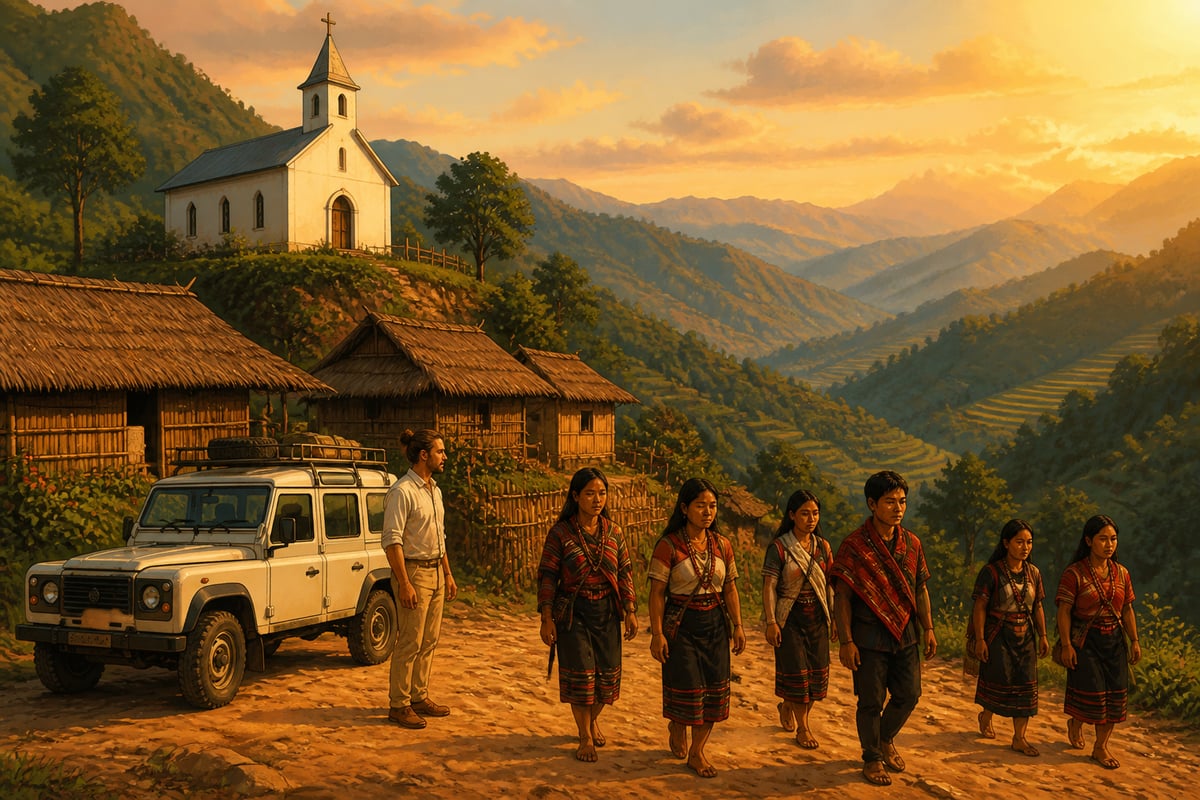
Evangelical organizations operate on the ground. While academics theorize, NGOs document, and media amplifies, churches and missionary organizations execute conversion operations, run educational institutions, and provide social services that create dependency networks.
The key insight is that evangelical operations benefit from every other node's output. Academic theories that frame Hinduism as oppressive create intellectual justification for conversion. NGO reports that document caste discrimination create the moral case. Media coverage that portrays India as persecuting minorities creates international political cover. Government pressure creates diplomatic leverage.
The conversion machine does not operate in isolation. It is the ground-level expression of an ecosystem that provides intellectual, moral, informational, and political support from thousands of miles away.
Node 5: Western Governments and International Bodies (The Enforcer)
Government bodies like USCIRF, the US State Department, the European Parliament, and UN human rights mechanisms serve as the enforcement layer. They convert academic theories, NGO documentation, and media narratives into political pressure: sanctions threats, trade conditions, diplomatic consequences, and international shame.
When USCIRF recommends that India be designated a "Country of Particular Concern," it triggers a cascade. Media amplifies the recommendation. NGOs use it to demand policy changes. Academics cite it as evidence of their theories. The loop feeds itself again.
The Self-Reinforcing Dynamic
The ecosystem's power lies not in any single node but in the feedback loops between them. Each node treats the others as independent sources, creating the illusion of converging evidence when the evidence is actually circular.
Academic paper is cited by NGO report. NGO report is cited by media article. Media article is cited by government commission. Government commission is cited by academic paper.
No single actor needs to be dishonest. Each can genuinely believe they are doing independent work. The system produces coordinated outcomes without requiring coordinated intent. This is what makes it an ecosystem rather than a conspiracy, and why it is far more resilient than any conspiracy could be.
The Pattern: The East India Company's Proto-Ecosystem
The Breaking India ecosystem is not new. Its prototype operated three centuries ago under the East India Company.
The Company's conquest of India was not achieved by military force alone. It operated through a remarkably similar multi-institutional system where each component legitimized and enabled the others.
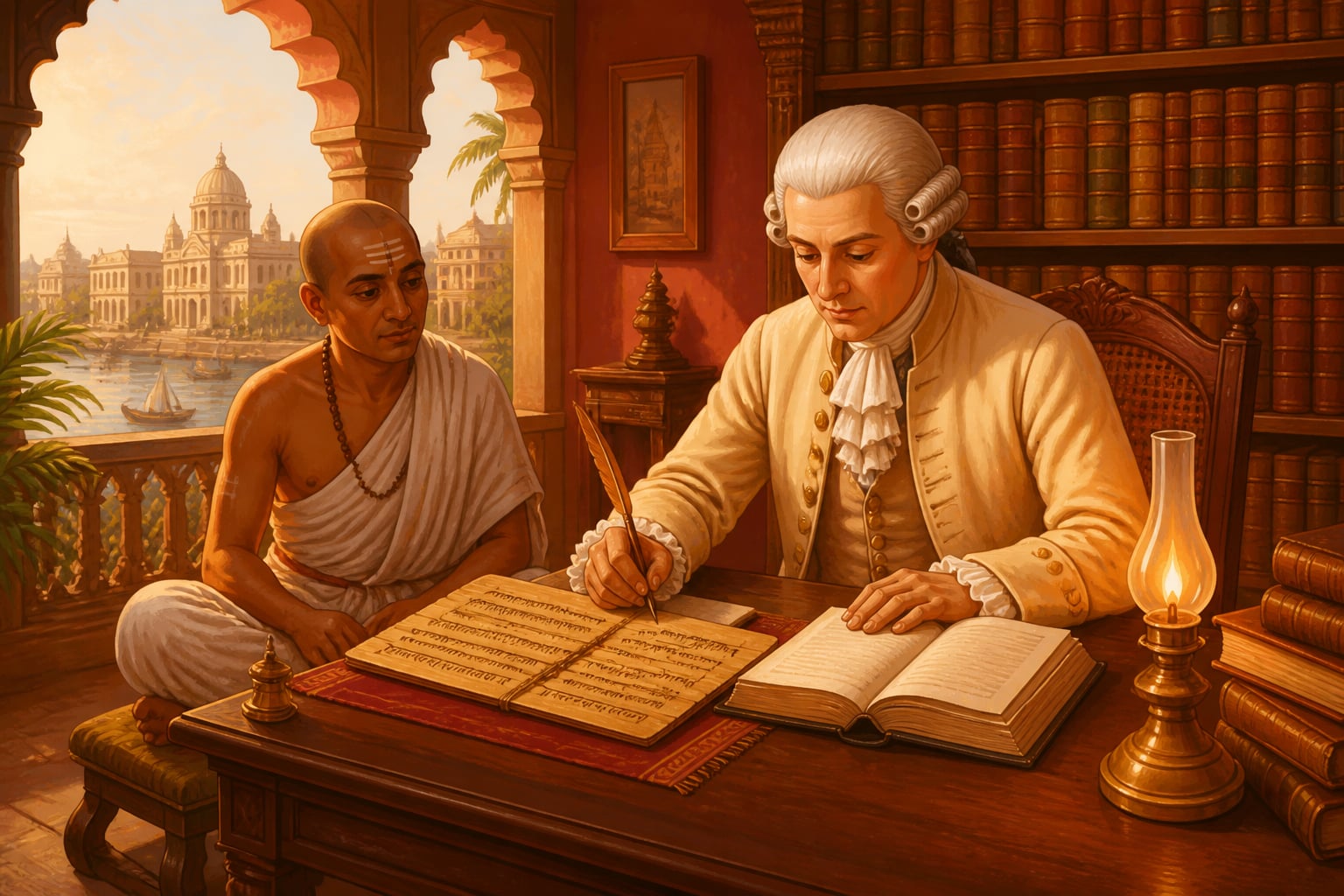
Orientalist scholars like William Jones, H.H. Wilson, and Max Mueller served as the academic node. They translated Sanskrit texts, classified Indian religions, and produced knowledge frameworks that presented Indian civilization as ancient but decadent, sophisticated but stagnant, worthy of study but incapable of self-governance. Their scholarship was genuine in its erudition but shaped by colonial assumptions that positioned Europe as the standard against which all civilizations were measured.
Missionaries served as the moral node. Organizations like the Baptist Missionary Society and the Church Missionary Society framed colonial rule as a civilizing and Christianizing mission. William Carey's operations in Serampore combined printing presses, translation projects, educational institutions, and evangelical activity into an integrated system. Missionaries documented "Hindu atrocities" like sati and infanticide, providing the moral justification for deeper colonial intervention.
Company administrators served as the policy node. They used Orientalist scholarship to design governance systems and missionary reports to justify expansion. When Charles Grant wrote his influential "Observations on the State of Society among the Asiatic Subjects of Great Britain" (1792), he synthesized Orientalist scholarship and missionary documentation to argue that Indians needed British moral improvement. Grant was simultaneously a Company director, a Member of Parliament, and a founding member of the evangelical Clapham Sect. One person embodied three nodes of the ecosystem.
The British Parliament served as the enforcement node. Parliamentary debates on the Company's charter renewals (1793, 1813, 1833) used Orientalist and missionary testimony to expand both commercial and civilizing mandates. The 1813 Charter Act, which opened India to missionary activity and mandated funding for Western education, was the ecosystem's legislative product.
The parallel is precise. Scholars legitimized. Missionaries operated on the ground. Administrators made policy. Parliament enforced. Each node treated the others as independent validation. The system produced coordinated civilizational assault without requiring a single controlling intelligence.
The modern ecosystem is the digital-age descendant of this colonial architecture, operating through universities instead of Orientalist societies, NGOs instead of missionary societies, media instead of pamphlets, and international bodies instead of Parliament.
Dharmic Wisdom: Indrajala and the Web of Maya
The Arthashastra uses the concept of Indrajala (Indra's net of illusions) to describe deceptive warfare. In strategic context, Indrajala refers to creating an interconnected web of deceptions where each element reinforces the others, making it impossible for the target to distinguish reality from manufactured narrative.
The Breaking India ecosystem operates as a modern Indrajala. Each node produces outputs that appear independent but are structurally interconnected. The academic paper seems like independent scholarship. The NGO report seems like independent documentation. The media article seems like independent journalism. The government hearing seems like independent oversight. But they form a single web.
The Panchatantra offers a precise insight. A single predator may be resisted. But when multiple actors converge on a single target from different directions, the target cannot defend against all of them simultaneously. The ecosystem's strength is precisely this: India cannot simply counter the academic, or the NGO, or the media, or the government pressure in isolation. They are not isolated. They are nodes in a single system.
The Mahabharata's diagnostic wisdom adds another layer. Vidura warns that the most dangerous affliction is not the one that strikes suddenly and violently, but the one that works slowly and constantly. The Breaking Ecosystem is this slow disease. Each individual action (a course redesign in a university, a grant to an NGO, a news cycle about Hindu violence) appears trivial in isolation, well below the threshold of national alarm. But cumulatively, it erodes civilizational confidence, institutional trust, and youth identity over decades. By the time the damage is visible, the body has been weakened for a generation.
The Sanskrit concept of Kutayuddha (deceptive warfare) from the Arthashastra recognizes that the most effective attacks are those the target does not recognize as attacks. When academic scholarship, humanitarian advocacy, journalism, and democratic oversight all appear to be performing their legitimate functions, recognizing the systemic effect requires a level of Viveka that most civilizations never develop.
The Defense: Seeing the System, Not Just the Nodes
The first defense against an ecosystem is recognizing that it IS an ecosystem. Most responses to Breaking India forces fail because they target individual nodes. They challenge a single academic paper, debunk a single NGO report, or counter a single media article. This is like treating symptoms while ignoring the disease.
Trace the citation chain. When you encounter a claim about India in international discourse, trace it backward. Who cited whom? Where did the original "evidence" come from? How many times has the same claim been recycled through different institutional letterheads? The Viveka Log from the previous lesson can be extended: not just "who benefits from my anger?" but "who cited whom in this chain?"
Map the funding architecture. Follow the money. Which foundations fund both the academic positions and the NGOs? Which governments fund both the commissions and the advocacy organizations? Publicly available data (FCRA filings in India, 990 forms in the US, charity commission records in the UK) make this mapping possible. When you discover that the same foundation funds the professor who theorizes, the NGO that documents, and the media outlet that amplifies, you are seeing the ecosystem's circulatory system.
Build counter-infrastructure at the ecosystem level. India needs its own knowledge production infrastructure: universities that produce globally competitive scholarship on Indian civilization, media organizations with genuine international reach, think tanks that engage at the policy level, and legal frameworks that address foreign institutional interference. Individual rebuttals on social media cannot counter an institutional ecosystem. Only institutional counter-infrastructure can.
The lesson from the East India Company era is that India recognized the individual threats (missionaries, administrators, scholars) but failed to see them as a system until it was too late. The Sabhyata Raksha (civilizational defense) that this course teaches begins with seeing the system whole.
Case studies
The East India Company's Multi-Institutional Ecosystem
By the early 19th century, the East India Company had constructed a self-reinforcing system that combined commerce, scholarship, missionary activity, and parliamentary legislation. Orientalist scholars like William Jones, H.H. Wilson, and Max Mueller produced academic works that framed Indian civilization as ancient but decadent, providing intellectual justification for intervention. Missionary organizations including the Baptist Missionary Society and Church Missionary Society, anchored by William Carey at Serampore, supplied the moral argument: India needed saving. Company administrator Charles Grant formalized this in his 1792 tract 'Observations on the State of Society among the Asiatic Subjects,' arguing that moral improvement through Christianity and Western education was both a duty and a commercial necessity. The 1813 Charter Act renewal translated this ecosystem into law, opening India to missionaries and mandating Western education funding. Each node fed the others: scholars legitimized missionaries, missionaries pressured Parliament, Parliament protected the Company, and the Company funded scholars.
The Arthashastra warns that a state's vulnerability begins when its knowledge systems are captured by interests external to its own civilization. What the Company built was precisely this: a system in which the very categories used to understand India were designed outside India, by people with material interests in India's subordination. The Upanishadic principle that avidya (ignorance) is the root of bondage applies here institutionally. When a civilization accepts a foreign framework as the lens through which it understands itself, the external force no longer needs coercion. The ecosystem produces self-colonization.
The 1813 Charter Act institutionalized what was previously informal pressure. Missionaries gained legal access to India, Rs. 1 lakh annually was mandated for Western learning, and Charles Grant's moral framework became state policy. By 1835, Macaulay's Minute on Education formalized the displacement of Sanskrit and Persian education. The ecosystem had converted commercial extraction into a civilizational project backed by Parliament, academia, the Church, and Company administration simultaneously.
When commerce, scholarship, religion, and legislation align around a single civilizational project, no single node needs to be the villain. The system operates through distributed legitimacy. Identifying one actor misses the structure. The structure is the threat.
The same architecture appears today in any context where foreign-funded NGOs, international academic framing, diaspora media narratives, and UN mechanisms converge on a single country or region. The nodes are different; the self-reinforcing logic is identical.
Charles Grant was simultaneously a Company director, Member of Parliament, and founding member of the Clapham Sect evangelical movement. One person embodied three nodes of the ecosystem, illustrating how the system concentrated in individuals, not just institutions.
The Northeast India Church-NGO-Academic Nexus
Northeast India presents a living example of the multi-node ecosystem. Over roughly a century of missionary activity, tribal populations in Nagaland (approximately 90% Christian), Mizoram (approximately 87% Christian), and Meghalaya (approximately 75% Christian) were converted by American Baptist and Welsh Calvinist missions, which also established the primary educational and healthcare infrastructure in these regions, creating deep institutional dependency. Western anthropologists subsequently framed these same populations as 'indigenous peoples' distinct from and colonized by the Hindu mainland, a framing that entered UN mechanisms through UNDRIP (the UN Declaration on the Rights of Indigenous Peoples, adopted 2007). Organizations like NPMHR (Naga Peoples Movement for Human Rights) carry local grievances into international bodies and foreign media. International outlets regularly cover Northeast India through an 'occupation' or 'counterinsurgency' frame. Each node sustains the others: academics supply the conceptual vocabulary, churches operate the ground infrastructure, NGOs translate local events into internationally legible rights language, and media amplifies to apply diplomatic pressure.
The Vedic concept of samskara refers to the deep impressions that shape identity and perception. When a population's formative samskara (its education, language of prayer, institutional memory, understanding of its own history) is constructed by an external civilizational project, the resulting identity is genuinely felt but externally authored. Dharmic epistemology emphasizes that the frame through which one perceives reality is itself a product of someone's agenda. The question to ask of any framework imposed on a community is: who built this frame, and what does it make invisible?
The ecosystem has produced sustained low-intensity separatist pressure, periodic insurgencies, and significant diplomatic costs for India at forums including the UN Human Rights Council. It has also fragmented tribal communities internally, as conversion-based identity creates conflict with pre-existing clan and village structures. The 'indigenous peoples' framing has made ordinary Indian administrative and developmental activity legible internationally as 'colonization.'
A self-reinforcing ecosystem does not require central coordination. When academic frameworks, ground-level institutions, documentation networks, and media amplification share compatible incentives, the system produces outcomes no single actor planned. Disrupting one node without understanding the others achieves little.
The Northeast model is not unique to India. The same structure (foreign mission activity creating institutional dependency, academic indigeneity framing, NGO documentation pipelines to international bodies, and sympathetic foreign media coverage) operates in multiple regions globally where civilizational friction exists between a majority culture and minorities shaped by external missionary activity.
American Baptist Foreign Mission Society missionaries arrived in Nagaland in 1839. Within 80 years, they had built the region's primary school network, transliterated Ao Naga language into Roman script, and produced the first written literature in that language. The script, the literature, and the institutional memory of the community were authored by the mission before the Indian state existed.
Reflection
- Think of a specific anti-India narrative you encountered in the past month, whether in a news article, academic paper, documentary, or social media post. Can you trace it upstream? Who authored it? Who funds that publication or institution? Who cited it next, and who cited them? Apply the ecosystem lens: does this narrative move through academia, media, NGOs, and foreign policy channels in the pattern described in this lesson? What does this exercise reveal about your own media consumption habits, and where does Viveka need to be sharpened so you are not unknowingly carrying Indrajala forward?
- Every living civilization requires honest internal criticism, voices that name what is broken and demand repair. Yet this lesson argues that legitimate grievances can be weaponized by external actors to serve destabilization rather than healing. How do you hold both truths at once? What is the test that distinguishes a reform movement rooted in love for the civilization from one that, however sincere its participants, has been captured by an ecosystem that benefits from India's fragmentation? What does Sva-Rajya demand when the tools of self-governance are being used to hollow out the self that is to be governed?
- The ecosystem described in this lesson is a coherent geopolitical instrument. Should India build a mirror image: funding think tanks abroad, backing friendly media, supporting diaspora organizations that shape narratives in host countries? If India refuses, does it remain perpetually outmatched in the information domain? If India proceeds, does it become what it criticizes, and does Dharma permit that? The Arthashastra does not shy away from hard-edged statecraft. Kshatriya Dharma does not ask the warrior to fight only with one hand. But does deploying the same methods corrupt the civilization that deploys them?